Browse by need · 53 entries
Medical
Stop bleeding, treat wounds, and buy time
When help is hours away or not coming, you are the first responder. Build outward from life-threatening bleeding to everyday wounds, and keep the skills to match the kit.
Start with the full guide
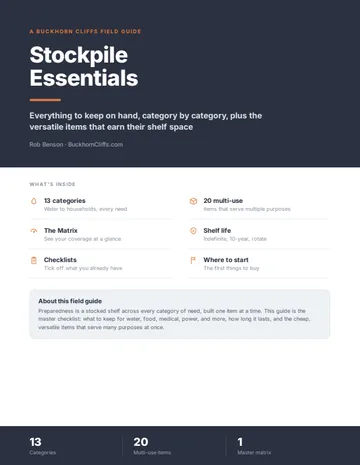 Field guideStockpile Essentials Field GuideThe master checklist: 239 items across 16 categories, the shelf life class of each, and the 20 multi-use items that cover the most jobs. 39 pages.Open the field guide Master guideMedical PreparednessWhat to stock in a house, mobile, and vehicle medical kit, what to do first in 15 common emergencies, and how to store medicines and records.Open the full page Master guidePrescription and Emergency MedicationsHow to get a physician-prescribed emergency medication kit, what is in it, which medication fits which problem, and how to store it so it lasts for years.Open the full page
 Paper on the shelf is what works
A printed first-aid or survival-medicine manual does not need power or signal. Keep one, and get real training, because a book does not replace hands-on practice.
Formulas 34
Compounds 2
Supplies 3
Skills 1
Guides 11
Spare parts lists 1
Reference charts 1
Nothing matches those filters. Clear one and try again.
The checklist
Tick what you already have. Checks are saved on this device.
Medical and First Aid Stop bleeding, treat wounds, and buy time
Stop the bleed (trauma)
Dress the wound
Medicines
Tools & multi-use
Herbal & supportive
Prescription and Advanced Medical The deeper medicine chest, staged with a provider
Antibiotics, by class
Antiviral, antifungal & antiparasitic
Rescue & emergency
Symptom control & topical
Audit questions
From the walk-around audit. Tap a question for what a good answer looks like.
Do you have supplies for minor injuries?
Cuts, burns, blisters, sprains, splinters and stomach bugs are the injuries you will actually treat. Good is a kit with the bandages, tape, wound wash, antibiotic ointment, blister care, an elastic wrap and the over-the-counter medicines, restocked after every use. Medical Preparedness lists the kit and walks through 15 emergencies.
Do you have supplies for trauma?
Severe bleeding kills in under five minutes. Good means a real tourniquet (not a belt), hemostatic gauze, a pressure bandage and chest seals, in a place you can reach in seconds, in the truck as well as the house. The medical page covers bleeding control first for that reason.
Do you know how to use what you own?
A tourniquet you have never applied is a prop. Good means a Stop the Bleed and a CPR class for at least two people in the house, the kit opened and practiced on, and a reference on the shelf: the three medical books worth owning.
Does anyone rely on daily prescriptions?
If yes, that person is the first medical priority and the supply is the plan. Good means every daily medication is written on a list with dose and prescriber, for every person and pet, and the list lives in the logbook where a responder can find it.
How many days of supply do you actually have?
Fewer than seven days of any prescription is a red flag. Good is 14 to 30 days ahead, filled early each cycle and rotated, plus a prescribed emergency antibiotic kit for the infections that do not wait. How to keep prescription medications on hand is the method.
Are medications stored correctly?
Cool, dry and dark, not the bathroom cabinet, and the ones that need cold (insulin above all) have an outage plan: insulin holds 28 days unrefrigerated at 59 to 86°F and is never used frozen. Shelf life past the expiration date and vacuum-sealing medications cover storage.
Common mistake
A kit you have never opened and cannot use under stress.
Skills to learn
stop a bleed with a tourniquet · pack a wound · assess vitals
When it matters