Right now
Something is happening
You have minutes, not hours. Each scenario opens with what to do first and the clocks that are already running.
Preparedness: Understood & Organized
Knowledge, supplies, and self reliance for when the normal systems fail. Ask it a question, or browse by what you need and what is happening.
What brings you here?
Right now
You have minutes, not hours. Each scenario opens with what to do first and the clocks that are already running.
Looking it up
Is it still good? Can these two share a shelf? How do I make it? Look it up here, free, no sign-in.
Getting ready
Nothing is happening yet, and that's the time to build. The steps in order, what to stock, and where you're weakest.
Stay Ready
New entries, updates, and useful instruction.
Stay one step ahead on your preparedness journey.
Why become a member
When the grid goes down, this site goes with it. Paper does not. Membership opens every page and every recipe from the book, hands over every field guide as a PDF, and gives you My Manual: one binder built from this site for your household alone.
My Manual · the reason to join
Every page here has a "Save to My Manual" button. Press it on the recipes, charts, parts lists, and whole field guides that fit your house, arrange them in the order you want, name it, and print one manual with a cover . Or keep it as a PDF that opens with no signal. No book on any shelf fits your household this exactly.
Browse by need
Browse by event
Free download
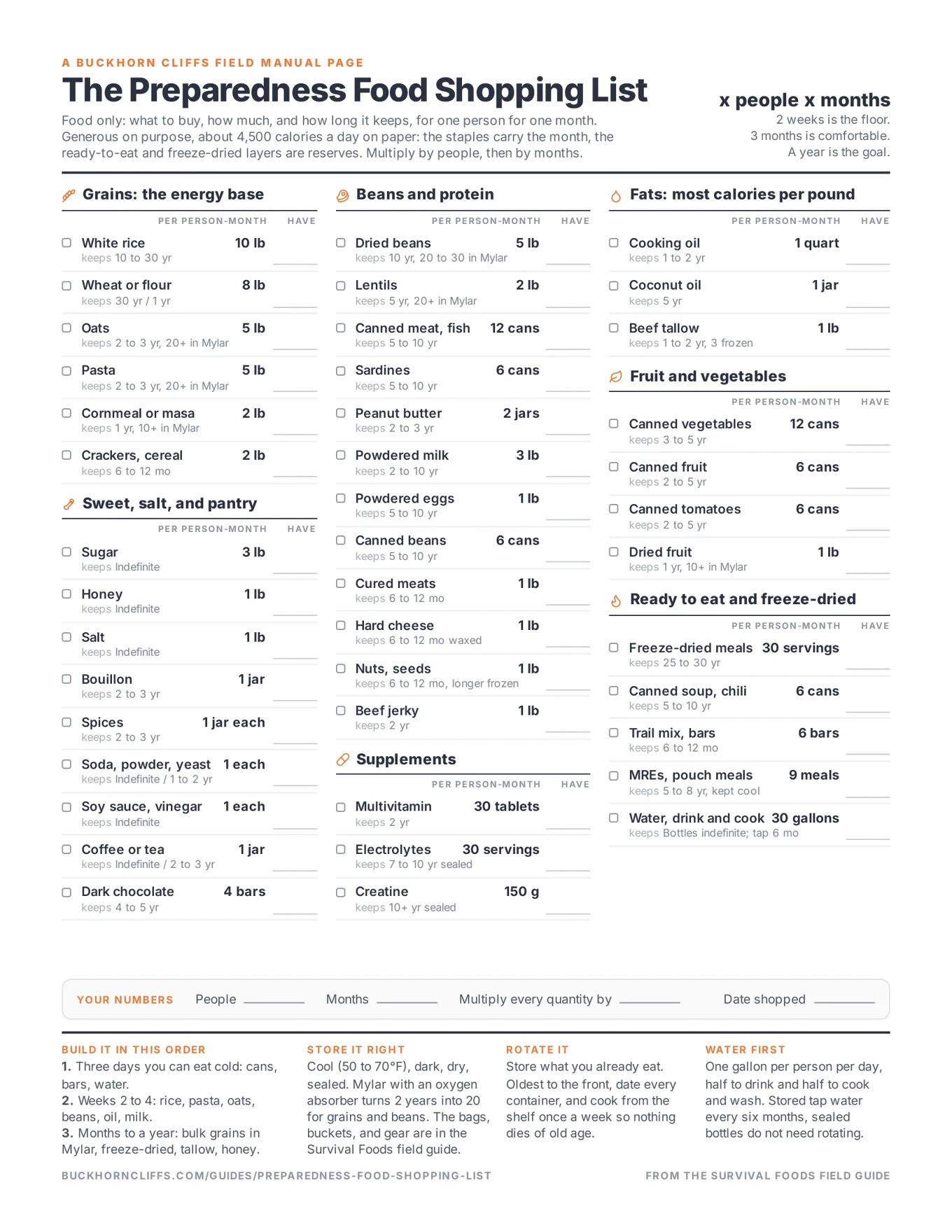
Get the one-page food shopping list
What to store, how much of it for one person for one month, and how long it keeps. One page with checkboxes, built from the Survival Foods field guide. Print it, multiply by your people and months, and take it to the store.
The PDF comes by email, with my newsletter now and then. Already on the list? You still get it. Read the full page.
New to this?
Where to begin, the order to build in, what I recommend, and a full tour of everything on this site.
Look it up fast
Print it, keep it
Each one is a printable PDF built to live in a binder: checklists, charts, and numbers you can use with the power out. Buy one of the six standalone guides for $10, or get every one of them with membership.

Start with this one
It tells you what to fix before you spend a dollar. Every other guide makes more sense once you know your weakest system.
15 systems scored200 checkpoints1 to 5 readiness scale33 pages

The master checklist
239 items across 16 categories, with the 20 multi-use items that earn their shelf space. Use it to shop with a plan.
16 categories239 items to check off20 multi-use items39 pages

For the pantry
Real shelf life for 64 foods against the date on the label, how much to store, and how to tell when something has turned.
50+ foods & staples18 sections4 appendices35 pages

For the compound shelf
All 33 compounds on quick cards: what it does, how to store it, how long it keeps, and what never to mix.
33 compoundsA-Z every entry listed9 never-mix pairs29 pages

For the house itself
260 parts across 27 systems. The cheap parts that fail, listed so you can buy them before you need them.
27 categories260 parts listedBuy 2 store 140 pages

For the binder
25 sections of fill-in pages: contacts, medical, documents, plans, supplies. The record your family uses when you are not there.
4 parts25 sections161 fill-in fields30 pages
Power and light · prints from its page
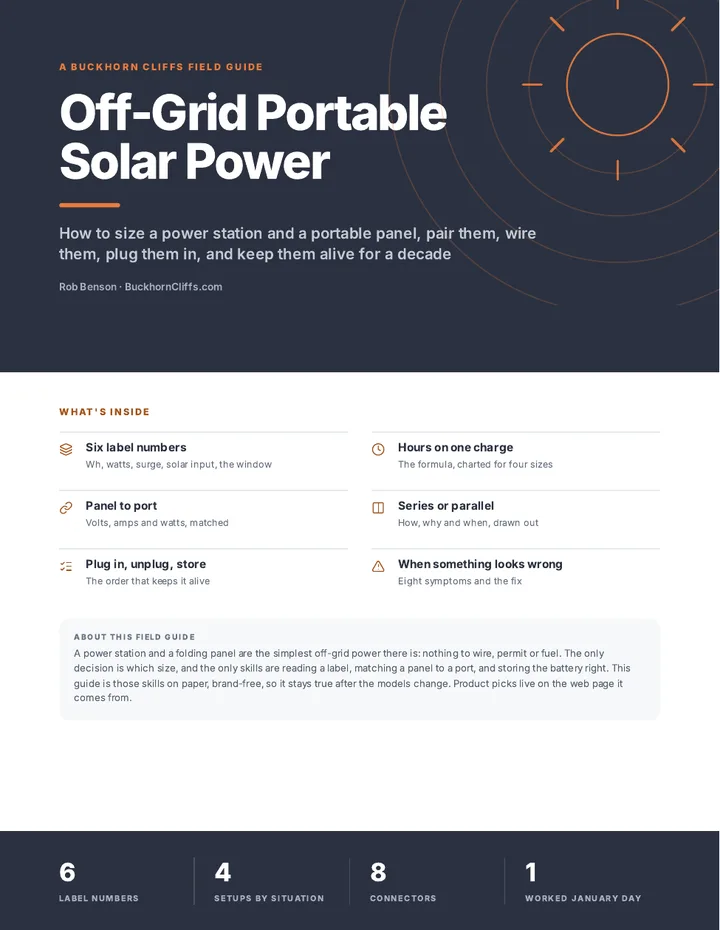
Size a power station and a folding panel, pair them, wire them, keep them alive.
16 pagesFree to read
Power and light · prints from its page
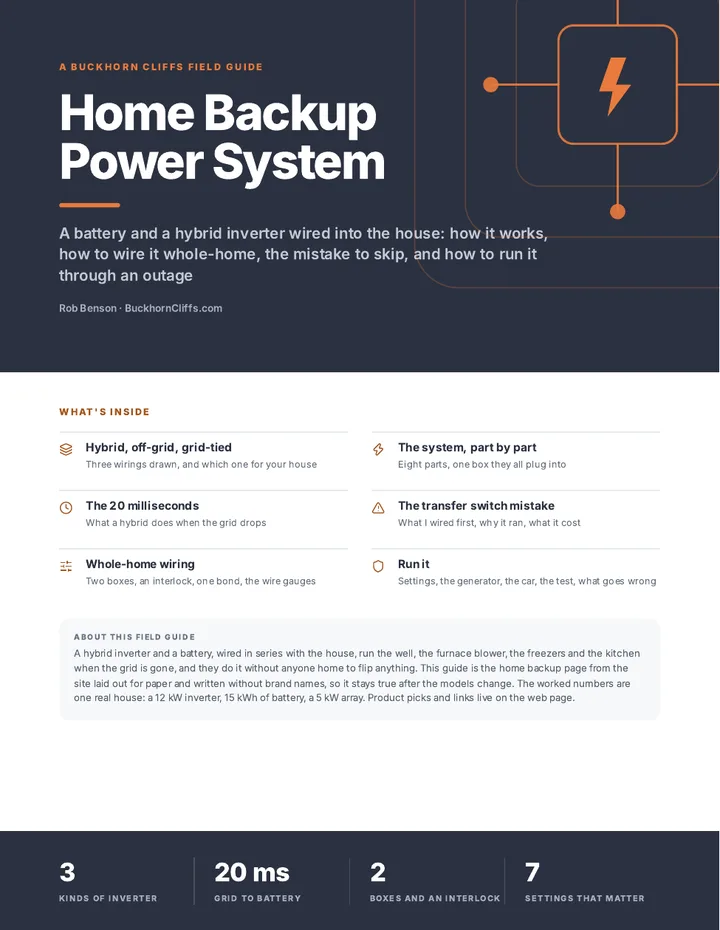
A battery and a hybrid inverter wired into the house: hybrid against off-grid, the wiring, the mistake to skip.
20 pagesFree to read
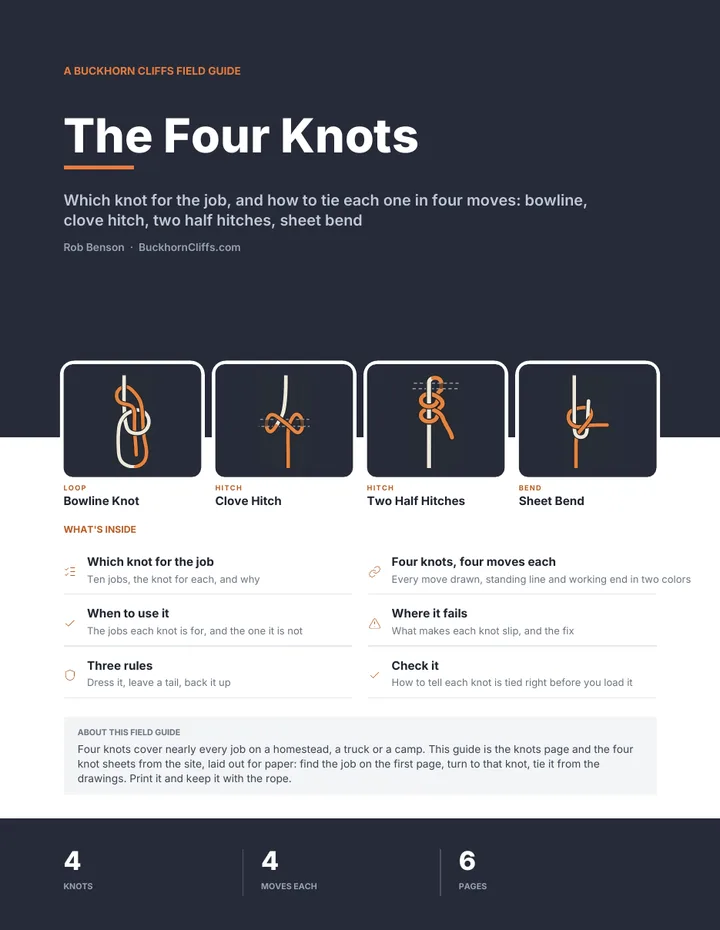
Skill · prints from its page
Which knot for the job, and how to tie each one in four moves.
6 pagesFree to read
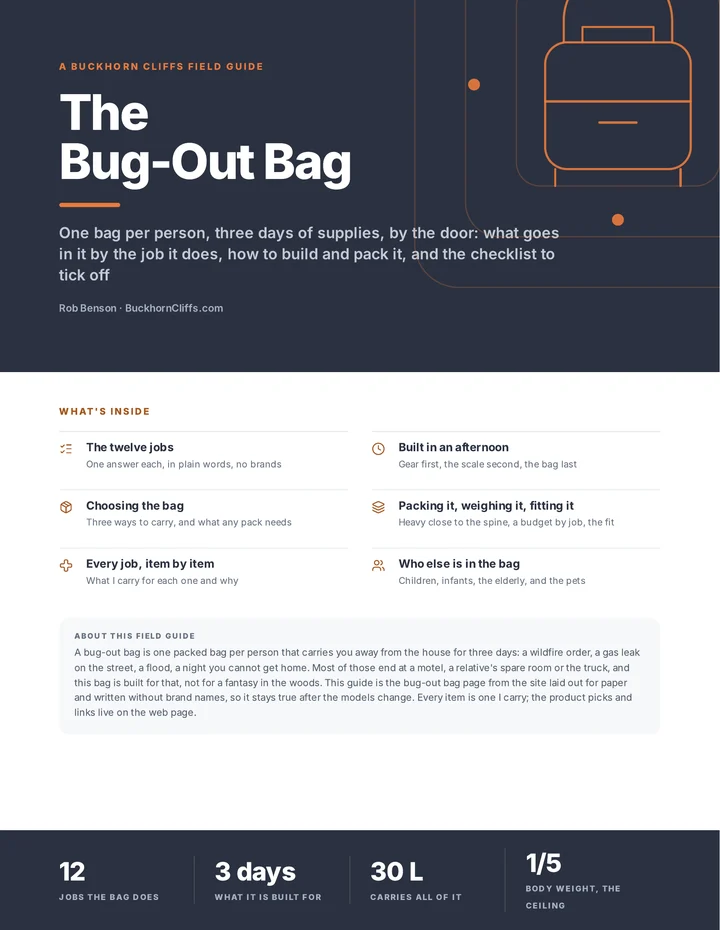
Evacuation · prints from its page
One bag per person for three days: the twelve jobs, the afternoon build, the packing plan, every item by job, and the checklist.
18 pagesFree to read
Or get every one of them
Ten guides bought one at a time cost $100. Membership is $49.95 per year and adds every member recipe with exact amounts, every recipe and resource from the Prepper's Chemical Survival Guide, the full audit and logbook, all the reference charts, and My Manual: your own printed binder.
Take it off the grid
This site works while the internet does. The printed book and the PDF field guides work when it does not. Members can also build a manual of their own from any page here and print it.
One last look
Each one changes what you do this week. The pages behind them are free to read.
The power just went out
The food in the fridge, the water pressure in the lines, and the heat in the house. What you do in the first 45 minutes matters more than anything you buy afterward: fill every container with water, confirm the scope, stay out of the stores.
The blackout page: the first 45 minutes, the first three days, and beyond30 to 50gallons
Your water heater holds 30 to 50 gallons of clean water. Add the pipes, the toilet tank (not the bowl) and the ice in the freezer, and the first few days are covered before you open a single bottle.
How to drain it safely17hours
Hours on a charge = watt-hours × 0.85 ÷ the load's watts. A 1,024 Wh power station runs a fridge averaging 50 W for about 17 hours, and a 400 to 480 W folding panel refills it in an afternoon of sun. No wiring, no permit, useful on day one.
Size a station and panel to your loads10+phone charges
A 60,000 mAh bank charges a phone more than ten times. The first hour of an outage is headlamps, a lantern, the power bank and the radio on, with the fridge and freezer kept shut.
The gear for the first hour, night and week20milliseconds
Grid-tied panels with no battery shut off when the grid does. A battery and a hybrid inverter keep the house on: mine islands the whole panel in 20 ms, and the transfer switch I bought first only narrowed the pipe.
The 15 kWh system, the mistake and the fix10years
Liquid bleach loses its strength in a year or two. Dry calcium hypochlorite keeps up to ten years, and one tablespoon of stock solution treats a gallon in 30 minutes.
The compound, the mix and the warnings5minutes
A major bleed can kill in under five minutes, faster than any ambulance arrives. A real tourniquet, hemostatic gauze and the training to use them come before everything else in the kit.
Build the kit in this order5compounds
Baking soda, non-iodized salt, calcium hypochlorite, white vinegar and 3 percent peroxide. They purify water, disinfect, clean and preserve, and every other compound builds on them. Buy those first and learn them before you add a sixth.
The four phases, with amounts and where to buy30years
In the store bag, white rice is good for four or five years. Seal the same rice in Mylar with an oxygen absorber, keep it cool and dark, and it keeps 20 to 30. Ten pounds a month per person, about 1,650 calories a pound.
How to store it, and how much per personUnder 50%humidity, 50 to 70°F
Steady temperature, dry air, no light, and glass instead of metal. Get those four right and a supply that would fail in months lasts for years.
Conditions, containers and labelsStay Ready
Stay one step ahead on your preparedness journey.