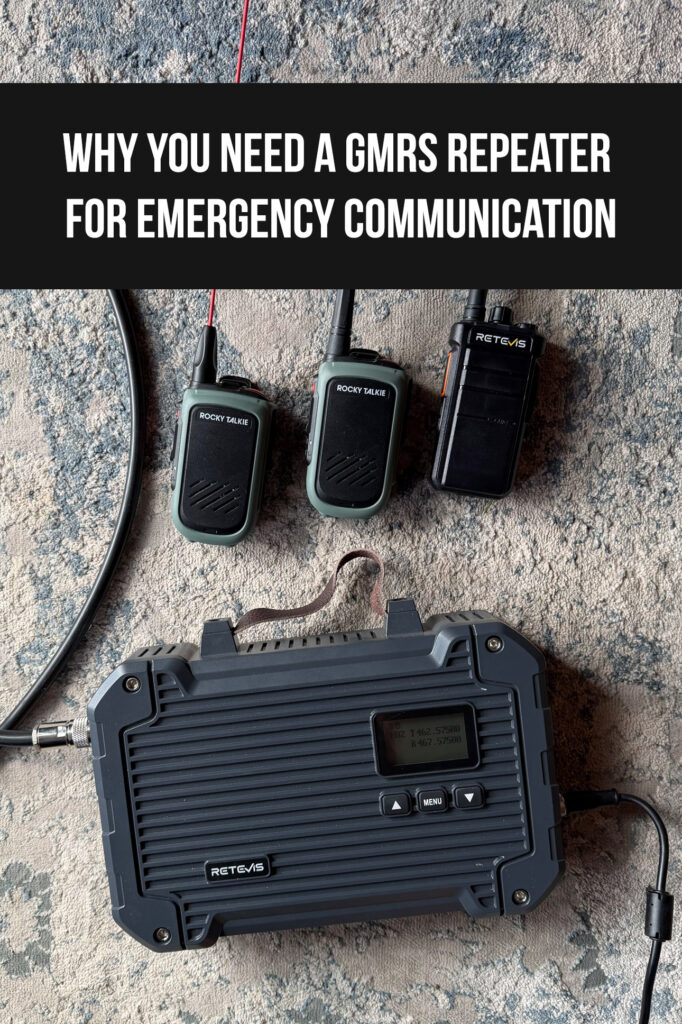
Here’s a scenario most people don’t think about until it’s too late. A major storm rolls through, knocks out power across three counties, and suddenly your smartphone is nothing more than an expensive flashlight. No bars. No data. No way to reach your family two miles down the road.
We saw it happen during the Camp Fire in Paradise, California. Cell towers burned. Landlines melted. People couldn’t reach each other during the most critical hours of their lives. Same thing in Lahaina, Hawaii during the 2023 wildfires. And it happens on a smaller scale every single winter when ice storms take out infrastructure across the Midwest and South.
The uncomfortable truth is that our entire communication system sits on a fragile foundation. Cell towers need power. Power grids fail. Backup generators run out of fuel. Internet goes down. And when all of that collapses at the same time, you’re left with two options: yell really loud, or have a radio system that doesn’t depend on any of it.
That’s where GMRS comes in. And more specifically, that’s where owning your own GMRS repeater changes the game entirely.
If you want to get started with GMRS info, check out this post first:
How to Communicate with NO Cell Service or Internet (GMRS Recommendations)
If you already have GMRS or want to know more about repeaters:
What Exactly Is a GMRS Repeater (And How Does It Work)?
Let’s keep this simple. A GMRS repeater is basically a relay station for your two-way radio signals. It receives a transmission from your handheld or mobile radio, then rebroadcasts that signal at a higher power and from a better vantage point. The result? Your little 5-watt handheld that normally reaches a mile or two can suddenly communicate 10, 15, or even 20+ miles through the repeater.
Here’s how the mechanics work. GMRS operates on UHF frequencies in the 462 MHz and 467 MHz bands. There are 8 dedicated repeater channel pairs built into the GMRS frequency plan. Your radio transmits on one frequency (the input), and the repeater listens on that frequency, then immediately rebroadcasts your voice on a different frequency (the output). This is called full-duplex operation, and it’s what makes conversations through a repeater feel natural and seamless, just like talking on a phone.
Without a repeater, you’re limited to simplex communication, meaning your radio transmits and receives on the same frequency. That works fine for short distances with clear line of sight. But throw in some hills, trees, buildings, or any real distance, and your signal drops off fast. A repeater solves that problem by sitting at a high point and acting as the middleman between radios that otherwise couldn’t hear each other.
Why Own Your Own Repeater Instead of Using Public Ones?
There are over 1,700 GMRS repeaters across the United States right now. Many of them are open to use by any licensed operator. You can find them on mygmrs.com and start using them with a repeater-capable radio. So why spend money on your own?
Because you don’t control those repeaters. And in a real emergency, that matters more than most people realize.
Public repeaters are owned by individuals or clubs. They can go offline at any time. The owner might lose power. The site might get damaged. They might decide to take it down for maintenance right when you need it most. Or the repeater could simply be too far away from your location to be useful when conditions deteriorate.
When you own your own repeater, you control the coverage area. You control the power source. You control when it’s on and who has access. You can position it exactly where it needs to be to cover your property, your neighborhood, or your route. You can run it off solar, a car battery, or a generator. It becomes part of YOUR infrastructure, not someone else’s.
There’s also the congestion factor. During widespread emergencies, public repeaters get hammered. Everyone and their cousin is trying to talk at once. With your own repeater on a separate channel pair with your own CTCSS tone, you’ve got a “private” communication network that’s not competing with anyone else for airtime.
One more thing worth noting. The FCC recently clarified that GMRS repeaters cannot be linked together via the internet. That means each repeater is a standalone, localized system. If you’re counting on some wide-area linked network to save you during a disaster, that’s not happening. Your communication plan needs to be local and self-sufficient. A personal repeater fits that model perfectly.
Use Cases That Go Way Beyond Preparedness
Let’s be clear. A GMRS repeater isn’t just a piece of doomsday gear collecting dust in your garage. People use these things every single day for completely practical reasons.
Farms and Ranches. If you’re managing hundreds or thousands of acres, you already know that cell coverage is spotty at best in rural areas. A repeater mounted on a barn, silo, or hilltop gives you reliable voice communication across your entire operation. Coordinate with workers, check on livestock, or call back to the house without relying on a cell signal that may or may not exist.
Off-Road Groups and Convoys. Running trails in Moab? Overlanding through remote BLM land? A portable repeater mounted on the lead vehicle keeps your entire group connected through canyons and terrain where cell phones are completely useless. Users have reported maintaining contact across 10+ miles of rough canyon terrain using the RT97L.
Construction Sites. Large job sites with metal buildings, heavy equipment noise, and workers spread across 10 or 15 acres need instant, reliable communication. A repeater eliminates dead zones and keeps everyone connected without monthly service fees.
Events and Festivals. Security teams, medical staff, and event coordinators at large outdoor gatherings need a communication backbone that works even when thousands of cell phones overwhelm the local towers. A portable repeater solves that overnight.
Neighborhood Emergency Networks. This one is growing fast. Communities across the country, from Butte County, California to Lake Oswego, Oregon, are building neighborhood GMRS networks with repeaters as the backbone. When the next wildfire, earthquake, or ice storm hits, these neighborhoods can coordinate evacuations, share resource information, and request medical help without needing a single cell tower.
Product Spotlight: The Retevis RT97L 25W GMRS Repeater
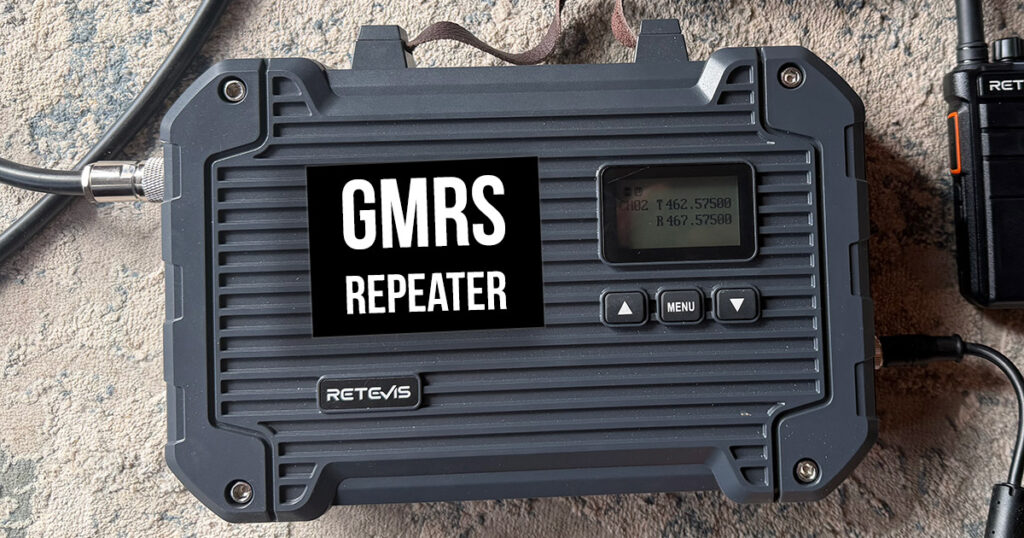
Now let’s talk hardware. The Retevis RT97L is the third generation of Retevis’ portable GMRS repeater line, and it addresses a lot of the complaints people had about earlier models. It’s not perfect (and I’ll get into that), but for the price point and feature set, it’s worth serious consideration for anyone looking to set up their own repeater.
Key Specs at a Glance
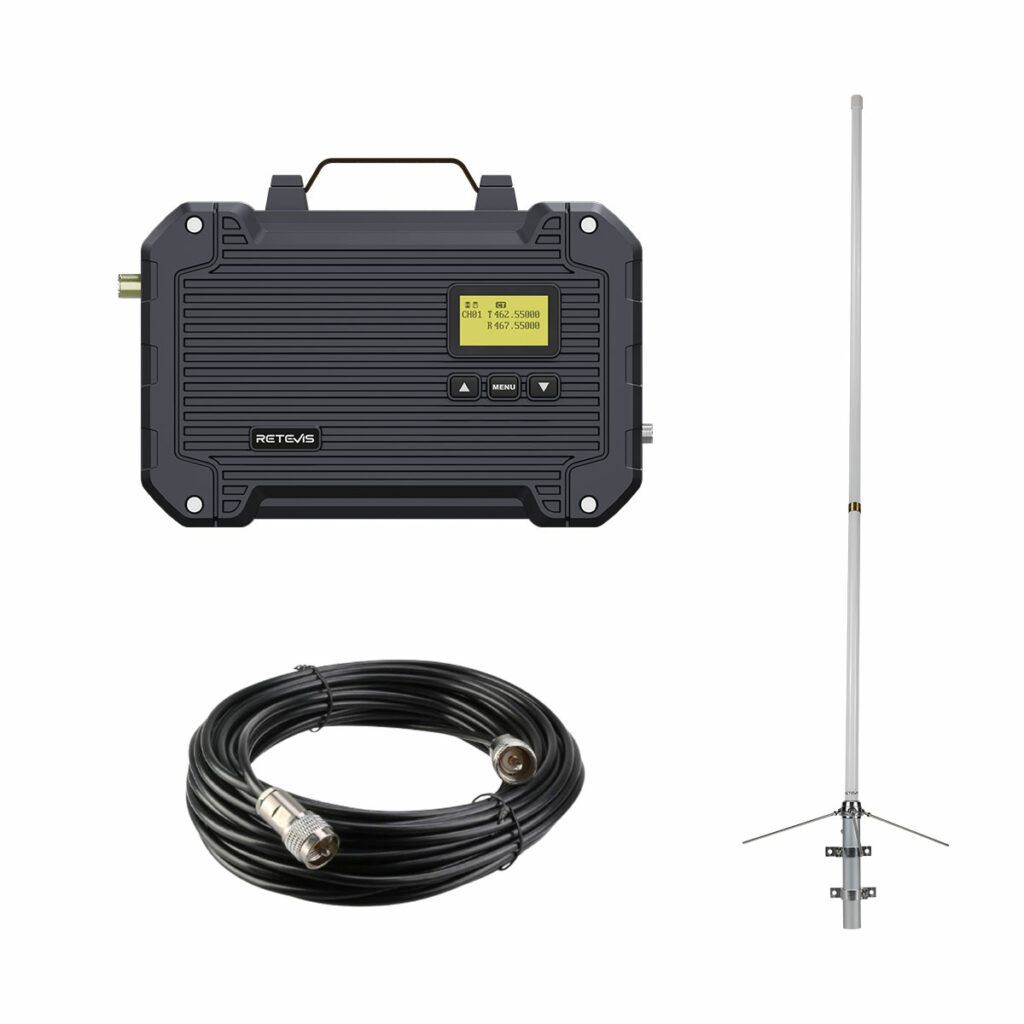
Power Output: 25 watts high, 5 watts low. That 25W output is a massive upgrade over the older 10W models and puts significantly more signal into the air. More power means better penetration through obstacles and longer range to the edge of your coverage area.
Frequency Range: 462-467 MHz GMRS bands, fully FCC compliant. It comes pre-programmed with 16 GMRS channels, with the first 8 set for wideband and the remaining 8 for narrowband operation. You can also program custom frequencies within plus or minus 5 MHz of center.
Waterproofing: IP66 rated. That means it’s completely dustproof and can handle powerful water jets from any direction. You can mount this thing outside without babysitting it every time clouds roll in. That said, giving it some overhead cover is still smart practice for long-term installations.
Built-In Duplexer: This is a big deal. The duplexer is what allows the repeater to transmit and receive simultaneously on a single antenna without the signals interfering with each other. Many cheaper repeater setups require you to buy a separate duplexer. The RT97L has it built in and the duplexer has been upgraded from earlier versions.
Thermal Management: The all-aluminum alloy case handles heat dissipation during continuous operation. If internal temps climb above 60 degrees Celsius, the repeater automatically drops to low power to prevent damage. On the cold end, an internal heating system kicks in at minus 15 degrees Celsius, keeping the unit operational down to minus 30 degrees Celsius. That cold weather capability is a real standout feature for anyone in northern climates.
Display and Controls: An LCD screen shows frequency, channel, sub-tone settings, and other status information. Volume and channel adjustments are handled with two buttons, and there’s a scan function built in.
Size and Weight: 11.2 x 7.3 x 2.7 inches, roughly 7.86 pounds. Small enough to toss in a backpack or mount in a vehicle. This isn’t a rack-mounted commercial repeater that needs its own room. You can deploy it just about anywhere.
Power Requirements: 12-15V DC input, drawing about 6 amps at full transmit power. It runs at 100% duty cycle, meaning it can transmit continuously without needing cool-down breaks. Compatible with solar panel setups for truly off-grid deployment.
The Honest Assessment: Strengths
The transmit side is strong. Users consistently report getting 10 to 15 miles of usable range from the repeater, and some setups in favorable terrain push well beyond that. The 25W output gives it real punch compared to budget 5W or 10W units. Setup is genuinely plug-and-play. It comes pre-programmed with GMRS channels, so a complete beginner can have it operational in minutes. That matters when you’re deploying it in an emergency and don’t have time to fiddle with programming software.
The weatherproofing is legitimate. The IP66 rating means you can mount it in exposed locations without constant worry. The thermal protection on both ends (hot and cold) gives it operational flexibility that most consumer-grade repeaters simply don’t offer.
The portable form factor is a genuine advantage. Being able to throw this in a vehicle, power it from a car battery, and have a working repeater wherever you need it is a capability that matters for emergency response, off-road groups, and anyone who needs flexible deployment.
GMRS Licensing: It’s Easier Than You Think
A lot of people hear the word “license” and immediately tune out. Don’t. Getting a GMRS license is about as painless as government paperwork gets.
How to Get a GMRS License: Step-by-Step Guide, Costs, and Benefits
Here’s the deal. You apply online through the FCC’s Universal Licensing System (ULS). There’s no test. No exam. No Morse code. No technical knowledge required. You fill out a form, pay $35, and wait about 24 to 48 hours. That’s it. Your license is good for 10 years and covers your entire immediate family, including your spouse, kids, grandkids, parents, siblings, aunts, uncles, nieces, and nephews. One license, one fee, your whole family can operate.
You do need to be at least 18 years old and a U.S. citizen (or eligible non-citizen) to apply. Once licensed, you get an FCC call sign that you’re required to announce at least every 15 minutes during a conversation and at the end of your transmissions.
Compare that to amateur (ham) radio, which requires passing a technical exam, and it’s clear that GMRS was designed to be accessible to regular people who just need reliable communication.
In a survival scenario, what’s a license?
Setting Up Your Repeater: What Actually Matters
You can buy the best repeater on the market and still get terrible results if you ignore the fundamentals of radio installation. Here’s what actually moves the needle.
Height Is Everything
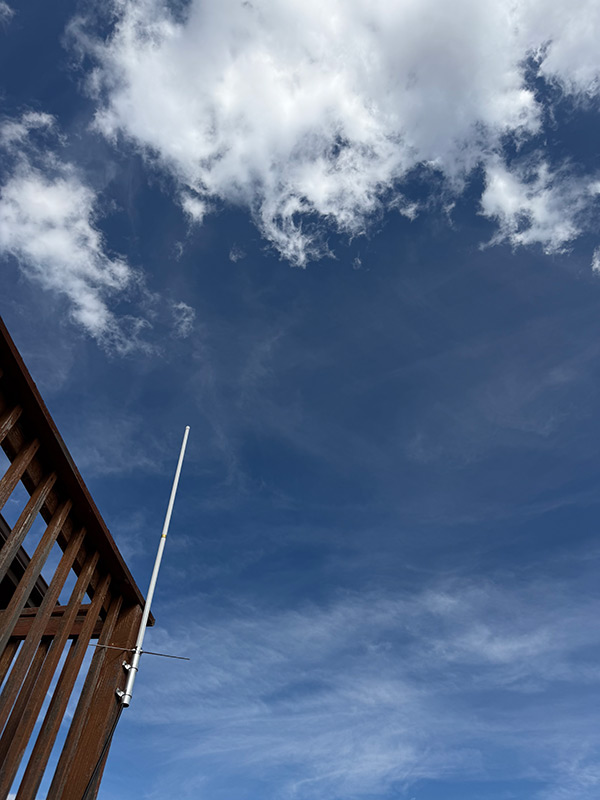
This is the single most important factor in repeater performance. Radio signals at UHF frequencies travel in roughly straight lines. The higher your antenna, the farther the radio horizon extends. A repeater antenna at 30 feet will dramatically outperform the same repeater at 10 feet, regardless of power output. Mount it on a roof, a tower, a tall tree, or the highest structure you have access to. Every foot of elevation you gain translates directly into better coverage.
Antenna Selection
The antenna is arguably more important than the repeater itself. A high-gain fiberglass (FRP) antenna designed for the GMRS band will focus your signal where you need it and improve receive sensitivity at the same time. The RT97L kits that include an FRP antenna and 15-meter coax cable are a smart starting point. If you’re doing a permanent installation, invest in quality low-loss coaxial cable. Every foot of cheap cable between your repeater and antenna eats into your effective power.
Channel and Tone Selection
Before you fire up your repeater, check mygmrs.com to see what repeater pairs are already in use in your area. You only have 8 repeater pairs to work with across the entire GMRS band, and you don’t want to step on someone else’s repeater. Pick an unused pair if possible, and set a CTCSS (Continuous Tone-Coded Squelch System) or DCS tone to control access. This acts like a key that only lets radios programmed with the matching tone activate your repeater.
Power Source Planning
The RT97L runs on 12-15V DC, which gives you options. For a permanent installation, a regulated power supply connected to your home electrical system works fine, with a battery backup for outages. For portable or off-grid deployment, a deep-cycle 12V battery works great. At 6 amps during transmit, a 100Ah battery can keep the repeater running for a long time, especially when it’s not transmitting continuously. Add a solar panel to the mix and you’ve got a self-sustaining communication station that doesn’t need the grid at all.
Frequently Asked Questions
Do I need a license to operate a GMRS repeater? Yes. You need an FCC GMRS license, which costs $35 and lasts 10 years. No exam required. Your immediate family members can also operate under your license.
What kind of range can I realistically expect? It depends heavily on antenna height, terrain, and what radios you’re using. Most users report 15+ miles of reliable coverage with the RT97L using a decent antenna at moderate elevation. Flat terrain with a high antenna placement can push that further. Mountainous or heavily forested terrain will reduce it.
Can I link my repeater to other repeaters over the internet? No. The FCC explicitly prohibits linking GMRS repeaters via the internet or any other network. Each repeater must operate as a standalone, localized system. This rule was clarified and reinforced in 2024.
What radios work with the RT97L? Any GMRS radio with repeater capability will work. Popular options include handheld radios from Retevis, Baofeng (GMRS-specific models), Midland, and Wouxun, and my favorite: Rocky Talkies (more here). Just make sure the radio supports repeater channels and can be programmed with the appropriate CTCSS/DCS tones.
Is 25 watts overkill for my needs? Probably not. More power gives you better signal penetration through buildings, trees, and terrain. The RT97L also has a low-power 5W mode for situations where you don’t need full output and want to conserve energy. Having 25W available when you need it is always better than being stuck at 5W when conditions get tough.
Can I use GMRS for business or commercial purposes? GMRS licenses are issued to individuals, not businesses. The service is intended for personal and family communication. However, licensees can use GMRS to coordinate activities on their own property, including farm operations and similar uses. If you need dedicated business communications, you should look into a Part 90 commercial radio license.
What’s the difference between this and ham radio? Ham (amateur) radio requires passing a technical exam and operates on different frequency bands with different rules. GMRS is simpler to get into, with no exam and equipment that’s generally less expensive. The tradeoff is that GMRS has a more limited frequency allocation and lower maximum power compared to ham. For most families and small groups focused on local communication and emergency preparedness, GMRS hits the sweet spot of capability versus complexity.
Communication Is the First Thing to Fail (And the Last Thing People Prepare For)
Most preparedness planning focuses on water, food, shelter, and medical supplies. Those are all critical. But communication is the force multiplier that ties everything else together. Without it, you can’t coordinate with your family. You can’t call for help. You can’t share information about road conditions, fire movement, or where resources are available.
And yet communication is consistently one of the first capabilities to disappear when things go sideways. Cell networks overload within minutes during a major event. Power outages take out towers and repeaters. Internet goes dark. Landlines are increasingly rare.
A GMRS repeater sitting on your property, powered by a battery or solar panel, connected to a good antenna, gives you a communication backbone that doesn’t depend on any external infrastructure. It works when the power is out. It works when the cell towers are down. It works when the internet is gone. It just works.
The Retevis RT97L isn’t the most expensive repeater on the market and it’s not the cheapest. It sits in a practical middle ground that makes personal repeater ownership accessible to people who would have been priced out of the market a few years ago. The 25W output, weatherproof construction, thermal management, and portable form factor make it a genuinely useful tool for farms, families, off-road groups, and anyone who takes preparedness seriously.
Get your GMRS license. Set up a repeater. Program your family’s radios. Test it regularly. Because when the cell towers go dark, you’ll be glad you did.
Pin it