
Yes, you should have a bug out bag and be prepared to move. HOWEVER:
One of the biggest mistakes people make in preparedness is believing that leaving immediately is safer than staying put. It usually isn’t.

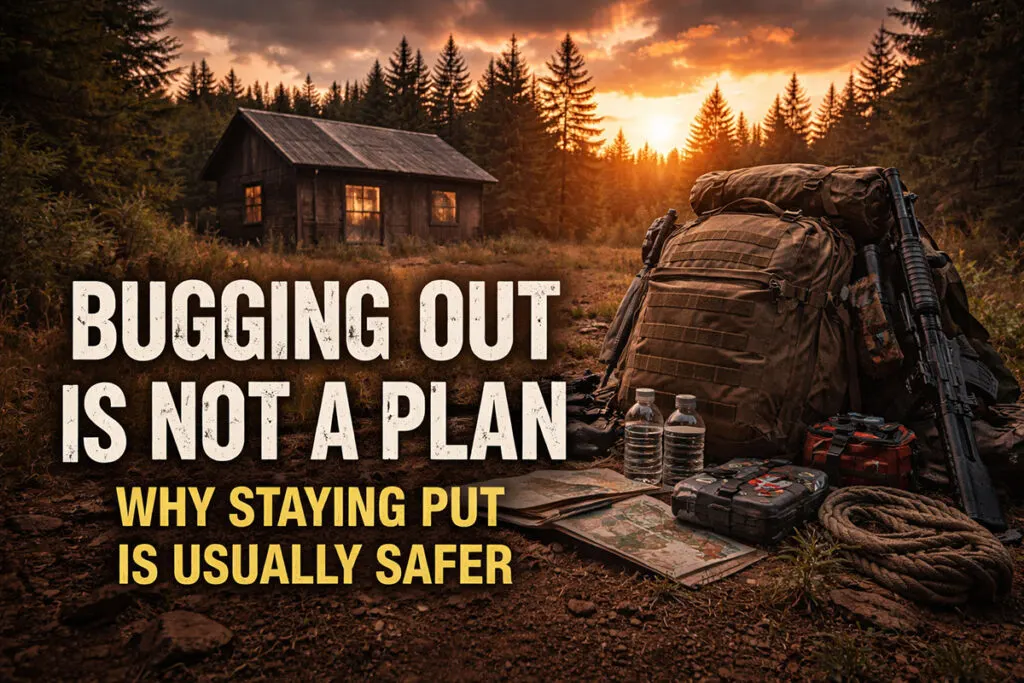
Movement introduces risk. Distance burns calories. Roads funnel people. Destinations are rarely empty. And once you leave, you give up control of the one place you actually know and can defend.
Bugging out is not a strategy. It’s something you prepare for only after better options are gone.
Here is how disasters actually unfold and where bugging out fits in reality.
Phase 1. Normal Life With Hidden Risk
Everything looks fine. Power is on. Stores are stocked. People are comfortable.
This is when preparedness matters most.
What to focus on:
- Food, water, medical, fuel, and energy stored at home
- Home hardening and basic security
- Situational awareness habits
- Skills and redundancy
Bugging out here is pointless. Leaving stability for uncertainty makes no sense.
Phase 2. Early Disruption
Supply chains slip. Fuel gets weird. Power flickers. Tension shows up online and in public spaces.
This is where people panic and make bad decisions.
Common mistakes:
- Evacuating based on fear or headlines
- Overestimating speed and mobility
- Assuming roads will stay clear
What to do instead:
- Stay home
- Reduce consumption
- Finalize plans quietly
- Load gear without deploying it
This is preparation time, not movement time.
Phase 3. Infrastructure Degradation
Utilities are unreliable. Emergency services are stretched. Response times slow down.
This phase feels uncomfortable, not catastrophic.
Reality check:
- Travel becomes more dangerous
- Crime becomes opportunistic
- Medical access degrades
Best move:
- Stay inside your controlled environment
- Limit exposure
- Operate quietly
- Conserve resources
Leaving now usually increases risk instead of reducing it.
Phase 4. Human Threat Phase
Rules stop being enforced consistently. Groups form. Desperation shows up.
This is where bugging out fantasies die.
Key truth:
People are now the biggest threat, not the event itself.
Movement here means:
- Checkpoints
- Ambush risk
- Encounters with armed or desperate people
Unless your location is directly threatened, staying hidden and disciplined is still safer than moving.
Phase 5. Forced Displacement
This is the only time bugging out becomes unavoidable.
Examples:
- Fire
- Flood
- Structural failure
- Direct targeting
- Toxic exposure
This is not a hike. This is escape under pressure.
What actually matters:
- Knowing your routes
- Keeping packs light
- Moving with intent
- Avoiding population corridors
- Weapons ready
If you do not have a destination, you are just wandering.
Phase 6. Transitional Survival
You made it out. That does not mean you are safe.
Most people fail here.
Why:
- Fatigue sets in
- Injuries happen
- Supplies disappear fast
- Other people arrive
What to do:
- Establish shelter immediately
- Rest and reassess
- Gather information before moving again
- Assume you are not alone
Reaching a location does not mean you own it.
Phase 7. Stabilization or Long Term Reality
At some point, systems either recover or they do not.
Now the question becomes sustainability.
- Food access
- Water access
- Security
- Community or isolation
This is where preparation pays off, not speed.
The Bottom Line
Bugging out is not heroic. It is expensive in calories, exposure, and risk.
The safest position in most disasters is:
- Depth over speed
- Discipline over panic
- Staying invisible instead of mobile
Your home, if prepared correctly, is almost always safer than the road.
Prepare to leave, but plan to stay.
That is how you survive when things actually go sideways.
pin it
Kelli Baker
Saturday 17th of January 2026
Any suggestions on making a home secure? I have vulnerabilities but not sure the best way to address them...
Arnie Carr
Saturday 21st of February 2026
@Kelli Baker, have wood ready painted black on one side to cover all windows so no light gets out to let you neighbors know