
When the supply chain breaks or the power goes out, a cabinet full of single-purpose products, one spray for the counters, one bottle for the drain, one kit for first aid, becomes a liability. It runs out, it expires, and it takes up space. A smarter approach is to stock a small set of basic chemical compounds that each do many jobs, cost very little, and store for years or even indefinitely.

This guide covers 33 of those compounds: what each one is, why it earns a place in your supply, how long it keeps, what it can do, and, just as important, how to store and handle it without hurting yourself. Store this knowledge now, while you can read the label in good light, and you will not be sorting out which chemicals are safe to keep near each other in the middle of an emergency.
A note before we start: this is a field reference, not a recipe book. It tells you what each compound does and how to keep it safe. The exact measurements, dilutions, and step-by-step methods live in the full Long-Term Chemical Compounds book. Always match the grade to the job, wear the right gear, and treat every oxidizer, acid, and caustic with respect.
Purchase the 29 Page Chemical Compounds Field Guide

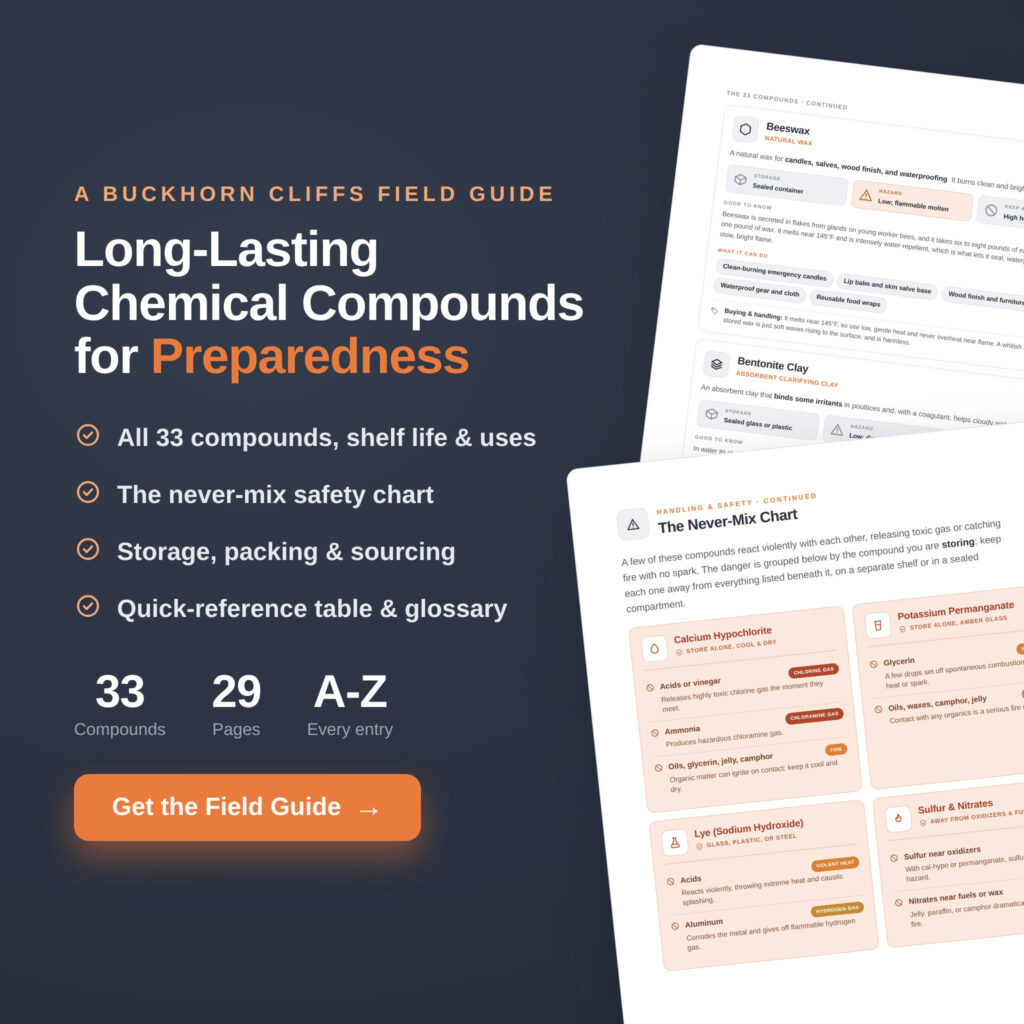
Everything you read here is yours to use for free. But if you want it all in one place, organized and ready to reach for when it matters, grab the complete Chemical Compounds Field Guide as a printable, savable PDF. Download it once, keep it on any device, and print a copy for the shelf. Highly recommended if you want the full reference at your fingertips.
This PDF download is also available to subscribers. Available on Instagram, YouTube, and Facebook for $2.99 per month. Click on whichever platform is your favorite to join.
What’s Included:
- All 33 compounds, A to Z, with real shelf life, storage, and hazards at a glance
- What each one can do, in quick, scannable use tags
- The complete never-mix safety chart, grouped by the compound you store
- Storage foundations: the right containers, packing steps, and labeling
- A sourcing checklist: match the grade and read the label with confidence
- A quick-reference table and a plain-language glossary
- 29 pages, downloadable and printable, yours to keep and back up on any device
Why a Few Compounds Beat a Cabinet of Products
The appeal of building a supply around raw compounds is simple: versatility, cost, and shelf life. A single pound of calcium hypochlorite (pool shock) can disinfect on the order of 10,000 gallons of water. Honey dresses wounds, soothes a cough, and preserves food, and it keeps almost forever. Baking soda is an antacid, a cleaner, a deodorizer, a leavening agent, and a fire suppressant. Vinegar cleans, descales, deodorizes, and kills weeds.
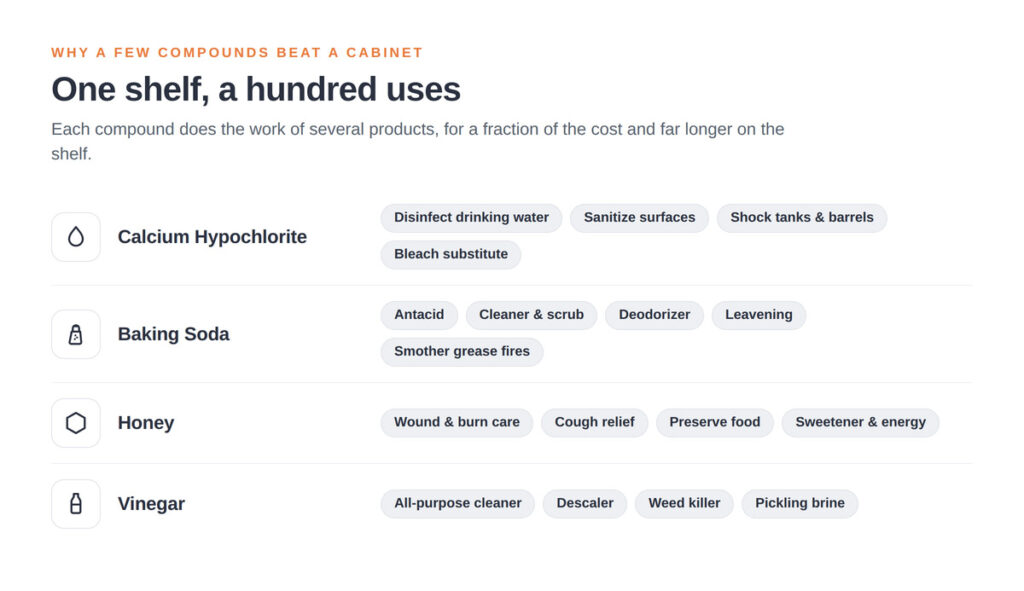
Buy these once, store them well, and you have replaced a shelf of products that would have expired and cost far more. The trade-off is that raw compounds demand a little knowledge to use and store safely, which is exactly what the sections below cover.
Storing Your Supply
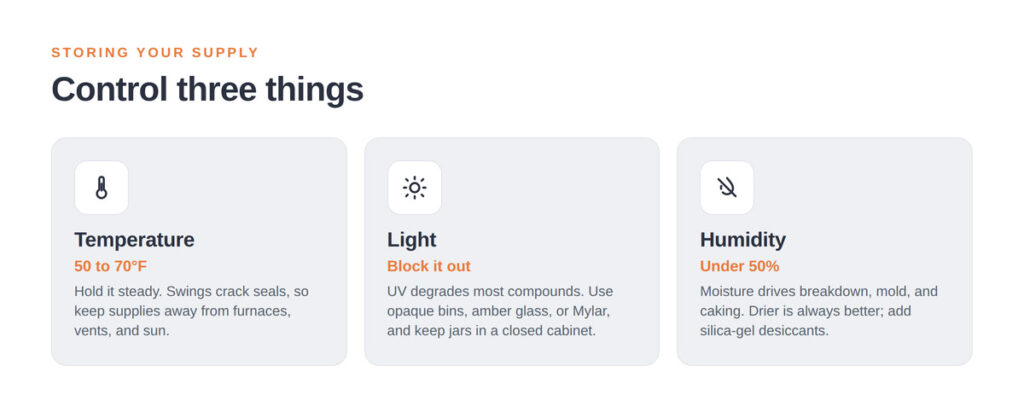
Proper storage is what separates a supply that lasts for years, or indefinitely, from one that fails in months. Control three environmental factors, pick the right container, and keep reactive compounds apart.
The three environmental factors
- Temperature. Hold a steady 50 to 70 degrees Fahrenheit. Swings make containers expand and contract, which cracks seals. Keep supplies away from furnaces, vents, appliances, and direct sun.
- Light. UV light degrades most compounds. Use opaque bins, amber or brown glass, or Mylar, and keep clear jars in a closed cabinet away from windows.
- Humidity. Keep it under 50 percent, and drier is better. Moisture drives breakdown, mold, and caking, so there is no such thing as too dry. Use silica-gel desiccants in sealed containers and dehumidify damp rooms.
Good storage spots include basements, root cellars, interior closets, and climate-controlled rooms. Avoid attics, garages, and sheds, spots near furnaces or appliances, direct sunlight, and wet or below-grade spaces.
The three workhorse containers
Oxygen, light, and moisture drive most degradation, so the container is your first line of defense.
- Glass jars are inert and permanent, the best choice for acids, bases, and oxidizers. Use plastic-lined caps, never metal, and amber glass for light-sensitive compounds.
- HDPE plastic is light, stackable, and food-safe, good for non-corrosive powders and dilute solutions with tight lids. Avoid bleach, lye, and strong peroxide in plastic; use glass for those.
- Mylar bags block light, air, and moisture completely, ideal for dry powders and granules with a desiccant, then heat-sealed. Not for liquids or sharp items.
The rule that covers all of them: default to glass, never metal. Glass never reacts, so it is the safe default for anything corrosive, reactive, or light-sensitive. Metal corrodes and can contaminate the contents.
Two tools, two different threats
Desiccants and oxygen absorbers do different jobs, and they are not interchangeable.
- Silica-gel desiccants fight moisture. Color-indicating beads absorb humidity inside any sealed container holding a dry powder. When the color changes they are saturated. They do not expire; dry them out and reuse them.
- Oxygen absorbers fight air. Iron packets pull oxygen out of a container, but only for dried foods with residual moisture, never for pure dry chemical powders, salt, or baking soda, which clump or fail. Size them to the container: about 300 to 500 cc per gallon and 1,500 to 2,000 cc per 5-gallon bucket.
Never put both tools in the same container, and never use an oxygen absorber with a dry chemical.
Packing and Labeling for the Long Term
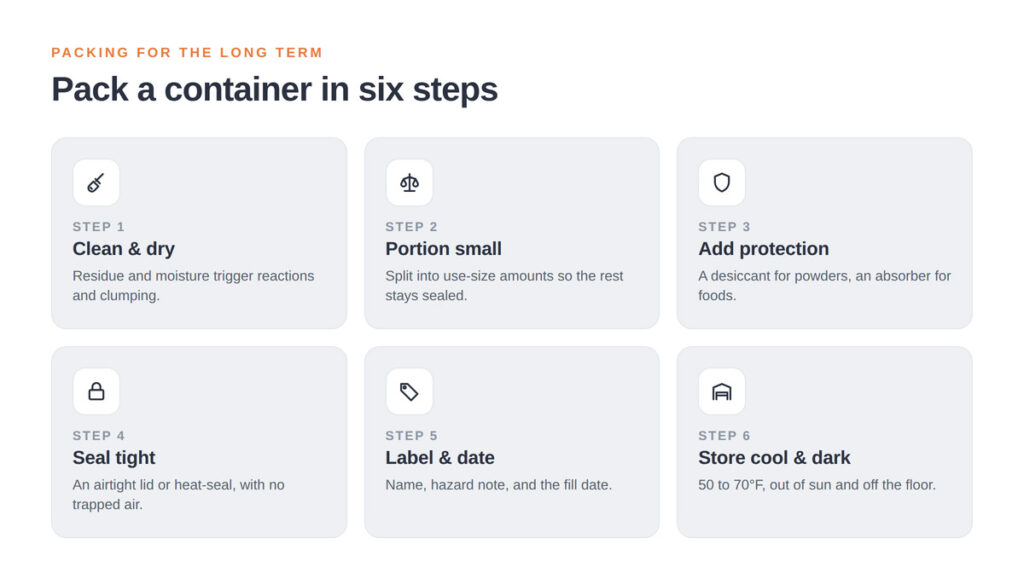
A container only protects what you pack into it correctly. Follow the same six steps every time: clean and dry the container, portion into use-size amounts so the rest stays sealed, add the right protection (a desiccant for powders), seal it tight with no trapped air, label and date it, and store it cool and dark.
Keep your silica gel working rather than tossing it. When the beads change color, dry them in a low oven until the color returns, cool them in a sealed jar, and reuse them. They last for years.
Finally, label every container the same way: name and formula, a hazard note, the fill date, quantity, storage location, and grade. Group acids, bases, and oxidizers on separate shelves, use the oldest stock first, keep heavy items on lower shelves, and inspect monthly for leaks, discoloration, or spent desiccants.
Handling and Safety: Gear Up First
Many of these compounds are caustic, oxidizing, or produce dust and fumes. The right gear turns a dangerous slip into a non-event.
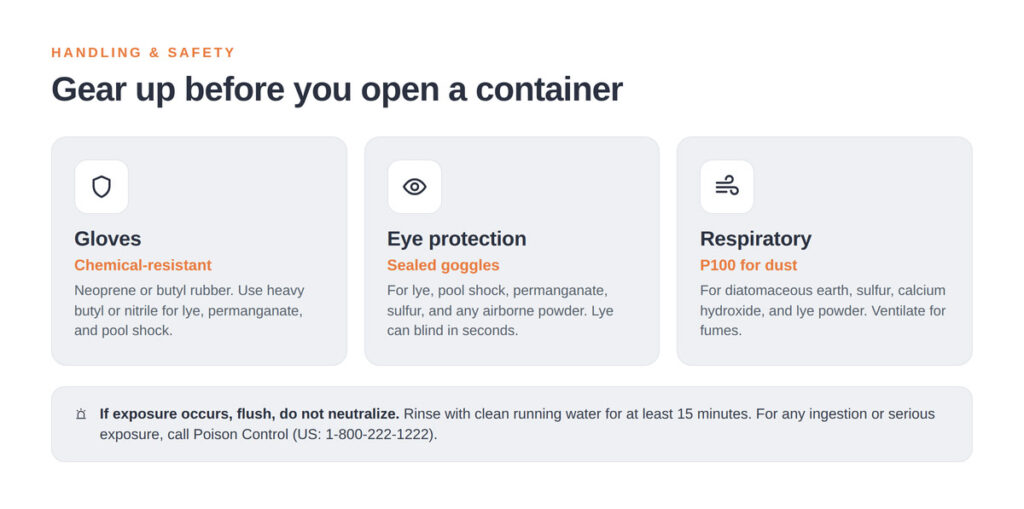
- Gloves: chemical-resistant neoprene or butyl rubber. Use heavy butyl or nitrile for lye, permanganate, and calcium hypochlorite; thin disposables tear on strong alkalis.
- Eye protection: sealed splash goggles for lye, calcium hypochlorite, permanganate, sulfur, and any airborne powder. Lye can blind in seconds, and regular glasses leave gaps.
- Respiratory: a P100 respirator for dust from diatomaceous earth, sulfur, calcium hydroxide, and lye powder. For bleach or pool-shock fumes, ventilate or work outdoors.
Keep neutralizers and water within reach: vinegar neutralizes base spills like lye or washing soda, baking soda neutralizes acid spills, and clean water flushes almost any splash. If exposure occurs, the answer for almost any chemical is large amounts of clean running water for at least 15 minutes. Do not try to neutralize a burn on skin, since that adds heat. For any ingestion or serious exposure, call Poison Control (US: 1-800-222-1222) or emergency services while you keep flushing.
The Never-Mix Chart
A few of these compounds react violently with each other, releasing toxic gas or catching fire with no spark. The safest way to think about it is by the compound you are storing: keep each one away from everything listed under it, on a separate shelf or in a sealed compartment.
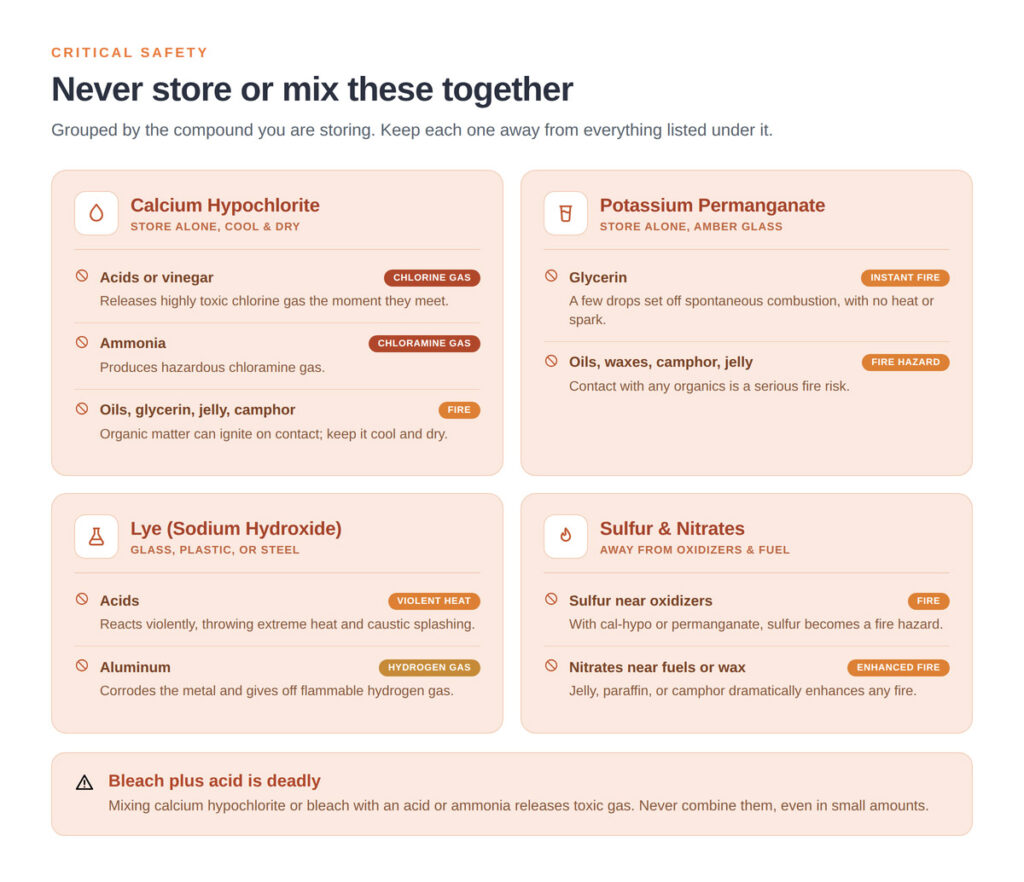
- Calcium hypochlorite (pool shock): never near acids or vinegar (releases toxic chlorine gas), ammonia (releases chloramine gas), or oils, glycerin, jelly, and camphor (fire). Store it alone, cool and dry.
- Potassium permanganate: never near glycerin (spontaneous combustion, no heat needed) or oils, waxes, camphor, and jelly (serious fire hazard). Store it alone in amber glass.
- Lye (sodium hydroxide): never near acids (a violent reaction with extreme heat and splashing) or aluminum (produces flammable hydrogen gas). Store it in glass, plastic, or steel.
- Sulfur and nitrates: keep sulfur away from strong oxidizers and keep nitrates away from fuels and wax, since both combinations dramatically enhance fire.
A second tier of pairings will not explode, but stored together they corrode containers, break down, or cancel each other out: acids and bases neutralize and lose usefulness; vinegar or citric acid corrodes metal containers; Lugol’s iodine degrades metal or plastic (use amber glass); hydrogen peroxide breaks down faster near organics; and activated charcoal absorbs odors and loses its power near strong smells.
The golden rules that tie it all together: isolate oxidizers, split acids and bases onto separate shelves, keep flammables cool and away from oxidizers, and seal and label everything. And the one that bears repeating, because it kills people every year: mixing bleach or calcium hypochlorite with an acid or ammonia releases toxic gas. Never combine them, even in small amounts.
The 33 Compounds at a Glance
Here is the full lineup, alphabetical, with real shelf life, the best container, and the main jobs each one does. Anything marked indefinite keeps essentially forever when stored sealed, cool, and dry.
| Compound | Shelf life | Best container | Key uses |
|---|---|---|---|
| Activated Charcoal | Indefinite | Sealed container | Poison binding, water filtering, odor control |
| Ascorbic Acid (Vitamin C) | 15 to 20+ yr | Cool, dark, sealed | Supplement, food preservation, removes chlorine taste |
| Baking Soda | Indefinite | Sealed container | Cleaning, baking, first aid, fire suppressant |
| Beeswax | Indefinite | Sealed container | Candles, waterproofing, salves |
| Bentonite Clay | Indefinite | Sealed container | Poultices, water settling aid |
| Borax | Indefinite | Sealed container | Cleaning, laundry, pest baits, flux |
| Boric Acid | Indefinite | Sealed container | Insecticide, eye and foot wash, antifungal |
| Calcium Hydroxide (slaked lime) | Indefinite | Sealed container | Egg preserving, soil, sanitation, mortar |
| Calcium Hypochlorite (pool shock) | Up to 10 yr | Glass jar, cool and dry | Water disinfection, bleach, sanitation |
| Camphor | Indefinite sealed | Airtight jar or tin | Muscle and chest rub, pest block, fire starter |
| Castile Soap | Indefinite | Original bottle | Body, hair, laundry, gentle first aid |
| Citric Acid | Indefinite | Sealed container | Food preservation, rust and scale removal, cleaning |
| Cornstarch | Indefinite | Sealed container | Cooking, thickening, skin and body powder |
| Creatine Monohydrate | 10+ yr | Cool, dry, sealed | Strength, recovery, focus under stress |
| Diatomaceous Earth (food grade) | Indefinite | Sealed container | Pest control, protecting stored grain |
| Electrolytes (CARDNL) | 7 to 10 yr | Sealed container | Hydration, recovery, heat and sweat |
| Epsom Salt | Indefinite | Sealed container | Muscle soaks, laxative, magnesium for plants |
| Ethanol (grain alcohol) | Indefinite | Glass bottle, cool | Disinfectant, solvent, tinctures, fuel |
| Glycerin | Indefinite | Glass or plastic bottle | Skin care, alcohol-free tinctures, fire starting |
| Honey (raw) | Indefinite sealed | Sealed glass jar | Wound and burn care, cough relief, food preservation |
| Hydrogen Peroxide 3% | 1 to 3 yr | Opaque bottle, cool | Around wounds, surfaces, tools, garden |
| Isopropyl Alcohol 70% | 5 to 10+ yr | Sealed bottle, cool | Disinfecting skin and gear, cleaning |
| Lugol’s Iodine 2% | 5 to 10 yr | Amber glass bottle | Wound antiseptic, water backup, thyroid block |
| Lye (sodium hydroxide) | Indefinite | Sealed, never aluminum | Soap making, clearing drains |
| Paraffin Wax | Indefinite | Sealed container | Candles, jar seals, fire starters, waterproofing |
| Petroleum Jelly | Indefinite | Original container | Skin barrier, rust prevention, fire starters |
| Potassium Nitrate (saltpeter) | Indefinite | Sealed, cool | Meat curing, stump removal, fertilizer |
| Potassium Permanganate | Indefinite | Amber glass, sealed | Water pre-treatment, skin soaks, fire starting |
| Salt (sodium chloride) | Indefinite | Sealed container | Curing, brining, oral rinses, electrolytes |
| Sodium Nitrate | Indefinite | Sealed, cool | Meat curing, fast nitrogen fertilizer |
| Sulfur | Indefinite | Sealed, ventilated | Garden fungicide, skin treatment, fumigation |
| Vinegar (5% acetic) | Indefinite | Glass bottle | Cleaning, descaling, preserving, weed control |
| Washing Soda | Indefinite | Sealed container | Heavy-duty degreasing, laundry, softening water |
The Compounds by Job
Read the table one way and you see shelf life. Read it another and you see a whole preparedness plan built from a few cheap ingredients. Here is how the 33 break down by the work they do.
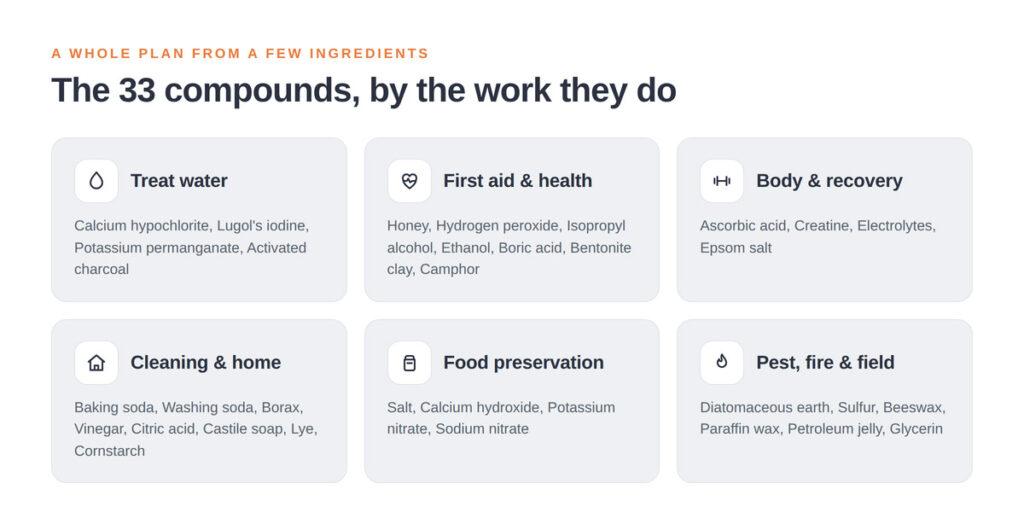
Treating water
The first thing to secure in any emergency. Calcium hypochlorite is the heavy hitter, disinfecting large volumes from a tiny amount of dry granule. Lugol’s iodine treats clear water as a backup and doubles as a wound antiseptic and thyroid block. Potassium permanganate strips iron, manganese, and odor from water (though you still boil afterward), and activated charcoal improves taste and filters sediment. None of these removes every threat, so pre-filter cloudy water and pair chemical treatment with boiling or filtering when you can.
First aid and health
A medicine cabinet built from shelf-stable supplies. Honey dresses shallow wounds and minor burns and soothes a cough. Hydrogen peroxide and isopropyl alcohol clean around wounds and disinfect gear. Ethanol disinfects, makes tinctures, and burns as clean fuel. Boric acid is a mild antiseptic and a patient insect killer, bentonite clay makes drawing poultices, and camphor is a warming muscle and chest rub.
Body and recovery
Ascorbic acid is vitamin C in shelf-stable powder, the nutrient long-stored diets lack most. Creatine supports strength, recovery, and clear thinking under stress and sleep loss. Electrolytes replace the sodium, potassium, and magnesium you lose to heat and hard work, and Epsom salt is the classic warm muscle soak.
Cleaning, soap, and home
This is where a few powders replace a cabinet of products. Baking soda is the multitool. Washing soda cuts baked-on grease and softens hard water. Borax cleans and baits pests, vinegar and citric acid handle descaling and preserving, castile soap is a gentle all-purpose wash, lye makes soap and clears drains, and cornstarch thickens food and keeps skin dry.
Food preservation and curing
Salt cures and brines meat and serves a dozen everyday jobs. Calcium hydroxide water-glasses eggs for months and sweetens acidic soil. Potassium nitrate and sodium nitrate are curing salts that fix color and block botulism in preserved meat, so cure only with precise, weighed amounts.
Pest control, fire, and field supplies
Diatomaceous earth kills insects by drying them out and protects stored grain, no poison involved. Sulfur is a garden fungicide and a skin treatment. Beeswax and paraffin wax make candles, waterproofing, and fire starters, petroleum jelly stops rust and lights cotton balls for tinder, and glycerin is a skin protectant and a humectant.
Sourcing: Match the Grade, Read the Label
The right compound is only useful if you buy the right grade. Use this in-store checklist.
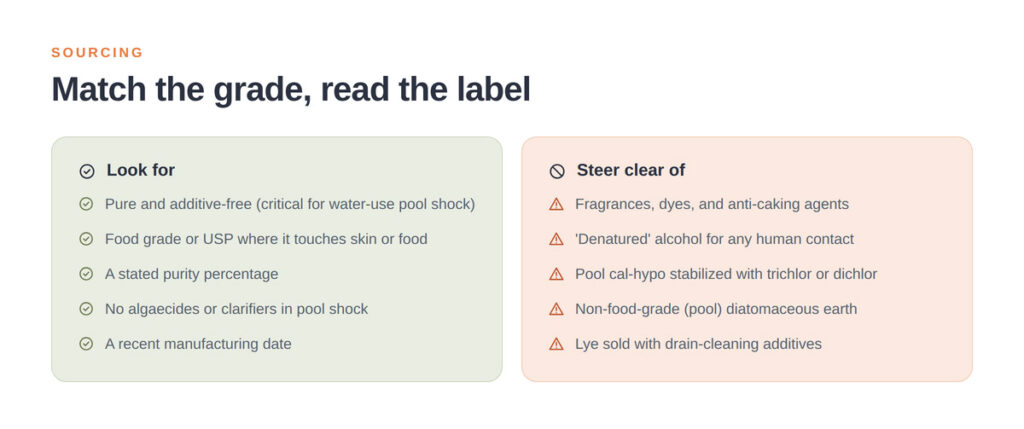
What to look for on the label:
- No additives or fillers. Look for “pure” or “additive-free,” which is critical for calcium hypochlorite used in drinking water.
- Food grade (GRAS or food-safe) for anything internal, on skin, or in cooking.
- A USP symbol for pharmaceutical quality, best for first aid, eye care, and internal use.
- A purity percentage, since a higher percent means more active ingredient. Watch calcium hypochlorite (65 to 73 percent) and permanganate.
- No algaecides or clarifiers, required for water disinfection with calcium hypochlorite.
- A recent manufacturing date. Prefer fresh stock and avoid anything far past its date.
What to avoid: fragrances, dyes, and anti-caking agents; “denatured” alcohol for any human contact; pool calcium hypochlorite stabilized with trichlor or dichlor; non-food-grade (pool) diatomaceous earth, which can cause silicosis if the dust is inhaled; and lye sold with drain-cleaning additives.
The One Rule to Remember
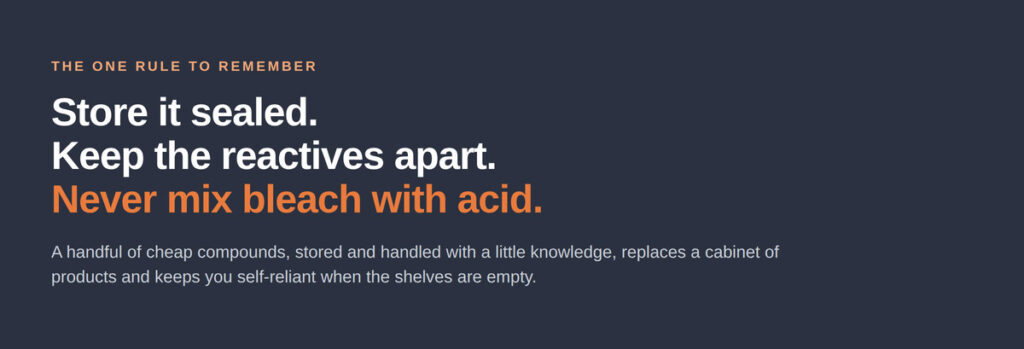
Store each compound cool, dry, dark, and sealed, in glass or the right plastic, never metal. Keep oxidizers, acids, bases, and flammables apart, and label everything. Match the grade to the job, and never mix bleach with an acid or ammonia. A handful of cheap compounds, stored and handled with a little knowledge, can replace a cabinet of products and keep you self-reliant when the shelves are empty.
About the Guide
This article is drawn from the Buckhorn Cliffs Chemical Compounds field guide, a 29-page downloadable and printable PDF that distills all 33 compounds into fast, at-a-glance entries: what each one is, why to store it, how long it keeps, what it can do, and what never to mix, plus the storage, safety, and sourcing references above. Save it to any device, back it up, or print a copy for the shelf.
The complete hardcover book, coming in 2026, goes further, expanding every compound into 137 tested, step-by-step recipes with exact measurements for water treatment, first aid, cleaning, and food preservation across over 200 pages of detail, quick-reference tables, and appendices. This guide names what each compound can do; the book shows you exactly how.
Pin it