A while back I wrote Salt for Survival, which covered why your body needs salt, how it stores for the long haul, and the emergency jobs it handles, from wound rinses to fire suppression. This post picks up the next question. You stand in the store aisle and there are a dozen boxes and bags, all called salt, at wildly different prices. Which ones do you keep, and what is each one for?
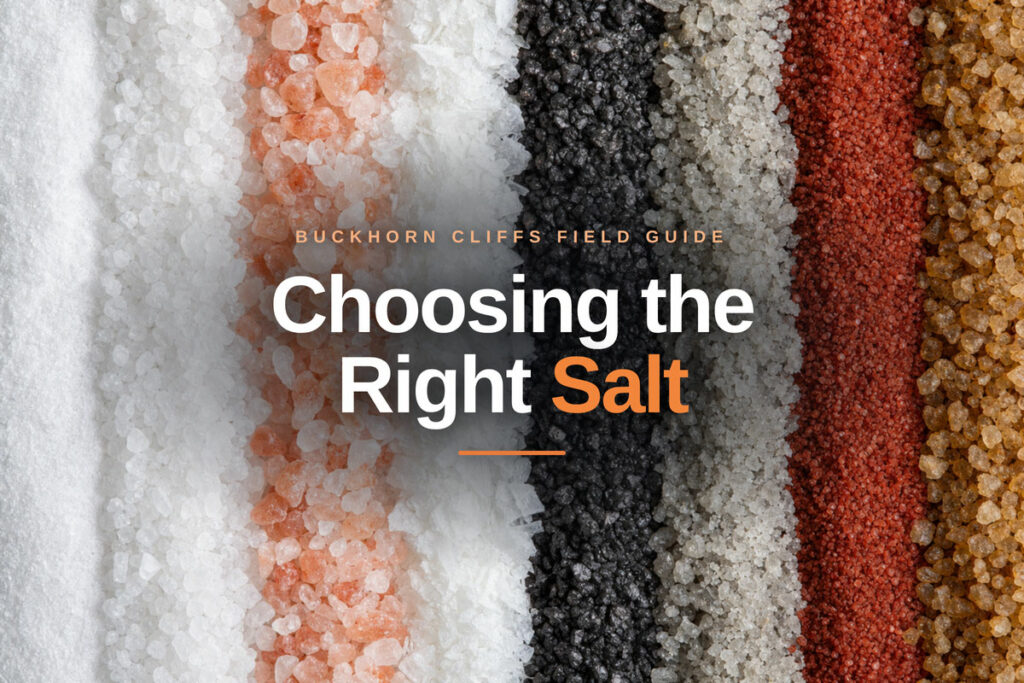
A recipe says salt and leaves it there. But the kind you reach for changes how a batch cures and how well it keeps. Get this part right and one shelf-stable mineral covers seasoning, preserving, and basic first aid for the rest of your life.
Why the Salt You Keep Matters
Two things in ordinary table salt will ruin preserving work: added iodine and anti-caking agents. Iodine can darken pickles, and anti-caking agents cloud a brine and can stall a ferment. Curing meat is its own case, because it needs a salt blended with nitrite for safety.
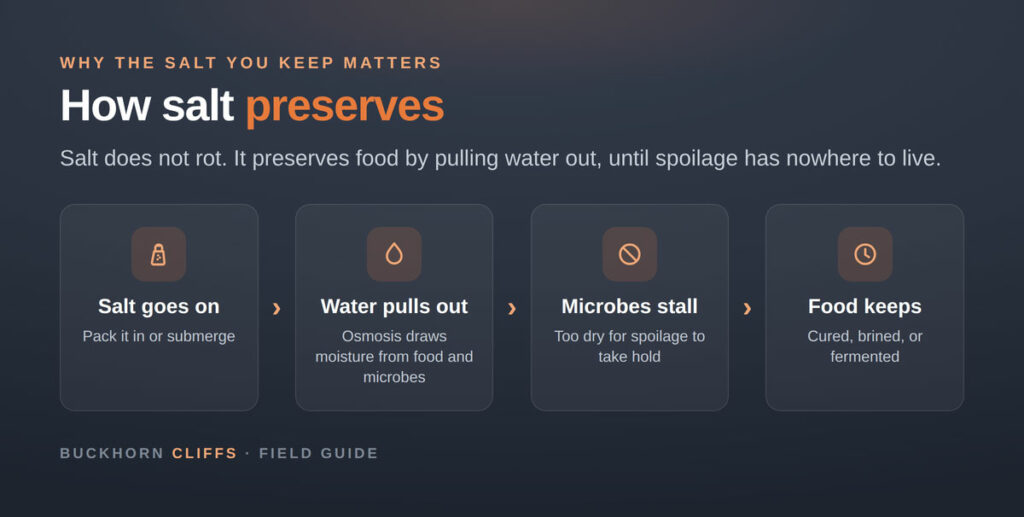
A short lineup covers it. Keep a plain everyday salt for the table, a pure pickling salt for brines, and a pink curing salt for meat, and almost any job is handled. Before you buy for any preserving job, read the label and pick a salt that lists only salt.
The Six Salts Worth Knowing
Here is the full field, with what each one does best and what to watch for.

Table salt. Fine grained and cheap, with added iodine and anti-caking agents. Fine for everyday seasoning at the table and stove. Keep it off your brines and ferments, where those additives cause trouble.
Ancient unrefined sea salt. Salt from ancient sea beds, never refined, with natural trace minerals. This is my daily go-to for eating and seasoning, and it doubles as an electrolyte base in water. It is coarser and less uniform, so a fine pickling salt dissolves cleaner when a brine has to be exact.
Pickling and canning salt. Pure, fine sodium chloride with nothing added. It dissolves clear. This is the one to reach for on brining, fermenting, pickling, and most preserving. Because it has no anti-caking agent, it clumps in humid air, so keep it sealed.
Kosher salt. Coarse, flaky crystals, and most brands come without iodine. Good for drawing moisture from meat and for general cooking. Some brands do add anti-caking, and it measures differently by volume than table salt, so check before you swap it one for one.
Himalayan pink salt. Mined rock salt, tinted by a trace of minerals. Good for everyday seasoning and finishing. It is still almost pure sodium chloride, so the extra minerals are too small to matter nutritionally.
Curing salt (Prague Powder). Table salt blended with sodium nitrite, and in the case of #2 with nitrate too, then dyed pink. Its one job is curing meat safely, where nitrite blocks botulism. It is toxic in excess, so use exact weighed amounts and never treat it as table salt.
If you already keep Celtic (sel gris) or another unrefined sea salt, those are close cousins of ancient sea salt and Himalayan pink. For daily eating and finishing they are basically interchangeable. None of them dissolve as cleanly as a fine pickling salt, so keep them off precise brines.
Match the Salt to the Job
Most jobs want a plain, additive-free salt. A few are specific. Here is the quick lookup.
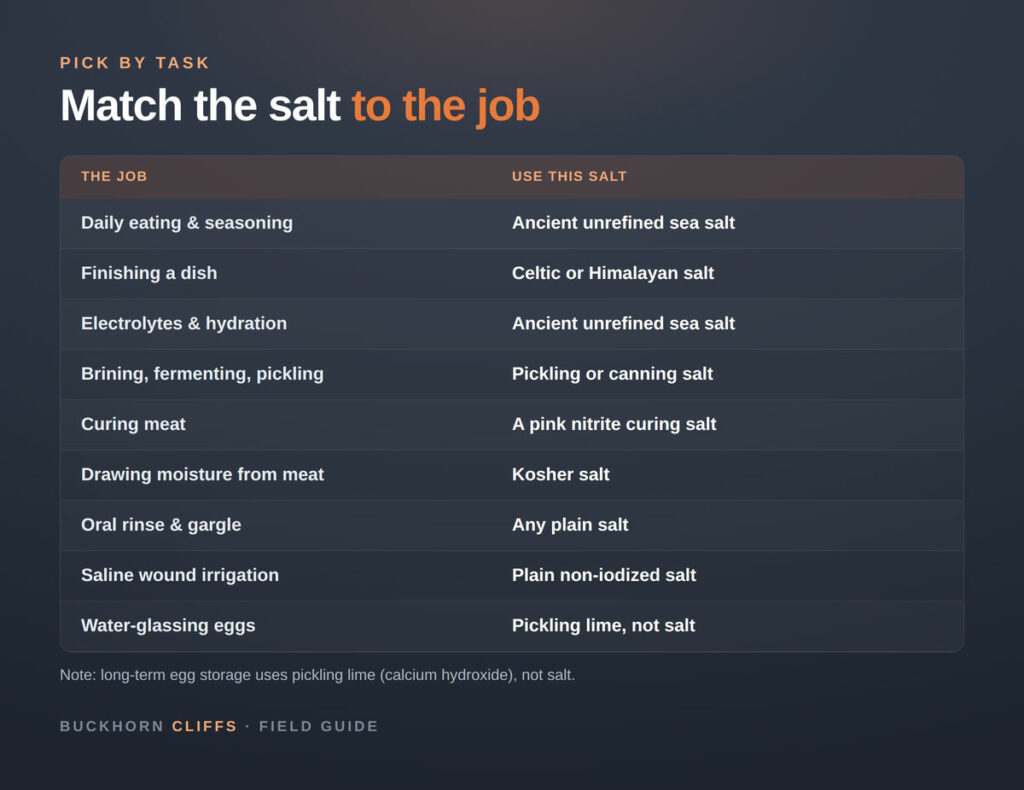
| The job | Use this salt | Why |
|---|---|---|
| Daily eating and seasoning | Ancient unrefined sea salt | Clean flavor and trace minerals |
| Finishing a dish | Celtic or Himalayan salt | Coarse crystals for crunch and pop |
| Electrolytes and hydration | Ancient unrefined sea salt | Sodium plus trace minerals the body sheds |
| Brining, fermenting, pickling | Pickling or canning salt | Non-iodized and additive-free, dissolves clear |
| Curing meat | A pink nitrite curing salt | Nitrite fixes color and blocks botulism |
| Drawing moisture from meat | Kosher salt | Coarse flakes pull surface moisture well |
| Oral rinse and gargle | Any plain salt | Dissolved in warm water for a sore throat |
| Saline wound irrigation | Plain non-iodized salt | Clean salt in boiled, cooled water |
| Water-glassing eggs | Pickling lime, not salt | Eggs are preserved in a lime solution |
That last row trips people up. Long-term egg storage uses a solution of pickling lime, which is calcium hydroxide, not salt. Salt cures meat and brines vegetables, but it will not preserve eggs.
Brining, Fermenting, and Pickling
This is where the additive-free rule earns its keep. A measured salt brine holds back spoilage while the good bacteria do their work. Iodized salt can darken pickles and anti-caking agents cloud the liquid, so reach for pickling or canning salt every time.
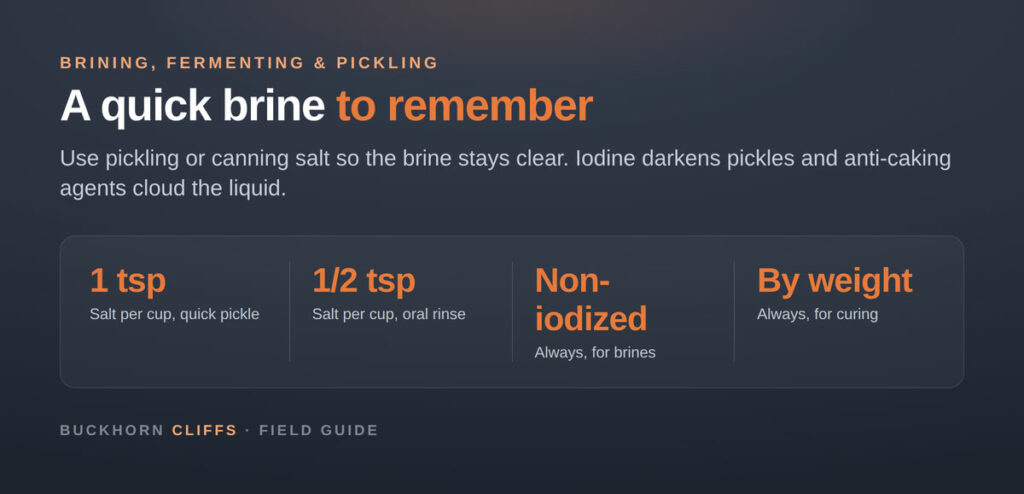
A couple of ratios worth keeping in your head: about 1 teaspoon of salt per cup of water for a quick pickle, and about a half teaspoon per cup for an oral rinse. Season and brine to taste, since there is room for it. Curing is the one place where taste has nothing to do with it.
Curing Salts and Safety
Curing salts are table salt blended with a small, exact amount of sodium nitrite or nitrate, then dyed pink so no one confuses them with seasoning. The nitrite fixes cured meat’s color and, more importantly, blocks Clostridium botulinum, the source of botulism. That same power is what makes these salts dangerous in excess.
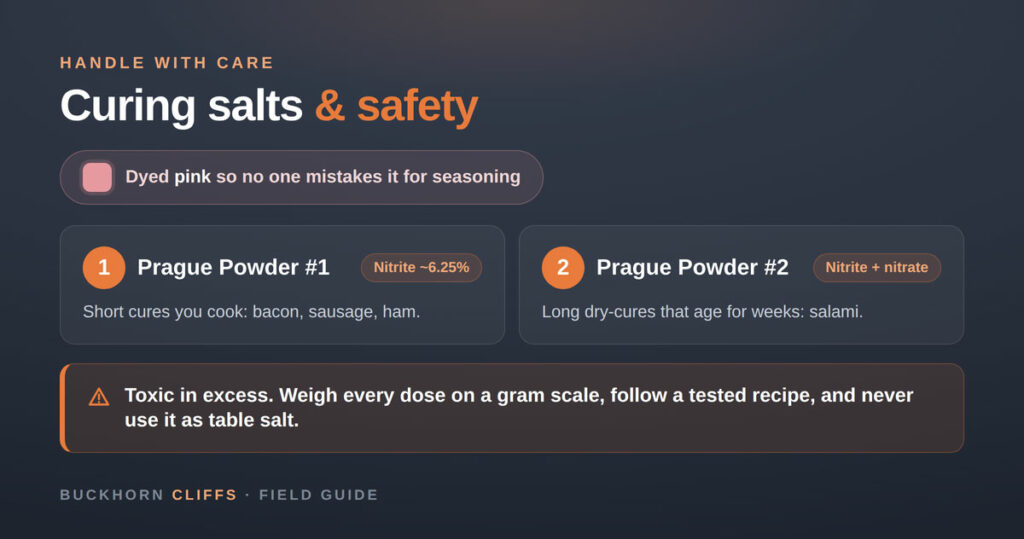
There are two you will see. Cure #1 (Prague Powder) is about 6.25% nitrite and is for short cures you will cook, like bacon, sausage, and ham. Cure #2 adds nitrate and releases its nitrite slowly, which suits long dry-cures that age for weeks, like salami and dry sausage.
The rules here are simple and not optional. Weigh curing salt on a gram scale, follow a tested recipe exactly, keep it labeled and stored well away from your table salt, and cure at cold, controlled temperatures. Never eyeball the dose, never scale up by feel, and never assume more nitrite is safer. Keep it away from children.
Storing Salt for the Long Haul
Plain salt keeps forever. Its only enemy is moisture, not time. Store it dry and sealed and it will outlast almost everything else in your supply.

A few notes that go against common food-storage habits. Skip oxygen absorbers, because salt never spoils and they can make it clump. Add a silica desiccant instead, which pulls humidity and keeps the salt free-flowing. Seal it in an airtight container and keep it off bare metal, which can corrode. Curing salts also keep indefinitely when sealed and cool, but close them up tight, since the nitrate pulls moisture from the air and cakes.
The Body Side of Salt
Everything above is about choosing and using salt in the kitchen and the pantry. The other half of the story, why your body needs sodium, how much to store per person, and the first-aid and emergency uses, is in the original post. If you have not read it yet, start with Salt for Survival and come back here to sort out your shelf.
Get the Full Field Guide
This PDF download is also available to subscribers. Available on Instagram, YouTube, and Facebook for $2.99 per month. Click on whichever platform is your favorite to join.
Everything in this post is pulled from the Buckhorn Cliffs field guide, Choosing the Right Salt. The guide lays it all out on the page: the six salts side by side, a full match-the-salt-to-the-job table, the curing safety rules, a storage checklist, and a plain-English glossary. It is built to print and keep with your supplies.

The PDF is free for subscribers. One subscription unlocks every Buckhorn field guide, including the Chemical Compounds guide, the Walk-Around Preparedness Audit, and the off-grid guides, plus each new one the day it drops.
This PDF download is also available to subscribers. Available on Instagram, YouTube, and Facebook for $2.99 per month. Click on whichever platform is your favorite to join.
or pin it