BUCKHORN CLIFFSA preparedness field manual

Garden and Livestock · Guide

Straw vs Hay: What Each One Is, What a Bale Weighs, and What to Do with It

Hay is feed: grasses and legumes cut green and dried. Straw is the hollow stem left after a grain harvest, and it is bedding, mulch and insulation, not food. How to tell them apart at the feed store, what a bale weighs, what to check before you buy, and every job straw does on my place.

Quick facts

Hay
Grasses (timothy, orchard, brome) and legumes (alfalfa, clover), cut green and dried; animal feed
Straw
Hollow stems of wheat, oats, barley or rye left after the grain is combined; bedding and mulch
Tell them apart
Hay is green to gray-green and smells sweet; straw is gold, shiny and hollow
Small square bale
Hay 45 to 70 lb; straw 35 to 50 lb; both roughly 14 x 18 x 36 inches
Round bale
800 to 1,500 lb; needs a tractor or a bale spear
Before you mulch with it
Ask if the field was sprayed with a persistent herbicide (aminopyralid, clopyralid)
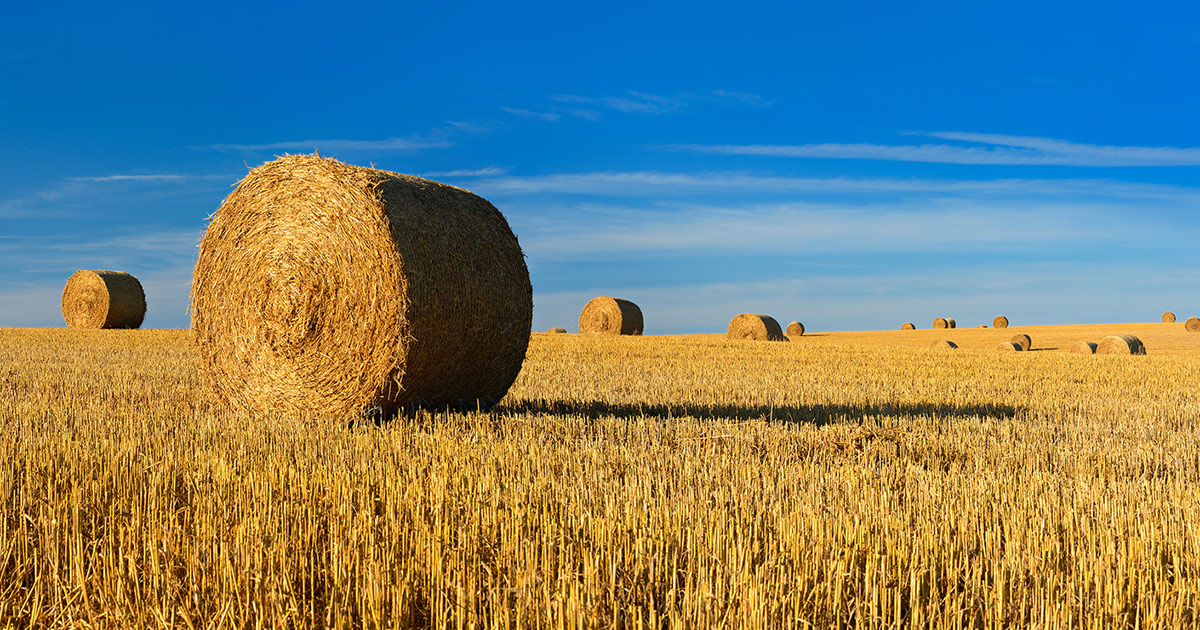
They sit inches apart at the feed store, they are both baled, and both are yellow-ish from ten feet away. One is food and the other is a building material. If you keep animals or a garden you will buy both, and buying the wrong one is an expensive mistake in one direction and a sick animal in the other.

HayFeedGrass and legumes, cut green
StrawBedding and mulchGrain stems after harvest
45 to 70 lbSmall hay baleStraw 35 to 50 lb
800+ lbRound baleTractor territory

Hay: the feed

Hay is a whole plant, grasses or legumes or a mix, cut while it is still green and growing, left in the field to dry to about 15 percent moisture, then raked and baled. It is cut before the seed heads form because the protein and energy are in the leaves, and both fall off fast once the plant goes to seed. Good hay is green to gray-green, smells sweet, and still has its leaves.

Grass hayTimothy, orchardgrass, brome, bermuda. The maintenance feed for horses and for adult goats, sheep and cattle that are not milking or growing. Lower protein, safer to feed free-choice.
Legume hayAlfalfa and clover. High protein and calcium, the feed for milking goats, growing kids and thin animals. Too rich as the only hay for an idle horse.
Mixed hayGrass with some alfalfa, the middle ground and what most small places buy. Ask the percentage; it changes the price and the feeding rate.
Checking a bale before you pay
  • Break one open. Green inside, sweet smell, leaves on the stems.
  • Push a hand into the middle. Warm means it was baled wet and will mold; a hot stack can catch fire.
  • Brown, gray, dusty or musty hay was rained on or stored badly. Dust is mold; horses get heaves from it.
  • Weeds, sticks, trash and baling twine in the bale mean you are paying hay price for garbage.

Straw: the leftover stem

Straw is what the combine leaves behind. Wheat, oats, barley and rye are grown for their seed heads; once those are threshed off, the hollow stems standing in the field are cut, raked and baled. There is almost no feed value in them, which is exactly why straw is cheap and why it is such a good bedding: it is dry, hollow, springy and slow to rot.

Wheat strawis the common one, stiff and gold, the general purpose bale.
Oat strawis softer and more absorbent, my pick for bedding under animals and in nest boxes.
Barley strawhas sharp awns that get into eyes and skin; fine for mulch, not for bedding. Floated in a mesh bag it also keeps algae down in a stock tank or pond.
Rye strawis long and tough, the traditional thatch and the best for a windbreak or erosion mat.

Straw carries a little grain seed. A few wheat sprouts in the garden after mulching are normal; pull them.

Telling them apart in ten seconds

HayStraw
ColorGreen to gray-greenGold, shiny
SmellSweet, grassyDry, faint, dusty
StemsSolid, leafy, sometimes with flowersHollow tubes, no leaves
Weight, small bale45 to 70 lb35 to 50 lb
PriceTwo to four times strawCheap
JobFeedBedding, mulch, insulation

Hay is for horses. Straw is for stalls. Feed straw to a horse and it goes hungry; bed a horse on alfalfa and it eats its bed and gets fat.

Bales: what you are buying

A bale is a compressed, tied bundle so the stuff can be moved and stacked. The two shapes matter because they decide what equipment you need.

Small square balesTwo-string, about 14 x 18 x 36 inches, 45 to 70 lb of hay or 35 to 50 lb of straw. One person lifts them, they stack in a truck bed and a shed, and you can feed by the flake. This is what a small place buys.
Large square balesThree-string at 100 to 125 lb, or the 3 x 3 x 8 foot bales at 800 lb and up. Cheaper per ton, not liftable.
Round bales800 to 1,500 lb. The cheapest hay per ton, but they need a tractor with a spear, a feeder ring so the animals do not waste half of it, and dry storage; a round bale left out loses its outer foot to rot.

Buy hay by weight when you can. A light, loosely packed bale at the same price is less feed.

What straw does on my place

Garden mulch4 to 6 inches around tomatoes, peppers, squash and along paths. Holds water, stops weeds, keeps fruit off the dirt, and turns into soil by spring.
Animal beddingGoats, chickens, the dog house. Absorbent, warm, easy to fork out. Deep litter in the coop through winter: keep adding straw over the old, turn it, and clean out once in spring.
InsulationBales stacked around a well head, a stock tank, the north wall of the coop or a cold frame. Straw does not wick like hay and a dry bale stays a bale for a season or two.
Lawn seed coverA thin scatter over new grass seed keeps birds off and the soil damp. Thin enough to see soil through it.
Straw bale gardeningCondition a bale with water and nitrogen for two weeks, plant into the top, and grow potatoes and tomatoes where there is no soil at all.
Backstop and windbreakA stacked wall stops arrows, cuts wind across a garden bed, and slows runoff on a slope. Soiled bales go to the compost pile and finish the job there.
The herbicide question

Some hay and straw fields are sprayed with persistent broadleaf herbicides (aminopyralid, clopyralid, picloram). They pass through animals and survive composting, and mulch or manure carrying them will curl and stunt tomatoes, beans, peas and potatoes for a season or more. Before straw or manure goes on a vegetable bed, ask the grower what was sprayed. If nobody knows, plant a few bean seeds in a pot of the suspect material and watch for twisted leaves before you spread it.

Storing both

  • Off the ground, on pallets, under a roof. Ground contact rots the bottom bale and wicks moisture up the stack.
  • Hay needs air: stack with gaps, never against a wall, and never stack fresh hay tight in a closed barn. Wet hay heats and can ignite.
  • Straw is forgiving; a tarp over a pallet stack outdoors gets it through a season. Keep the tarp off the sides so air moves.
  • Mice love both. Cats, traps and a tidy stack.
  • Buy hay in summer when it is cut. Winter hay is the same hay at a higher price, and in a hard year there is none to buy.

Questions this answers

Tap a question for the short answer.

What is the difference between straw and hay?

Hay is food: grasses and legumes cut while green, dried in the field and baled for feed. Straw is the hollow stalk left in the field after wheat, oats, barley or rye have been combined for grain; almost no feed value, which is exactly why it is cheap bedding, mulch and insulation. Hay is green and smells sweet. Straw is gold, shiny and hollow.

What is hay made of?

Grasses such as timothy, orchardgrass, brome and bermuda, legumes such as alfalfa and clover, or a mix. It is cut before the plants set seed, because feed value drops as they mature, dried to under about 15 percent moisture and baled. Alfalfa is the high-protein hay for dairy goats and growing stock; grass hay is the maintenance feed for horses and adult animals.

What is straw made of?

The stems left standing after a cereal grain is harvested. The combine takes the seed heads and leaves the straw, which is raked and baled. Wheat straw is the common one; oat straw is softer and the one I want for bedding; barley straw has stiff awns that irritate skin and eyes.

What can I use straw for?

Animal bedding, chicken coop litter, garden mulch, covering new lawn seed, insulating a well head or a stock tank, a windbreak or an archery backstop, growing potatoes and tomatoes in straw bales, and compost once it is soiled. It is not feed, though goats and cattle will pick at it as roughage.

Can I mulch a vegetable garden with straw?

Yes, and it is my favorite mulch: a 4 to 6 inch layer holds moisture, blocks weeds and breaks down into the soil by the next season. Two cautions. Straw that was sprayed with a persistent herbicide (aminopyralid or clopyralid) will stunt and curl tomatoes, beans and potatoes, so ask the grower before you buy. And straw carries some grain seed, so expect a little wheat to sprout and pull it.

Do horses eat hay or straw?

Hay. Straw is bedding. A horse will nibble straw bedding and it does no harm as roughage, but it cannot live on it. The old line, hay is for horses, is the easiest way to keep the two straight.

How much does a bale of hay weigh?

A small two-string square bale of grass hay runs 45 to 60 lb; alfalfa 60 to 70 lb; three-string bales 100 to 125 lb. Straw bales are lighter, 35 to 50 lb, because the stems are hollow. Round bales run 800 to 1,500 lb depending on size and density.

How do I tell if hay is good?

Green color, a sweet smell, leaves still on the stems, and no dust, mold or heat when you break a bale open. Brown, dusty or musty hay was rained on or baled wet. Push your hand into the middle of a bale; if it is warm, it was baled too wet and can mold or even start a fire in the stack.

Keep going

Read nextColorado High-Elevation Vegetable GardeningHow to plan a vegetable garden for Colorado's short, high-altitude season: zones, weather, crop choices, site and soil prep, beds and frost dates.Garden and Livestock · Guide

Related to this

Membership · $49.95 per year

There is a lot more behind the lock

158member pages in full
125recipes with exact amounts
6field guide PDFs, 206 pages
1manual of your own, built from any page

Every recipe and resource from the Prepper's Chemical Survival Guide, all six field guides to read here and download, the full audit and logbook, all twelve reference charts, and no ads.

My Manual · included

Build your own field manual

The most useful thing a membership gives you. Save any page on this site, recipes, charts, and whole field guides included. Arrange them in the order you want, name it, and print one manual with a cover and contents, or keep it as a PDF that opens with no signal.

  • It works when this site does not
  • Only your pages
  • Anyone in the house can use it
  • One current copy, not a pile of printouts
  • The house binder
  • A copy for the bug-out bag or truck
  • A copy for family
  • An offline PDF

Join for $49.95 per year

Garden and Livestock · GuideLast reviewed 2026-09-29

Membership

Save to My Manual is a member tool

Members build their own manual from the pages that fit their household, then print it or keep it as a PDF.

Why it matters

When the grid goes down, this site goes with it. Paper does not. Membership is how you get the whole manual off the screen and onto the shelf: every page in full, every field guide, and a binder built for your own household.

The field guide library

All six field guides. 206 pages. Included.

The complete Buckhorn Cliffs PDF set, yours to download, print, and keep from the day you join.

$60if bought one at a time

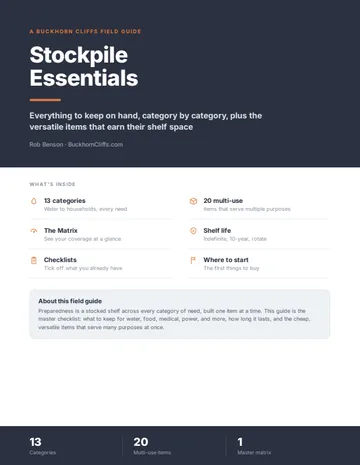
  • Cover of Stockpile Essentials Field GuideStockpile Essentials39 pagesEverything to keep on hand, category by category, plus the 20 multi-use items.
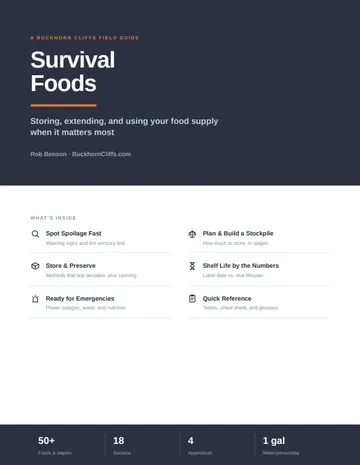
  • Cover of Survival Foods Field GuideSurvival Foods35 pagesStoring, extending, and using the food supply. Real shelf life by the numbers.
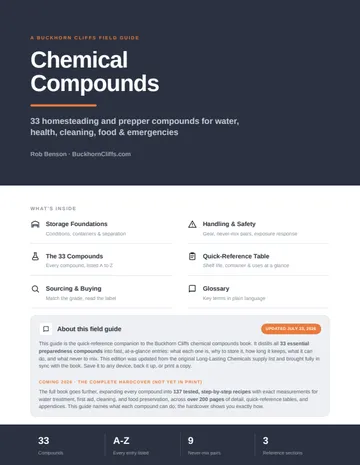
  • Cover of Chemical Compounds Field GuideChemical Compounds29 pagesThe 33 compounds: storage, top uses, hazards, and the never-mix chart.
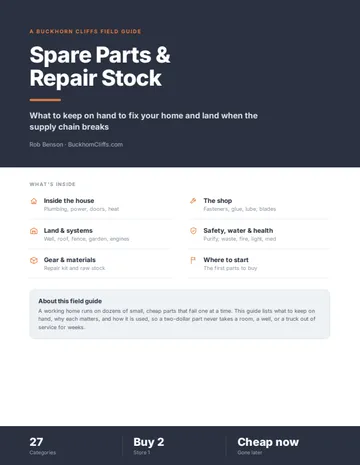
  • Cover of Spare Parts and Repair Stock Field GuideSpare Parts and Repair Stock40 pagesWhat to keep on hand to fix the home and land when the supply chain breaks.
  • Cover of Walk-Around Preparedness AuditWalk-Around Preparedness Audit33 pagesFifteen systems scored 1 to 5, with the printable scorecard.
  • Cover of The Preparedness LogbookPreparedness Logbook30 pagesThe household information that needs to be on paper.

My Manual · included

Build your own field manual

The most useful thing a membership gives you. No book fits your household exactly. My Manual does. Save any page on this site, recipes, charts, and whole field guides included, arrange them in the order you want, and print one manual with your name on the cover. It holds only what is relevant to you, and nothing you would skip.

Why it matters

  • It works when this site does notNo power and no signal means no website. A printed manual and an offline PDF still open, which is the whole point of writing any of this down.
  • Only your pagesThis site covers every household. Yours needs a fraction of it. Your manual holds the pages that match your water source, your climate, and your gear, so nobody digs through the rest under stress.
  • Anyone in the house can use itThe person who reads this site may not be the one home when it counts. A binder on the shelf, in the order you chose, is something a spouse or a teenager can follow.
  • One current copy, not a pile of printoutsEvery page prints in the same field guide layout with a cover and the print date. Change a page, print again, and the old copy is easy to spot.

What to build with it

  • The house binderYour water source, your climate, your gear. Only the pages you would reach for.
  • A copy for the bug-out bag or truckA short version that travels: water, first aid, comms, and the recipes you rely on.
  • A copy for familyHand a parent or a grown kid a manual built for their house and their supplies.
  • The shop and the barnParts lists, repair skills, and the never-mix chart, kept where the work happens.
  • A recipe book of your ownThe cleaners, fuels, and remedies you make, with exact amounts, in one place.
  • An offline PDFSaved to a phone, a tablet, or a drive in the Faraday bag. It opens with no signal.

How it works

  1. 1Save what fitsPress "Save to My Manual" on any page: a recipe, a chart, a guide, a parts list, or a whole field guide.
  2. 2Arrange it your wayOn My Account, drag the pages into the order you want. Name the manual and add your household name.
  3. 3Print it or save a PDFOne button makes a real PDF file, laid out for 8.5 x 11 inch paper with a cover. Print it from any device or keep the file. Field guides go in exactly as the PDFs are laid out. No ads, no photos.
  4. 4Keep it currentAdd a page, pull one out, print again. The cover carries the date, so you always know which copy is the latest.

Also included

  • The entire site, unlockedAll 158 member pages open in full: exact amounts, every step, every warning, every parts list. Nothing held back.
  • Every recipe and resource in the bookAll 138 recipes and 33 compounds from Prepper's Chemical Survival Guide, with exact amounts, every step, every warning, and the reference charts.
  • A clean PDF of any entryOne press turns any page into a field guide sheet for the binder, the truck, or the shop wall.
  • Checklists and audit scores that follow youSaved to the account, so the phone, the laptop, and the shop computer always match.
  • No adsMembers read the whole site without a single ad.
$49.95per year. About 14 cents a day. Cancel any time and keep the year you paid for.