When an emergency hits, the information you need most is scattered. Your medical facts are in your head, your account numbers are in an app, your insurance policy is in a drawer, and the plan for where the family meets is something you talked about once. A cyber attack, a house fire, a storm, or a sudden trip to the hospital does not wait for you to gather it, and that is the exact moment you cannot.
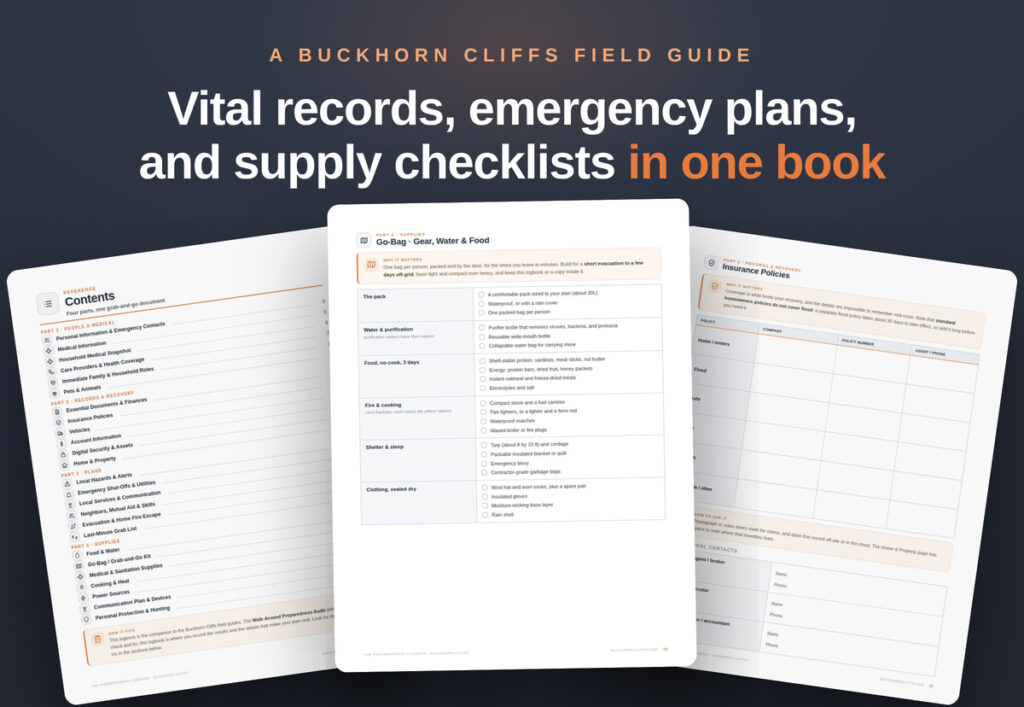
A smarter approach is to put all of it in one place: a single document your family, or a first responder, can pick up and act on even when you are not there to explain it. That is the Preparedness Logbook. Think of it as a self-managed insurance plan, the records, contacts, plans, and supply lists that turn a scramble into a plan you can actually follow.
This logbook covers everything a household would record before an emergency and reach for during one: who you are and who to call, medical facts for every person under your roof, your documents and money, your accounts and digital life, your home and vehicles, your local hazards and how you get warned, how your family reconnects, how you get out, and every supply worth keeping on hand.
A note before we start: this is a fill-in record and plan, not a survival manual. It is where you write down and organize what is yours. The step-by-step methods, how to treat a wound or make water safe, live in the Buckhorn Cliffs field guides. Fill this out now, while you have time and good light, and you will not be hunting for a policy number or a shut-off valve in the middle of the emergency.
Purchase the Preparedness Logbook
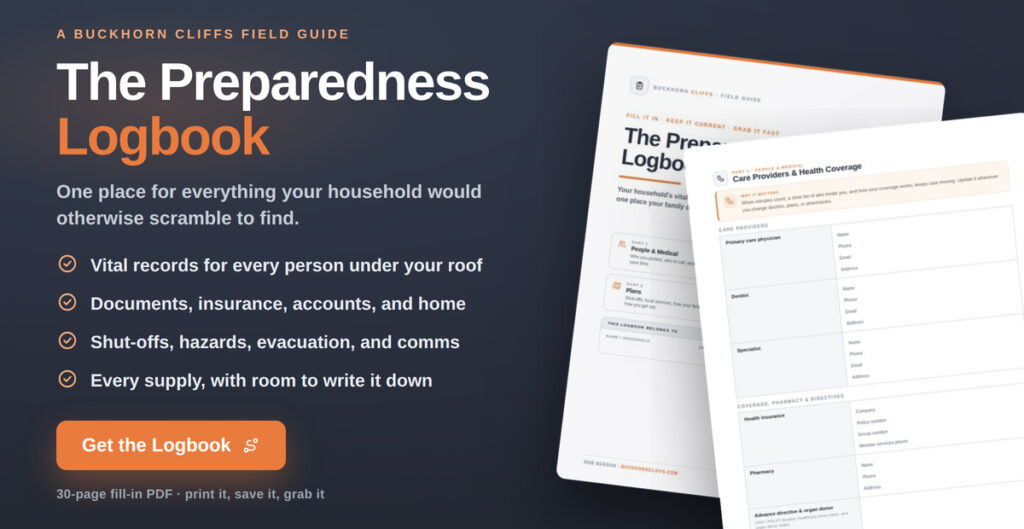
If you want it all in one place: a clean document you can fill in, print, and grab on the way out the door, get the complete Preparedness Logbook as a printable, savable PDF. Download it once, keep it on any device, and print a copy for the binder or the go-bag.
This PDF download is also available to subscribers. Available on Instagram, YouTube, and Facebook for $2.99 per month. Click on whichever platform is your favorite to join.
What’s Included
- Every vital record for your household, organized into four parts you fill in once and keep current
- Medical facts for every person, not just one, plus care providers, coverage, and directives
- Documents, insurance, accounts, vehicles, and a room-by-room home inventory, ready for recovery
- Emergency shut-offs, local services, a family communication plan, a home fire escape, and a last-minute grab list
- A full supply spread: food and water, the go-bag, medical and sanitation, cooking and heat, power, communication, and protection
- Print-friendly and light on ink, built to fill in by hand and keep on a shelf or in a bag
- 30 pages, downloadable and printable, yours to keep and back up on any device
Why One Document Beats a Scattered Plan
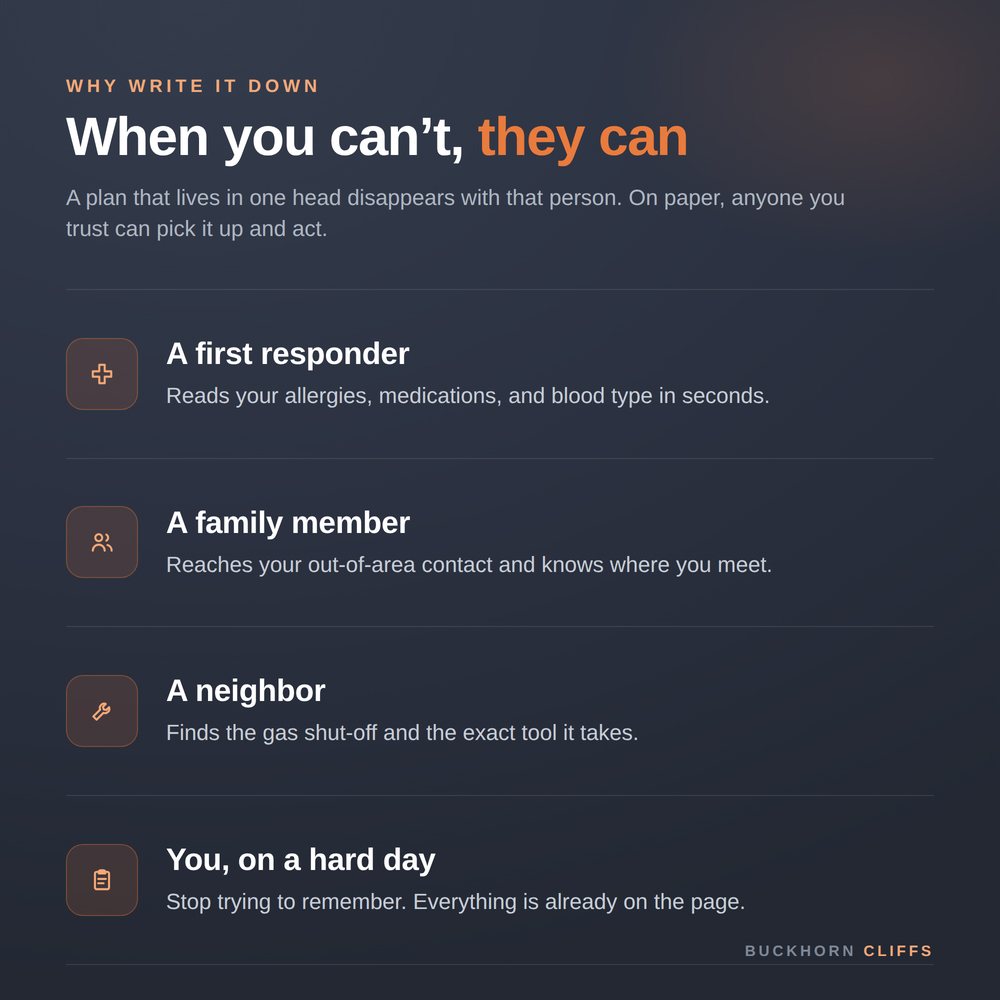
A plan that lives only in one person’s head is not a plan. When that person is hurt, away, or overwhelmed, everything they were holding disappears with them. The appeal of writing it all down is simple: speed, clarity, and the ability to hand it off. A first responder treats you faster with your allergies and medications in hand. A family member reaches your out-of-town contact without hunting for the number. A neighbor shuts off your gas because you wrote down where the valve is and what tool it takes.
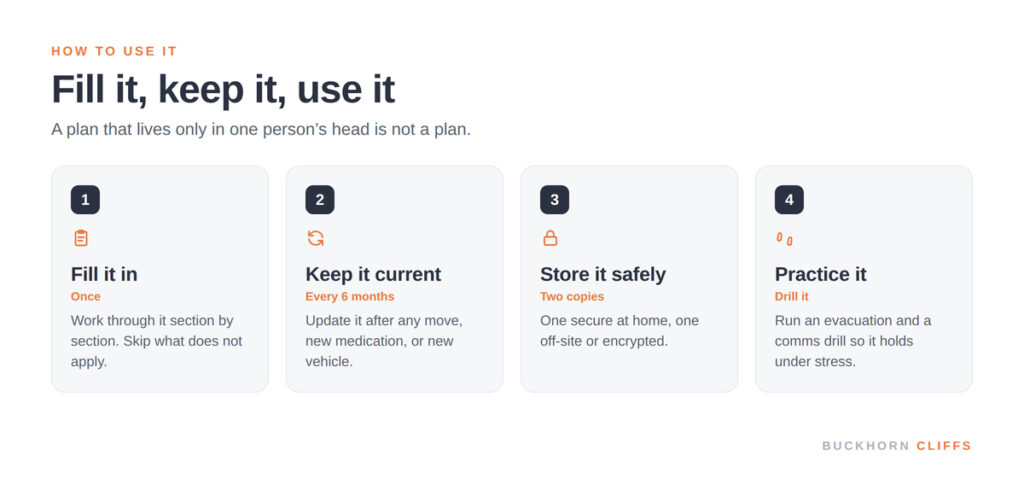
Fill this out once, keep it current, and you have replaced a dozen scattered notes, screenshots, and half-remembered plans with a single record anyone you trust can act on. The trade-off is a little time up front, filling it in and reviewing it each season, which is exactly what the sections below walk through.
How to Use the Logbook
Fill it in once, section by section, and skip what does not apply. Review it every six months and after any big change: a move, a new medication, a new baby, a new vehicle. Store one copy somewhere secure but reachable at home, a second copy off-site or encrypted, and tell one trusted person where to find it. Then practice it, because a plan you have never run is a guess. Walk an evacuation and a communication drill so the plan holds up under stress.
One rule on security: this holds sensitive personal and financial details, so treat it that way. Write full passwords or PINs only if the logbook itself lives in a locked safe. Otherwise leave those blank and keep the record where a stranger cannot use it against you.
What’s Inside, Part by Part
The logbook is organized into four parts, the same order you would work through your own preparedness.
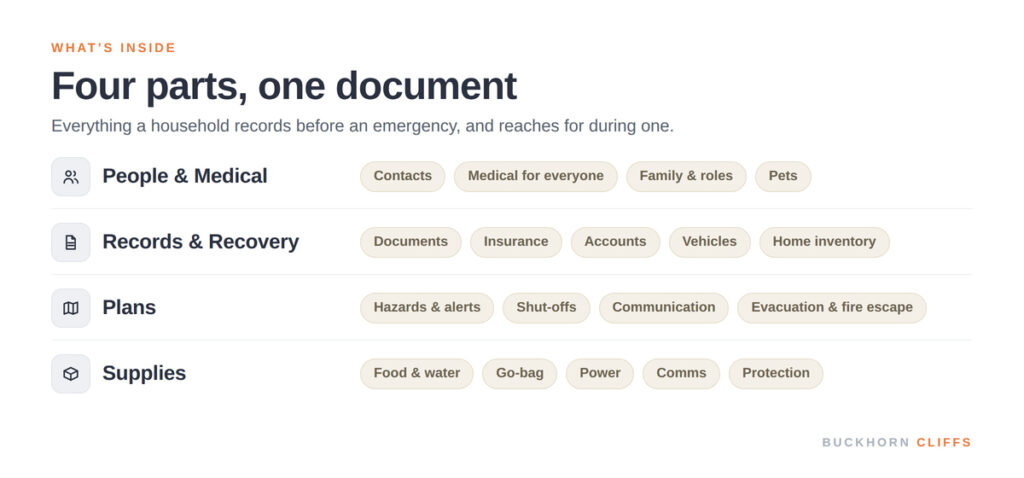
Part 1: People and Medical
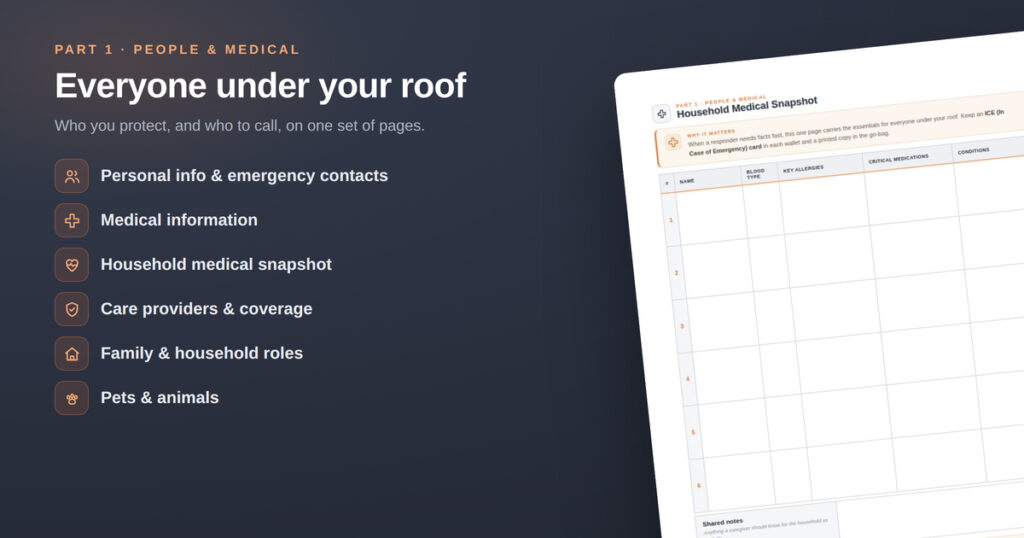
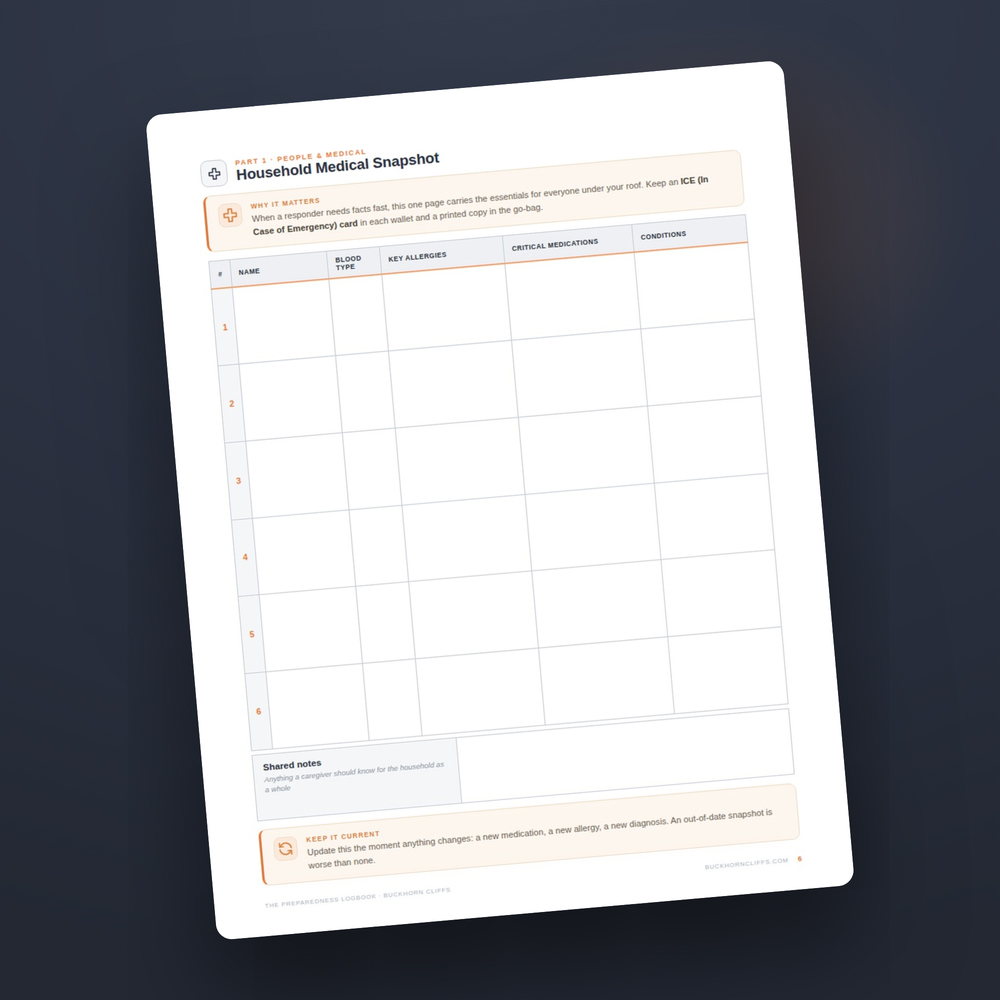
Who you protect and who to call. Your personal information and emergency contacts, a full medical page for the primary keeper, and a household medical snapshot that carries blood type, allergies, critical medications, and conditions for everyone under your roof. Care providers, health coverage, and advance directives. Your immediate family and who holds each household role, with a backup. And a page for pets and animals: vet, microchip and rabies records, and a feeding plan so anyone can step in.
Part 2: Records and Recovery
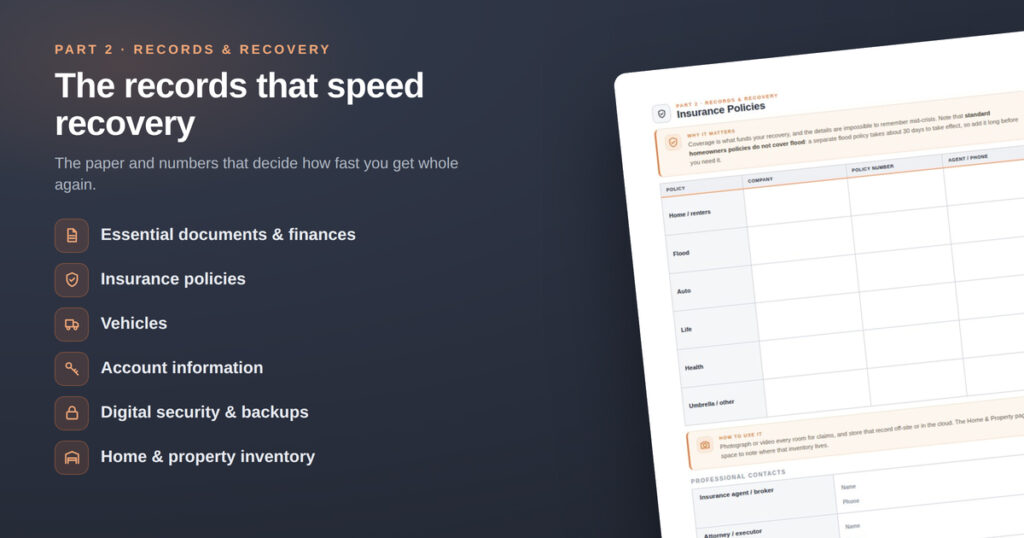
The paper and numbers that decide how fast you recover. Where your essential documents live and whether each is an original or a copy. Your insurance policies, home, flood, auto, life, and health, with the reminder that standard homeowners policies do not cover flood. Your vehicles, accounts, digital security and backups, and a room-by-room home inventory for claims.
Part 3: Plans
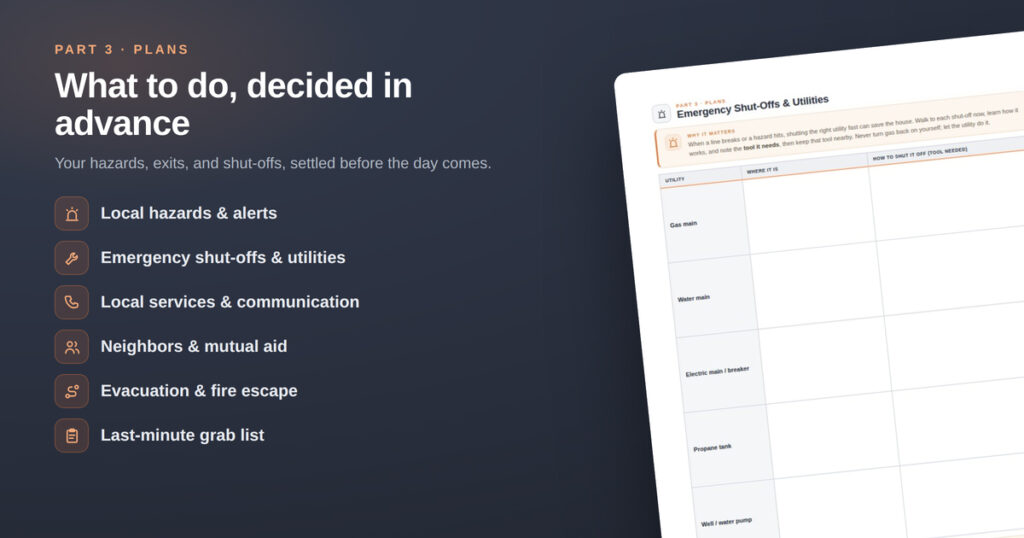
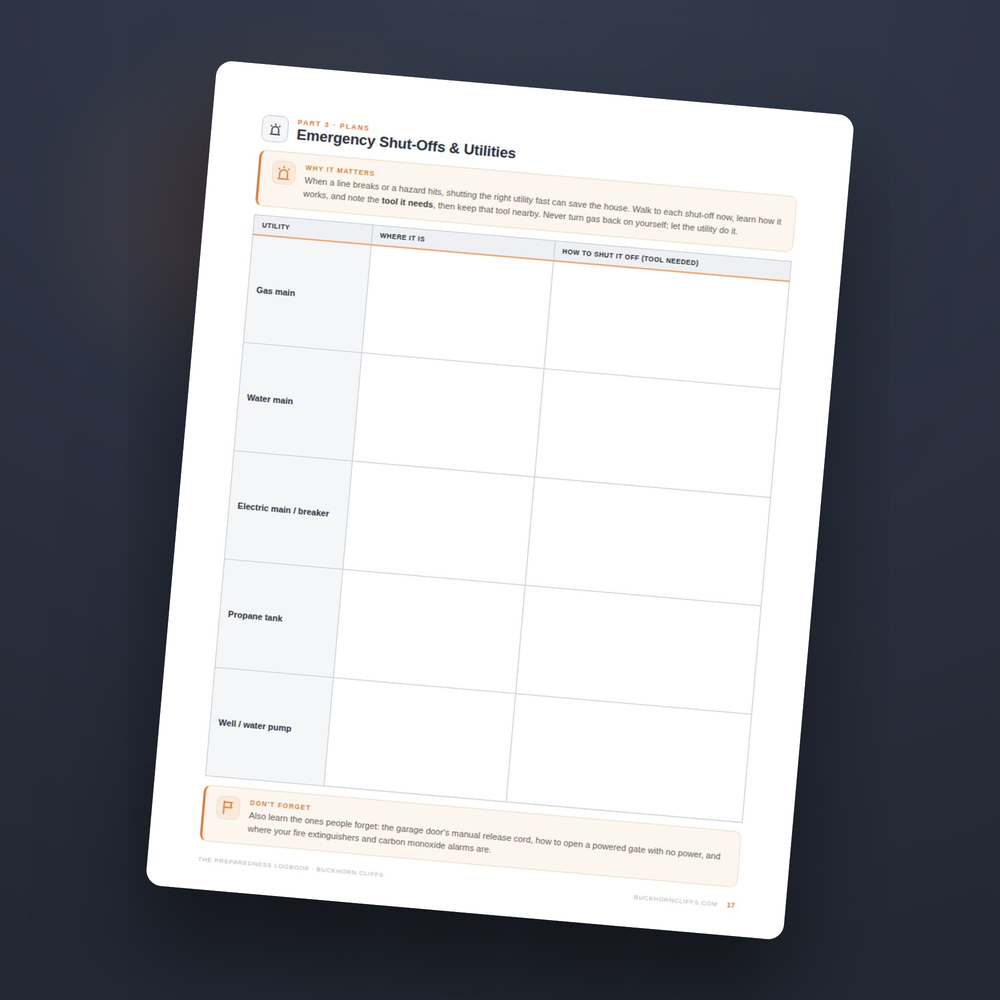
What to do, decided in advance. Your local hazards and exactly how official warnings reach you. Where every utility shut-off is and what tool it takes. Local emergency services and a family communication plan. Your neighbors and their skills. An evacuation plan with two ways out, a home fire escape, and a last-minute grab list for the irreplaceables you cannot pre-pack.
Part 4: Supplies
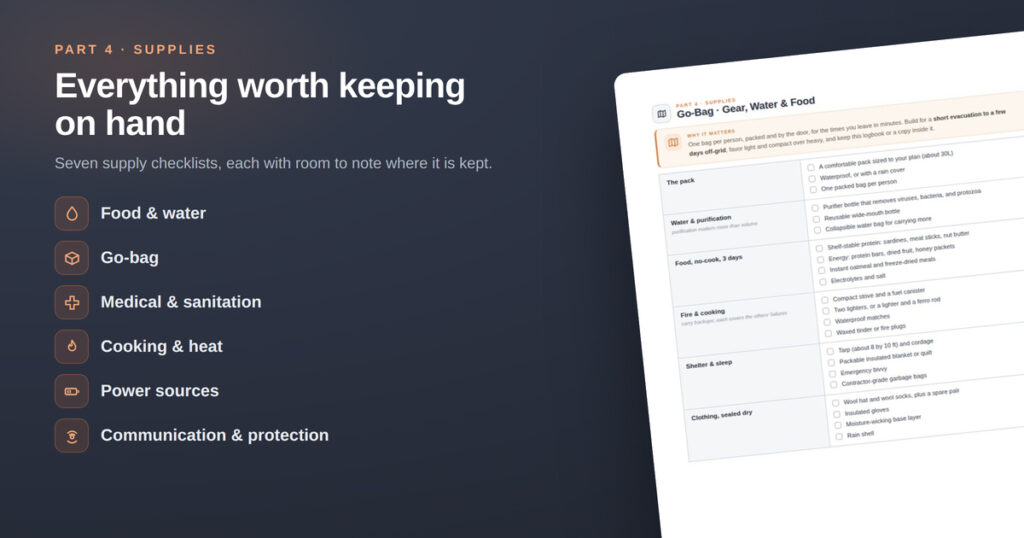
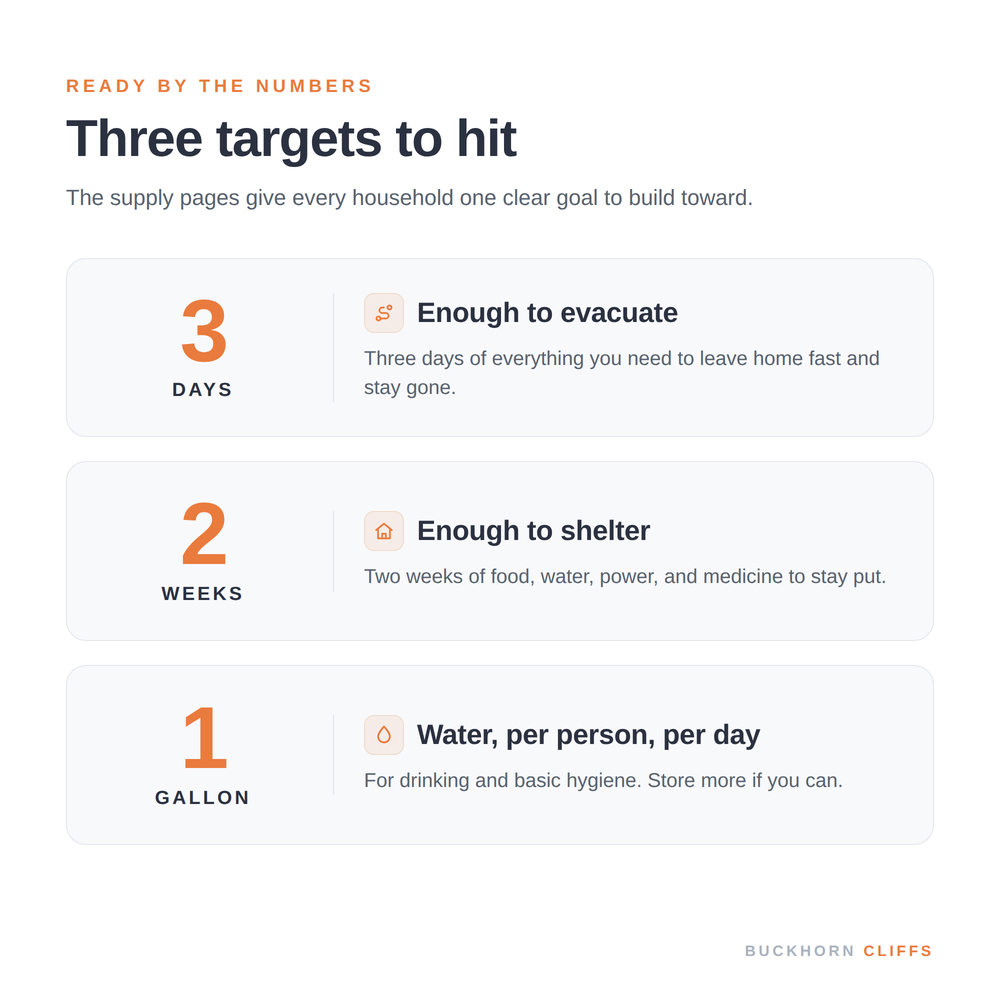
What to keep on hand, with a clear target: three days of everything to evacuate, two weeks to shelter in place, and one gallon of water per person per day. Checklists for food and water, a two-page go-bag, medical and sanitation, cooking and heat, power, a layered communication plan, and personal protection, each with room to note where it is kept.
The One Rule to Remember
The information that saves you is worthless if it lives only in your head or scattered across a dozen places. Write it down, keep it current, store it where your family can reach it, and practice the plan. One document, filled in and kept up to date, turns the worst day into something you and the people you love can actually work through.
About the Logbook
This article is drawn from the Buckhorn Cliffs Preparedness Logbook, a 30-page downloadable and printable PDF that gives your whole household one place to record its vital information, plans, and supplies. It is built to fill in by hand, print light on any home printer, and grab on the way out the door. Save it to any device, back it up, or print a copy for the binder and the go-bag.
Pair it with the Walk-Around Preparedness Audit, which tells you what to check and fix, and the Buckhorn Cliffs field guides on survival foods, chemical compounds, off-grid power, and off-grid communication for the step-by-step detail behind every section.
Pin it
Tiffany
Friday 14th of February 2025
Thank you so much for that document after being evacuated for a forest fire the day after moving back home to my place I realized quickly that I needed a better plan. Life is very overwhelming being a widowed single parent to a special needs child now living in the country and studying for board exams and working 3 jobs. That took a lot of stress away from me. Last night in -30°C we lost power for 4 hours. I don’t have a wood stove and was wondering if you had previously done a piece on emergency heat sources that I missed and might add. Thankfully I have a candle addiction and it didn’t get too bad and it was only a few hours.
Rob Benson
Monday 24th of February 2025
Welcome! Hope everything is going well for you. I like this as a fast emergency heat source: https://buckhorncliffs.com/cordless-forced-air-propane-heater/
Just make sure to have a carbon monoxide detector in the room.
Lori
Thursday 10th of October 2024
Thank you for sharing this. I live in a rural forest area that has had wild fires, mud slides, frequent electric company power outages , and other problems. We always shelter in and help those who evacuate or can't get back in. All your recs are very good. Our community has a repeater on solar and most residents have gmrs radios (weekly community radio checks), we have an active fire safe council , canyon watch, volunteer fire, and intercanyon league that helps our community. You can never be overprepared. Starlink has been wonderful. at one time we had another satellite system and we were the only ones with phone service, even for emergencies. Get water filters, run generators periodically to ensure working, solar flashlights & cell battery packs, never let car gas tanks go below 1/2 tank so you have fuel for equipment. Don't expect help and do expect government wanting you to leave and not get in their way. Plan now, and hopefully you don't need to use your supplies, but you will be glad if you do.
Rob Benson
Sunday 13th of October 2024
This is great information, thanks for taking the time to share!
Tonja
Friday 19th of July 2024
Thank you so much!
Rob Benson
Friday 19th of July 2024
You're welcome!
Martin Cazares
Friday 19th of July 2024
Mr. Rob Benson thank you so much for all that you offer in preparedness, you are truly a God sent. Keep up the amazing work you do and God bless you Sir.
Rob Benson
Friday 19th of July 2024
That's so nice, thank you! And you're welcome, glad to do it.
Katie Fricke
Saturday 11th of May 2024
Please send me your pdf Emergency Care Docs