
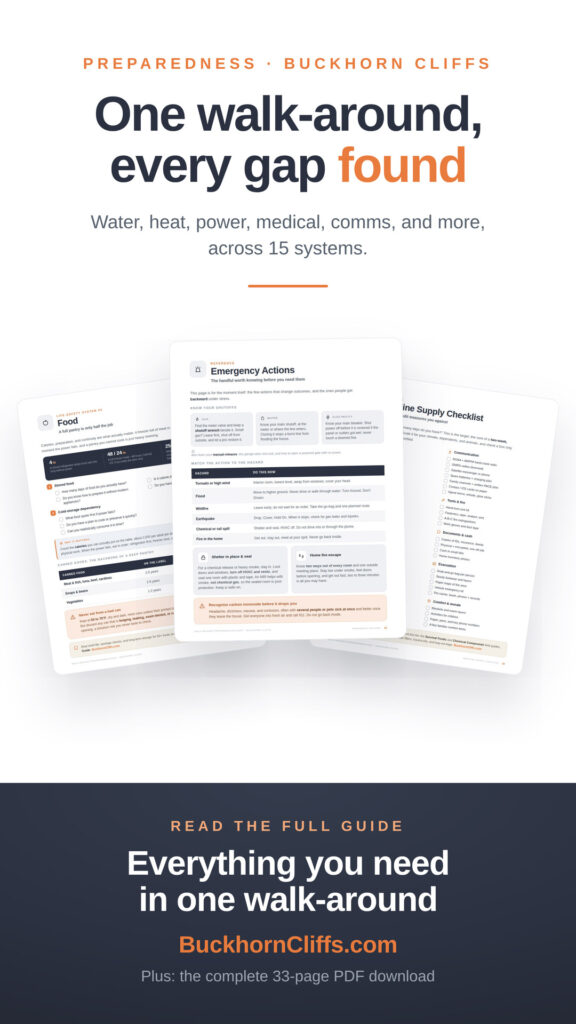
You can fill a garage with supplies and still get caught out on a bad day. Usually the gear is fine. What gets people is the weak link nobody checked, like a generator that has never run under load, or a plan only one person in the house really knows. This audit is how you find that weak link while it is still cheap and easy to fix.
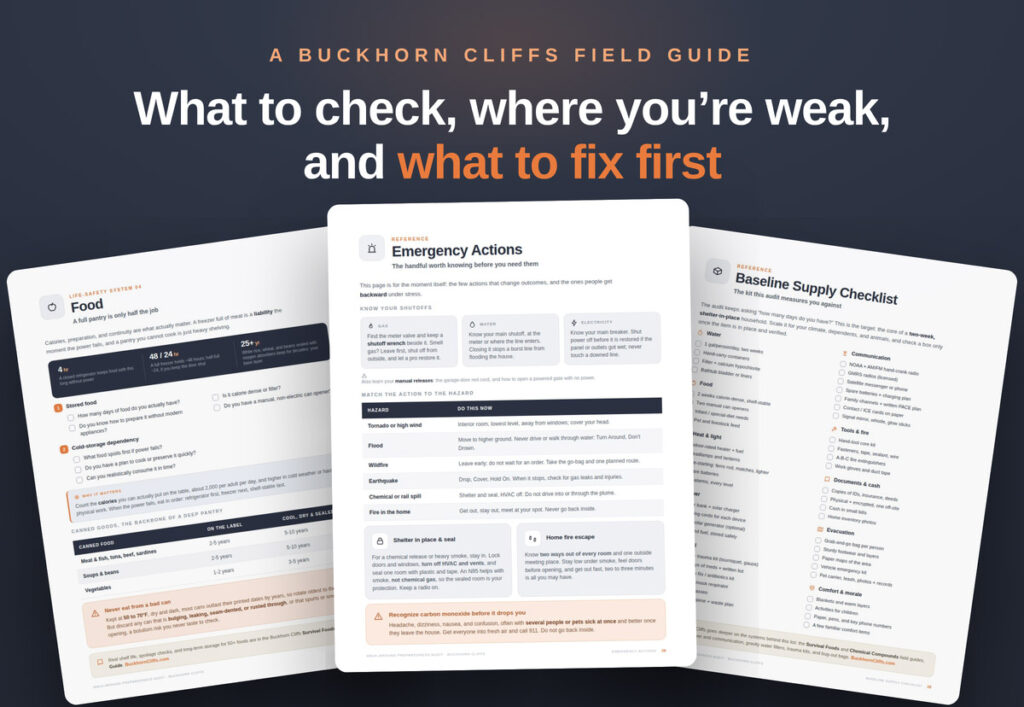
A checklist tells you what to buy. It cannot tell you whether any of it works. The Walk-Around Preparedness Audit gets you up and moving through your home and land, one system at a time, checking what is true today instead of what you meant to get to. You score each system, mark where it is weakest, and finish with a short list of fixes in priority order. This post covers what it checks and how to use it.
Purchase the 33-Page Walk-Around Preparedness Audit
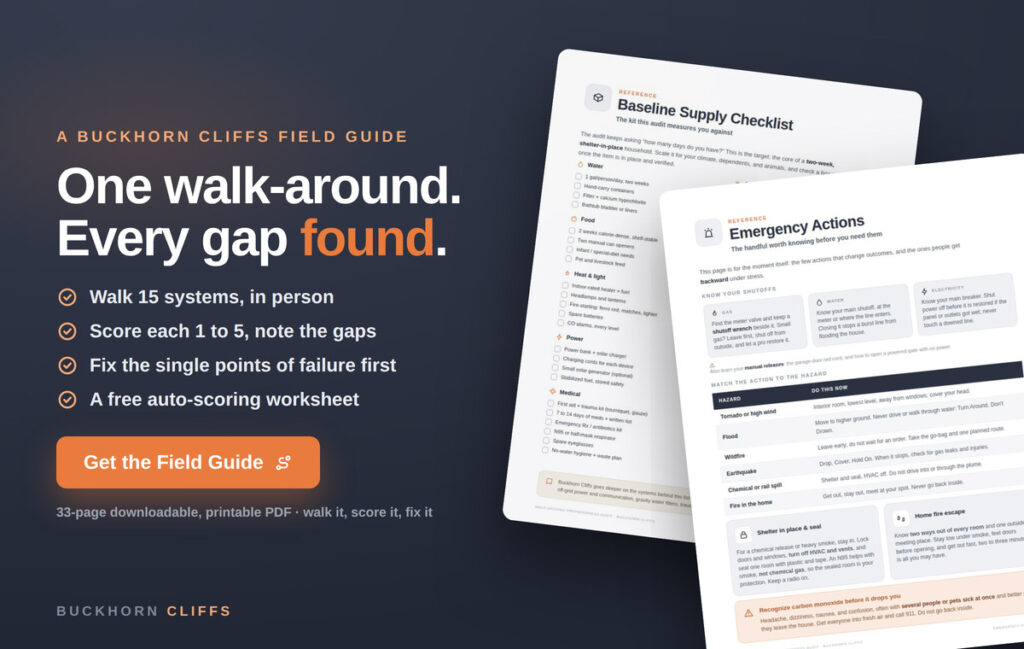
Everything on this page is free to use. If you want it all in one place, get the complete Walk-Around Preparedness Audit as a printable PDF you can carry while you walk your property. It has all 15 systems and the free scoring worksheet, ready to print and go.
This PDF download is also available to subscribers. Available on Instagram, YouTube, and Facebook for $2.99 per month. Click on whichever platform is your favorite to join.
What’s Included
- All 15 systems, from water and heat to comms and documents
- Target numbers and warning signs for each one, with the quickest fixes
- 200+ checkpoints you score 1 to 5, so the weak spots stand out
- Benchmarks checked against FEMA, CDC, USDA, the U.S. Fire Administration, and NOAA
- An Emergency Actions page and a medical-recognition page for the moment itself
- A baseline two-week supply checklist to measure your kit against
- A maintenance schedule so your setup does not go stale
- A free auto-scoring worksheet that ranks your fixes, in Google Sheets or Excel
- 33 pages, built to print and carry
Why a Walk-Around Beats a Checklist
A checklist tells you what to own. Whether it works is a different question, and it is the one that matters when the power is out. Most of the trouble hides in the space between owning a generator and knowing it will run the fridge for eight hours on the fuel you keep on hand.
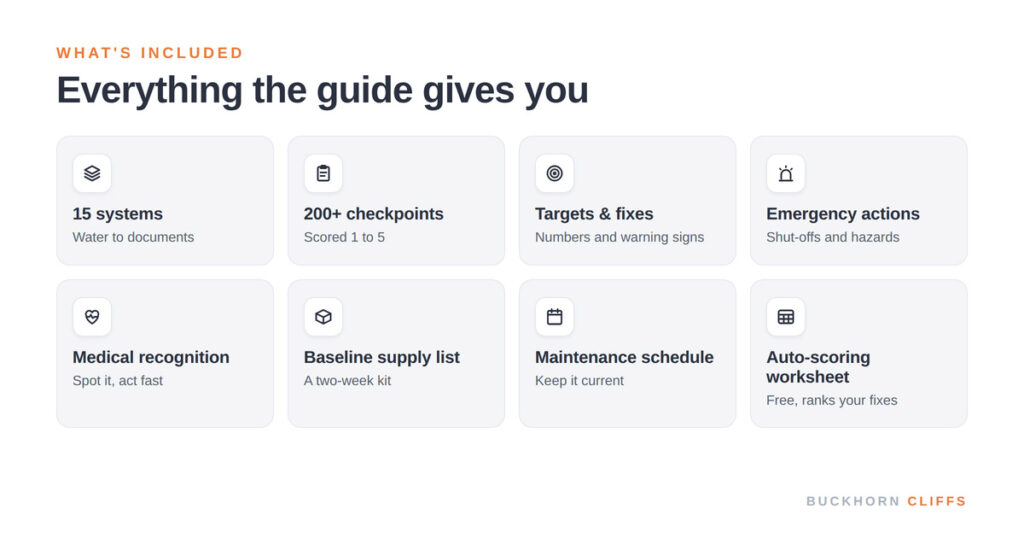
Walking the audit puts that question to every system. When you go and look, the weak spots turn up on their own: the well pump with no hand backup, or the heat that quits the moment the furnace fan loses power. A list on paper lets you nod past those. Standing in front of them does not.
How to Walk the Audit
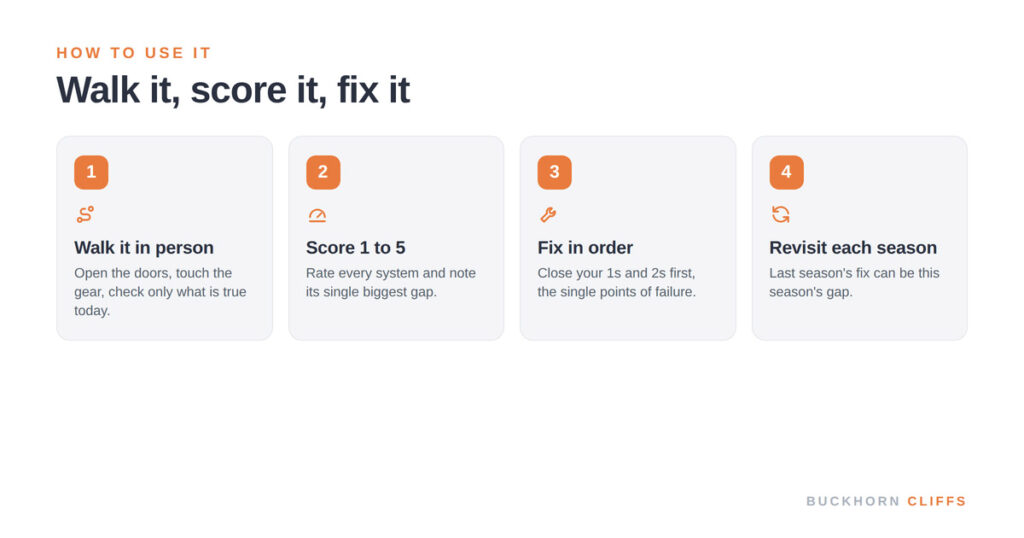
Walk it in person
Do it on your feet. Move through the house and out onto the property with the guide in hand. Open what you would have to open in a real event, and be honest about what you find.
Score every system 1 to 5
Give each system a score, a 1 for a gap up to a 5 for solid, and write down its biggest weakness. The score is not a grade. It points you at what to fix.
Fix in the right order
Take your scores to the prioritization page and start with the 1s and 2s. Those are the single points of failure that can pull several other systems down with them. Close them before you spend a dollar anywhere else.
Revisit each season
Readiness slips over time. Walk the audit again every season, because the fix you made last spring can be a gap by fall.
The 15 Systems You’ll Inspect
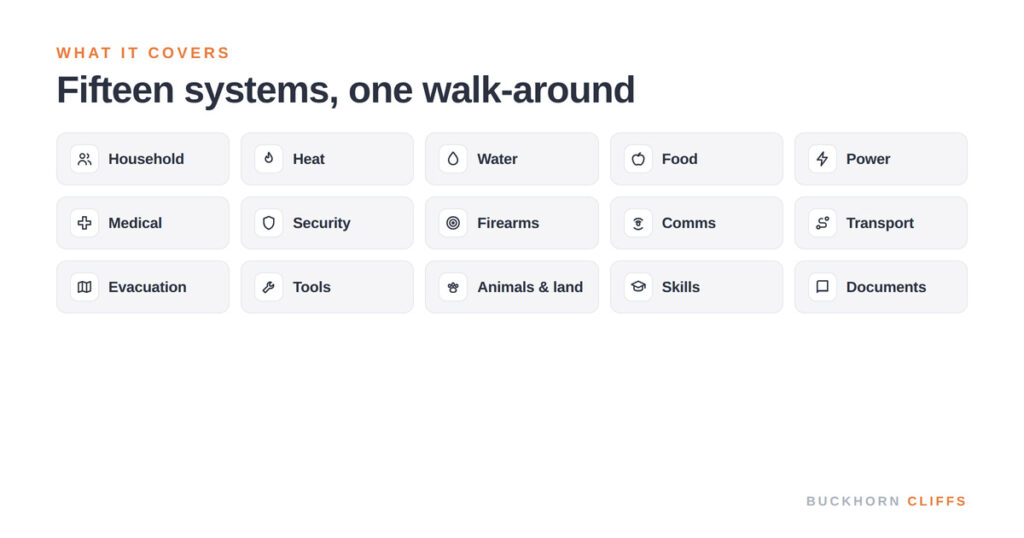
The audit runs in six groups, in the order you would work through your own place.
Foundation
- Household & Plan: who you are responsible for, and who does what
Life-safety systems
- Heat & Temperature Control: staying warm in a freeze and cool in a heat wave
- Water: how you store it and make it safe without power
- Food: what lasts, how you cook it off-grid, and real canned-goods shelf life
- Power & Energy: your critical loads, your backup, and the fuel behind it
- Medical & Hygiene: first aid, trauma, medications, and sanitation
Security & response
- Security & Awareness: hardening the house and seeing trouble early
- Firearms as a Defensive Tool: ownership, safety, and the law
- Communication: NOAA radio, GMRS, satellite, and a family PACE plan
Mobility & evacuation
- Transportation and Mobility: the vehicle, your routes, and moving on foot
- Evacuation & Go-Bag: when to go, the bag, and the family plan
Self-reliance
- Tools and Repair: fixing what breaks without a store
- Animals and Land: feed, water, shelter, and land risks
- Skills and Knowledge: the hands-on skills you can do under pressure
Records & recovery
- Documents & Cash: your papers, some cash, and a home inventory
The Numbers You’re Checking Against
Every system comes with a real target to hit. A few of them:
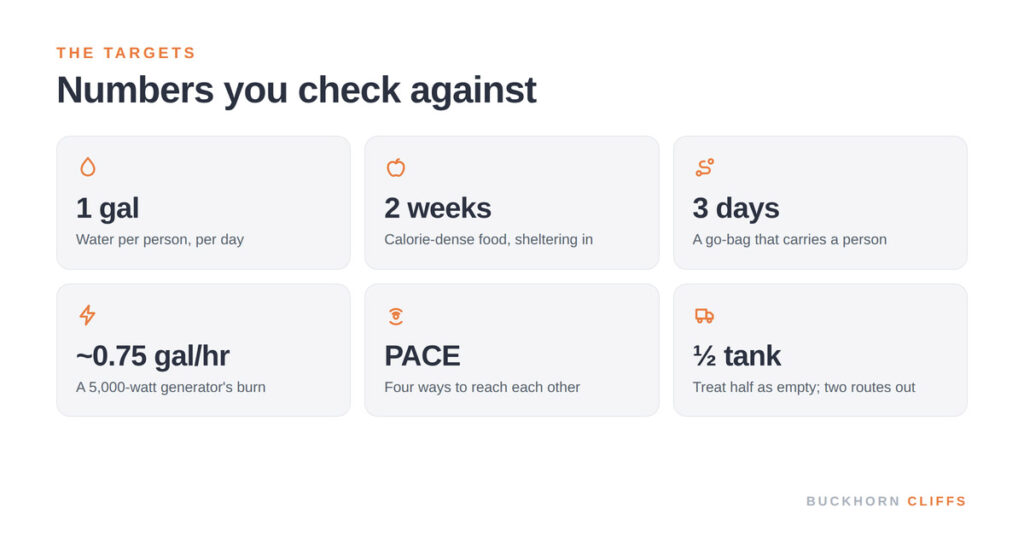
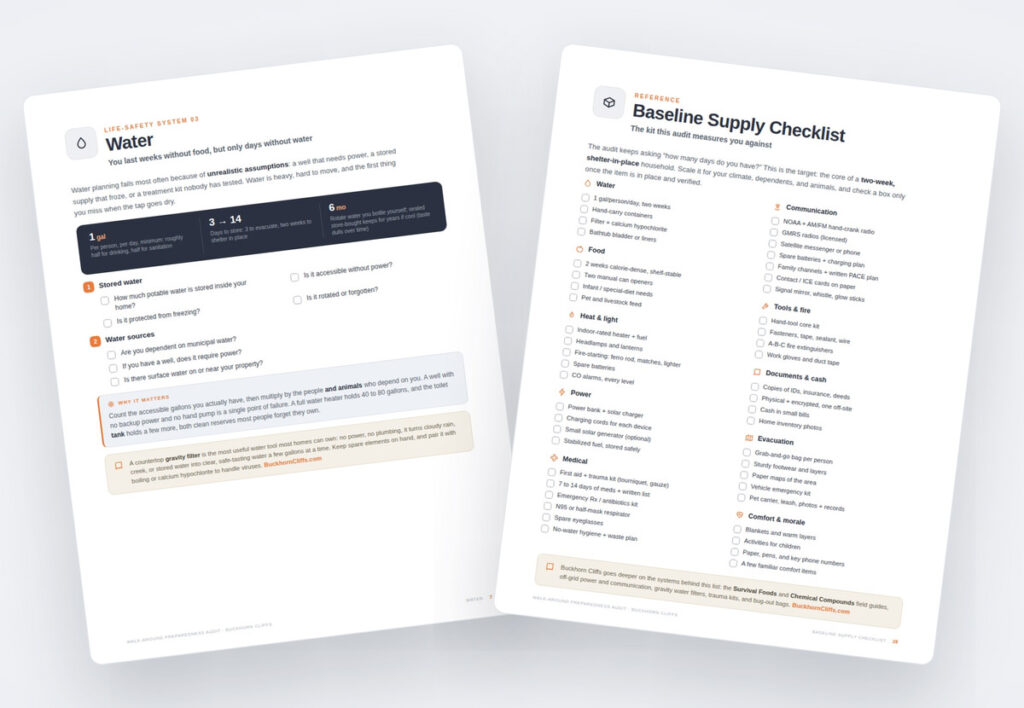
- Water: 1 gallon per person per day, two weeks to shelter in place, three days to evacuate
- Food: two weeks of calorie-dense, shelf-stable food, around 2,000 calories per adult per day
- Canned goods: stored cool, dry, and sealed, most cans outlast their printed dates by years
- Power: a 5,000-watt generator burns about 0.75 gallons an hour, near 18 gallons in a day
- Communication: a PACE plan, four ways to reach each other, from primary to emergency
- Vehicles: treat half a tank as empty, and know two routes out you have driven
- Heat: seal and heat one small room instead of the whole house, and never run combustion indoors
When It Happens: Emergency Actions and Recognizing the Emergency
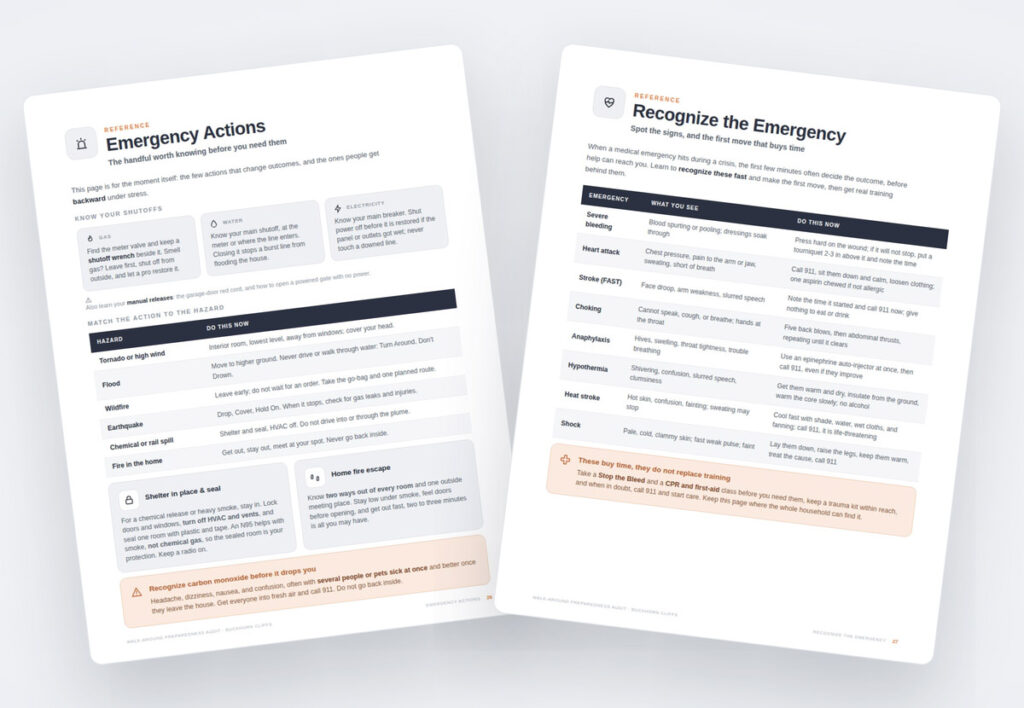
Two pages are built for the moment itself. Emergency Actions covers the things people fumble under pressure, like finding the gas shut-off in the dark or deciding whether to shelter or run from a chemical release. Recognize the Emergency is a fast medical page. It lays out the warning signs for a stroke, severe bleeding, heat stroke, and the rest, with the first move to make before help arrives. Keep it somewhere the whole house can grab it.
The Baseline Supply Checklist
The audit keeps asking how many days you have. This checklist is the answer to measure against, the core of a two-week household that can shelter in place. It runs from water and food to power, medical, comms, and documents. Scale it to your climate and everyone who depends on you, animals included, and only check a box once the item is in place and you know it works.
Keeping It Current
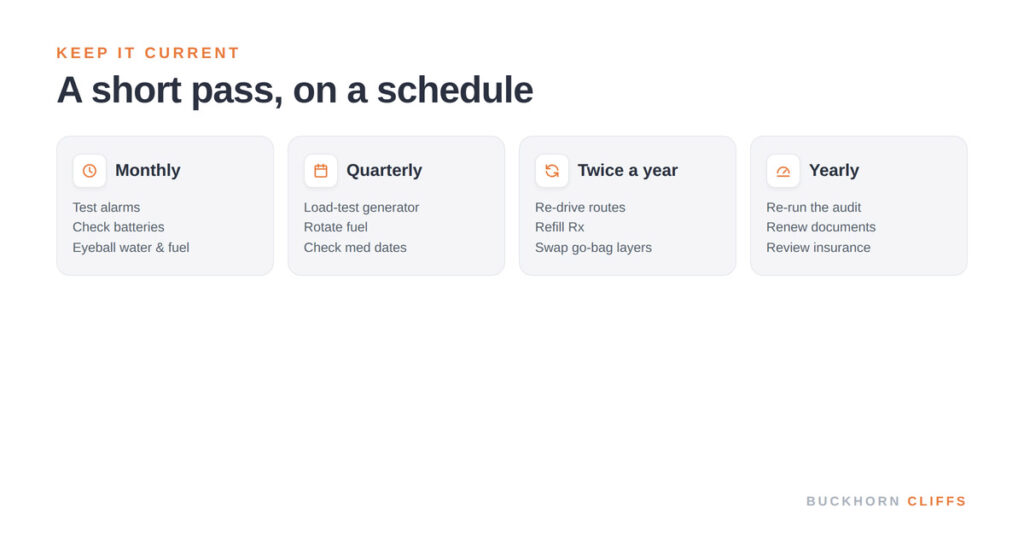
Readiness is not something you finish once. Gear ages and dates pass, and the plan you wrote last year stops matching your life. The maintenance schedule gives you a short pass to run on a rhythm, monthly, quarterly, twice a year, and yearly, plus a nudge to review after any big change like a move, a new baby, or a new vehicle. Put the dates on your calendar so the checks happen instead of getting skipped.
The Free Auto-Scoring Worksheet
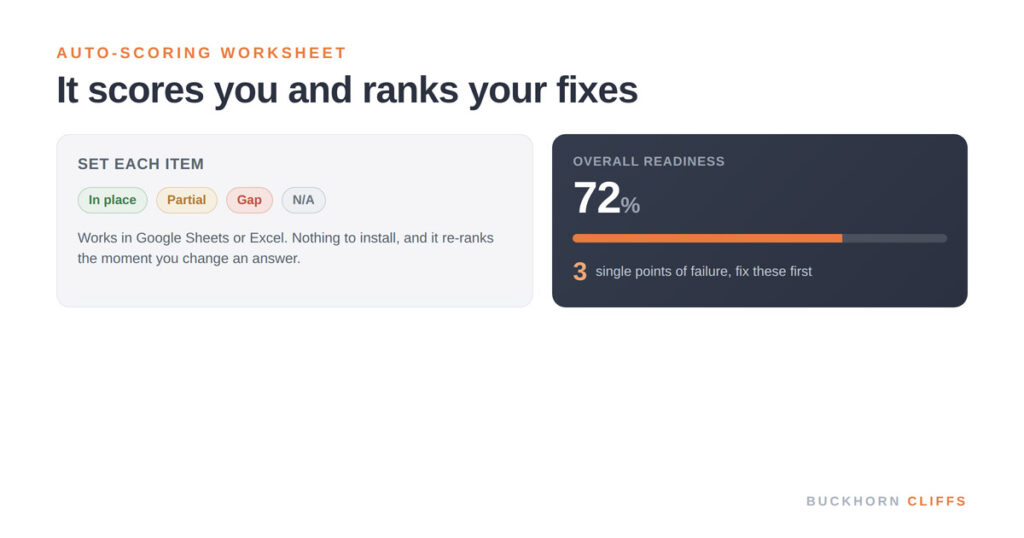
Every checkpoint in the guide also lives in a free spreadsheet you can open on a phone or laptop. Set each item to In place, Partial, Gap, or N/A, and the sheet scores every system for you. It flags your single points of failure and re-ranks your fixes as you change answers. Nothing to install, and it works in Google Sheets or Excel.
The One Rule to Remember
Do not guess at your readiness. Walk it in person and be honest about what you find. Every gap you catch now is one less thing to discover during the emergency itself. Walk your ground and fix the worst problems first. Then do it again next season.

About the Walk-Around Preparedness Audit
This article comes from the Buckhorn Cliffs Walk-Around Preparedness Audit, a 33-page printable PDF that turns a plain checklist into a working inspection of your home and land. It covers 15 systems and 200+ checkpoints, checked against FEMA, CDC, USDA, the U.S. Fire Administration, and NOAA, and it ships with a free auto-scoring worksheet. Pair it with the Buckhorn Cliffs guides on survival foods, chemical compounds, off-grid power, and off-grid communication for the deeper how-to behind each system.
Pin it
Janet
Saturday 7th of February 2026
Thank You so much for all the time you put into producing this for us. I have learnt so much following you. I appreciate your ideas.
Rob Benson
Sunday 8th of February 2026
Thank you!
Debbie
Thursday 8th of January 2026
Thank for this list. I appreciate the tips you have been sharing on your YT channel.
Rob Benson
Friday 9th of January 2026
You're welcome, and thank you!