If you’ve been watching the news lately and feeling like things are a little unstable, you’re not alone. Whether it’s economic uncertainty, grid vulnerabilities, supply chain issues, or just the general feeling that the safety nets we rely on aren’t as solid as we thought, more people are asking the same question: where do I even start?
This is about taking practical steps right now so that if something does go sideways, you’re not scrambling with everyone else. Here’s what I’d do today if I were starting from scratch.
Get Cash on Hand
Get some of your cash out of the bank. I’m not saying drain your accounts. But having at least one to two weeks worth of physical cash for local expenses is just smart.
Here’s why this matters more than most people think:
- Bank runs aren’t ancient history. We saw them with Silicon Valley Bank in 2023. When confidence drops, people rush to withdraw and banks lock up fast.
- Cyber attacks on financial infrastructure are a growing and very real threat. If banking systems go offline for even a few days, every digital transaction stops.
- Prolonged power outages take down ATMs, card readers, and online banking. Your debit card needs infrastructure to work. Cash doesn’t need WiFi.
- In a localized emergency, cash is king. Gas stations, small shops, and private sellers will take cash when nothing else works.
Think about what you’d actually spend locally in a normal two-week stretch. Groceries, gas, maybe a hardware store run. Pull that amount out and keep it somewhere secure at home. Mix of small bills is ideal. A $100 bill doesn’t help when someone can’t make change.
Water Filtration
Water is the single most important resource you need to secure. You can survive weeks without food but only days without clean water. And here’s the thing most people don’t consider: even if you have municipal water, that system depends on electricity to run pumps and treatment facilities. When the grid goes down, water pressure drops and eventually stops entirely.
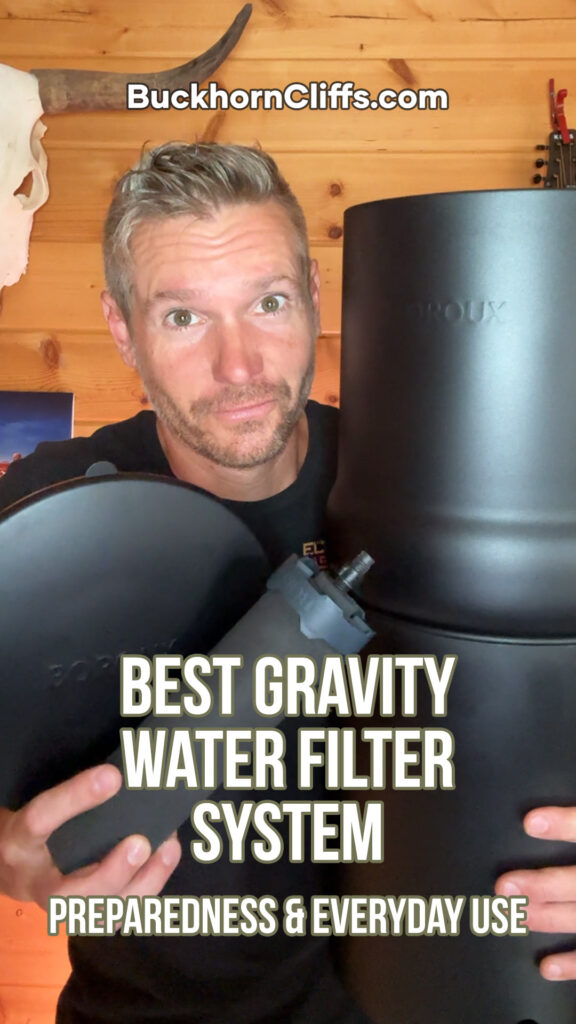
A gravity water filter is one of the best investments you can make for your household. Here’s why:
- No power required. No plumbing needed. Completely off-grid capable.
- Removes bacteria, parasites, heavy metals, and other contaminants from virtually any freshwater source.
- Can filter lake water, river water, rainwater, or even questionable tap water during a boil advisory.
- One set of filters can process thousands of gallons before needing replacement.
- Dead simple to use. Pour water in the top, clean drinking water comes out the bottom.

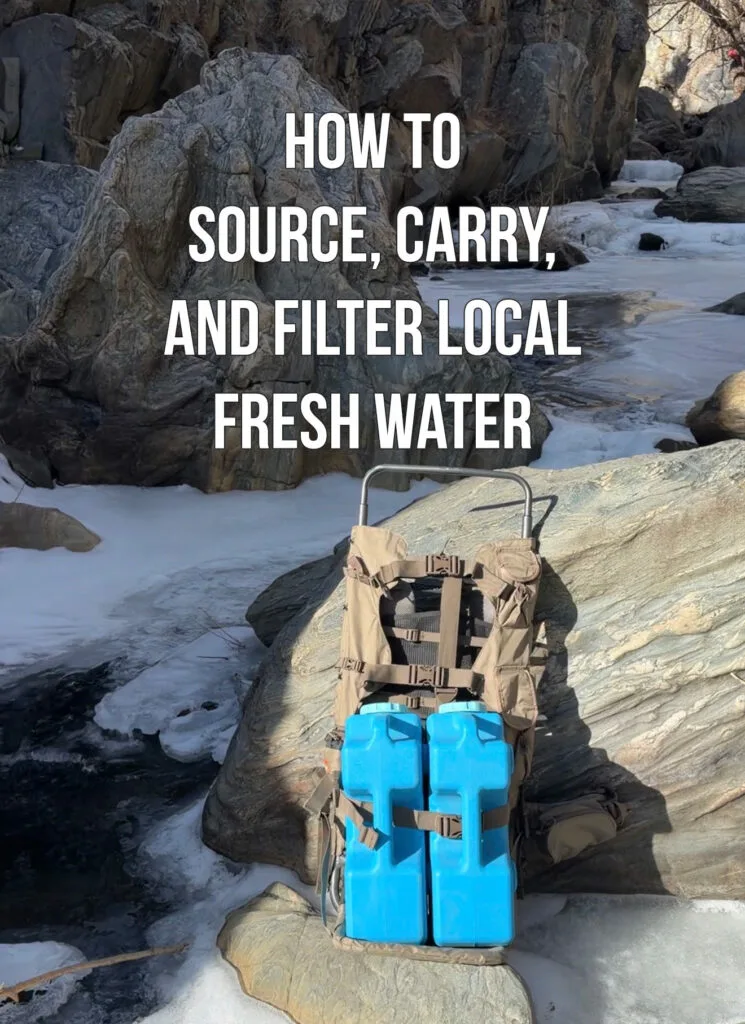
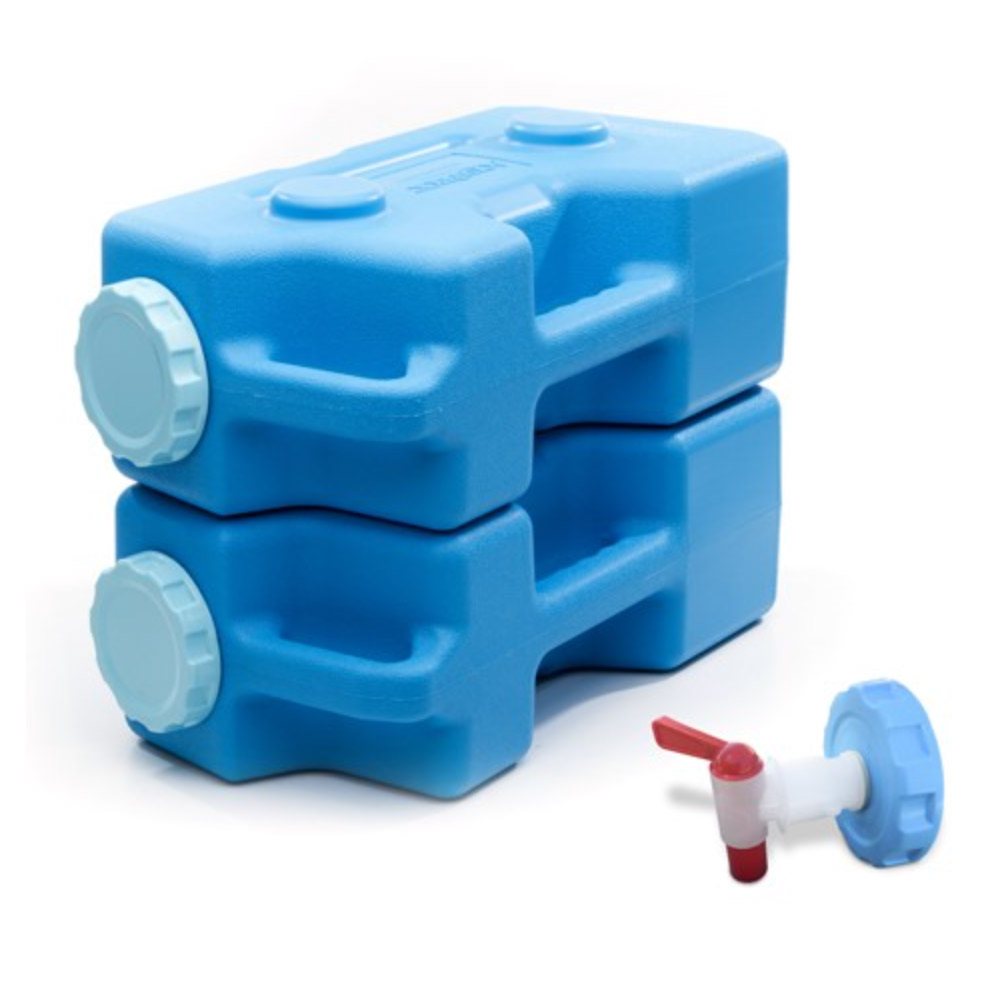
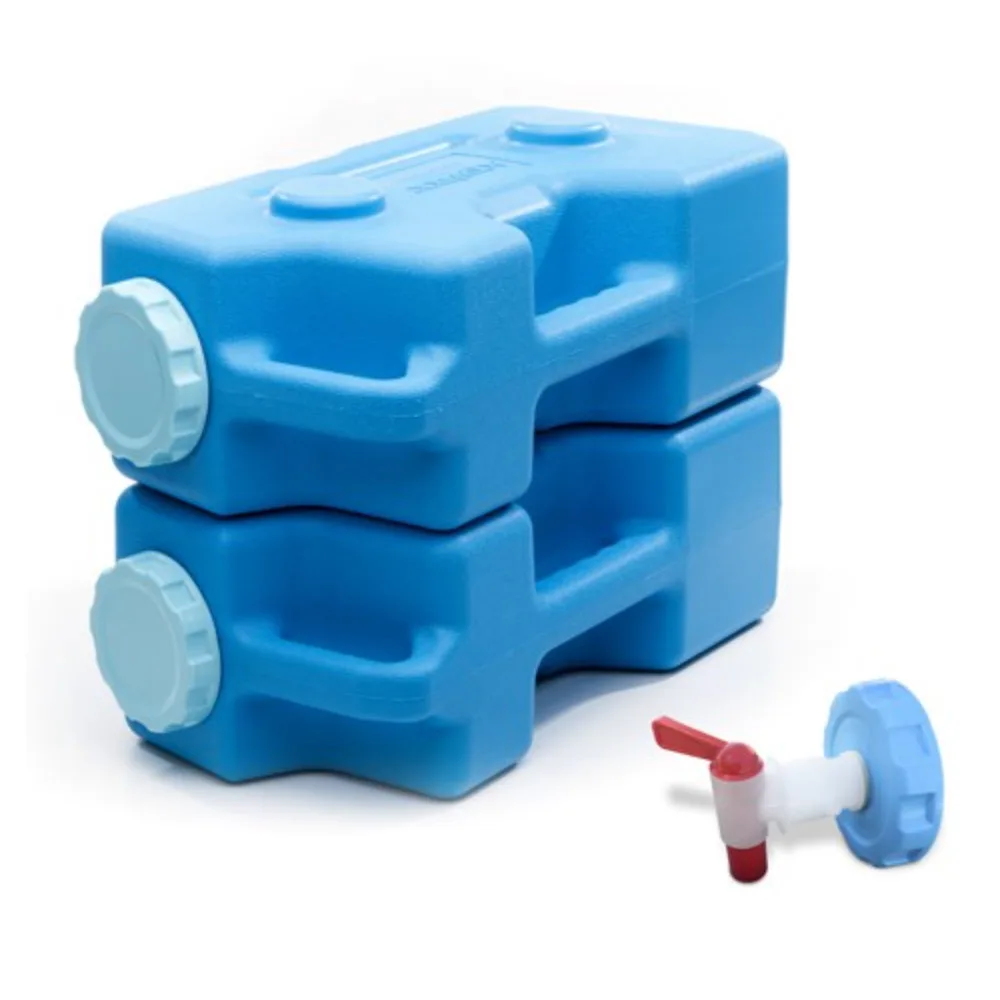
Beyond the filter itself, think about where your water is actually coming from if the tap stops. Do you have a creek, pond, lake, or river nearby? Do you have rain barrels or a way to collect rainwater? The filter solves the purification problem, but you still need a source to filter from. Start thinking about that now, not when you’re thirsty.
Stock Up on Staple Foods
Head to Costco or Sam’s Club and load up on four things:
- Rice. Cheap, calorie dense, stores for years in a cool dry place. White rice actually outlasts brown rice in storage because the oils in brown rice can go rancid. A 25-pound bag costs next to nothing and provides hundreds of servings.
- Beans. Dried beans store almost indefinitely and when combined with rice they form a complete protein. Black beans, pinto beans, kidney beans, whatever you prefer. Buy them dry in bulk, not canned, for long-term storage.
- Sardines. Most people overlook these and that’s a mistake. Sardines are loaded with omega-3 fatty acids, protein, calcium, and healthy fats. They’re one of the most nutrient-dense shelf-stable foods you can buy. They require zero cooking and the cans last for years.
- Canned Beef. Calorie dense, protein heavy, and ready to eat straight from the can if needed. In a grid-down situation where you’re burning more calories than usual through physical labor and stress, you need foods that pack a punch per serving.
Don’t overthink this part. You don’t need a perfectly curated food storage system on day one. You need calories, protein, and nutrition that won’t spoil anytime soon. These four items check every box and a solid initial supply run might cost you $75 to $100. That’s cheap insurance.

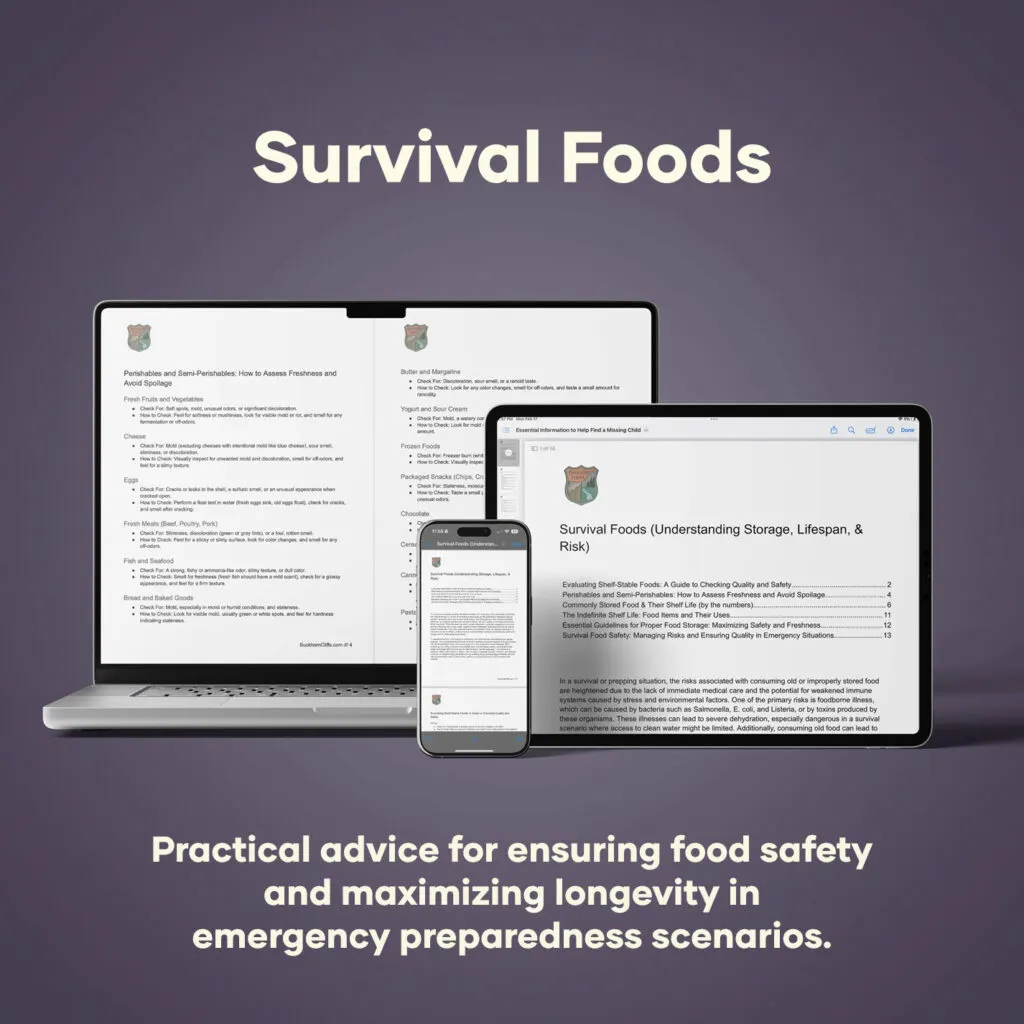
One more note: rotate what you buy. Use the oldest stuff first and replace it. This keeps your supply fresh and makes it part of your normal routine instead of something sitting forgotten in a closet.
Figure Out How You’ll Cook Without Power
Here’s a question most people skip right over. If the power goes out tomorrow and stays out for a week, how are you cooking your food? All that rice and canned beef doesn’t do you much good if you can’t heat it up.
Go pick up a simple camp stove and some small propane tanks at Walmart. Here’s what to look for:
- A basic single-burner or double-burner camp stove. Nothing fancy. You need something that lights reliably, boils water, and heats food.
- Small 1-pound propane canisters. Grab at least 6 to 8 of them. Each one gives you roughly 1 to 2 hours of cook time depending on flame setting.
- A lighter or waterproof matches stored with the stove. Don’t assume you’ll find one when you need it.
The whole setup is a $30 to $50 investment that solves a massive problem. Keep it stored with your propane canisters and a basic pot and pan. You don’t need a fancy outdoor kitchen. You need a reliable way to boil water and heat food when the stove in your kitchen is just a countertop decoration.
If you want to go a step further, consider a small charcoal grill or even a rocket stove that burns sticks and small wood. Multiple cooking options means you’re not dependent on any single fuel source running out.
Personal and Home Defense
When systems break down, when supply chains stop, when law enforcement is stretched thin across a widespread event, your safety becomes your responsibility.
If you already own a firearm: Drive over to your local gun shop or farm and ranch store and increase your ammo supply. Ammunition is one of the first things to disappear during a crisis. We saw that play out in 2020 in real time. Shelves went bare and stayed bare for months. Prices tripled. If you’re sitting on a box or two, that’s not enough. Stock deeper while you can and while prices are reasonable.
If you don’t own a firearm: There are options under $500. Here’s how I’d approach it:
- Go to your local gun shop or farm and ranch store and talk to the person behind the counter. Tell them you’re new to this. Most gun shop employees are happy to walk you through the basics, explain different types of firearms, and help you figure out what fits your situation, your home, and your comfort level.
- Don’t feel pressured to buy on the spot. Take the information they give you, go home, head to YouTube, and watch a few reviews on the specific models they recommended. Get comfortable with the idea before you commit.
- Then go back and make your purchase with confidence.
If firearms aren’t your thing: Consider pepper spray. Good quality pepper spray is cheap, legal almost everywhere, easy to carry, and extremely effective. You hopefully never need it. But if you ever did, at that exact moment of need, it’ll be the best purchase you’ve ever made.
And this part is non-negotiable regardless of what you choose: Buying isn’t good enough. You need to practice. A firearm you’ve never trained with is a liability, not an asset. Pepper spray you’ve never deployed is a question mark when you need a sure thing. Plan on regularly practicing with whatever you choose. Go to the range. Take a class. Practice drawing, aiming, and firing until it feels natural. This isn’t optional.
Portable Power
If you’ve got the means, get a portable solar panel setup and a portable power station. Here’s why this combination matters so much:
- When the grid goes down, information stops. You can’t charge your phone to check emergency alerts. You can’t power a radio to monitor local conditions. You can’t communicate with family members. A power station solves that problem immediately.
- Medical needs don’t stop during a blackout. CPAP machines, nebulizers, blood glucose monitors, rechargeable hearing aids. If anyone in your household depends on a powered medical device, a portable power station isn’t a luxury. It’s a lifeline.
- Solar makes it renewable. A power station without a way to recharge it is just a big battery with an expiration date. A solar panel setup lets you top it off every day using nothing but sunlight. No fuel. No grid. No dependency on anything but the sun coming up.
- They’re useful right now, not just in emergencies. Use it for camping, tailgating, power outages during storms, or as a backup for your home office. This isn’t gear that sits collecting dust. It’s something you can integrate into your regular life.
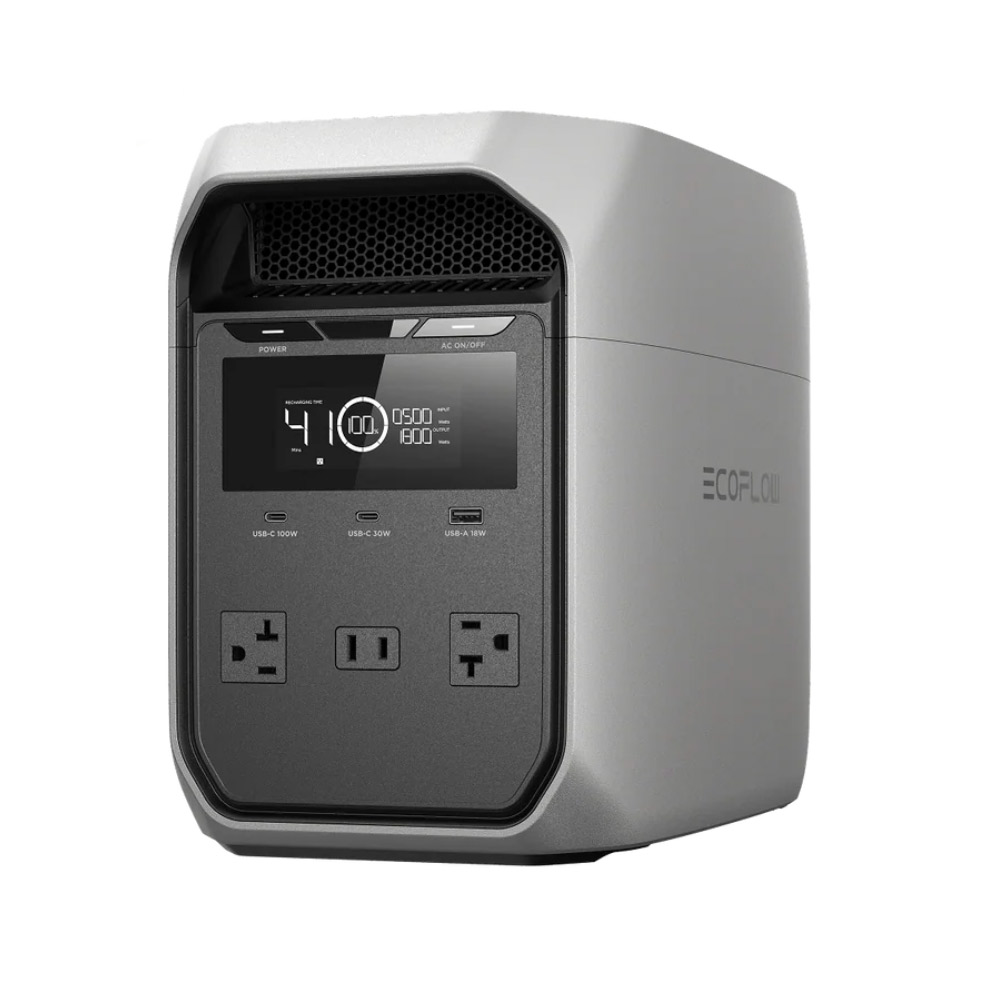
EcoFlow DELTA 3 Classic Portable Power Station (1024Wh)
- 1,024Wh LFP Battery. Lasts 10+ years with 4,000 charge cycles. Safe, stable chemistry that’ll still work when you actually need it years from now.
- 1,800W Output (Surge to 3,600W). Runs real appliances like fridges, microwaves, CPAP machines, and power tools. Not just phone chargers.
- Full Charge in About an Hour. Also charges via solar, car, or generator. Four ways to fill it means you’ve always got options, grid or no grid.
- 10ms UPS Switchover. Power drops and it kicks in instantly. Keeps medical devices, computers, and critical electronics running without interruption.
- 27 Pounds, Grab and Go. Small enough for a car trunk or closet. When you need to move, this beats dragging a generator and fuel cans.
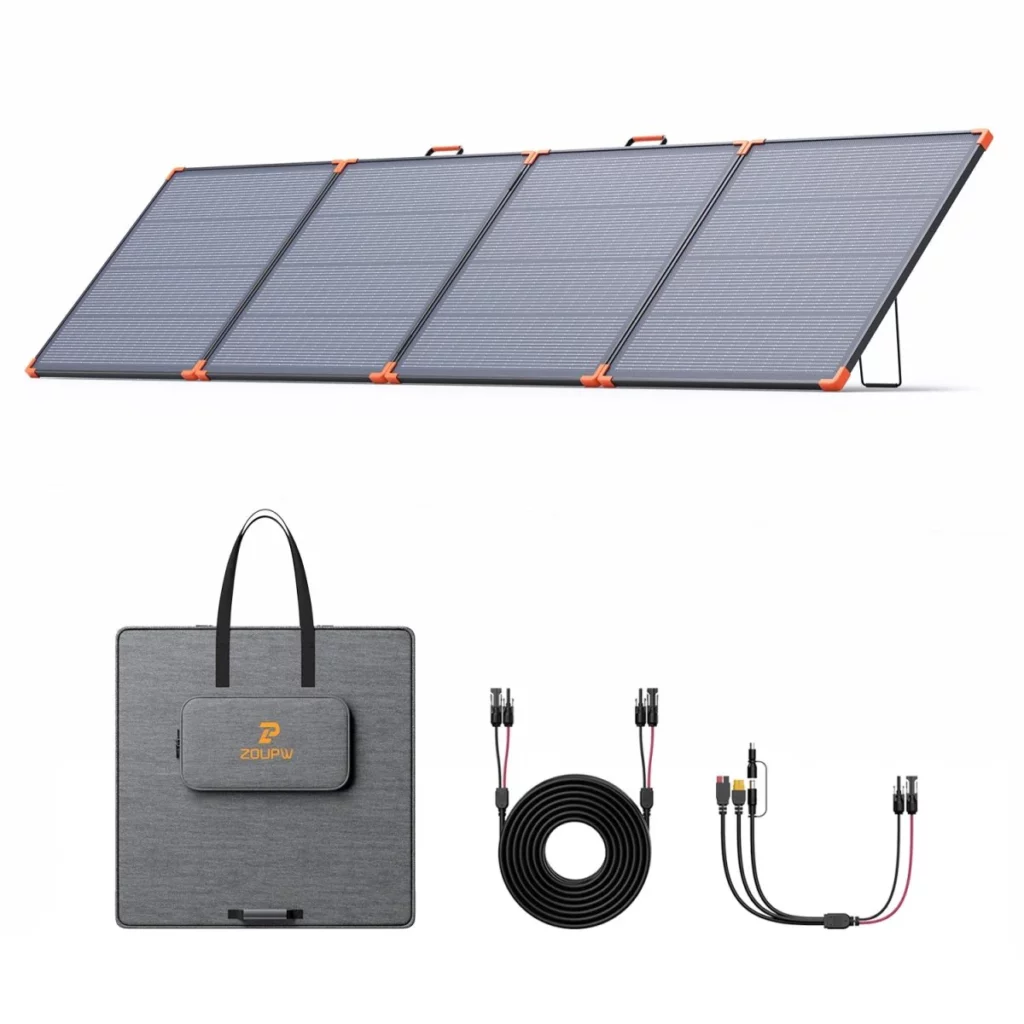
- 400W N-Type Cells with 25% Efficiency. Newer cell technology that outperforms standard panels, especially in low light, cloudy conditions, and high heat. Keeps producing power when older panel tech drops off.
- Foldable with Built-In Kickstands. Four-panel layout folds down for transport, unfolds and deploys in under a minute. Kickstands adjust up to 45 degrees to chase the sun angle throughout the day.
- IP68 Waterproof, ETFE Coated. Rain, dust, humidity, it handles all of it. You don’t have to babysit this panel or rush to pack it up when weather rolls in.
- 4-in-1 Connector Cable Included. Comes with DC7909, DC8020, XT60, and Anderson adapters right in the box. Plugs into EcoFlow, Jackery, Bluetti, Anker, and most other power stations without buying extra cables.
- 20% Lighter Than Standard 400W Panels. Aluminum frame keeps it rigid enough to hold up outdoors but light enough for one person to carry and set up solo. Folds into a padded storage bag that fits in a trunk or RV compartment.
First Aid Supplies
A first aid kit from the drugstore with some band-aids and antiseptic wipes is a start, but it’s not going to cut it in a serious situation. When EMS response times stretch from minutes to hours, or when hospitals are overwhelmed and you can’t get in, you need supplies that can handle real injuries and real medical needs.
Here’s what to think about beyond the basics:
- Trauma supplies. Tourniquets, Israeli bandages (compression bandages), chest seals, hemostatic gauze. These items stop severe bleeding, which is the number one preventable cause of death in emergency situations.
- Medications. Pain relievers (ibuprofen, acetaminophen), anti-diarrheal medication, antihistamines for allergic reactions, electrolyte packets for dehydration, and any prescription medications your household depends on. Try to keep at least a 30-day surplus of prescriptions on hand.
- Infection prevention. Antibiotic ointment, betadine solution, sterile gauze, medical tape, nitrile gloves. In a prolonged grid-down scenario, a simple cut that gets infected can become a life-threatening problem when you can’t get to a doctor.
- Tools. Tweezers, medical shears, a SAM splint for fractures, an oral thermometer, a blood pressure cuff if you know how to use one.
- Knowledge. Supplies without training are just stuff in a bag. Take a Stop the Bleed course. Take a wilderness first aid class. Watch YouTube videos on tourniquet application, wound packing, and basic triage. The knowledge in your head is the most important piece of your first aid kit.
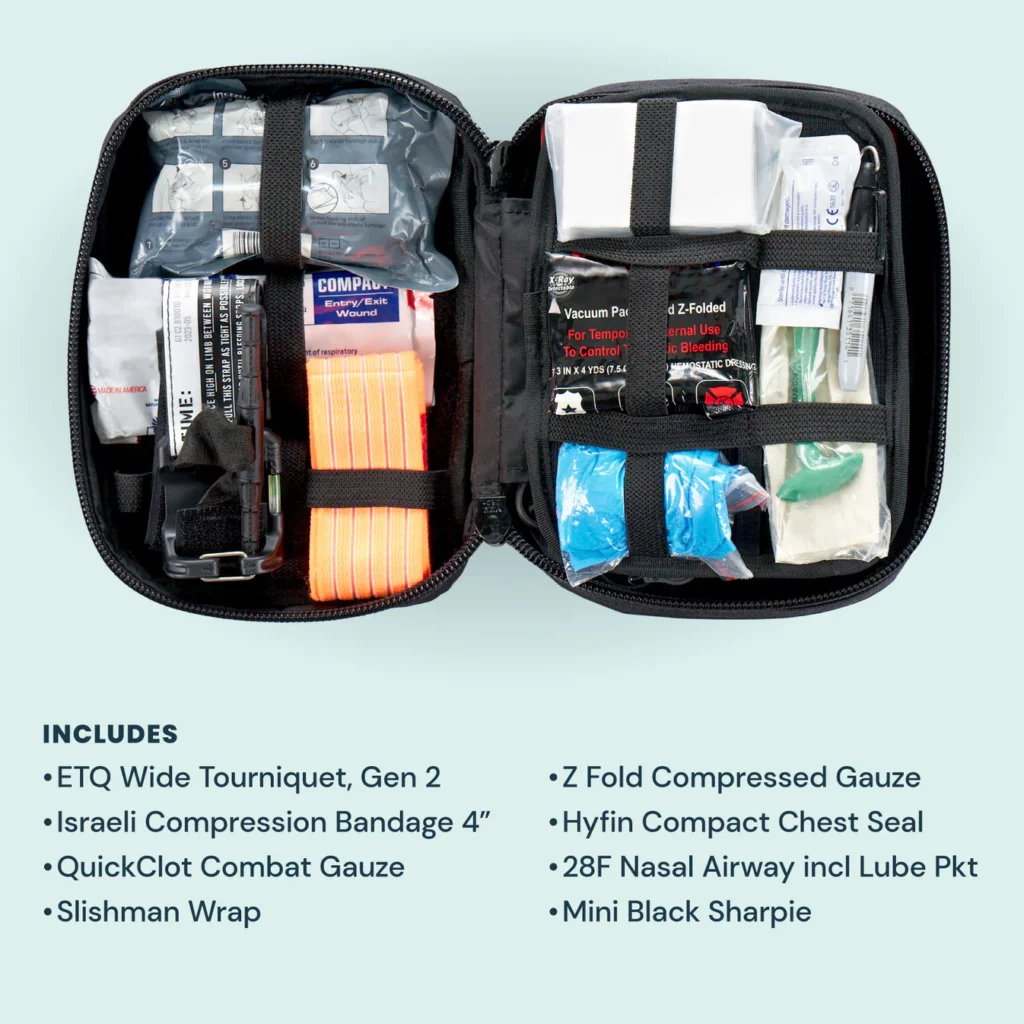
- Professional-Grade “Stop the Bleed” Kit. Includes an ETQ Wide tourniquet, hemostatic gauze with kaolin for accelerated clotting, Israeli compression bandage, and Slishman Pressure Wrap. These are the same caliber tools used by special operations medics and law enforcement, not the cheap knockoffs you find in drugstore kits.
- Trauma Pill Pack with Real Prescription Medications. Inspired by the military’s Combat Pill Pack, it includes adult-dose prescriptions for pain, inflammation, and infection to take immediately after a serious injury. These are actual Rx medications, not over-the-counter placeholders. That matters when you’re hours away from a hospital.
- Designed by Wilderness and Disaster Medicine Experts. Built for austere, off-grid, and tactical environments where help isn’t coming fast. Vehicle accidents on remote roads, field injuries on the ranch, grid-down scenarios where EMS response times stretch from minutes to hours or longer.
- Instructional Cards Included for Non-Medical Users. Step-by-step guidance walks you through how to use each component in the kit. You don’t need to be a paramedic to apply a tourniquet or pack a wound correctly. The cards bridge the gap between owning the gear and knowing what to do with it.
- Compact, Organized, and Field Ready. Everything is stored in labeled compartments inside a water-resistant case. You can find what you need fast under stress, which is the whole point. Fits in a bug-out bag, vehicle kit, range bag, or keeps in a closet at home.

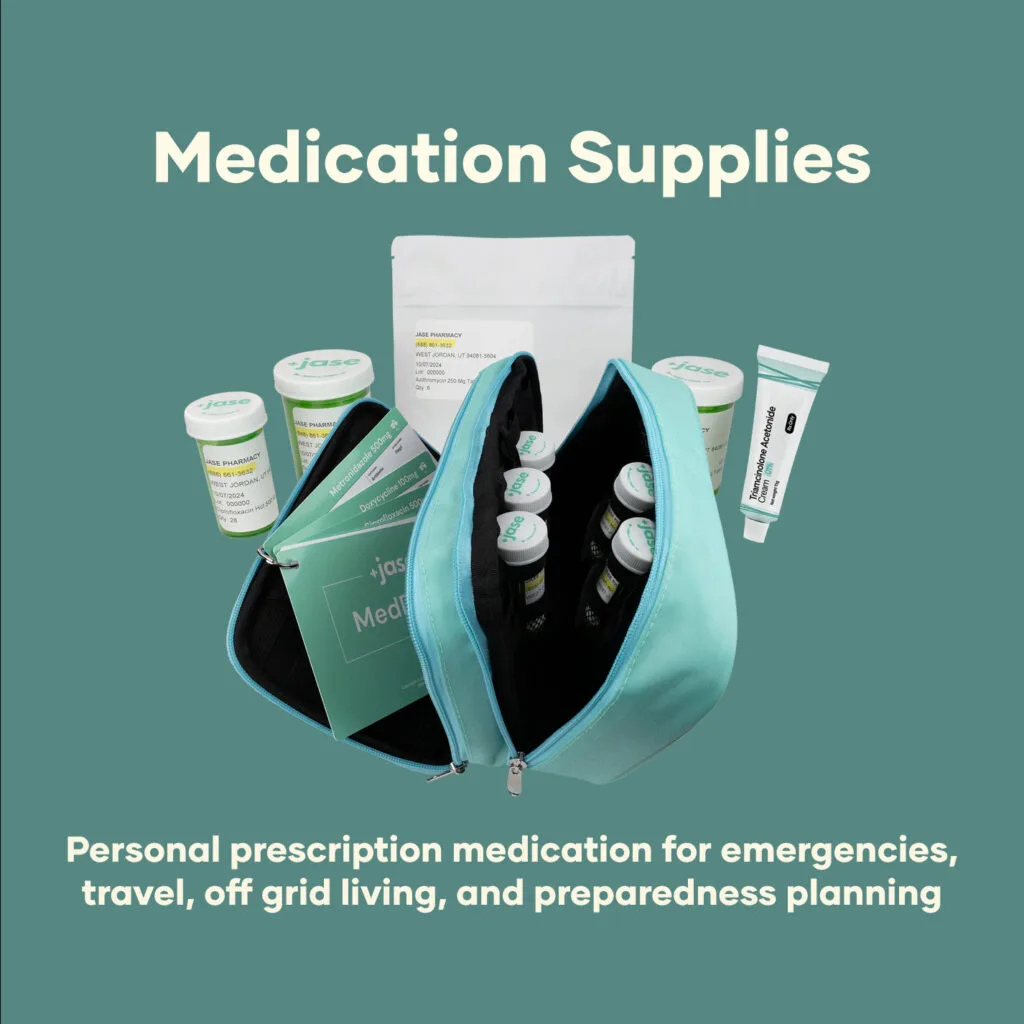
Personal Prescription Medication Supplies
This allows you to order (long shelf-life) prescription drugs online.
Local Communication
When cell networks go down, and they will during any widespread event, you need a backup communication plan. This is the piece that most people completely overlook, and it’s one of the most critical.
Think about it. How do you reach your spouse across town when there’s no cell signal? How do you check on your parents 10 miles away? How do you coordinate with neighbors about road conditions, fire movement, or where to find resources? Without communication, you’re isolated and operating blind.
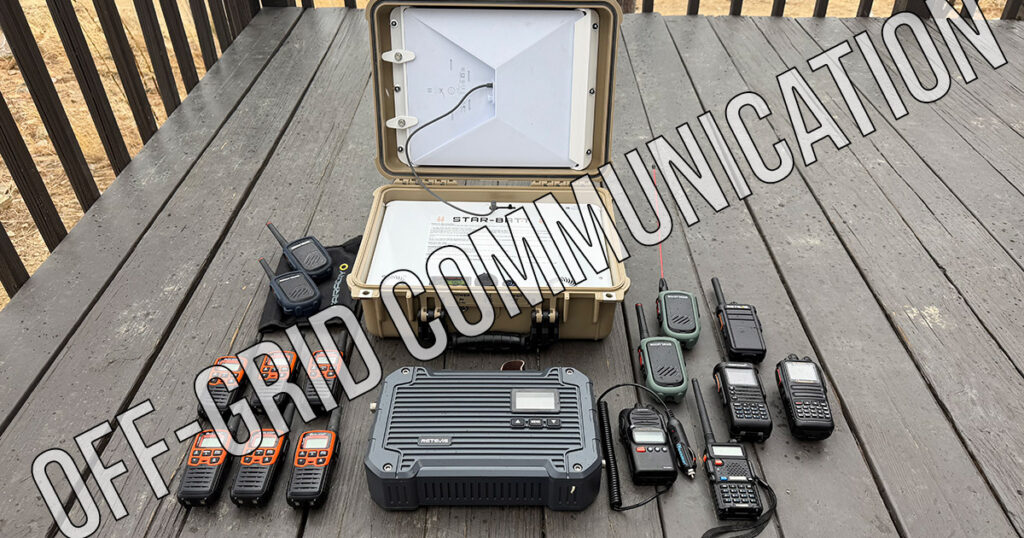
The Complete Guide to “Off-Grid” Communication (No Cell Service Required)
Here’s what I recommend:
- GMRS radios are one of the best options for families and small groups. A $35 FCC license covers your entire immediate family, no exam required, and it’s good for 10 years. Handheld GMRS radios can reach 1 to 2 miles on their own, and with a repeater that range extends to 10, 15, or even 20+ miles.
- Set up a family communication plan now. Decide on a primary channel and a backup channel. Make sure everyone in the household has a radio and knows how to use it. Practice with it. Don’t wait until an emergency to figure out which button is push-to-talk.
- Consider a repeater if you want serious range and coverage across your property or community. I’ve written in depth about GMRS repeaters and the Retevis RT97L on the site. It’s a setup that works when everything else fails.
- Meshtastic is another option worth exploring for text-based off-grid communication, especially if you’re more tech-oriented.
The bottom line: if your entire communication plan depends on cell towers and internet, you don’t actually have a communication plan.
Starlink for Internet
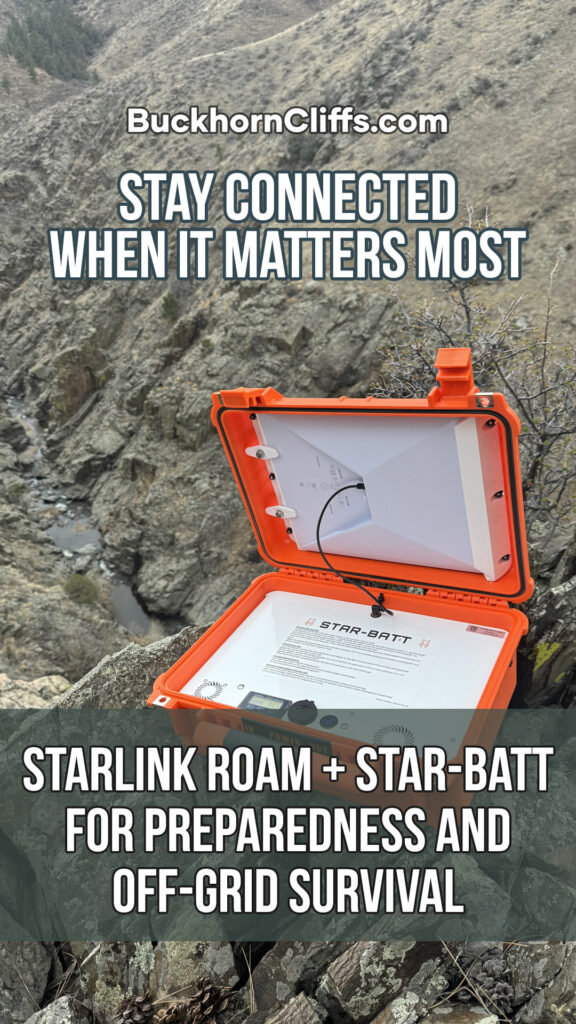
If you don’t already have Starlink, it’s worth considering for emergency internet access. And here’s something most people don’t realize: you can downgrade to a $5 per month standby plan.
Here’s why that matters:
- The $5 plan keeps your account active and your hardware ready to go. The dish sits in your closet or garage until you need it.
- When an emergency hits, you bump it back up to a full plan and you’ve got satellite internet that doesn’t depend on ground infrastructure.
- Starlink works when cable, DSL, and fiber are all down. The signal comes from space, not from a local hub that needs power and intact fiber lines.
- During extended outages, internet access means weather updates, emergency information, coordination with people outside your area, and the ability to let distant family know you’re okay.
Worth it times a million. The hardware cost is the main investment. After that, $5 a month to keep it on standby is nothing for the capability it provides when you actually need it.
Sanitation
Indoor plumbing is a luxury that disappears fast during extended power outages, water main breaks, or infrastructure failures.
Here’s your sanitation checklist:
- Wet wipes. For quick “showers” when running water isn’t available. Baby wipes work great and they’re cheap in bulk. Hygiene matters more during a crisis, not less, because stress and poor conditions make you more susceptible to illness.
- Extra trash bags. Heavy duty, large capacity. When trash service stops, waste piles up fast and becomes a health hazard. You also need bags for improvised toilet setups, debris cleanup, and general waste management.
- Toilet paper. We all saw what happened in 2020. When it’s gone from store shelves, it’s gone. Keep a deep supply at home. It stores indefinitely, takes up minimal space, and you’re going to use it eventually anyway.
- A 5-gallon bucket and heavy-duty bags can serve as an emergency toilet if indoor plumbing fails. Line the bucket with a bag, do your business, add a scoop of kitty litter or sawdust to reduce odor, tie off the bag, and dispose of it properly. Not glamorous, but it works.
- Hand sanitizer and soap. Sanitation-related illness is one of the biggest threats in any prolonged emergency. Clean hands prevent the spread of disease when medical care is limited or unavailable.
Fuel Storage
Do you have a couple of 5-gallon fuel tanks? If not, go pick some up. Here’s why fuel storage deserves its own spot on your list:
- Your vehicle is your primary evacuation tool. If you need to leave in a hurry, you need a full tank plus reserves. Gas stations need electricity to pump fuel. When the power is out, those pumps are dead.
- Fuel runs generators, camp stoves, chainsaws, and vehicles. It’s the lifeblood of almost every tool you’ll rely on during an extended emergency.
- Two 5-gallon cans gives you 10 extra gallons. Depending on your vehicle, that could be 200 to 300 additional miles of range. That might be the difference between getting somewhere safe and being stuck.
One critical note: if you think your stored fuel might sit unused for more than three months, add fuel stabilizer. Gasoline breaks down over time. Untreated fuel goes stale, gums up carburetors and fuel injectors, and can damage small engines in generators and chainsaws. Stabilizer keeps fuel viable for 12 months or longer. It costs a few dollars and saves you from pouring useless fuel down the drain.
Store your fuel cans in a cool, shaded area away from your house and any ignition sources. A detached garage or shed is ideal.
Starting Somewhere Is the Point
Look, this list isn’t everything. There’s a lot more to preparedness and I cover it in depth on the website. But if you’re just getting started, these steps give you a real foundation.
You’ll have cash when electronic payments fail. Clean water when the tap stops. Food that doesn’t need a fridge. A way to cook it. A way to defend yourself and your family. Power that doesn’t depend on the grid. The medical supplies to handle emergencies before help arrives. Communication that works without cell towers. Internet that doesn’t need ground infrastructure. Basic sanitation when plumbing fails. And fuel to keep your tools and vehicles running.
That’s not a complete preparedness plan. But it’s a powerful starting point that puts you ahead of the vast majority of people who haven’t done any of this.
Starting somewhere gives you peace of mind. And that peace of mind changes everything about how you handle a crisis. You stop reacting and start responding.
Step it up? You might be interested in this: