Members download all six field guides (206 pages) and unlock the whole site for $49.95 per year.
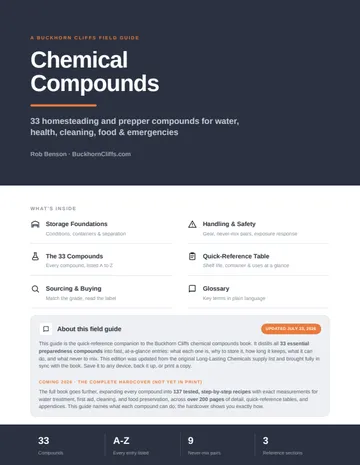
33Compounds
A-ZEvery entry listed
9Never-mix pairs
3Reference sections
What it is
This guide is the quick-reference companion to the Buckhorn Cliffs chemical compounds book. It distills all 33 essential preparedness compounds into fast, at-a-glance entries: what each one is, why to store it, how long it keeps, what it can do, and what never to mix. This edition was updated from the original Long-Lasting Chemicals supply list and brought fully in sync with the book. Save it to any device, back it up, or print a copy.
Storage foundationsConditions, containers, and separation
Handling and safetyGear, never-mix pairs, exposure response
The 33 compoundsEvery compound, A to Z, on its own card
Quick-reference tableShelf life, container, and uses at a glance
Sourcing and buyingMatch the grade, read the label
GlossaryKey terms in plain language
How long the 33 last
Sealed and dry, most of these outlast the shelf they sit on.
26Keep indefinitely
7Carry a date
33 compounds in all.
All 33 at a glance
Compound
Shelf life
Best container
Key uses
Activated Charcoal
Indefinite
Sealed container
Poison binding, water filter
Ascorbic Acid
5-10 yr
Cool, dark, sealed
Food preservation, antioxidant
Baking Soda
Indefinite
Sealed container
Cleaning, baking, first aid
Beeswax
Indefinite
Sealed container
Candles, waterproofing, salve
Bentonite Clay
Indefinite
Sealed container
Poultice, water settling aid
Borax
Indefinite
Sealed container
Pest control, laundry, flux
27 more compounds in the full table
One compound card, as it appears in the guide
Activated Charcoal
TOXIN-BINDING CARBON
Shelf lifeIndefinite if dry
Ultra-porous carbon that traps toxins on its vast surface: a single gram can hide up to a thousand square meters of surface area.
StorageSealed glass jar
HazardLow; nuisance dust
Keep away fromOdors, moisture
Good to know
Charcoal works by adsorption: toxins cling to the outside of its vast, pitted surface rather than soaking in, and a single gram can hide up to a thousand square meters of it. The fit is selective, though, so it traps many organic toxins and drugs but barely touches alcohols, metals, strong acids, or fuels.
What it can do
Bind some swallowed toxins (with Poison Control)Drawing poultice for bites and stingsPull odors from the airImprove water taste and smellFilter sediment in a bottle filter
Buying & handling: It adsorbs, not absorbs, and the fit is selective: it does not bind alcohols, metals, lye, or fuels. It improves taste but does not make unsafe water safe to drink.
Inside the guide
13 chapters. The first 2 are open. The rest show what they cover.
01Chapter
About this guide
Open sample
This guide is the quick-reference companion to the Buckhorn Cliffs chemical compounds book. It distills all 33 essential preparedness compounds into fast, at-a-glance entries: what each one is, why to store it, how long it keeps, what it can do, and what never to mix. This edition was updated from the original Long-Lasting Chemicals supply list and brought fully in sync with the book. Save it to any device, back it up, or print a copy.
33Compounds
A-ZEvery entry listed
9Never-mix pairs
3Reference sections
02Foundations
Storing Your Supply
Open sample
Conditions and containers that keep compounds good for years
Proper storage is what separates a supply that lasts for years, or indefinitely, from one that fails in months. Control three things (temperature, light, and moisture), pick the right container, and keep reactive compounds apart.
50-70°FSteady temperature
Under 50%Relative humidity
OpaqueLight barrier
MonthlyInspect & rotate
The three environmental factors
Temperature
Hold a steady 50-70°FSwings expand and contract containers, cracking seals. Keep supplies away from furnaces, vents, and sun.
Light
Block it outUV degrades most compounds. Use opaque bins, amber glass, or Mylar, and keep clear jars in a closed cabinet.
Humidity
Keep it under 50%Moisture drives breakdown, mold, and caking. There is no such thing as too dry; use silica-gel desiccants in sealed jars.
Where to keep it
Good locations
Basements and root cellars
Interior closets
Climate-controlled rooms
Heated or cooled living-space cabinets
Places to avoid
Attics, garages, and sheds
Near furnaces, vents, or appliances
Direct sunlight and windows
Wet or below-grade spaces
03Storing Your Supply · Continued
Containers & Moisture Control
Oxygen, light, and moisture drive most degradation, so the container is your first line of defense. Match the vessel to what you are storing, seal it well, and add the right tool to fight the threat that matters.
10 lines in this chapter. Members read it here, download it, and add it to My Manual. See the two ways to get it
04Storing Your Supply · Continued
Packing & Labeling for the Long Term
A container only protects what you pack into it correctly. Follow the same six steps every time, keep your desiccants working, and label every jar the same way so an organized store stays a usable one.
11 lines in this chapter. Members read it here, download it, and add it to My Manual. See the two ways to get it
05Foundations
Handling & Safety
Many of these compounds are caustic, oxidizing, or produce dust and fumes. The right gear and a little planning turn a dangerous slip into a non-event. Read this page before you handle anything on the compound pages.
7 lines in this chapter. Members read it here, download it, and add it to My Manual. See the two ways to get it
06Handling & Safety · Continued
The Never-Mix Chart
A few of these compounds react violently with each other, releasing toxic gas or catching fire with no spark. The danger is grouped below by the compound you are storing: keep each one away from everything listed beneath it, on a separate shelf or in a sealed compartment.
22 lines in this chapter. Members read it here, download it, and add it to My Manual. See the two ways to get it
07Handling & Safety · Continued
Separations & Storage Rules
These pairings will not explode, but stored together they corrode containers, break down, or cancel each other out. Keep them apart too, then follow the golden rules that keep the whole supply safe.
17 lines in this chapter. Members read it here, download it, and add it to My Manual. See the two ways to get it
08Safety
Never mix, and keep apart
The pairs that must never share a shelf or a bucket.
21 lines in this chapter. Members read it here, download it, and add it to My Manual. See the two ways to get it
09The cards
The 33 compounds, A to Z
The heart of the guide: all 33 compounds in alphabetical order. Each entry gives its form, why it earns a place in your supply, an at-a-glance strip for storage and hazards, a "good to know" note from the full book, what it can do, and what to look for when buying.
485 lines in this chapter. Members read it here, download it, and add it to My Manual. See the two ways to get it
10Reference
Quick reference table
Real shelf life for well-stored, sealed supplies, with the best container and the main uses. Values in orange keep indefinitely.
34 lines in this chapter. Members read it here, download it, and add it to My Manual. See the two ways to get it
11Reference
Sourcing & Buying Guide
The right compound is only useful if you buy the right grade. Match the grade to the job, look for the markings below, and steer clear of the wrong product.
17 lines in this chapter. Members read it here, download it, and add it to My Manual. See the two ways to get it
12Chapter
Glossary
Every term in the guide, in plain language.
16 lines in this chapter. Members read it here, download it, and add it to My Manual. See the two ways to get it
13Chapter
This guide is a field reference, not a lab manual
It tells you what each compound is, what it can do, how to store it, and what never to mix. It does not give recipe measurements or step-by-step methods. Always match the grade to the job, wear the right gear, and treat every oxidizer, acid, and caustic with respect.