Interactive and printable
Tools
Interactive and printable preparedness tools: the audit, the logbook, the calculators, the charts, and the sheets to fill in.
Score your readinessThe walk-around auditWalk the house and the land, tick what is true today, and score 15 systems from 1 to 5. The lowest score is where to work next.200 checkpointsStart the audit Write it downThe preparedness logbookWho to call, what everyone needs, where the shutoffs are, what is on the shelf: filled in here, printed, and kept where the household can reach it.25 sectionsOpen the logbook Look it upThe shelf life tableEvery stored food, compound and supply with its real lifespan, not the label date, and the storage that gets it there.220 itemsOpen the table
Look it up
Checkers, calculators and finders. Each one answers in a few seconds and links to the page behind the answer.
Never-mix checkerPick any two compounds and see whether they can share a shelf, a bucket or a drain.Absorber and desiccant calculatorPick the food and the container; get the packet size, the fill weight and how long it keeps.Canning times by altitudeWater bath or pressure canner, the tested times, and the pressure for your elevation.Multi-use matrixTwenty items by eight jobs: which ones earn their shelf space.Find your situationBlackout, winter storm, flood, EMP and the rest: the pages for each, in the order to read them.How do IThe question, then the page that answers it.Conversions and dosingTeaspoons to milliliters, drops, ppm, and the coins in a pocket as weights.Glossary233 terms, each linked to where it is used.
Fill in and print
The plans and lists that live on paper. Free to read; members print each one as a sheet or add it to My Manual.
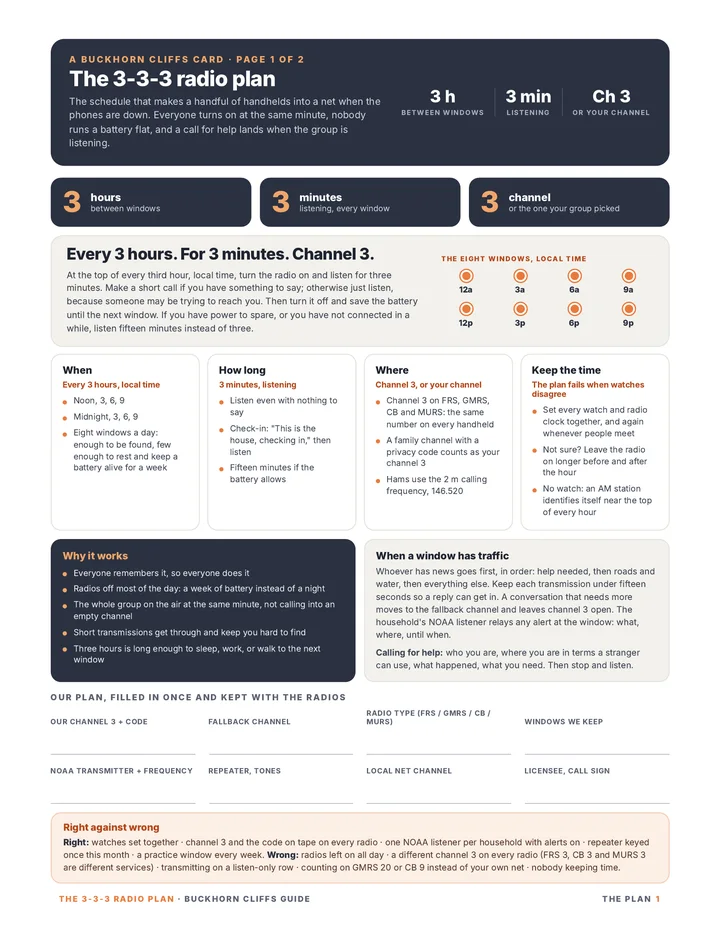 The 3-3-3 radio planThe schedule, the frequency chart with who may transmit, and a plan to fill in.
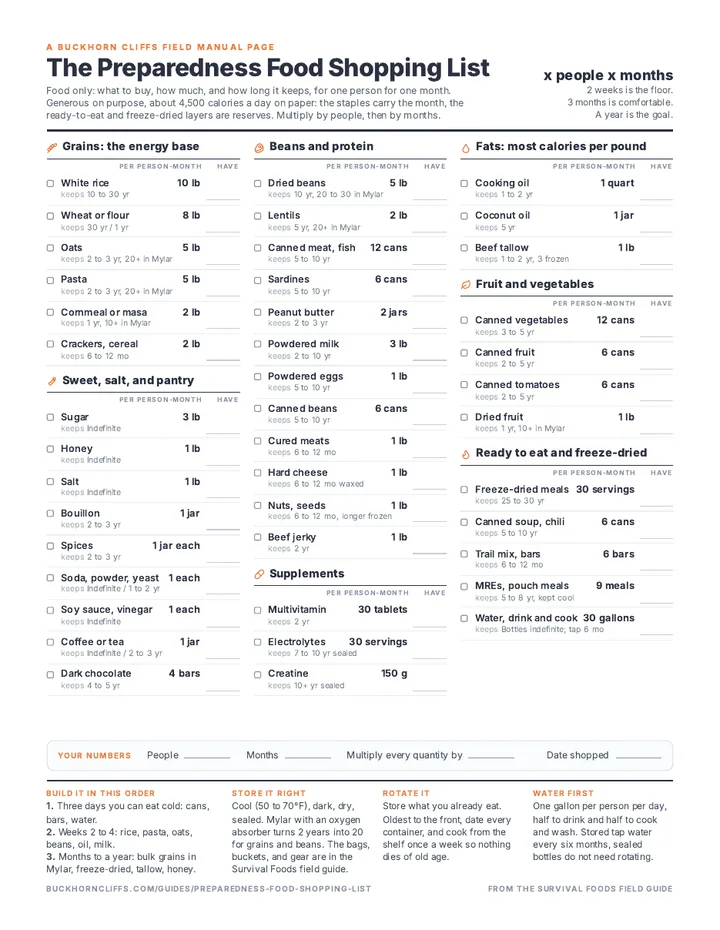 Food shopping listOne person, one month: what to buy, how much, how long it keeps.
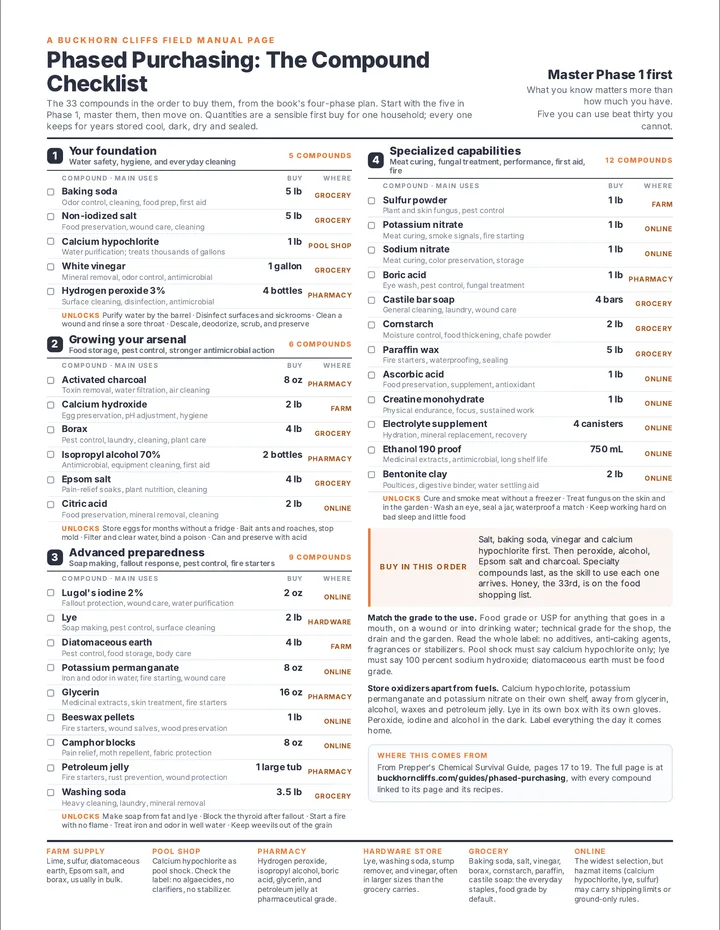 Phased purchasing checklistThe 33 compounds in the order to buy them, with the quantity and where each is sold.
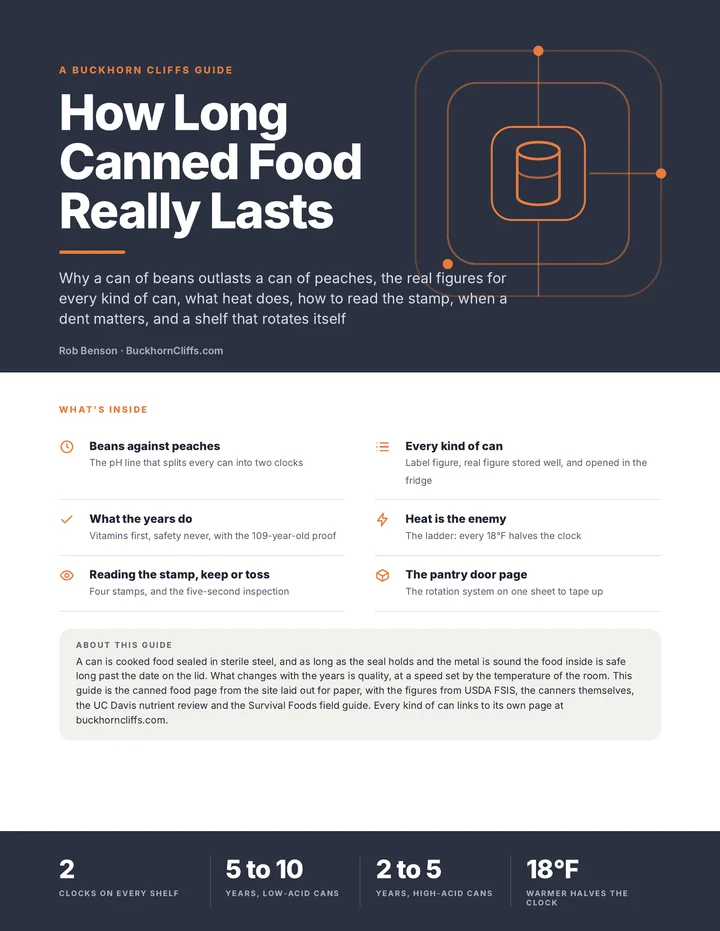 Canned food rotation sheetEvery kind of can with its real figure, and the pantry-door page that rotates the shelf.
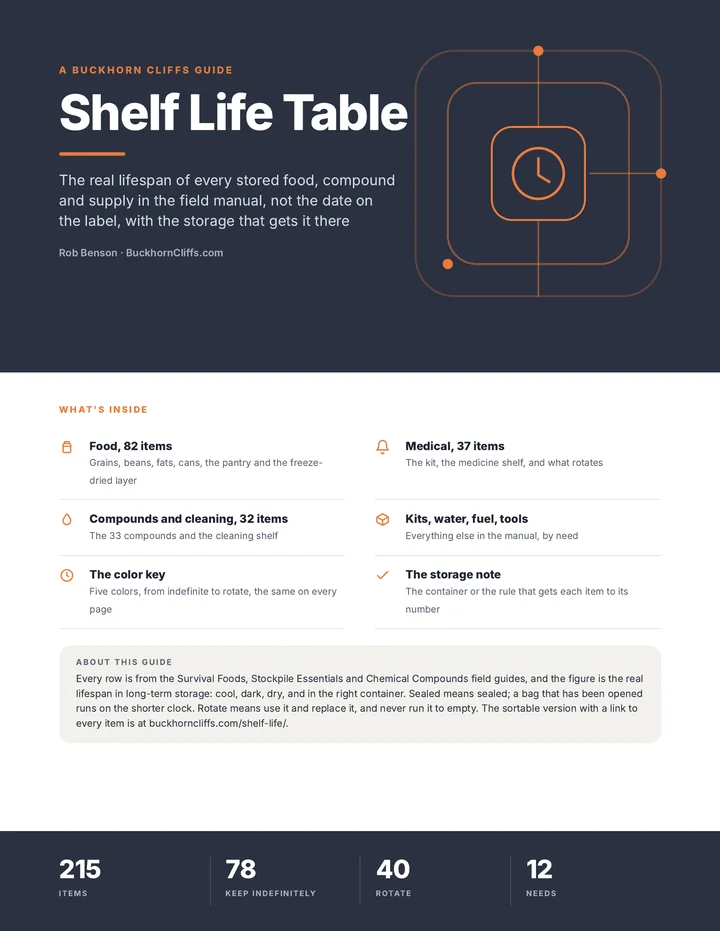 Shelf life table, on paperThe whole table grouped by need, with the color key on every page..xlsxCompound inventory trackerThe fillable spreadsheet for the 33 compounds: how much, where, and when to test or replace.
Reference charts from the book
The appendices of Prepper's Chemical Survival Guide, laid out for the screen. Every recipe number opens its recipe.
Degrease, Descale, Disinfect: Match the Cleaner to the JobCleaning comes down to three jobs: cut grease, dissolve mineral scale, or kill germs. The compounds for each are not interchangeable.All 33 Compounds at a Glance (Quick Reference Table) Shelf life, the best container, and the main uses for every compound in the guide, each linked to its full chapter.Conversions and Dosing: Measure Anything, Even Without ToolsVolume, weight, and temperature conversions, dose-by-eye tricks for when there is no scale, solution strengths, the water treatment quick reference, and what ppm means.Emergency Scenarios: Find Your Situation, Fast37 situations across water, first aid, food, pests, garden, home, sanitation, and nuclear. Each names the compound and links straight to the recipe with full instructions.Sourcing Checklist: Match the Grade, Read the Label The in-store checklist for buying compounds: match the grade to the job, look for the right markings, and steer clear of the wrong product.Find a Recipe by What You Need to Do (Cross-Reference Index)All 206 jobs the 33 compounds can do, grouped by need: body and health, home and shelter, water and food, land, tools, and storage. Each links to its chapter.Storage, Shelf Life and Inventory: Store It Right, Track It, Know When It's Spent How to store each of the 33 compounds against its biggest enemy, the sign each one is wearing out, the inventory sheet with a free fillable tracker, and the twice-a-year check.Tools and Equipment: What to Gather, and What Each Is For A plain-language guide to the 36 everyday tools the recipes call for, with the safety gear marked.Tincture Herbs: A Grouped Quick Reference for 23 Useful Herbs 23 herbs grouped by use, each with the part to use, alcohol strength, how well it works as a glycerite, a starting dose, and the cautions.Garden Uses: The Right Recipe for Soil, Plants, Pests, and Harvest A symptom-to-recipe chart, every garden task with its recipe, the key rates pulled from each one, the mistakes that ruin a crop, and what to do in each season.Storing Your Compounds: Conditions, Containers, Packing and LabelsThe conditions and containers that keep compounds good for years: temperature, light, and humidity targets, which container for which compound, the six packing steps, and what goes on every label.Handling and Safety: Gear up Before You Open a ContainerThe protective gear for caustic, oxidizing, and dusty compounds, the neutralizers to keep within reach, and what to do the moment an exposure happens.Sources Behind the BookEvery figure in the Prepper's Chemical Survival Guide, compound by compound and recipe by recipe, with the primary source it rests on and a live link to each.Military Field Manuals9 current US Army manuals worth keeping: survival, first aid, water and sanitation, fieldcraft, cold weather and firearms. Free, searchable, each linked to the Army's own copy.Army Survival Manual (ATP 3-50.21): What Is in It and Where to Find ItA chapter by chapter breakdown of the current US Army survival manual: what each part covers, the numbers worth knowing, every snare, shelter and knot in it, and the free PDF.Army First Aid Manual (ATP 4-02.11): What Is in It and Where to Find ItA part by part breakdown of the current US Army first aid manual: the order to treat in, bleeding, airway, shock, burns, fractures, bites, heat and cold, with page references and the free PDF.Army Field Hygiene and Sanitation (TC 4-02.3): What Is in It and Where to Find ItA breakdown of the US Army field hygiene manual: personal hygiene, heat and cold, insects, small-scale water disinfection and the leader checklist, with page references and the free PDF.Army Unit Field Sanitation Teams (ATP 4-25.12): What Is in It and Where to Find ItA breakdown of the Army manual on keeping a camp healthy: water supply, food service, waste and latrines, pests, heat, cold and noise, with page references and the free PDF.Army Cold Weather Handbook (TC 21-3): What Is in It and Where to Find ItA breakdown of the Army's cold weather handbook: the five cold zones, layered clothing, sleeping warm, cold injuries, snow shelters, ice thickness and travel, with page references and the free PDF.Army Military Mountaineering (TC 3-97.61): What Is in It and Where to Find ItA breakdown of the Army's mountaineering manual: terrain and weather, altitude illness, avalanches, mountain walking, knots, anchors, climbing, stream crossing and rescue, with page references and the free PDF.Army Visual Signals (TC 3-21.60): What Is in It and Where to Find ItA breakdown of the Army's visual signals manual: hand and arm signals on foot, for vehicles and for aircraft, ground-to-air emergency codes, and flares and smoke, with page references and the free PDF.Army Foot Marches (ATP 3-21.18): What Is in It and Where to Find ItA breakdown of the Army's manual on moving on foot: pace and halts, water, load, packing, foot care and march injuries, with page references and the free PDF.Army Rifle and Carbine Manual (TC 3-22.9): What Is in It and Where to Find ItA breakdown of the Army's rifle and carbine manual: safe handling, how the action works, the shot process, stability, aiming, trigger control, malfunctions and zeroing, with page references and the free PDF.
Printable checklists
Stay Ready
New entries, updates, and useful instruction.
Stay one step ahead on your preparedness journey.