Where to begin with preparedness: what to do in what order, what I recommend, and how to use everything on this site.
The idea
A self-managed insurance plan
You already pay for insurance you hope never to use. Preparedness is the policy you manage yourself, and it pays out in water, food, heat, light, and calm instead of a check that arrives weeks later.
The goal is simple: reduce your dependency on fragile systems. Cover the essentials first, then add depth, redundancy, and skill. You build it in layers, one section at a time, around how you actually live.
1Cover the essentialsWater, food, light, power, and medical basics. The things that hurt fastest when they stop.
2Add depth and redundancyA second way to do every critical job. One light is none.
3Build skillDrills, written plans, and practice. Gear you have never used is a guess.
What works
Audit before you buyWalk the house and find what fails first. Your money goes to real gaps.
Store what you already eatExtra normal groceries first, then long shelf life staples you rotate.
Simple gear you can maintainReliable beats clever. If you cannot fix it or feed it, it is a liability.
Write it downUnder stress, memory fails. Paper plans cut decisions when you have no time to think.
PracticeLights-out drills, water handling, radio checks, cooking without the grid.
What does not
Buying gear firstA garage full of equipment and no stored water is backwards.
One big purchaseA pallet of freeze-dried food does not cover water, heat, or medical.
Notes on your phoneDead battery, no plan. Dosing and dilution notes belong on the container.
Bugging out earlyIf you are stocked, staying put is usually safer. Leaving is a decision with triggers, not a reflex.
Variety over trainingA simple setup you use well beats a collection you have never run.
If I were starting from scratch today
Eleven buys, in the order I would make them, that put you ahead of almost everyone before the ten steps below add depth. Most of it is one trip to a warehouse store, a hardware store, and a gun shop.
1
Cash on hand
One to two weeks of local spending in small bills, kept at home. Bank runs, cyber attacks on banking, and long outages all stop card readers and ATMs. Cash needs no signal, and a $100 bill is useless when nobody can make change.
No power, no plumbing, thousands of gallons per set of filters. Municipal water depends on electric pumps, so pressure drops when the grid does. Know your source too: a creek, a pond, rain barrels. During a boil advisory, still boil after filtering.
Rice, dried beans, sardines, and canned beef. Rice and beans together make a complete protein and store for years; sardines and canned beef need no cooking. A first run costs $75 to $100. Use the oldest first and replace it.
A single or double burner stove, 6 to 8 one-pound propane canisters (about 1 to 2 hours of cooking each), and a lighter stored with it. About $30 to $50 total. Cook with it outdoors only: camp stoves and charcoal put out carbon monoxide.
If you own a firearm, stock ammunition deeper now; it vanished for months in 2020. If you do not, a gun shop or farm and ranch store will walk a new buyer through the options, many under $500. If firearms are not for you, quality pepper spray is cheap, legal almost everywhere, and effective.
Phones, radios, and medical devices such as CPAP machines keep running, and the panel refills the battery every day. It earns its keep camping and through storm outages, so it is not gear that collects dust.
Tourniquet, compression bandage, chest seals, and hemostatic gauze for severe bleeding; pain relievers, anti-diarrheal, antihistamines, and electrolytes; the largest prescription supply you are allowed, 90 days if you can. Then take a Stop the Bleed class, because supplies without training are stuff in a bag.
One $35 license covers the household for 10 years, no exam. Handhelds reach 1 to 2 miles, and a repeater stretches that to 10 to 20 miles or more. Pick a primary and a backup channel now and practice before you need them.
The $10 a month standby plan keeps the account and the dish ready in a closet. When cable, fiber, and cell towers are down, bump it to a full plan and you have weather, alerts, and a way to tell family you are fine.
Wet wipes, heavy trash bags, a deep supply of toilet paper, soap and hand sanitizer, and a 5-gallon bucket with bags and kitty litter or sawdust as the emergency toilet. Illness spreads fastest when medical care is out of reach.
Ten gallons is 200 to 300 miles of range when the pumps are dead, and it runs the generator, the chainsaw, and the stove. Add stabilizer if it may sit more than three months; it keeps gasoline good for 12 months or more. Store the cans cool and shaded, away from the house and anything that sparks.
That is not a complete plan. It is cash when payments fail, water when the tap stops, food that needs no fridge and a way to cook it, a way to protect the house, power and communication without the grid, medical supplies before help arrives, sanitation when plumbing fails, and fuel to keep moving. Then work the steps below.
How to use this site
This is a reference manual, built to be searched. You do not read it front to back. You come with a problem and leave with the answer.
A lock on a card means a member article. You still get the summary and what it covers. Members get the exact amounts, every step, and the full parts lists.
This site holds far more than any one household needs. My Manual is how a member keeps only the part that fits: your water source, your climate, your gear, your people.
Save any page on the site, a recipe, a chart, a parts list, or a whole field guide. Arrange them in the order you want, put your name on the cover, and print one manual, or keep it as a PDF that opens with no signal. Field guides go in page for page, exactly as the PDFs are laid out.
A Buckhorn Cliffs field manualMy ManualBuilt for your household
1Save what fitsPress "Save to My Manual" on any page: a recipe, a chart, a guide, a parts list, or a whole field guide.
2Arrange it your wayOn My Account, drag the pages into the order you want. Name the manual and add your household name.
3Print it or save a PDFOne button makes a real PDF file, laid out for 8.5 x 11 inch paper with a cover. Print it from any device or keep the file. Field guides go in exactly as the PDFs are laid out. No ads, no photos.
4Keep it currentAdd a page, pull one out, print again. The cover carries the date, so you always know which copy is the latest.
Only want a field guide? Each of the six is a $10 PDF in my shop, yours to keep. Membership includes all six, lets you read them on the site, and is the only way to build a manual of your own. Compare the two
The order to build in
10 steps. Work down the list. Each one links to the pages that go deeper.
01
Run a fast audit before you buy anything
Before you spend money, find your weak points. Walk the house and the property and look for dependencies you have never tested.
Ask these five questions
What fails first if the power goes out
What breaks if water pressure drops
What you cannot do without internet
What requires a store run
What becomes a safety issue without fast response times
Practical tips
Run it every season. Your gaps in January are not your gaps in July.
Score honestly. A plan in your head is a 2, not a 4.
Water is the first thing you run short of and the fastest way to get sick. Build it in this order, because each layer buys time for the next.
Build it in this order
Storage for immediate use: enough to buy time and cut panic
Transport: a way to move real quantities from a local source
Filtration: gravity filters work without power
Chemical treatment: compact, long lasting, and your backup to everything above
Practical tips
Water is heavy. Plan around weight and stability.
Sanitize containers on a schedule so biofilm never gets started.
Keep calcium hypochlorite on the shelf. Liquid bleach loses strength in months. Dry pool shock does not.
For this, I recommend
Boroux gravity water filter
Stainless, gravity fed, no power and no plumbing. Strong contaminant reduction without electricity, and the elements also fit a Berkey style housing you may already own.
I have run a freeze dryer for about a decade. It is a big purchase and not where you start, but it turns 10 to 15 pounds of fresh food per batch into long-term storage.
Water glassing eggs, the laundry powder, and 28 more recipes are free. The other 125, including every recipe from the book, are member recipes with exact amounts and every step.
04
Light and power
A power loss compounds: no lights, no charging, limited cooking, weaker communications, less awareness. Cover light first, then charging, then the bigger loads.
The minimum baseline
Several flashlights and headlamps
Spare batteries, or rechargeables and a way to charge them
A way to recharge essential devices
A plan for the longer outage
Practical tips
Treat lighting like redundancy planning. One light is none.
Put lights where problems happen: bedrooms, kitchen, entry points, garage.
Name your critical loads. Charging a phone and running a freezer are different problems.
Solar is the cleanest path to daily reliability, because it does not wait on a fuel resupply.
For this, I recommend
EcoFlow DELTA 3 Classic with a 400 watt panel
The best value portable power pairing I know: a 1024Wh station and a 400 watt panel, about $850 together when I priced them. Code BUCKHORN8 on the panel.
Medical preparedness is supplies, documentation, and the ability to act calmly under stress.
Cover these first
Bleeding control and wound care
Infection prevention
Pain, fever, allergy, and GI support
Prescription medications and continuity
Storage that protects medications long term
Practical tips
Build a house kit and a mobile kit. They do different jobs.
Write dosing guidance down and store it with the kit.
For this, I recommend
Jase Case emergency antibiotics
A kit of emergency antibiotics for the day the pharmacy is closed or empty. Fill out a medical intake form and the prescriptions ship direct. They also fill a 12 month backup of your current prescriptions.
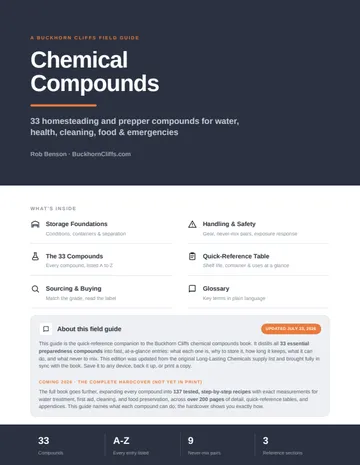
This is the highest leverage shelf in the house. A few stable compounds solve problems across water, hygiene, cleaning, preservation, and pest control. One pound of calcium hypochlorite disinfects about 10,000 gallons of water. Baking soda is an antacid, a cleaner, a deodorizer, a leavener, and a fire suppressant.
Start with compounds that are
Stable in storage
Useful across many tasks
Simple to apply safely
A replacement for products that degrade or are hard to resupply
Practical tips
Store dry, sealed, labeled, and away from moisture.
Keep a written dilution and use card inside the container, not in your phone.
Check any two compounds in the never-mix checker before they share a shelf.
For this, I recommend
Prepper's Chemical Survival Guide
My 230 page book: 33 compounds and 138 recipes in print, so it works when the grid does not. Members get every recipe from it on this site.
Six of the twelve reference charts from the book are free. Members open all twelve, and print any of them clean in My Manual.
08
Communication and information
Build a plan that works when cell service is unreliable, congested, or down. Local outages often break local routing while a call out of the area still goes through.
Set these up first
A written communication plan, with copies in the home kit, the vehicle, and the go-bag
One out-of-area contact everyone calls or texts first
Two-way radios that do not rely on cell towers
Power for all of it: cables, a battery bank, and a recharge method that is not an outlet
Practical tips
Standardize one channel plan for the household, and tape a card to each radio.
Terrain and buildings control range. Test in the places you actually move.
A booster makes a weak signal usable. It does nothing in a true dead zone.
For this, I recommend
Rocky Talkie 5 watt GMRS radio
My number one GMRS pick. Shatterproof screen, reinforced housing, and a battery built for long days out.
Satellite internet on battery power keeps messaging, maps, and coordination alive when the towers are down. It needs a clear view of the sky and a real power plan. Code BUCKHORN takes $100 off the Star-Batt.
A dead flapper, a burst line, a failed pump: each cheap part can idle an entire system, and repair parts are among the first things to vanish from shelves. Stock the part ahead, then put the whole plan on paper, where a dead phone cannot take it from you.
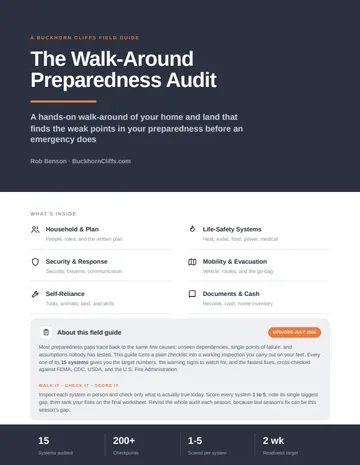
It tells you what to fix before you spend a dollar. Every other guide makes more sense once you know your weakest system.
Most preparedness gaps trace back to the same few causes: unseen dependencies, single points of failure, and assumptions nobody has tested. This guide turns a plain checklist into a working inspection you carry out on your feet.
15 systems scored200 checkpoints1 to 5 readiness scale33 pages
Household & Plan: People, roles, and the written plan
Life-Safety Systems: Heat, water, food, power, medical
Security & Response: Security, firearms, communication
Mobility & Evacuation: Vehicle, routes, and the go-bag
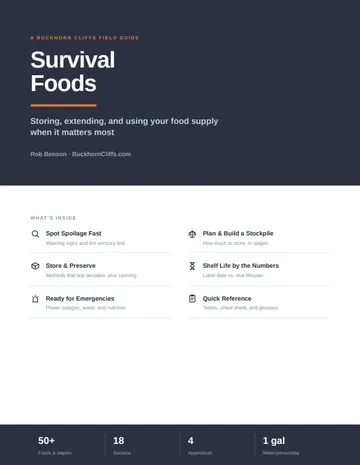
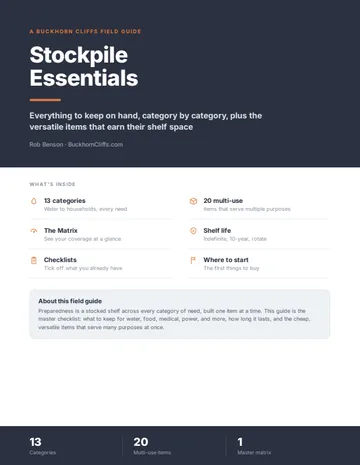
Real shelf life for 64 foods against the date on the label, how much to store, and how to tell when something has turned.
Most stored food outlives its label by years, if it is stored right. This guide gives the real numbers for more than 50 foods, how to spot spoilage fast, how much to store, and how to build a stockpile in phases.
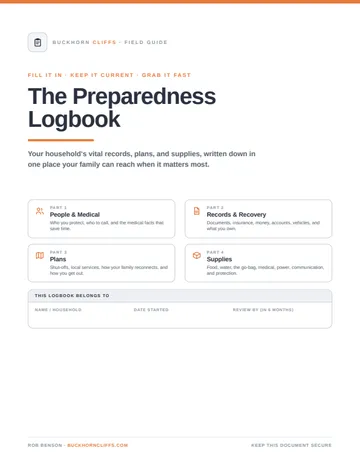
25 sections of fill-in pages: contacts, medical, documents, plans, supplies. The record your family uses when you are not there.
When the phone is dead, the cloud is no help. The logbook is the one document that holds who to call, what everyone needs, where the shutoffs are, and what is on the shelf. Fill it in by hand, keep it with the go-bag.
4 parts25 sections161 fill-in fields30 pages
Part 1: People & Medical: Personal Information & Emergency Contacts, Medical Information, Household Medical Snapshot and more
Part 2: Records & Recovery: Essential Documents & Finances, Insurance Policies, Vehicles and more
Part 3: Plans: Local Hazards & Alerts, Emergency Shut-Offs & Utilities, Local Services & Communication and more
Part 4: Supplies: Food & Water, Go-Bag / Grab-and-Go Kit, Medical & Sanitation Supplies and more
The most useful thing a membership gives you. No book fits your household exactly. My Manual does. Save any page on this site, recipes, charts, and whole field guides included, arrange them in the order you want, and print one manual with your name on the cover. It holds only what is relevant to you, and nothing you would skip.
Why it matters
It works when this site does notNo power and no signal means no website. A printed manual and an offline PDF still open, which is the whole point of writing any of this down.
Only your pagesThis site covers every household. Yours needs a fraction of it. Your manual holds the pages that match your water source, your climate, and your gear, so nobody digs through the rest under stress.
Anyone in the house can use itThe person who reads this site may not be the one home when it counts. A binder on the shelf, in the order you chose, is something a spouse or a teenager can follow.
One current copy, not a pile of printoutsEvery page prints in the same field guide layout with a cover and the print date. Change a page, print again, and the old copy is easy to spot.
What to build with it
The house binderYour water source, your climate, your gear. Only the pages you would reach for.
A copy for the bug-out bag or truckA short version that travels: water, first aid, comms, and the recipes you rely on.
A copy for familyHand a parent or a grown kid a manual built for their house and their supplies.
The shop and the barnParts lists, repair skills, and the never-mix chart, kept where the work happens.
A recipe book of your ownThe cleaners, fuels, and remedies you make, with exact amounts, in one place.
An offline PDFSaved to a phone, a tablet, or a drive in the Faraday bag. It opens with no signal.
How it works
1Save what fitsPress "Save to My Manual" on any page: a recipe, a chart, a guide, a parts list, or a whole field guide.
2Arrange it your wayOn My Account, drag the pages into the order you want. Name the manual and add your household name.
3Print it or save a PDFOne button makes a real PDF file, laid out for 8.5 x 11 inch paper with a cover. Print it from any device or keep the file. Field guides go in exactly as the PDFs are laid out. No ads, no photos.
4Keep it currentAdd a page, pull one out, print again. The cover carries the date, so you always know which copy is the latest.
Not ready? Everything in the free column stays open, and each field guide is $10 on its own.
Free download
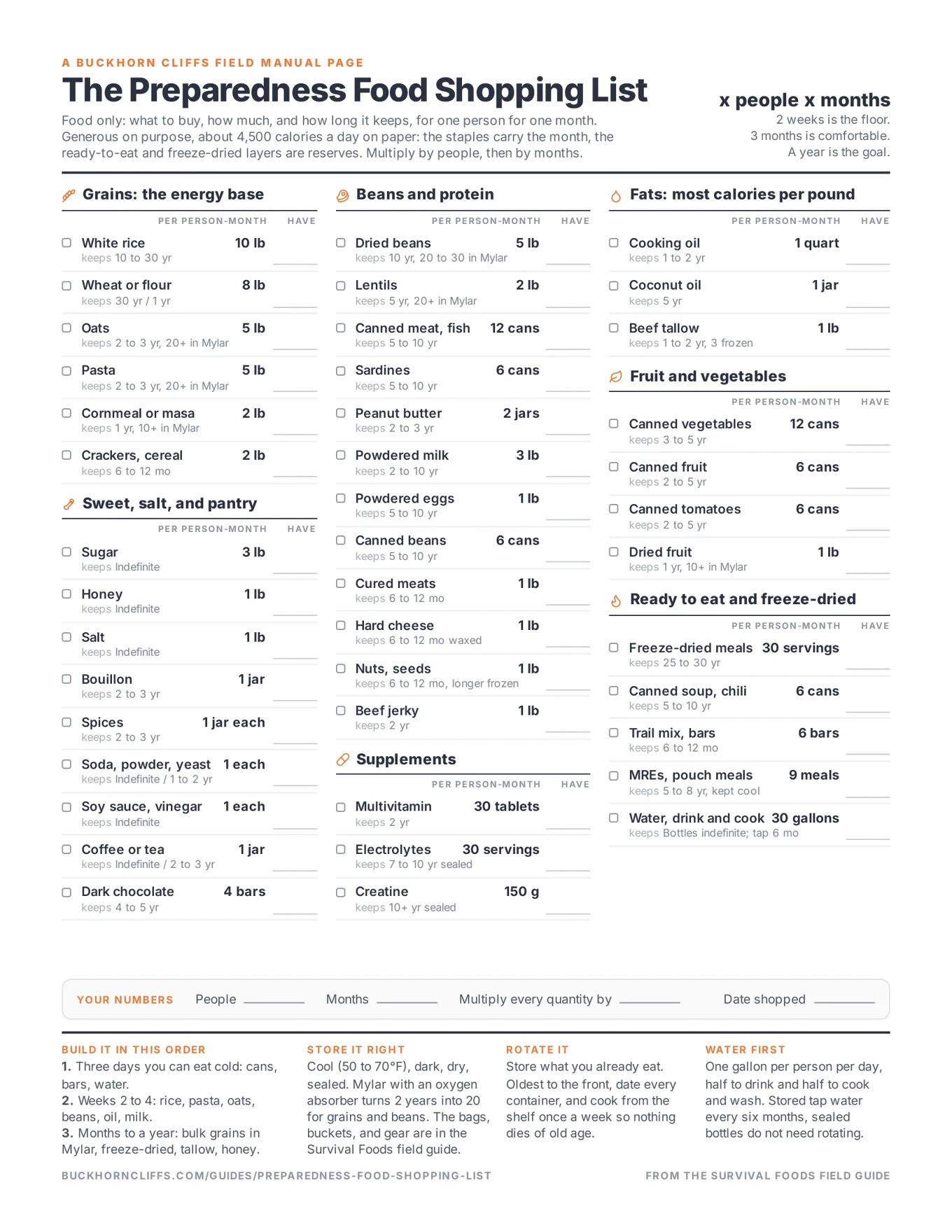
Get the one-page food shopping list
What to store, how much of it for one person for one month, and how long it keeps. One page with checkboxes, built from the Survival Foods field guide. Print it, multiply by your people and months, and take it to the store.
The PDF comes by email, with my newsletter now and then. Already on the list? You still get it. Read the full page.