BUCKHORN CLIFFS

Browse by need · 100 entries

Food

Eat-now, cook-from, and long-term bulk

Build in layers: food you can eat with no cooking, staples you cook from, and sealed bulk for the long haul. Store what your household eats, and rotate it.

Start with the full guide
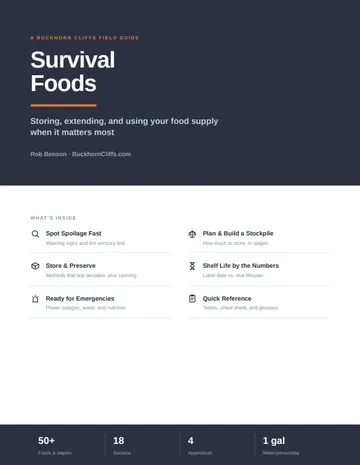
Store what you eat, and eat what you store

A stockpile you rotate through never expires on you. Deep pantry first, sealed bulk and a mill behind it. See the Survival Foods field guide for preservation and recipes.

Type
Event
Shelf life
More

Formulas 25

Formula Ascorbic acid dip to keep cut fruit and vegetables from browning The moment you cut into an apple, pear, or peach, the exposed flesh starts turning brown. Handle with care Formula Baking soda leavening and baking powder substitute Fresh: 1 soda : 2 cream of tartar; Jar mix: add 1 part starch; Rises: with acid present Handle with care Formula Citric acid for canning and food preservation Fresh lemon juice varies in acidity from batch to batch, but citric acid powder delivers precise, repeatable pH reduction every time you measure it. Handle with care Formula Cornstarch Thickener for Emergency Cooking Cornstarch turns thin, watery broth into a hearty, spoon-coating meal. Stirred into a hot liquid it swells and sets into a smooth gel, so a spoonful can stretch a thin soup into something that fills you up. Handle with care Formula Curing a Raw Hide with Salt Salt does not tan a hide. It cures one, which is a different and more urgent job: it stops the rot so the hide keeps until you can tan it properly. Soak a salted hide and it goes off like any other raw meat, because nothing salt does is permanent. Handle with care Formula Food storage chili (canned beef and beans) All ingredients in one pot; bring to a boil, then simmer about 15 minutes Formula Fruit leather with ascorbic acid to prevent browning Fruit leather turns a short-lived harvest into lightweight, shelf-stable food you can store for months without refrigeration or canning equipment. Handle with care Formula Grain and Dry Food Storage Protectant A single grain moth or weevil infestation can destroy months of stored food in weeks. Handle with care Formula Honey Cough and Throat Syrup A spoonful of honey coats and soothes a raw throat, and it quiets a cough about as well as the common over-the-counter syrups do. The good evidence is in children over a year old, but honey is cheap, usually on hand, and easy to take, which makes it a sensible first thing to reach for. Handle with care Formula Honey for Minor Burns For a small, shallow burn, cooling it well matters far more than whatever you put on afterward. Once it is cooled, a thin layer of honey keeps the skin moist and clean while it heals, which suits a minor burn better than letting it dry and scab. As with any honey on skin, sterile medical honey is best and raw honey is only the fallback. Handle with care Formula Honey Wound Dressing Honey fights microbes several ways at once: the sugar is concentrated enough to pull water out of bacteria, it is naturally acidic, and an enzyme the bees leave behind slowly releases a trace of hydrogen peroxide. It is a real dressing, not just folklore, but the honey that belongs on a wound is not quite the honey in your cupboard. Handle with care Formula Meat Color and Freshness Preservation Freshly cut meat gradually turns brown as oxygen converts the red pigment oxymyoglobin into brown metmyoglobin, a process that becomes noticeable within a day or two under typical conditions. Handle with care Formula Meat Curing with Pink Curing Salt Saltpeter cures meat only after bacteria turn it into nitrite, and it is the nitrite that does the work: it blocks the deadly botulism bacteria, fixes the pink cured color, and holds off rancidity. Hazardous Formula Meat Preservation by Salt Curing (Dry Method) Salt preserves meat by pulling water out until there is too little left for bacteria to live on. It is the oldest method there is and it still works, but it works on a schedule: cold enough, salted long enough, and dried far enough, with a scale to prove it. Handle with care Formula Mold Control for Sprouted Grain Fodder A peroxide soak gives sprouting fodder grain a cleaner start by knocking back the mold spores it arrives carrying. It reduces the surface load; it does not prevent mold. A cool room, moving air, and full drainage are what actually keep mold out, and no chemical substitutes for them. Handle with care Formula Oatmeal packets for long-term food storage (3 recipes) 1 cup oats, 3 Tbsp dry milk powder per packet; cook with 2 cups water Formula Preserving Dry Foods in Honey Honey holds so little free water that microbes struggle to grow in it, so dry food tucked under the surface keeps without a fridge. Jars of honey have turned up sealed in ancient tombs, which is the same idea at work: sealed and dry, honey does not spoil. Handle with care Formula Quick-Pickle & Fermentation Brine Two brines, two methods: a vinegar brine for fast refrigerator pickles, and a salt brine that lets vegetables ferment themselves into tangy, long-keeping food. Handle with care Formula Reduce acidity in canned or preserved foods (baking soda) Years-old canned tomatoes, aging preserves, and vinegar-heavy stews can taste sharp, sour, or metallic, and a pinch of baking soda fixes that at the bowl when fresh ingredients aren't an option. Handle with care Formula Reusable Beeswax Food Wraps A cotton cloth soaked in beeswax becomes a washable, moldable wrap that clings to bowls and food, replacing single-use plastic for months. Hazardous Formula Traditional Meat Curing Salt Blend Sodium nitrate is the slow half of a cure: bacteria turn it into nitrite over weeks, and it is the nitrite that guards the meat, which is why nitrate suits long dry-aged hams and salami rather than quick cures. Hazardous Formula Turkey shepherd's pie with Keystone canned turkey One 28 oz can Keystone turkey; bake at 400°F for 25 minutes Formula Vinegar Shrub (Drinking Vinegar) Before refrigeration, a shrub was how you caught a fruit harvest before it spoiled: steeping fruit in sugar and vinegar draws its juice out into a tangy syrup that keeps for months. A spoonful in a glass of water or soda makes a bright, refreshing drink, and the acid does the preserving, so it needs no canning. Handle with care Formula Wash and disinfect produce (baking soda or vinegar) Residue wash: 2 tsp soda / quart; Soak: up to 15 min; Bacteria: 1:3 vinegar soak Handle with care Formula Water glassing eggs with hydrated lime (long-term egg storage) Ratio: 1 oz lime / quart; Per gallon: 4 oz (≈28-32 eggs); Submerge: 2 in on top Hazardous

Compounds 3

Supplies 65

Supply Alcohol (Spirits) Real shelf life: Indefinite. Label says Indefinite INDEFINITEMULTI-USE Supply Beef Jerky Real shelf life: 2 years. Label says 1 year 2 YR Supply Beef Tallow Shelf life: 1-2 yrs. Airtight jars or vacuum bags, cool and dark. Freeze for longest life. 1-2 YRSMULTI-USE Supply Beef Tallow Real shelf life: 2-3 years frozen. Label says About 1 year 2-3 YR FROZEN Supply Beef tallow: uses, energy density and storage 9 calories per gram; keeps 2 to 3 years frozen, 1 to 2 years airtight in a cool, dark spot Supply Bottled Water Real shelf life: Indefinite if sealed. Label says 2 years INDEFINITE IF SEALEDMULTI-USE Supply Bread & Baked Goods How to check bread & baked goods for spoilage. Supply Butter & Margarine How to check butter & margarine for spoilage. Supply Canned Beans Real shelf life: 5-10 years. Label says 2-5 years 5-10 YR Supply Canned Beef Real shelf life: 5-10 years. Label says 2-5 years 5-10 YR Supply Canned Fruit Real shelf life: 2-5 years. Label says 1-2 years 2-5 YR Supply Canned Goods How to check canned goods for spoilage. Supply Canned Meat & Fish Real shelf life: 5-10 yr 5-10 YR Supply Canned Pumpkin Real shelf life: 2-5 years. Label says 1-2 years 2-5 YR Supply Canned Soups Real shelf life: 5-10 years. Label says 2-5 years 5-10 YR Supply Canned Tomato Sauce Real shelf life: 2-5 years. Label says 18-24 months 2-5 YR Supply Canned Tuna Real shelf life: 5-10 years. Label says 3-5 years 5-10 YR Supply Canned Veg & Fruit How to check canned veg & fruit for spoilage. Supply Canned Vegetables Real shelf life: 3-5 years. Label says 1-2 years 3-5 YR Supply CARDNL Essential Electrolytes Real shelf life: 7-10 years sealed. Label says About 2 years (best-by) 7-10 YR SEALED Supply Cereal & Granola How to check cereal & granola for spoilage. Supply Cheese How to check cheese for spoilage. Supply Chocolate How to check chocolate for spoilage. Supply Coconut Oil Real shelf life: 5 years. Label says 2 years 5 YR Supply Condiments How to check condiments for spoilage. Supply Cooking Oil Real shelf life: 1-2 yr 1-2 YR Supply Corn Syrup Real shelf life: Indefinite. Label says 2-3 years INDEFINITEMULTI-USE Supply Cream of Tartar Real shelf life: Indefinite. Label says 3-4 years INDEFINITEMULTI-USE Supply Creatine Monohydrate Real shelf life: 10+ years sealed. Label says 2-3 years (best-by) 10+ YR SEALED Supply Cured Meats How to check cured meats for spoilage. Supply Dark Chocolate Real shelf life: 4-5 years. Label says 2 years 4-5 YR Supply Dried Beans Real shelf life: Up to 10 years. Label says 1-2 years UP TO 10 YR Supply Dried Beans & Legumes How to check dried beans & legumes for spoilage. Supply Dried Herbs & Spices Real shelf life: Longer, but lose potency. Label says 1-3 years LONGER, BUT LOSE POTENCY Supply Eggs How to check eggs for spoilage. Supply Fish & Seafood How to check fish & seafood for spoilage. Supply Freeze-Dried Foods Real shelf life: 25-30 years. Label says 10-25 years 25-30 YR Supply Fresh Fruit & Veg How to check fresh fruit & veg for spoilage. Supply Fresh Meats How to check fresh meats for spoilage. Supply Frozen Foods How to check frozen foods for spoilage. Supply Grains & Flours How to check grains & flours for spoilage. Supply Hard Cheese Real shelf life: 6-12 months. Label says 3-6 months 6-12 MONTHS Supply Instant Coffee Real shelf life: Indefinite. Label says About 2 years (best-by) INDEFINITEMULTI-USE Supply Jarred Items How to check jarred items for spoilage. Supply Lentils Real shelf life: Up to 5 years. Label says 2-3 years UP TO 5 YR Supply Long-lasting sweeteners for food storage Honey and white sugar keep indefinitely in airtight containers, cool and dry Supply Maple Syrup Real shelf life: Indefinite. Label says 1 year INDEFINITEMULTI-USE Supply MREs (meals, ready-to-eat): contents, heating, shelf life Shelf life 3 to 5 years; rated 3 years at 80°F, about 1 month at 120°F Supply Nuts & Seeds Real shelf life: 6-12 mo 6-12 MO Supply Oats Real shelf life: 2-3 years. Label says 1-2 years 2-3 YR Supply Packaged Snacks How to check packaged snacks for spoilage. Supply Pasta Real shelf life: 2-3 years. Label says 1-2 years 2-3 YR Supply Peanut Butter Real shelf life: 2-3 years. Label says 6-9 mo past best-by 2-3 YR Supply Powdered Milk Real shelf life: 2-10 years. Label says 18-24 months 2-10 YR Supply Powdered milk for food storage Nonfat dry milk lasts 2 to 10 years cool, dry, airtight, oxygen removed; no refrigeration needed Supply Rice Vinegar Real shelf life: Indefinite. Label says 2 years INDEFINITEMULTI-USE Supply Sardines (canned) Real shelf life: 5-10 years. Label says 3-5 years 5-10 YR Supply Soy Sauce Real shelf life: Indefinite. Label says 2-3 years INDEFINITEMULTI-USE Supply Sugar Real shelf life: Indefinite. Label says Indefinite INDEFINITEMULTI-USE Supply Survival spices to stock (10 picks with shelf life) Salt lasts indefinitely; most ground spices 2-3 years; whole cloves 3-4 years or longer; nutmeg 4-5 years Supply Tea Bags Real shelf life: 2-3 years. Label says 18-24 months 2-3 YR Supply Vanilla Extract Real shelf life: Indefinite. Label says Indefinite INDEFINITEMULTI-USE Supply Wheat Berries Real shelf life: Up to 30 years. Label says 6-8 months UP TO 30 YR Supply White Rice Real shelf life: 10-30 years. Label says 4-5 years 10-30 YR Supply Yogurt & Sour Cream How to check yogurt & sour cream for spoilage.

Guides 7

The checklist

Tick what you already have. Checks are saved on this device.

Food and Pantry Eat-now, cook-from, and long-term bulk

Eat now, little or no cooking

Cook from staples

Long-term bulk

Protein & boosters

Flavor, morale & fresh

Audit questions

From the walk-around audit. Honest answers show the gaps.

  • How many days of food do you actually have?
  • Is it calorie dense or filler?
  • Do you know how to prepare it without modern appliances?
  • What food spoils first if power fails?
  • Do you have a plan to cook or preserve it quickly?
  • Can you realistically consume it in time?
Score this in the audit

Common mistake

Storing food nobody will eat, or with no way to cook it off-grid.

Storing bulk grain and beans with no fat, salt, or way to make them worth eating.

Skills to learn

seal mylar with oxygen absorbers · rotate stock · cook from scratch · cook dried beans and grain · build balanced meals · preserve a harvest

When it matters