BUCKHORN CLIFFSA preparedness field manual

Medical · Supply

Cayenne Pepper

How long cayenne pepper keeps its heat, whole dried chiles against ground, how to store it, how to tell it has faded, and the eight jobs it does in a food store and a first aid kit.

5+ YR SEALEDFADES NOT SPOILSMULTI-USEWorks without power

Quick facts

  • Real shelf life5+ years vacuum-sealed or frozen; on the shelf ground 2 to 3 at full heat, whole 3 to 4
  • Label date says2 to 3 years
  • Best storageAirtight glass, dark, cool; whole chiles if you can
  • Watch for
    • Faded red to brown
    • little heat
    • clumping or mold

Cayenne is ground dried hot chile, and the heat in it, capsaicin, is stable: a jar fades in color and aroma over a few years but keeps most of its burn, which is why it is the one spice on this site with its own page and a list of jobs beyond the kitchen. Whole dried cayenne pods keep longest; ground keeps 2 to 3 years at full strength and years more at reduced strength.

Which to buy

Whole dried cayenne pods, or ground cayenne in a sealed bag from a bulk supplier, which costs a fraction of the shaker jar. Check the color: bright red is fresh, brown is old. For heat that stays, a bag of whole pods ground as needed in a dedicated coffee grinder. Grow it: a few plants dry a year's supply on a string in a warm room.

How long it really lasts

By how it is kept

FormLabel saysReal, stored well
Ground cayenne, airtight, dark2 to 3 years2 to 3 years at full heat; years more at reduced strength
Whole dried cayenne pods3 to 4 years; longer frozen
Either, vacuum-sealed or frozenRoughly double
Cayenne tincture in alcoholYears

How to store it

Airtight glass, dark, cool, away from the stove. Bulk bags sealed in the dark or the freezer, a small working jar out. Whole pods strung or in a jar in the dark. Moisture is the only thing that ruins it: never shake it over steam, and if it clumps, dry it on a sheet pan in a barely warm oven and break it up.

How to tell it has turned

Color and aroma: bright red with a sharp smell is good; dull brown with a dusty smell is faded. Taste a pinch: if the heat is there, it's still working, and faded cayenne is used at double the amount. Clumping with a musty smell or mold means moisture got in and the jar goes.

Keep it

Faded brown cayenne that still burns on the tongue; a clumped jar dried out and broken up.

Discard on sight

Mold or a musty smell.

How much, and how to use it

A pinch in the beans, the chili, the soup and the eggs is the first job; a cayenne-and-vinegar hot sauce from the pods is the second. The eight jobs listed below are the rest, from a warming salve to a pest spray for the garden. For a hot sauce that keeps: a cup of chopped dried cayenne simmered in a cup and a half of 5 percent vinegar with a teaspoon of salt, blended, bottled, and kept in the fridge.

Eight jobs it does

  • Topical pain relief for joints
  • Circulation and warming agent
  • Anti-inflammatory with food
  • Seasoning that preserves
  • Pest spray for plants
  • Bear, dog, and rodent deterrent
  • Sprinkle on a minor cut (traditional; direct pressure does the real work)
  • Cold and congestion remedy

If it goes bad Loses heat and color over time. Still safe, just milder.

Shelf-life figures are from the Survival Foods field guide; fridge, freezer and pantry times are from the USDA cold and pantry storage charts. Run the look, smell, taste check before eating anything past its date.

Questions this answers

Tap a question for the short answer.

What is cayenne pepper used for?

Cayenne does eight jobs: topical pain relief for joints, a circulation and warming agent, an anti-inflammatory with food, a seasoning that preserves, a pest spray for plants, a bear, dog, and rodent deterrent, a traditional way to slow heavy bleeding, and a cold and congestion remedy.

How long does cayenne pepper last?

Ground cayenne 2 to 3 years at full heat and years more at reduced strength; whole dried pods 3 to 4 years, longer frozen. It fades rather than spoils.

How do I store cayenne pepper long term?

Airtight glass, dark and cool, away from the stove; whole pods or bulk ground cayenne sealed in the dark or the freezer with a small working jar out.

How do I tell if cayenne pepper has gone bad?

Dull brown color and little heat mean faded, which is safe at double the amount. Clumping with a musty smell or mold means the jar goes.

Keep going

Read nextBeef Tallow and Cayenne Pepper: Uses and StorageCovers the food, skin and pain-relief uses of beef tallow and cayenne pepper, alone and combined, with storage methods and shelf life for each.Food · Guide

Related to this

Membership · $49.95 per year

Everything on this site, open, printable, and yours on paper

When the grid goes down, this site goes with it. Paper does not. Membership opens every member page and every recipe from the book, hands over all thirteen field guides as PDFs, and builds a binder from the pages your household uses.

  • 158member pagesopen in full, every amount and every step
  • 138recipeswith exact amounts, from the book and beyond it
  • 13field guides304 pages of PDFs, $130 bought one at a time
  • 1manual of your ownbuilt from any page here, printed with your cover
  • Every member page in full. the exact amounts, every step, every parts list
  • Every recipe and resource from the book. all 138 from the Prepper's Chemical Survival Guide, searchable here
  • All 13 field guides. read them here or download the PDFs, 304 pages
  • My Manual. save any page, recipe or whole guide, order it, print one binder with your own cover
  • The audit and the logbook, saved. your scores and checklists on every device
  • Print and Save as PDF on every page. and no ads

Join for $49.95 per year

  • One payment, $49.95 per year. Cancel any time and keep access to the end of the year you paid for.
  • Sign in by email. No password, and the sign-in renews itself on every visit.
  • Most of the site stays free. Membership is for the depth, the PDFs and the paper.
Membership

Save to My Manual is a member tool

Members build their own manual from the pages that fit their household, then print it or keep it as a PDF.

Why it matters

When the grid goes down, this site goes with it. Paper does not. Membership is how you get the whole manual off the screen and onto the shelf: every page in full, every field guide, and a binder built for your own household.

The field guide library

All thirteen field guides. 304 pages. Included.

The complete Buckhorn Cliffs PDF set, yours to download, print, and keep from the day you join.

$130if bought one at a time

  • Cover of Stockpile Essentials Field GuideStockpile Essentials39 pagesEverything to keep on hand, category by category, plus the 20 multi-use items.
  • Cover of Survival Foods Field GuideSurvival Foods35 pagesStoring, extending, and using the food supply. Real shelf life by the numbers.
  • Cover of Chemical Compounds Field GuideChemical Compounds29 pagesThe 33 compounds: storage, top uses, hazards, and the never-mix chart.
  • Cover of Spare Parts and Repair Stock Field GuideSpare Parts and Repair Stock40 pagesWhat to keep on hand to fix the home and land when the supply chain breaks.
  • Cover of Walk-Around Preparedness AuditWalk-Around Preparedness Audit33 pagesFifteen systems scored 1 to 5, with the printable scorecard.
  • Cover of The Preparedness LogbookPreparedness Logbook30 pagesThe household information that needs to be on paper.
  • Cover of Off-Grid Portable Solar Power Field GuideOff-Grid Portable Solar Power16 pagesSize a power station and a folding panel, pair them, wire them, keep them alive.
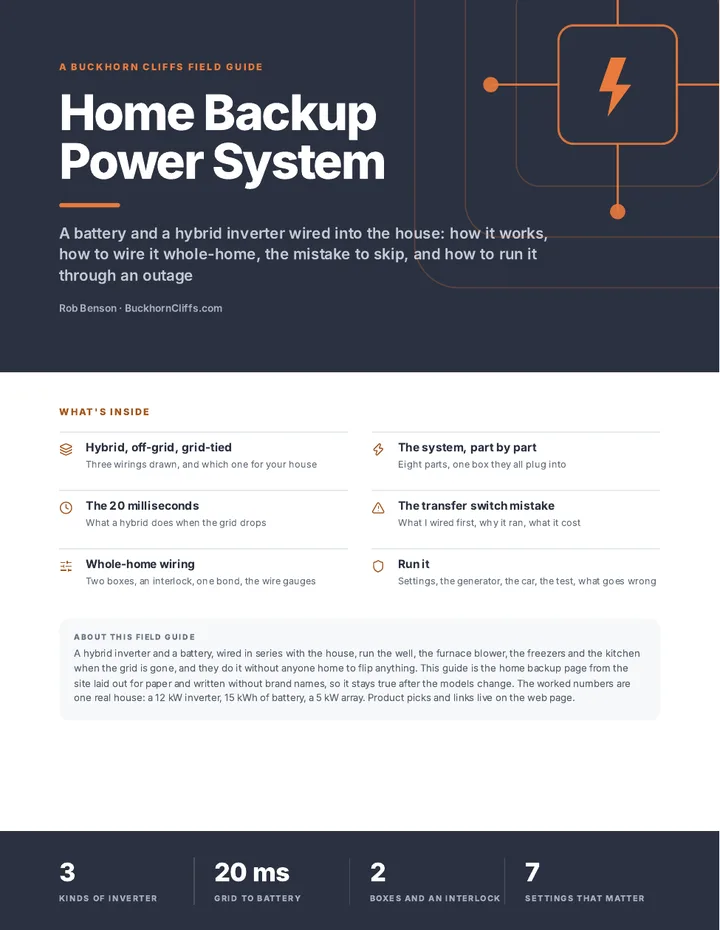
  • Cover of Home Backup Power System Field GuideHome Backup Power System20 pagesA battery and a hybrid inverter wired into the house: hybrid against off-grid, the wiring, the mistake to skip.
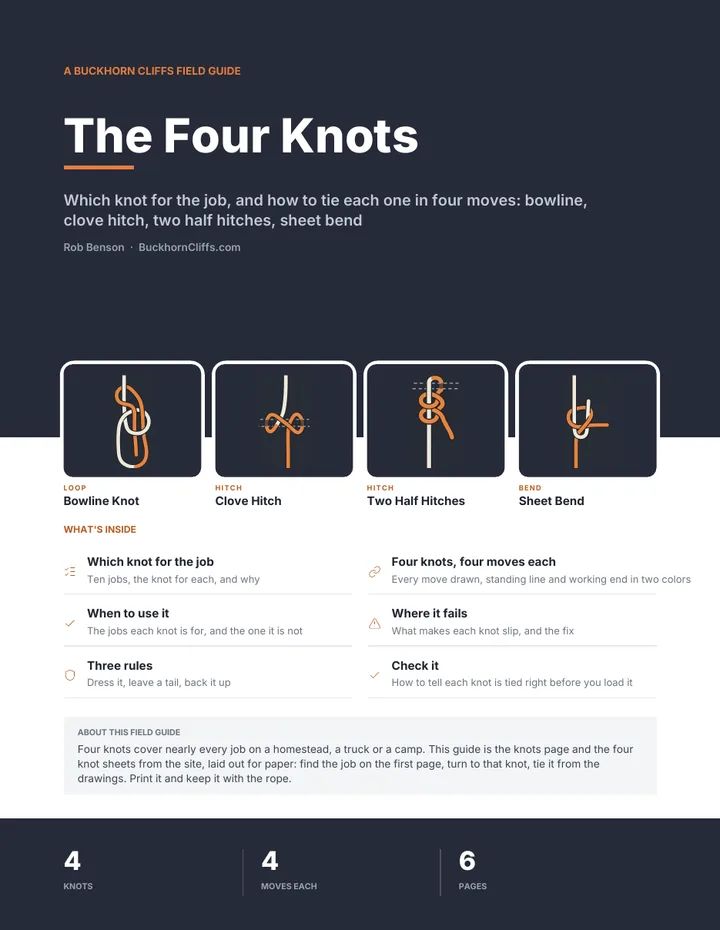
  • Cover of The Four KnotsFour Knots6 pagesWhich knot for the job, and how to tie each one in four moves.
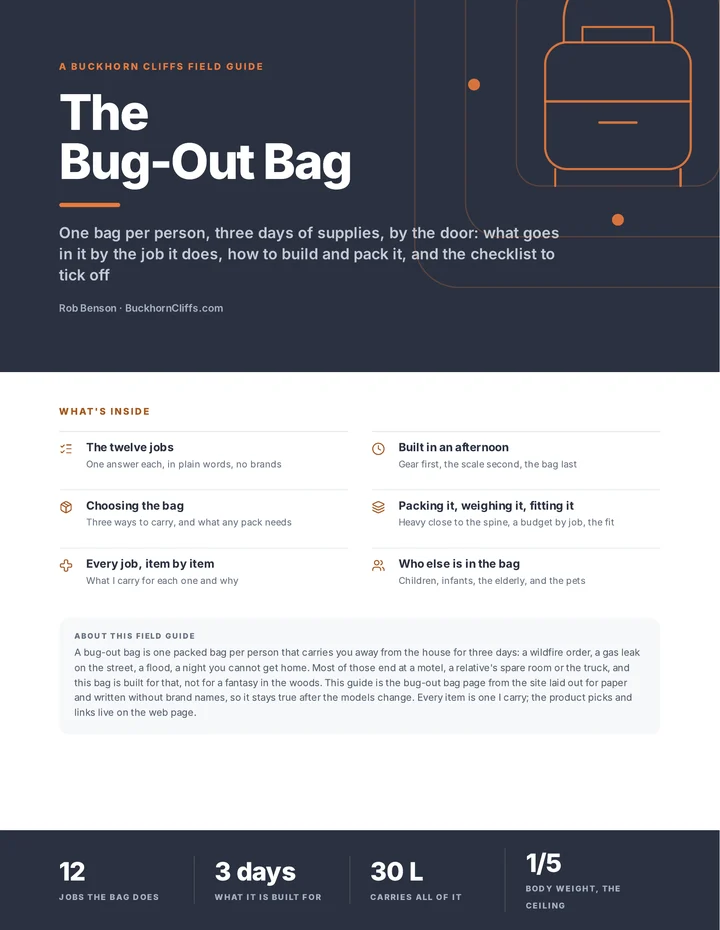
  • Cover of The Bug-Out Bag Field GuideBug-Out Bag18 pagesOne bag per person for three days: the twelve jobs, the afternoon build, the packing plan, every item by job, and the checklist.
  • Cover of Home Security and Defense Field GuideHome Security and Defense12 pagesThe four layers from the property edge to the people inside, what to build first, the night something feels wrong, and the plan with or without a weapon.
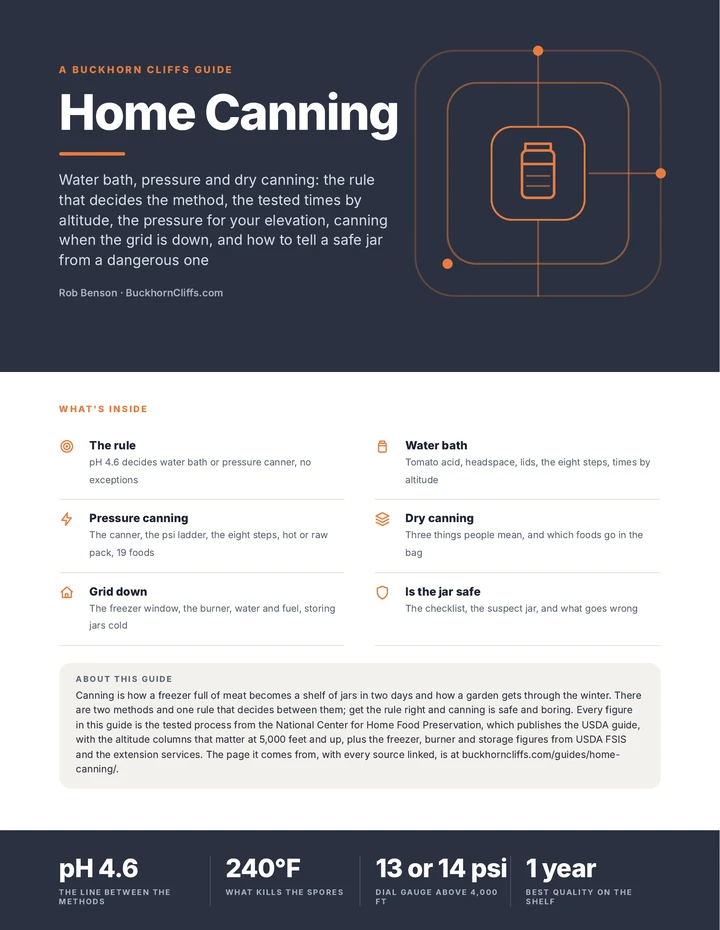
  • Cover of Home Canning Field GuideHome Canning13 pagesWater bath or pressure canner, the tested times by altitude, the pressure for your elevation, hot pack against raw pack, dry canning, and the safe-jar checklist.
  • Cover of Oxygen Absorbers and Desiccants Field GuideOxygen Absorbers and Desiccants13 pagesWhich packet every food and supply needs, the absorber and silica gel sizing charts, every storage container rated, and how to keep the packets alive.

My Manual · included

Build your own field manual

The most useful thing a membership gives you. No book fits your household exactly. My Manual does. Save any page on this site, recipes, charts, and whole field guides included, arrange them in the order you want, and print one manual with your name on the cover. It holds only what is relevant to you, and nothing you would skip.

Why it matters

  • It works when this site does notNo power and no signal means no website. A printed manual and an offline PDF still open, and that is why any of this is written down.
  • Only your pagesThis site covers every household. Yours needs a fraction of it. Your manual holds the pages that match your water source, your climate, and your gear, so nobody digs through the rest under stress.
  • Anyone in the house can use itThe person who reads this site may not be the one home when it counts. A binder on the shelf, in the order you chose, is something a spouse or a teenager can follow.
  • One current copy, not a pile of printoutsEvery page prints in the same field guide layout with a cover and the print date. Change a page, print again, and the old copy is easy to spot.

What to build with it

  • The house binderYour water source, your climate, your gear. Only the pages you would reach for.
  • A copy for the bug-out bag or truckA short version that travels: water, first aid, comms, and the recipes you rely on.
  • A copy for familyHand a parent or a grown kid a manual built for their house and their supplies.
  • The shop and the barnParts lists, repair skills, and the never-mix chart, kept where the work happens.
  • A recipe book of your ownThe cleaners, fuels, and remedies you make, with exact amounts, in one place.
  • An offline PDFSaved to a phone, a tablet, or a drive in the Faraday bag. It opens with no signal.

How it works

  1. 1Save what fitsPress "Save to My Manual" on any page: a recipe, a chart, a guide, a parts list, or a whole field guide.
  2. 2Arrange it your wayOn My Account, drag the pages into the order you want. Name the manual and add your household name.
  3. 3Print it or save a PDFOne button makes a real PDF file, laid out for 8.5 x 11 inch paper with a cover. Print it from any device or keep the file. Field guides go in exactly as the PDFs are laid out. No ads, no photos.
  4. 4Keep it currentAdd a page, pull one out, print again. The cover carries the date, so you always know which copy is the latest.

Also included

  • The entire site, unlockedAll 158 member pages open in full: exact amounts, every step, every warning, every parts list. Nothing held back.
  • Every recipe and resource in the bookAll 138 recipes and 33 compounds from Prepper's Chemical Survival Guide, with exact amounts, every step, every warning, and the reference charts.
  • A clean PDF of any entryOne press turns any page into a field guide sheet for the binder, the truck, or the shop wall.
  • Checklists and audit scores that follow youSaved to the account, so the phone, the laptop, and the shop computer always match.
  • No adsMembers read the whole site without a single ad.
$49.95per year. About 14 cents a day. Cancel any time and keep the year you paid for.