Quick facts
- Book 1
- Field Guide to Wilderness Medicine
- Auerbach
- 5th Edition
- Book 2
- Where There Is No Doctor
- Werner
- Thuman
- Maxwell
- Book 3
- The Survival Medicine Handbook
- Alton
- 4th Edition
- Alton lengthApproximately 700 pages, over 300 topics
- Format to buyPrint copies
- Training to add
- Wilderness first aid
- Stop the Bleed
- CPR
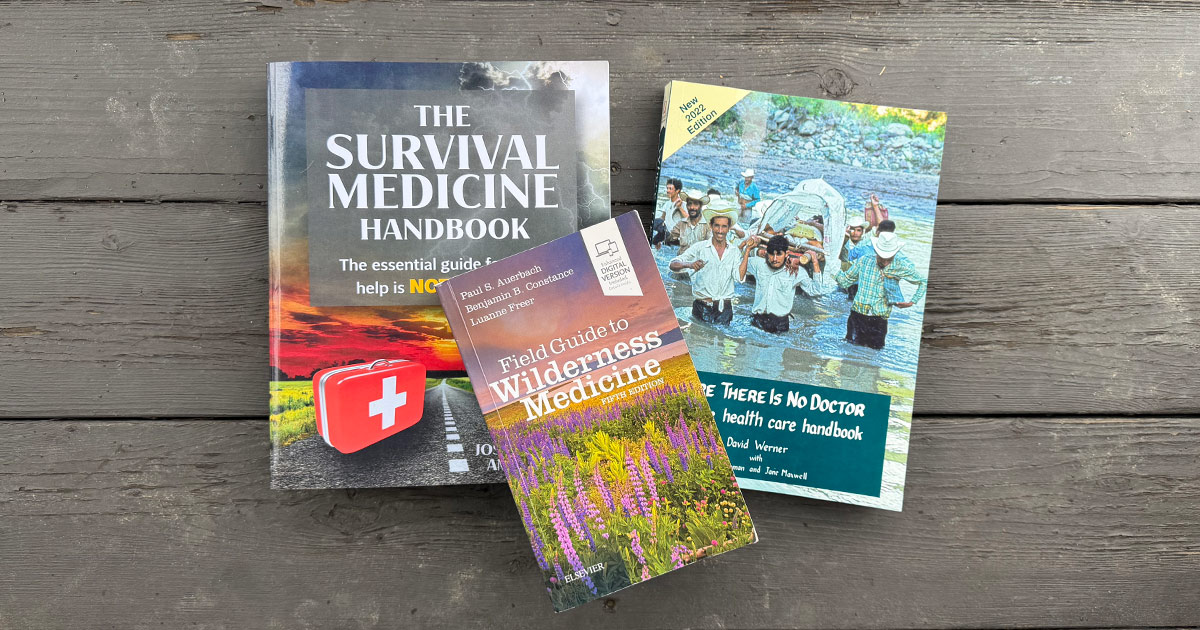
Medical knowledge gets overlooked in preparedness planning. Food storage, power, water, and comms all matter, but none of it helps when someone in your household is bleeding out, fighting an infection, or dealing with a broken bone two hours from the nearest hospital.
You can't pull up YouTube when the power is out and the cell tower is down. You need printed references on your shelf. Three books cover the spectrum from acute wilderness emergencies to long-term grid-down medical care. Here's what each one does and why it earns its spot.
1. Field Guide to Wilderness Medicine by Paul S. Auerbach, 5th Edition
Related: Field Guide to Wilderness Medicine
Dr. Paul Auerbach served as the Redlich Family Professor of Surgery in the Division of Emergency Medicine at Stanford University School of Medicine and is recognized as the world's leading authority on wilderness medicine. The Field Guide is the portable, condensed version of his comprehensive Wilderness Medicine textbook used by emergency physicians worldwide.
What it covers:
- High-altitude medicine
- Dive medicine and water-related emergencies
- Mountain medicine and wilderness survival
- Snake, insect, and animal injuries
- Plant and mushroom identification with color plates
- Bandaging and taping techniques
- Forest fires
- Hydration and dehydration
- Mental health in austere settings
- Global humanitarian and disaster medicine
- Travel medicine, immunizations, and medications
Each chapter uses a "Signs and Symptoms" and "Treatment" structure with bulleted lists and quick-reference text boxes. The book is sized to fit in a glove compartment or pack. The emphasis throughout is on improvising care with whatever materials are available.
Anyone living rural, elevated, or remote enough that EMS response time exceeds 30 minutes. The clinical depth is the strongest of the three books on this list.
Related: Medication Supplies
2. Where There Is No Doctor by David Werner, Carol Thuman, and Jane Maxwell
Related: Where There Is No Doctor
The World Health Organization considers this the most widely-used health care manual in the world. It has been translated into more than 75 languages. David Werner co-founded the Hesperian Foundation and has worked in over 50 countries on village health care, with consulting work for the WHO, UNICEF, UNDP, and the Peace Corps.
The book was written for communities with no access to formal medical care. That assumption is what makes it valuable for preppers.
What it covers:
- Examining sick people: checking breathing, pulse, temperature
- Identifying illness from symptoms and fever patterns
- Dehydration, cold and flu, asthma, allergic reactions, arthritis, back pain
- Serious diseases: malaria, tuberculosis, tetanus, dengue, typhoid
- Nutrition and diet
- Sanitation and disease prevention
- Vaccinations
- Appropriate use of medicines, including when not to use them
- Family planning and childbirth
- Care of children and the elderly
- Recognizing when a problem exceeds home care
Plain language with extensive hand-drawn illustrations on nearly every page. Designed to be usable by people with limited literacy or limited English. The latest reprint (May 2025, 21st printing) includes updated information on antibiotics and revised medical guidance.
Foundational diagnostic skills and the philosophy of self-reliant health care. Addresses root causes (cleanliness, diet, prevention) rather than just treating symptoms. The illustrations make it usable by anyone in your household.
3. The Survival Medicine Handbook by Joe Alton, MD and Amy Alton, ARNP, 4th Edition
Related: The Survival Medicine Handbook
Joe Alton is a board-certified physician who practiced obstetrics and pelvic surgery for over 25 years before focusing full-time on medical preparedness. Amy Alton is an Advanced Registered Nurse Practitioner and Certified Nurse-Midwife. The 4th edition runs approximately 700 pages and previous editions have won the Book Excellence Awards in medicine three times (2017, 2020, 2022).
The book's starting assumption is what separates it from the other two: a disaster has removed access to hospitals and doctors for the foreseeable future, and you are now the highest medical resource available to your family.
What it covers:
- Over 300 topics with more than 300 illustrations
- Trauma care and first aid
- Wound care, including suturing
- Infection management and antibiotic use
- Chronic disease management without a pharmacy (diabetes, hypertension, etc.)
- Performing a physical exam
- Dental emergencies
- Mental health crises
- Infectious disease outbreaks
- Integrative approaches combining modern medications with herbal and natural remedies
- Medical supply lists and kit-building
Plain English written for non-medical professionals. Available in color, black-and-white, and spiral-bound editions.
Long-term grid-down scenarios. This is the only one of the three books that explicitly addresses managing chronic conditions and providing extended care when modern medical infrastructure is unavailable.
How the Three Books Work Together
They cover overlapping territory with different assumptions. Auerbach assumes help is hours or days away. Werner assumes a community with no formal medical care. Alton assumes hospitals and doctors are gone for the foreseeable future.
| Book | Core Assumption | Strongest Area |
|---|---|---|
| Auerbach | Temporary wilderness/remote setting | Clinical depth, acute emergencies |
| Werner | Rural setting, limited resources, help exists somewhere | Diagnostic skills, foundational health philosophy |
| Alton | Help is not coming, possibly for a long time | Long-term care, prepper-specific scenarios |
Read together, you cover the spectrum from acute wilderness emergencies through community-level rural health care to long-term grid-down medical preparedness.
A Few Notes Before You Buy
Books don't replace training. Take a wilderness first aid course. Take a Stop the Bleed class. Get CPR certified. Books are reference material that supplement skills, not substitutes for them.
Buy print copies. When the power is out and your phone is dead, paper on the shelf is what works.
Read them before you need them. Mark the sections relevant to your environment, your family's medical conditions, and your most likely scenarios.
Books teach you what to do. This gets you what to do it with.
Get a stockpile of emergency antibiotics prescribed by a board-certified physician, delivered to your door. Pair it with the books above and you have a complete medical preparedness plan.
Questions this answers
Tap a question for the short answer.
What are the best medical books for preppers?
My three are the Field Guide to Wilderness Medicine by Auerbach (5th Edition) for acute emergencies, Where There Is No Doctor by Werner, Thuman, and Maxwell for diagnosis and self-reliant care, and The Survival Medicine Handbook by Joe and Amy Alton (4th Edition) for long-term grid-down care. Buy print copies.
What medical reference book should I keep for when there is no doctor?
Where There Is No Doctor was written for communities with no access to formal medical care, and it teaches examining sick people and identifying illness in plain language. For a long-term loss of hospitals, add The Survival Medicine Handbook, which assumes you are the highest medical resource your family has.
Is where there is no doctor worth buying?
Yes. It is considered the most widely-used health care manual in the world, translated into more than 75 languages. It builds foundational diagnostic skills, covers prevention, sanitation, medicines, and childbirth, and its hand-drawn illustrations on nearly every page make it usable by anyone in your household.
What is the best wilderness medicine book?
The Field Guide to Wilderness Medicine by Paul Auerbach, 5th Edition. It is the portable, condensed version of his textbook, organized by signs and symptoms and treatment, and sized for a glove compartment or pack. It has the strongest clinical depth of my three and suits anyone more than 30 minutes from EMS.
Which survival medicine book covers chronic conditions?
The Survival Medicine Handbook by Joe Alton, MD and Amy Alton, ARNP, 4th Edition. It is the only one of the three that explicitly covers managing chronic conditions like diabetes and hypertension without a pharmacy. It runs approximately 700 pages with over 300 topics, written in plain English.
Keep going
Related to this
Membership · $49.95 per year
There is a lot more behind the lock
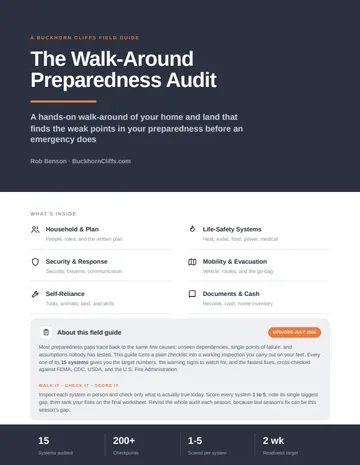
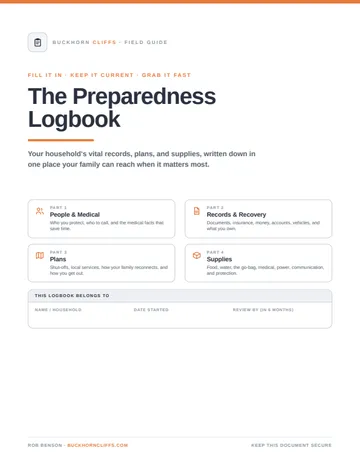
Every recipe and resource from the Prepper's Chemical Survival Guide, all six field guides to read here and download, the full audit and logbook, all twelve reference charts, and no ads.
My Manual · included
Build your own field manual
The most useful thing a membership gives you. Save any page on this site, recipes, charts, and whole field guides included. Arrange them in the order you want, name it, and print one manual with a cover and contents, or keep it as a PDF that opens with no signal.
- It works when this site does not
- Only your pages
- Anyone in the house can use it
- One current copy, not a pile of printouts
- The house binder
- A copy for the bug-out bag or truck
- A copy for family
- An offline PDF

Stay Ready
New entries, updates, and useful instruction.
Stay one step ahead on your preparedness journey.