US Army · TC 3-97.61 · November 2025
The Army's mountaineering manual, rewritten in November 2025: 432 pages on terrain, weather, altitude, avalanches, rope work, stream crossing and rescue.
The Army PDF is free and in the public domain. The field guide comes with membership, or it's $10 as a PDF. All 9 manuals
- 432pages
- 16chapters
- 3appendixes
- 5classes of terrain
- 10essentials
- 2025edition
Searches all 432 pages of the Army PDF and opens it at the page you pick.
Two versions of this manual
The official Army PDF
TC 3-97.61 exactly as the US Army published it. It's a work of the US government, so it's in the public domain, and it's marked "Approved for public release; distribution is unlimited."
- All 432 pages: 16 chapters and three appendixes
- The longest manual in this set
- The Army's file, unedited
The Buckhorn Cliffs field guide
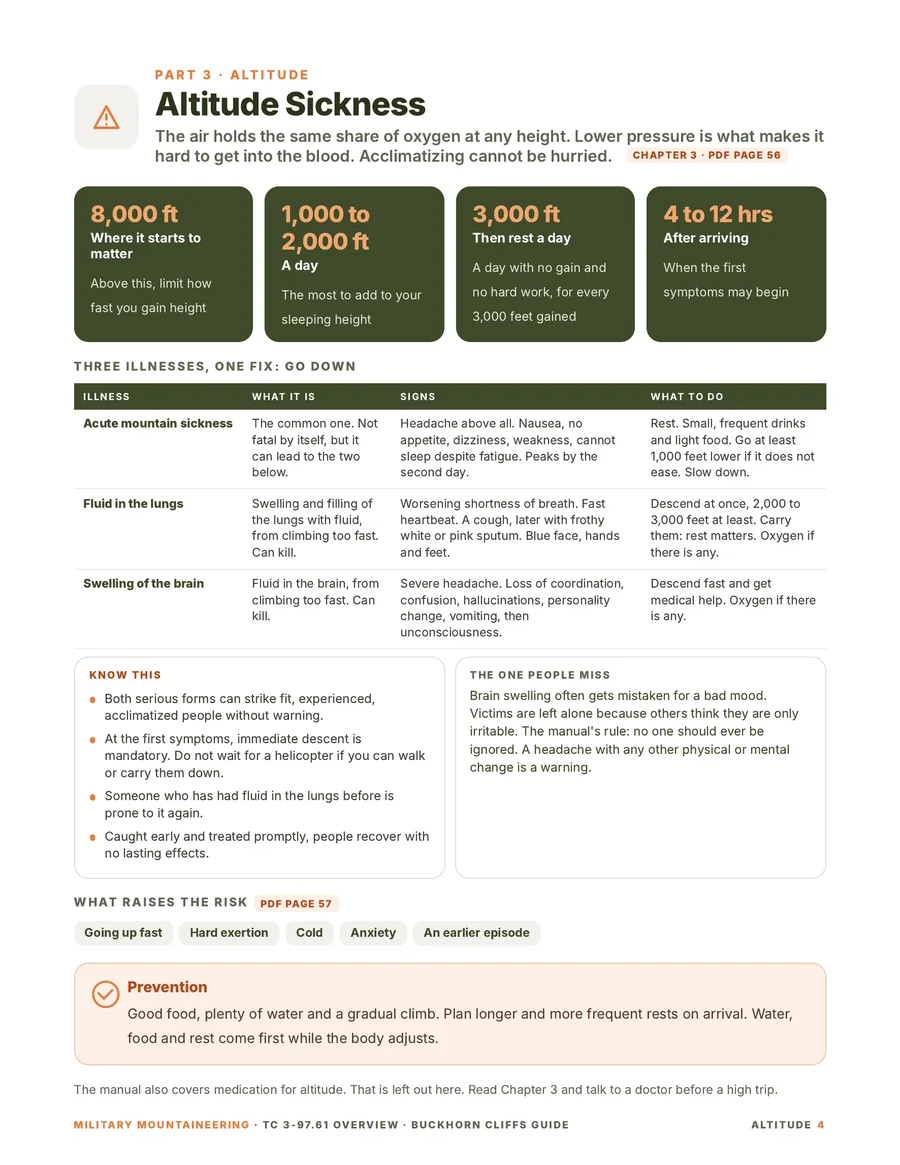
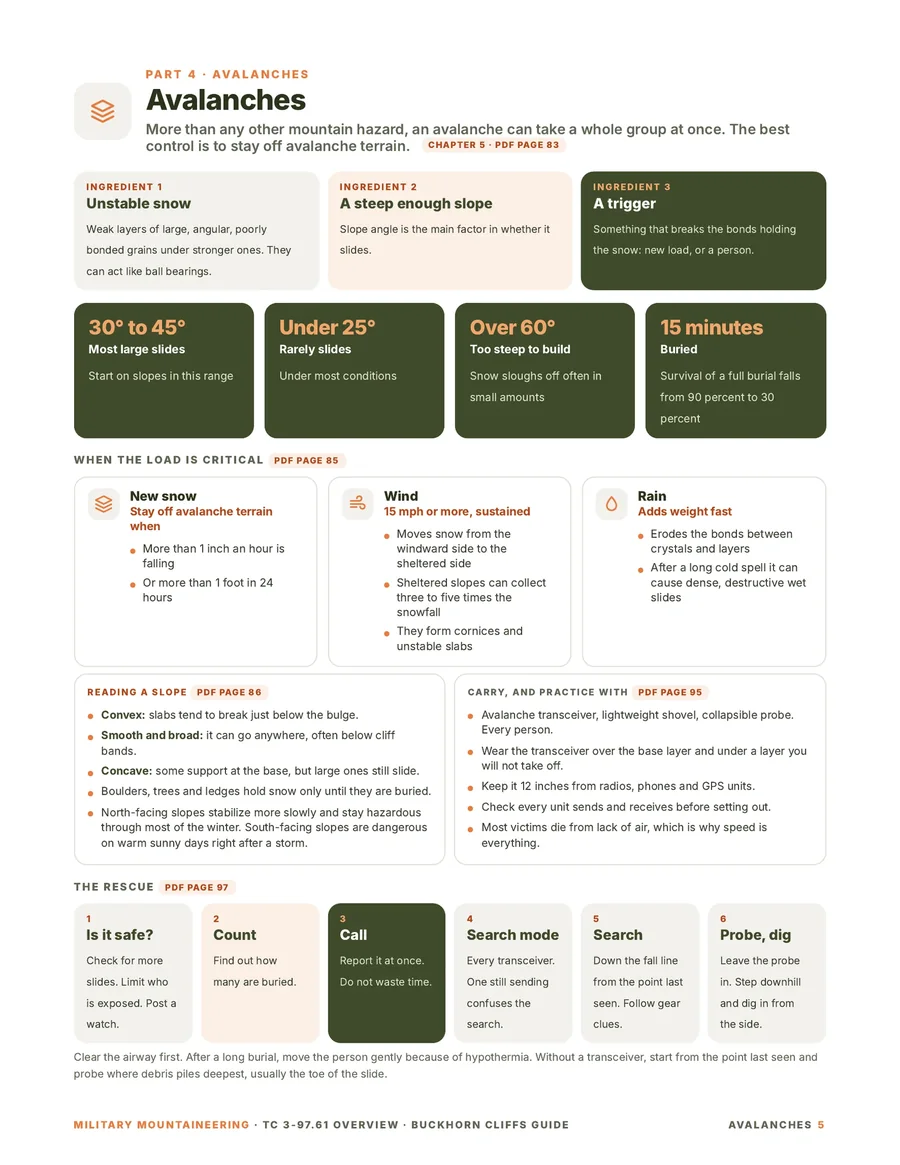
My 8-page overview of the same manual: terrain and walking, weather, altitude, avalanches, what to carry, stream crossing, and rope care. It's written from the Army's text and is not an Army publication.
- 8 pages in place of 432
- Altitude illness and avalanche rescue on a page each
- Leaves out anchors, belays, rappelling and hauling, which take hands-on training
- Boxes, charts, steps and checklists you can use at a glance
- Every section gives the page in the Army PDF
- Downloads as a PDF and saves to My Manual
Only want this one? Buy the field guide PDF for $10. This page is the free breakdown of the Army PDF. The field guide is the short version to print and keep.
- The most complete free mountain reference there is, and current.
- The chapters on weather, altitude and avalanches apply to any hiker.
- Knots are drawn step by step.
- More than half of it is technical rope work that needs an instructor.
- It is long. Finding one answer takes time.
- Parts are written for moving military units, not small parties.
- You hike, hunt or travel in mountains.
- You live at altitude.
- You want a knot and rope reference with drawings.
How the 432 pages break down
Mountain mobility, knots, anchors and climbing systems make up most of the book. Each bar opens the PDF at that part.
Part by part
Mountain Environment
16 pages, starts on PDF page 21
Terrain, rock and snow, the classes of terrain, and mountain weather.
Training Military Mountaineers
8 pages, starts on PDF page 37
The three levels of military mountaineer.
Environmental Injuries
16 pages, starts on PDF page 45
Cold injuries, then altitude: acclimatization and the three altitude illnesses.
Mountain Subsistence and Sustainment
22 pages, starts on PDF page 61
Fitness, food, clothing, what to carry, water and camps.
Avalanche
20 pages, starts on PDF page 83
How avalanches form, how to avoid them, and how to search and dig.
Mountain Mobility
56 pages, starts on PDF page 103
Walking, scrambling and climbing rock, then moving on snow and ice.
Navigation in Mountainous Terrain
10 pages, starts on PDF page 159
Tools and techniques for route finding.
Knot Tying and Rope Management
46 pages, starts on PDF page 169
Rope, webbing and carabiners, every knot drawn, and rope care.
Anchor Selection and Construction
40 pages, starts on PDF page 215
Natural and artificial anchors in rock, ice, earth and snow.
Rope Systems for Climbing
40 pages, starts on PDF page 255
Belayed, top rope and lead climbing.
Fixed Ropes
28 pages, starts on PDF page 295
Fixed ropes and rappelling.
Hauling and Lowering Techniques
20 pages, starts on PDF page 323
Mechanical advantage systems for moving loads.
Mountain Stream Crossing
10 pages, starts on PDF page 343
Choosing a site and crossing alone, as a team, or on a rope.
Glacier Travel and Crevasse Rescue
20 pages, starts on PDF page 353
Roped glacier travel and getting someone out of a crevasse.
Mountain Rescue and Evacuation
18 pages, starts on PDF page 373
Moving casualties with and without a litter.
Rope Bridges
14 pages, starts on PDF page 391
Building and crossing rope bridges.
Numbers worth knowing
These are the manual's own figures. Each tile opens the page it comes from.
Five classes of terrain
The manual rates ground by how hard it is to move over and what a fall would cost. It uses the same classes civilian climbers use in the United States.
| Class | The ground | What it takes |
|---|---|---|
| 1 | Gentle slopes and easy trails | Walking |
| 2 | Steeper, rugged, off trail | Hands for balance |
| 3 | Scrambling with plenty of holds | Some climbing experience. Ropes in bad conditions |
| 4 | Harder scrambling, often exposed | Belays or fixed ropes |
| 5 | Climbing terrain | Technical climbing with a belay |
The knots it teaches
Chapter 8 draws each of these one step at a time.
Edition and history
TC 3-97.61, Military Mountaineering, is dated 26 November 2025. It replaced the edition of 26 July 2012.
As of November 10, 2026 the Army lists it as the current edition.
TC 3-97.61 is a US Army publication, in the public domain as a work of the US government and marked "Approved for public release; distribution is unlimited." The Buckhorn Cliffs field guide is my own summary of it and is not an Army publication. BuckhornCliffs.com is not affiliated with or endorsed by the US Army or the Department of Defense.
Questions this answers
Tap a question for the short answer.
What is the army mountaineering manual
TC 3-97.61, Military Mountaineering, dated November 2025. It is 432 pages and approved for public release.
How fast should you gain altitude
The Army manual says that above 8,000 feet you should add no more than 1,000 to 2,000 feet a day to where you sleep, with a rest day for every 3,000 feet gained.
What slope angle causes avalanches
The manual says most large avalanches start on slopes between 30 and 45 degrees.
Keep going
Related to this
Membership · $49.95 per year
Everything on this site, open, printable, and yours on paper
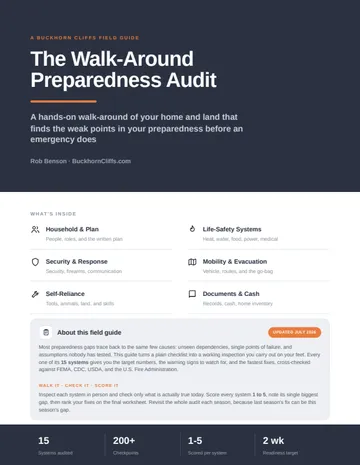
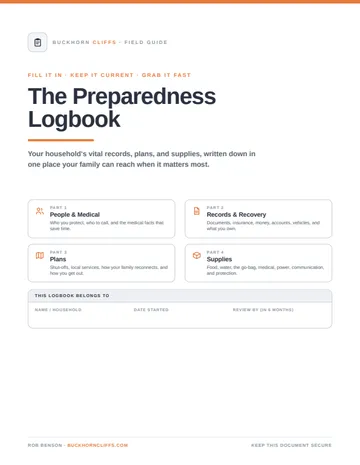
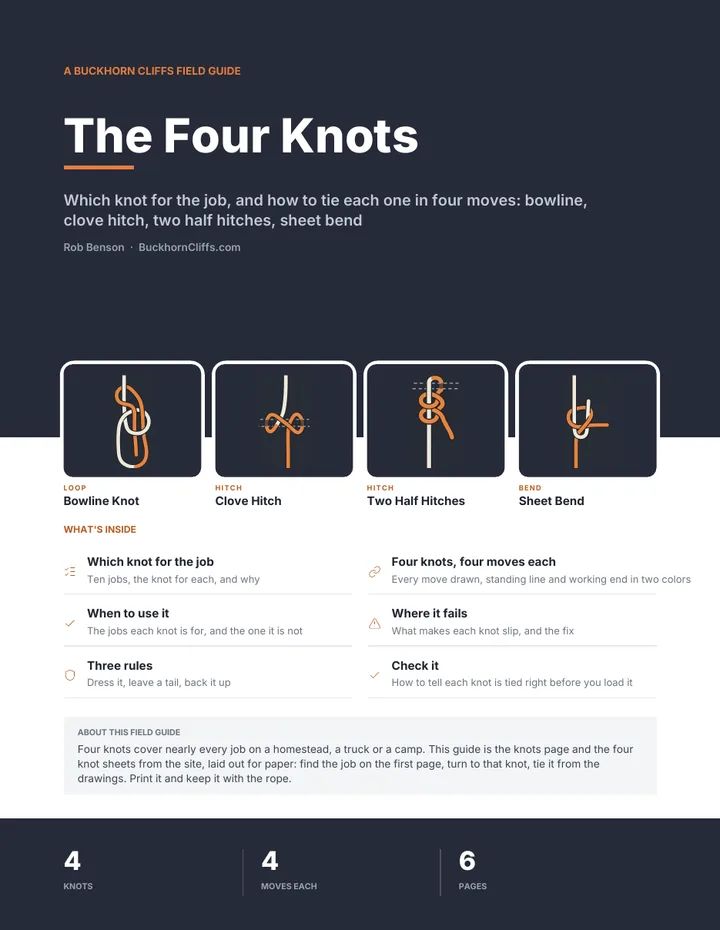
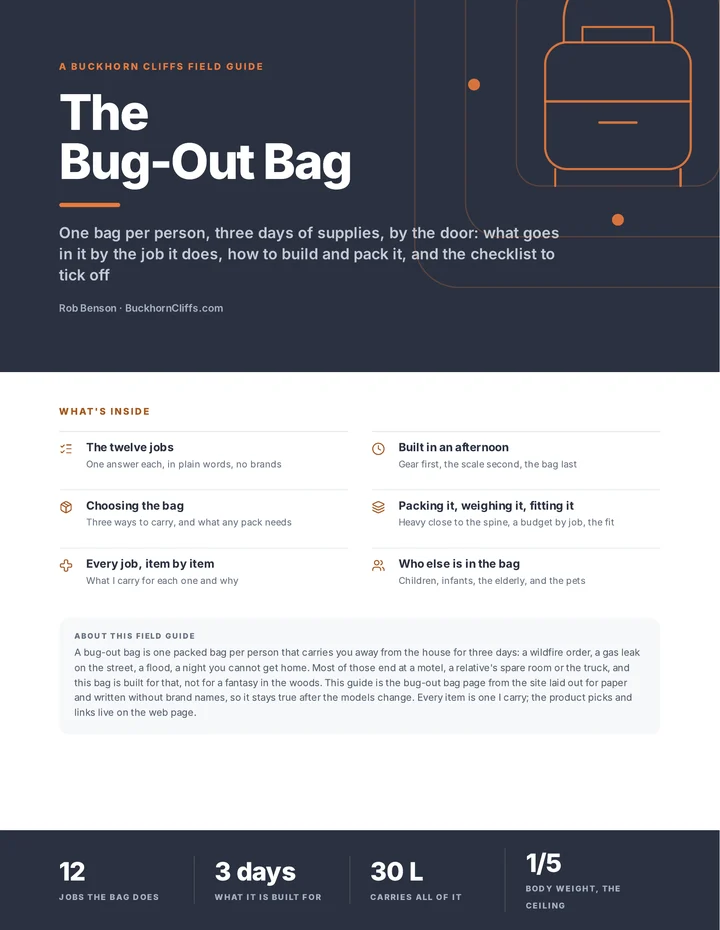
When the grid goes down, this site goes with it. Paper does not. Membership opens every member page and every recipe from the book, hands over all thirteen field guides as PDFs, and builds a binder from the pages your household uses.
- 158member pagesopen in full, every amount and every step
- 138compound recipesfrom the hardcover book, exact amounts. Pick any and add them to your manual
- 13field guides304 pages of PDFs, $130 bought one at a time
- 9military field guidesUS Army manuals cut to 66 pages and laid out to use
- 1manual of your ownbuilt from any page here, printed with your cover
- Every member page in full. the exact amounts, every step, every parts list
- Every recipe and resource from the book. all 138 from the Prepper's Chemical Survival Guide, searchable here
- All 13 field guides. read them here or download the PDFs, 304 pages
- A field guide for each of 9 Army manuals. the survival, first aid and other US Army manuals, each cut to 10 pages or fewer
- My Manual. save any page, recipe or whole guide, order it, print one binder with your own cover
- The audit and the logbook, saved. your scores and checklists on every device
- Print and Save as PDF on every page. and no ads
- One payment, $49.95 per year. Cancel any time and keep access to the end of the year you paid for.
- Sign in by email. No password, and the sign-in renews itself on every visit.
- Most of the site stays free. Membership is for the depth, the PDFs and the paper.






Stay Ready
New entries, updates, and useful instruction.
Stay one step ahead on your preparedness journey.