US Army · 9 current manuals · Public domain
The Army manuals worth keeping, free to read, with a search that reaches inside every page.
The official PDFs are free to everyone. My short field guide for each one comes with membership, or it's $10 as a PDF.
- 9manuals, current editions
- 1,788pages, all searchable
- Freeofficial Army PDFs
- 9field guides for members
- 66pages across the field guides
- Nov 2026editions last checked
These are 9 US Army manuals worth keeping, each one the current edition. I picked them for skills that carry over to a house, a homestead or a pack: survival, first aid, clean water, sanitation, cold, rope work, moving on foot and shooting. Each one comes as the official Army PDF, free to everyone, and as a short Buckhorn Cliffs field guide for members.
Every manual here comes two ways
The official Army PDF
The complete manual, exactly as the US Army published it. It's a work of the US government, so it's in the public domain, and each one is marked "Approved for public release; distribution is unlimited."
- Every chapter, figure and table, from 48 to 432 pages
- Written for soldiers, in Army language, with Army gear in mind
- The Army's file, unedited. Nothing added, nothing cut
- Free to download, print and share
The Buckhorn Cliffs field guide
My overview of the same manual, cut to the parts worth knowing cold and laid out to use fast. It's written from the Army's text and is not an Army publication.
- 10 pages or fewer, where the manual runs into the hundreds
- Only the methods and numbers that matter, with the Army's jargon taken out
- Boxes, charts, steps and checklists, like the other field guides here
- Every section gives the page in the Army PDF, so the full detail is one click away
- Downloads as a PDF and saves to My Manual
Start with the field guide to learn it. Keep the Army PDF for the full drawings and the detail.
The Army's top-level doctrine. Most of the famous hands-on FMs, like the old survival and first aid manuals, have been replaced by the two types below.
How a job gets done, step by step. The current survival and first aid manuals are both ATPs.
Written to teach one skill: land navigation, a rifle, hygiene, hand signals. Usually the easiest to read.
How I picked them
- Current edition only. If the Army replaced a manual, the old one isn't here.
- Approved for public release. That line is printed on the cover of every manual here.
- A skill you can use without Army gear. Staff work and anything about making weapons stayed out.
- The Army's own file. No reprints, no scans, no retyped copies.
What you get on each card
- The manual number, the date it was published and its page count.
- What it's good for, in one line.
- Why it's worth having and what's in the PDF.
- Links to the pages on this site that cover the same ground.
- A breakdown page on this site, chapter by chapter, with the page to open for each.
- Both versions: the official Army PDF, and the field guide for members.
It searches every page of the Army PDFs, 1,788 pages in all, and opens the PDF at the page you pick.
9 manuals
-
ATP 3-50.21September 2018 · 228 pagesStart hereSurvival
Survival
The Army's current survival manual. Start here if you only download one.
Why it's worth having
Every survival basic in one book, with a drawing for nearly every method. If you've never built a still, set a snare or tied a lashing, the picture is on the page, and it still opens when the internet is down.
What's in the PDF
- Water: three kinds of still, a beach well, filtering, and boil times
- Food: plant identification, 12 snares and traps, butchering, fishing gear
- Fire: site, fire lays, and 10 ways to start one
- Shelter: poncho, debris hut, snow cave, desert and swamp builds
- Navigation by shadow, watch and stars
- 15 knots and 3 lashings in the appendix
All 9 chapters and appendixes
- Overview
- Survival medicine
- Water
- Food
- Fire
- Shelter and clothing
- Movement and navigation
- Survival equipment
- Survival knots and rope
Came out of the revision of FM 3-05.70.
-
ATP 4-02.11March 2026 · 254 pagesStart hereMedical
Casualty Response, Tactical Combat Casualty Care, and First Aid
The newest Army first aid manual, written for soldiers who are not medics.
Why it's worth having
Published March 2026, so it's the newest first aid manual the Army has, and it's written for people who aren't medics. Treatment follows one order, MARCH: massive bleeding, airway, respiration, circulation, hypothermia. It has 109 figures.
What's in the PDF
- Massive bleeding control, chapter 4
- Airway, breathing and circulation, chapters 5 to 7
- Burns, fractures and splinting, chapters 12 and 13
- Bites and stings, chapter 16
- Heat and cold injuries, chapter 17
- What goes in a first aid kit, appendix A
All 22 chapters and appendixes
- Casualty response
- Casualty extraction and movement
- Fundamentals of tactical combat casualty care
- Massive bleeding control
- Airway control
- Respiration and breathing control
- Circulation control
- Hypothermia control
- Treatments
- Eye trauma
- Head injury
- Burns
- Fractures and splinting
- Expedient techniques for other secondary injuries
- Casualty monitoring and evacuation preparation
- Bites and stings
- Climatic and environmental injuries
- Sickle cell trait
- Environment
- Combat and operational stress control
- First aid case and kits
- Rescue equipment
Replaced TC 4-02.1, First Aid (2016).
-
TC 4-02.3May 2015 · 48 pagesWater and Sanitation
Field Hygiene and Sanitation
How one person stays healthy without plumbing, trash pickup or a clinic.
Why it's worth having
At 48 pages it's the shortest manual here and the fastest to read. It covers what keeps people from getting sick when the plumbing and trash pickup stop, and its appendix is a plain guide to disinfecting water.
What's in the PDF
- What one person does: washing, feet, food, water, sleep
- What a group does: water supply, waste, pests
- Disinfecting water with bleach, chlorine tablets, iodine tablets and calcium hypochlorite
- A bleach dose table for 5 percent household bleach
- How to tell when iodine tablets have gone bad
All 4 chapters and appendixes
- Health threats in military operations
- Individual preventive medicine measures
- Unit-level preventive medicine measures
- Techniques and procedures for disinfecting water
Replaced FM 21-10.
-
ATP 4-25.12April 2014, with changes to August 2025 · 174 pagesWater and Sanitation
Unit Field Sanitation Teams
The same subject for a group: water, waste and pests for many people in one place.
Why it's worth having
This is the group version of field hygiene: how to keep a camp full of people from getting sick. It has 22 tables, including bleach and calcium hypochlorite dose calculators and a work, rest and water guide for heat. It was updated in August 2025.
What's in the PDF
- Unit water supply and chlorine dosing, chapter 3
- Food service sanitation, chapter 4
- Latrines and waste, chapter 5
- Rodents, insects and the diseases they carry, chapter 6
- Heat injury and the work, rest and water guide, chapter 7
- Cold injury and wind chill charts, chapter 8
All 11 chapters and appendixes
- Unit field sanitation teams
- Health threats to soldiers in the field
- Unit water supply
- Food service sanitation
- Waste management
- Pest management
- Heat injury
- Cold injury
- Toxic industrial material hazards
- Noise hazards
- Exercise collapse associated with sickle cell trait
Replaced FM 4-25.12, which was FM 21-10-1.
-
TC 21-3September 2025 · 136 pagesCold and Mountain
Soldier's Handbook for Individual Operations and Survival in Cold-Weather Areas
Living and working in deep cold. A new edition, the first since 1986.
Why it's worth having
Rewritten in 2025 after almost 40 years. It teaches dressing by one rule, C-O-L-D: keep it clean, avoid overheating, wear it loose, keep it dry. It also gives the numbers cold demands, like at least 3.5 quarts of water and about 4,600 calories a day for hard work.
What's in the PDF
- Layering and the C-O-L-D rule, chapter 2
- Food, water and cold injuries, chapter 4
- A wind chill chart
- Skis against snowshoes, and when to use each
- Minimum ice thickness for crossing
- Cold weather survival, chapter 7
All 10 chapters and appendixes
- Introduction to cold-weather operations
- Personal clothing and equipment
- Weapons and ammunition
- Optimizing physical care
- Occupy a patrol base
- Individual movement
- Survival
- Measurement conversions
- Platoon task
- Emergency visual signals
Replaced the March 1986 edition.
-
TC 3-97.61November 2025 · 432 pagesCold and Mountain
Military Mountaineering
The biggest rope and knot reference the Army prints, plus mountain travel and rescue.
Why it's worth having
At 432 pages and 244 figures it's the largest manual here, and new as of November 2025. Chapter 8 draws more than 25 knots and hitches, from the figure-eight family to the prusik and Munter hitch. The rest covers anchors, hauling loads, crossing streams and moving an injured person over rough ground.
What's in the PDF
- Knot tying and rope management, chapter 8
- Anchors, chapter 9
- Hauling and lowering loads, chapter 12
- Mountain stream crossing, chapter 13
- Rescue and evacuation, chapter 15
- Altitude, cold and other environmental injuries, chapter 3
All 19 chapters and appendixes
- Mountain environment
- Training military mountaineers
- Environmental injuries
- Mountain subsistence and sustainment
- Avalanche
- Mountain mobility
- Navigation in mountainous terrain
- Knot tying and rope management
- Anchor selection and construction
- Rope systems for climbing
- Fixed ropes
- Hauling and lowering techniques
- Mountain stream crossing
- Glacier travel and crevasse rescue
- Mountain rescue and evacuation
- Rope bridges
- Climbing route classification
- Route planning tools
- Technical equipment
Replaced the July 2012 edition.
-
TC 3-21.60March 2017 · 96 pagesFieldcraft
Visual Signals
Signaling with hands, flags, panels, mirrors and flares when radios are down.
Why it's worth having
Almost all pictures: 130 figures in 96 pages. It gives a group a shared set of signals that work with no radio and no talking, and it covers how to signal an aircraft from the ground.
What's in the PDF
- Hand and arm signals for people on foot
- Signals for drivers, convoys and traffic control
- Ground-to-air panel signals
- Ground-to-air emergency signals and codes
- Signaling with mirrors and strobes
- Handheld flares and smoke
All 4 chapters and appendixes
- Hand-and-arm signals for dismount operations
- Hand-and-arm signals for ground vehicles
- Hand and arm signals for aircraft
- Pyrotechnics
Replaced FM 21-60.
-
ATP 3-21.18July 2025 · 168 pagesFieldcraft
Foot Marches
Covering distance on foot with a load: pace, rest, feet and water.
Why it's worth having
It puts numbers on walking out with a pack. A group on a road in daylight covers about 4 kilometers an hour with a 10-minute rest each hour, and a fighting load should run about 30 percent of body weight. The foot care appendix alone is worth the download.
What's in the PDF
- March rates and when to rest, chapter 1
- How much to carry and how to pack it, chapter 3
- Posture and body mechanics under a load, appendix C
- A training plan to build up to distance, appendix D
- Foot care and blister treatment, appendix E
- Heat, cold and overuse injuries, appendix F
All 9 chapters and appendixes
- Movement fundamentals
- March execution
- Soldier load
- March procedures
- Movement order and movement table
- Posture and body mechanics
- Training for the march
- Foot care
- Related injury and illness awareness
Replaced the April 2022 edition.
-
TC 3-22.9May 2016 · 252 pagesFirearms
Rifle and Carbine
The current Army rifle manual for the M4 and M16 family: how the rifle works and how to shoot it.
Why it's worth having
The Army's rifle manual for the M4 and M16, with 113 figures in 252 pages. It explains how the rifle cycles, how to build a stable position, and how to zero, and it has a flow chart for clearing malfunctions.
What's in the PDF
- How the rifle works, chapter 2
- Optics and aiming devices, chapter 3
- Stability, aim and trigger control, chapters 6 to 8
- Malfunctions and the corrective action flow chart, chapter 8
- Ammunition and ballistics, appendixes A and B
- Zeroing and 25-meter zero offsets, appendixes E and F
All 15 chapters and appendixes
- Overview
- Rifle and carbine principles of operation
- Aiming devices
- Mountable equipment
- Employment
- Stability
- Aim
- Control
- Movement
- Ammunition
- Ballistics
- Complex engagements
- Drills
- Zeroing
- 10-meter boresight offsets and 25-meter zero offsets
Includes changes 1 to 3. Replaced FM 3-22.9.
No manual matches that. Try a broader word, or .
How to use them
They're written for soldiers with issued gear, a medic and a supply line. The methods carry over. The equipment lists mostly don't.
Each card shows when the manual was published. Some are years old because the Army hasn't replaced them.
Download the ones you want and keep them on a drive or print the chapters you'd use. They do you no good on a website when the internet is down.
The official PDFs are US Army publications, in the public domain as works of the US government and marked "Approved for public release; distribution is unlimited." The Buckhorn Cliffs field guides are my own summaries of them and are not Army publications. BuckhornCliffs.com is not affiliated with or endorsed by the US Army or the Department of Defense. Editions were checked against the Army Publishing Directorate catalog on November 10, 2026.
Questions this answers
Tap a question for the short answer.
Are military field manuals free to download
Yes. US Army manuals are public domain as works of the US government, and those marked approved for public release are free from the Army Publishing Directorate. This page links the current edition of 9 of the most useful ones.
What is the current army survival manual
ATP 3-50.21, Survival, published September 2018. It replaced FM 3-05.70.
What is the current army first aid manual
ATP 4-02.11, Casualty Response, Tactical Combat Casualty Care, and First Aid, published March 2026. It replaced TC 4-02.1.
What I use for this
Gear from my recommended list
Keep going
Related to this
Membership · $49.95 per year
Everything on this site, open, printable, and yours on paper
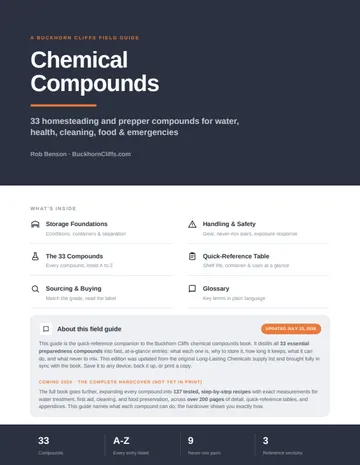
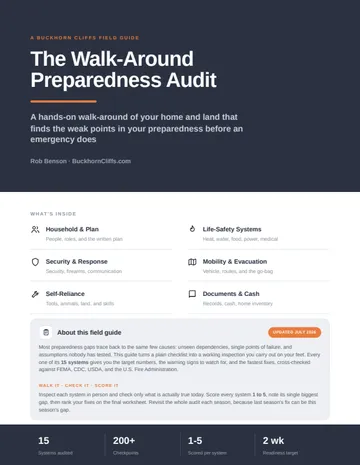
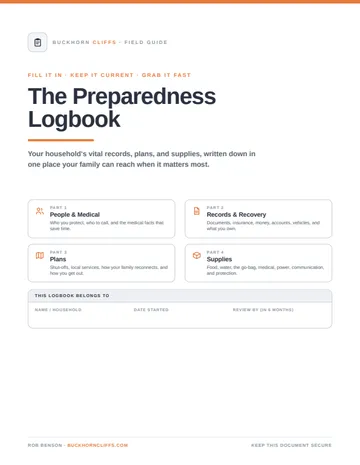
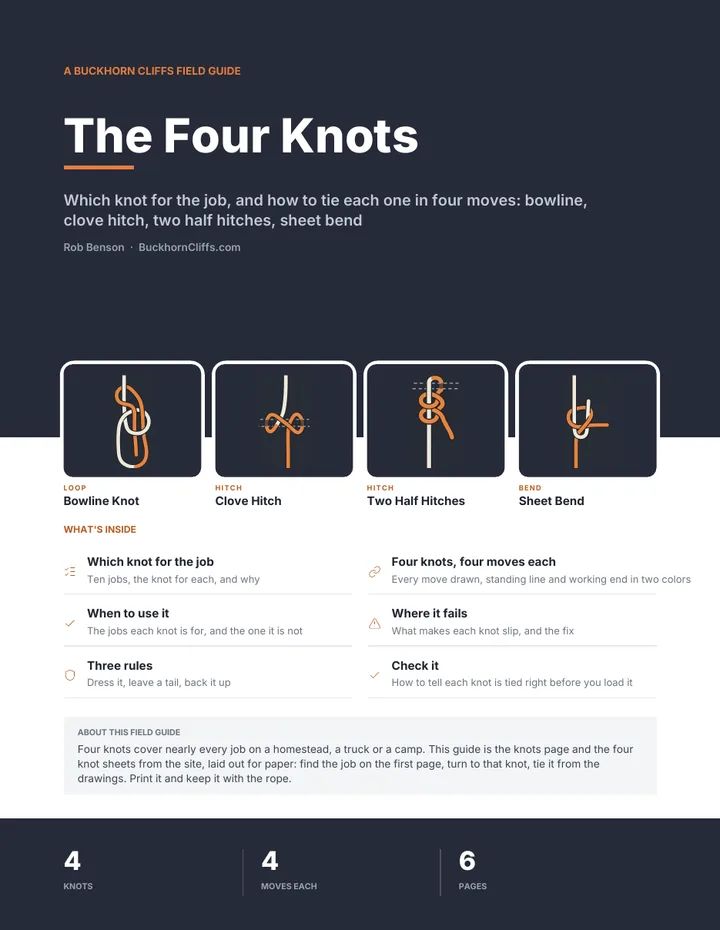
When the grid goes down, this site goes with it. Paper does not. Membership opens every member page and every recipe from the book, hands over all thirteen field guides as PDFs, and builds a binder from the pages your household uses.
- 158member pagesopen in full, every amount and every step
- 138compound recipesfrom the hardcover book, exact amounts. Pick any and add them to your manual
- 13field guides304 pages of PDFs, $130 bought one at a time
- 9military field guidesUS Army manuals cut to 66 pages and laid out to use
- 1manual of your ownbuilt from any page here, printed with your cover
- Every member page in full. the exact amounts, every step, every parts list
- Every recipe and resource from the book. all 138 from the Prepper's Chemical Survival Guide, searchable here
- All 13 field guides. read them here or download the PDFs, 304 pages
- A field guide for each of 9 Army manuals. the survival, first aid and other US Army manuals, each cut to 10 pages or fewer
- My Manual. save any page, recipe or whole guide, order it, print one binder with your own cover
- The audit and the logbook, saved. your scores and checklists on every device
- Print and Save as PDF on every page. and no ads
- One payment, $49.95 per year. Cancel any time and keep access to the end of the year you paid for.
- Sign in by email. No password, and the sign-in renews itself on every visit.
- Most of the site stays free. Membership is for the depth, the PDFs and the paper.






Stay Ready
New entries, updates, and useful instruction.
Stay one step ahead on your preparedness journey.