BUCKHORN CLIFFS

Compounds and Cleaning · Reference

Storing your compounds: conditions, containers, packing and labels

The conditions and containers that keep compounds good for years: temperature, light, and humidity targets, which container for which compound, the six packing steps, and what goes on every label.

Quick facts

Temperature
50 to 70°F, steady
Humidity
Under 50%
Default container
Glass, never metal
Inspect
Monthly

Proper storage is what separates a supply that lasts for years, or indefinitely, from one that fails in months. Control three things (temperature, light, and moisture), pick the right container, and keep reactive compounds apart.

The conditions that matter

50-70°FSteady temperature
Under 50%Relative humidity
OpaqueLight barrier
MonthlyInspect & rotate

The three environmental factors

Temperature: Hold a steady 50-70°FSwings expand and contract containers, cracking seals. Keep supplies away from furnaces, vents, and sun.
Light: Block it outUV degrades most compounds. Use opaque bins, amber glass, or Mylar, and keep clear jars in a closed cabinet.
Humidity: Keep it under 50%Moisture drives breakdown, mold, and caking. There is no such thing as too dry; use silica-gel desiccants in sealed jars.

Where to keep it

Good locations
  • Basements and root cellars
  • Interior closets
  • Climate-controlled rooms
  • Heated or cooled living-space cabinets
Places to avoid
  • Attics, garages, and sheds
  • Near furnaces, vents, or appliances
  • Direct sunlight and windows
  • Wet or below-grade spaces

Containers & Moisture Control

Oxygen, light, and moisture drive most degradation, so the container is your first line of defense. Match the vessel to what you are storing, seal it well, and add the right tool to fight the threat that matters.

The three workhorse containers

Glass jars: Inert and permanentBest for acids, bases, and oxidizers. The one exception is strong lye, which slowly etches glass, so keep lye in HDPE. Use plastic-lined caps, never metal. Amber glass shields light-sensitive compounds.
HDPE plastic: Light and food-safeBest for non-corrosive powders and dilute solutions with tight lids. Avoid bleach and strong peroxide; use glass for those. Lye is the exception and belongs in HDPE.
Mylar bags: Total light and air barrierBest for dry powders and granules with a desiccant, then heat-sealed. Not for liquids or sharp items.

Two tools, two different threats

Fights moisture: Silica-Gel DesiccantsColor-indicating beads absorb humidity inside any sealed container holding a dry powder or granular compound. When the color changes, they are saturated.
Fights air: Oxygen AbsorbersIron packets remove oxygen, but only for dried foods with residual moisture, never for pure dry chemical powders, salt, or baking soda, which clump or fail.

Sizing an oxygen absorber (dried foods only)

300-500 ccPer gallon of food
1500-2000 ccPer 5-gallon bucket
Dried foodsAbsorbers only, not powders
One per jobNever both in one container

Default to glass, never metal

Glass never reacts, so it is the safe default for anything corrosive, reactive, or light-sensitive. Metal corrodes and can contaminate the contents. Keep every compound in glass, HDPE, or Mylar, and store it cool, dark, and off the floor.

Packing & Labeling for the Long Term

A container only protects what you pack into it correctly. Follow the same six steps every time, keep your desiccants working, and label every jar the same way so an organized store stays a usable one.

Pack a container in six steps

  1. 1Clean & dryResidue and leftover moisture trigger reactions and clumping.
  2. 2Portion smallSplit into use-size amounts so the rest stays sealed.
  3. 3Add protectionOxygen absorber for foods, desiccant for powders.
  4. 4Seal tightAirtight lid or heat-seal, with no trapped air gaps.
  5. 5Label & dateName, hazard note, and the fill date on every container.
  6. 6Store cool & dark50 to 70°F, out of sunlight and off the floor.

Recharge silica gel, do not toss it

Heat to dry200 to 250°F, 1-2 hr
Cool sealedIn a closed jar
Reuse itThey never expire

Label and rotate

Label every containerMark each one the same way: name and formula, a hazard note, the fill date, quantity, storage location, and grade. Apply with waterproof ink and log the same details in a simple inventory.
Organize and rotateGroup acids, bases, and oxidizers on separate shelves. Use the oldest stock first (FIFO), keep heavy items on lower shelves, and inspect monthly for leaks, discoloration, or spent desiccants.

Field notes

A few habits from my own storage area that the sections above do not spell out.

  • Room: Use a clean, dry, lockable room or cabinet, and keep hazardous materials out of reach of children and pets. Skip bathrooms. Insulate the space to hold the temperature steady, and run a dehumidifier if you live in a humid climate.
  • Shelving: Keep containers away from the walls as well as off the floor, and do not overcrowd shelves, since packed shelves lead to damage and spills. Look for signs of pests when you inspect.
  • Light: A curtain or cover over open shelving blocks light when a closed cabinet is not an option.
  • Seals: Vacuum sealing is another way to cut air exposure. Test seals regularly to confirm they still hold, and replace oxygen absorbers once they are spent.
  • Flammables: Keep them away from heat and open flame, and check the product label for its storage needs.
  • Baking soda: Never store it in aluminum or any other reactive metal.
  • Labels: Add instructions for use next to the hazard note.

Questions this answers

Tap a question for the short answer.

What container should I store chemicals in?

Default to glass with a plastic-lined cap, never metal, especially for acids, bases and oxidizers, and pick amber glass for light-sensitive compounds. HDPE plastic suits non-corrosive powders and dilute solutions, but not bleach or strong peroxide. Lye is the exception: it slowly etches glass, so it goes in HDPE. Mylar bags work for dry powders with a desiccant, not liquids or sharp items.

Can I use oxygen absorbers with chemical powders?

No. Oxygen absorbers are only for dried foods with residual moisture. Pure dry chemical powders, salt and baking soda clump or fail with them, so put a silica-gel desiccant in those containers instead, and never put both in one container.

How do I recharge silica gel?

Heat the saturated beads at 200 to 250°F for 1 to 2 hours to dry them, let them cool inside a closed jar, then put them back to work. Silica gel never expires, so there is no reason to throw it out.

What should go on a storage label?

Mark every container the same way: name and formula, a hazard note, the fill date, quantity, storage location and grade. Write it in waterproof ink and record the same details in a simple inventory.

Keep going

Read nextStorage, shelf life and inventory: store it right, track it, know when it's spent How to store each of the 33 compounds against its biggest enemy, the sign each one is wearing out, the inventory sheet with a free fillable tracker, and the twice-a-year check.Compounds and Cleaning · Reference

Related to this

Membership · $49.95 per year

There is a lot more behind the lock

158member pages in full
125recipes with exact amounts
6field guide PDFs, 206 pages
1manual of your own, built from any page

Every recipe and resource from the Prepper's Chemical Survival Guide, all six field guides to read here and download, the full audit and logbook, all twelve reference charts, and no ads.

My Manual · included

Build your own field manual

The most useful thing a membership gives you. Save any page on this site, recipes, charts, and whole field guides included. Put them in your order, name it, and print one manual with a cover and contents, or keep it as a PDF that opens with no signal.

  • It works when this site does not
  • Only your pages
  • Anyone in the house can use it
  • One current copy, not a pile of printouts
  • The house binder
  • A copy for the bug-out bag or truck
  • A copy for family
  • An offline PDF

Join for $49.95 per year

Membership

Save to My Manual is a member tool

Members build their own manual from the pages that fit their household, then print it or keep it as a PDF.

Why it matters

When the grid goes down, this site goes with it. Paper does not. Membership is how you get the whole manual off the screen and onto the shelf: every page in full, every field guide, and a binder built for your own household.

The field guide library

All six field guides. 206 pages. Included.

The complete Buckhorn Cliffs PDF set, yours to download, print, and keep from the day you join.

$60if bought one at a time

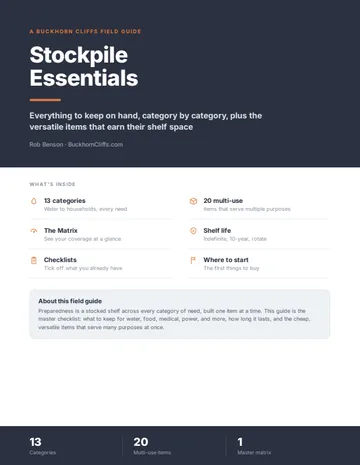
  • Cover of Stockpile Essentials Field GuideStockpile Essentials39 pagesEverything to keep on hand, category by category, plus the 20 multi-use items.
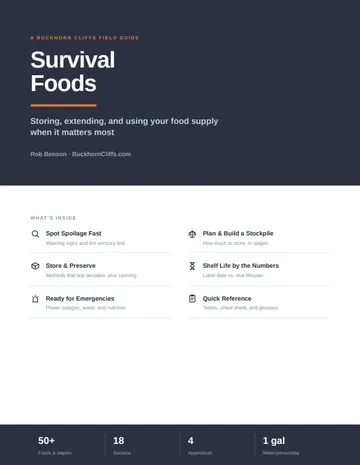
  • Cover of Survival Foods Field GuideSurvival Foods35 pagesStoring, extending, and using the food supply. Real shelf life by the numbers.
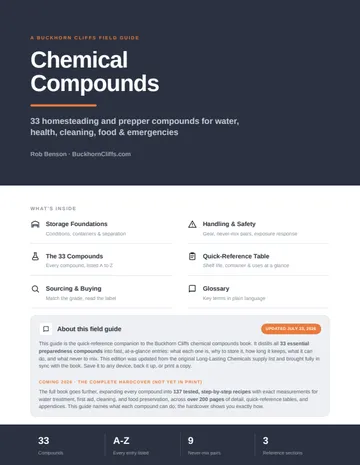
  • Cover of Chemical Compounds Field GuideChemical Compounds29 pagesThe 33 compounds: storage, top uses, hazards, and the never-mix chart.
  • Cover of Spare Parts and Repair Stock Field GuideSpare Parts and Repair Stock40 pagesWhat to keep on hand to fix the home and land when the supply chain breaks.
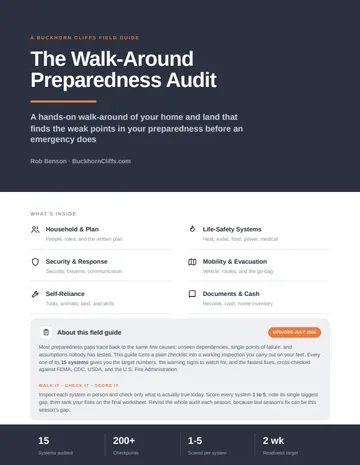
  • Cover of Walk-Around Preparedness AuditWalk-Around Preparedness Audit33 pagesFifteen systems scored 1 to 5, with the printable scorecard.
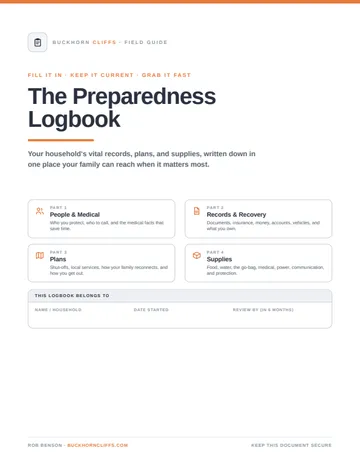
  • Cover of The Preparedness LogbookPreparedness Logbook30 pagesThe household information that needs to be on paper.

My Manual · included

Build your own field manual

The most useful thing a membership gives you. No book fits your household exactly. My Manual does. Save any page on this site, recipes, charts, and whole field guides included, put them in your order, and print one manual with your name on the cover. It holds only what is relevant to you, and nothing you would skip.

Why it matters

  • It works when this site does notNo power and no signal means no website. A printed manual and an offline PDF still open, which is the whole point of writing any of this down.
  • Only your pagesThis site covers every household. Yours needs a fraction of it. Your manual holds the pages that match your water source, your climate, and your gear, so nobody digs through the rest under stress.
  • Anyone in the house can use itThe person who reads this site may not be the one home when it counts. A binder on the shelf, in your order, with a contents page, is something a spouse or a teenager can follow.
  • One current copy, not a pile of printoutsEvery page prints in the same field guide layout with a cover, a contents page, and the print date. Change a page, print again, and the old copy is easy to spot.

What to build with it

  • The house binderYour water source, your climate, your gear. Only the pages you would reach for.
  • A copy for the bug-out bag or truckA short version that travels: water, first aid, comms, and the recipes you rely on.
  • A copy for familyHand a parent or a grown kid a manual built for their house and their supplies.
  • The shop and the barnParts lists, repair skills, and the never-mix chart, kept where the work happens.
  • A recipe book of your ownThe cleaners, fuels, and remedies you make, with exact amounts, in one place.
  • An offline PDFSaved to a phone, a tablet, or a drive in the Faraday bag. It opens with no signal.

How it works

  1. 1Save what fitsPress "Save to My Manual" on any page: a recipe, a chart, a guide, a parts list, or a whole field guide.
  2. 2Put it in your orderOn My Account, drag the pages into the order you want. Name the manual and add your household name.
  3. 3Print it or save a PDFOpen the preview, then print it or save a PDF. It is sized for 8.5 x 11 inch paper, with a cover and a contents page. Field guides go in exactly as the PDFs are laid out. No ads, no photos.
  4. 4Keep it currentAdd a page, pull one out, print again. The cover carries the date, so you always know which copy is the latest.

Also included

  • The entire site, unlockedAll 158 member pages open in full: exact amounts, every step, every warning, every parts list. Nothing held back.
  • Every recipe and resource in the bookAll 138 recipes and 33 compounds from Prepper's Chemical Survival Guide, with exact amounts, every step, every warning, and the reference charts.
  • A clean PDF of any entryOne press turns any page into a field guide sheet for the binder, the truck, or the shop wall.
  • Checklists and audit scores that follow youSaved to the account, so the phone, the laptop, and the shop computer always match.
  • No adsMembers read the whole site without a single ad.
$49.95per year. About 14 cents a day. Cancel any time and keep the year you paid for.