Works without power
The food shopping list: what to buy, how much, shelf life
One packet per container, never both. Dry, low-fat food at 10 percent moisture or under gets an oxygen absorber. Anything that rusts, cakes, molds or loses its snap gets a desiccant. Sugar, salt and anything moist get neither.
Oxygen absorber
Iron powder that rusts inside the packet and eats the oxygen in a sealed barrier container: Mylar, a jar, a PETE bottle or a #10 can. Rated in cc: 300 per gallon of dense food, about double for light food, 100 for a quart jar, 1500 for a 5-gallon liner.
Use it for- Wheat, white rice, corn
- Dry beans, lentils, split peas
- Pasta, rolled oats, potato flakes
- White flour, nonfat dry milk
- Freeze-dried food you pack yourself
- Dehydrated fruit and vegetables that snap when bent
- Brown rice and nuts, for months, not years
Desiccant
Silica gel or clay that holds water vapor in its pores and does nothing about oxygen. Rated in grams: about 31 g of silica gel per cubic foot of empty space, so 10 g for a .50 cal can, 5 g for a .30 cal or a gallon jar.
Use it for- Ammo, firearms, tools
- Electronics and optics
- Documents, photos, books
- Seeds for planting
- Medications, vitamins, test strips
- Herbs, spices, and any jar you open often
- The powdered compounds: baking soda, borax, citric acid and the rest
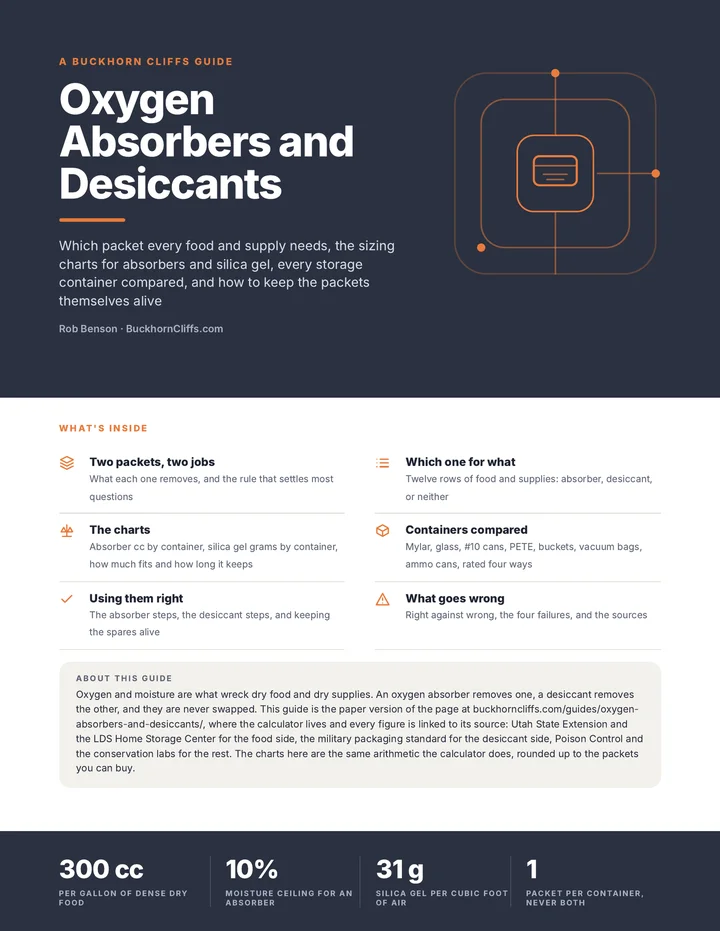
Oxygen and moisture are what wreck dry food and dry supplies. An oxygen absorber removes one, a desiccant removes the other, and they are never swapped. The two columns above are the answer most people come for; the calculator below sizes the packet for your food, your container and your climate, and the rest of the page is which packet every food and supply gets, every container compared, and how to keep the packets themselves alive. Figures from Utah State Extension, the LDS Home Storage Center and the conservation labs, each linked to its source.
CalculatorTwo packetsWhich one for whatContainersUsing absorbersUsing desiccantsKeeping packets aliveWhat goes wrong
Calculator: the absorber or desiccant for any container
01 · Food
02 · Container
03 · Fill
04 · Location
05 · Amount
01 · Container
Inside size, inches
02 · Contents
Your answer
1-gallon Mylar, white rice
What the calculator rests on. Pounds per container: the Home Storage Center's own fill weights for its 1-gallon pouches and #10 cans (wheat 7 lb and white rice 6.8 lb per gallon pouch; 5.4 lb rice, 5.5 lb wheat, 4.0 lb flour, 2.4 lb quick oats, 3.5 lb macaroni, 1.8 lb potato flakes per can), scaled to the container you chose. Absorber size: 300 cc per gallon of dense food and 1500 cc per 5-gallon liner (Home Storage Center and Utah State), light foods at about double, and the quart, 2-liter and light 5-gallon figures rounded up to the packet sizes sold, and the empty space in a part-filled container added at 795 cc of oxygen per gallon. Shelf life: the Home Storage Center's years at 75°F or cooler, halved for every 11°F warmer, the USDA rule Utah State cites. Desiccant: 1.2 units per cubic foot, about 31 g of silica gel, rounded up to a packet you can buy. These are the published rules applied as written; the one thing they cannot see is your seal, which is what the check on day two is for.
Two packets, two jobs
Both come as small packets and both go in a sealed container, which is where the confusion starts. They fight different enemies.
Oxygen absorber
- What it is
- Iron powder with salt and a little carbon. The iron rusts inside the packet, and rusting eats oxygen.
- What it removes
- Oxygen only. The nitrogen stays, so the bag pulls in tight but is not a vacuum.
- How far it goes
- To about 0.01 percent oxygen in a true barrier container, over a few days.
- What it protects against
- Rancidity, color and vitamin loss, and insects. Weevil eggs cannot hatch without oxygen.
- The rating
- Cubic centimeters of oxygen it can take up: 50, 100, 300, 500, 1000, 1500, 2000, 3000 cc.
- Where it belongs
- Dry, low-fat food in a container oxygen cannot get through: Mylar, glass, metal cans, PETE bottles.
- Where it does not
- Anything over about 10 percent moisture, sugar, salt, a plain bucket, a zip bag.
Desiccant
- What it is
- Silica gel beads, or bentonite clay. Both hold water vapor in their pores without getting wet.
- What it removes
- Water vapor. It does nothing about oxygen.
- How far it goes
- Silica gel holds up to a third of its own weight in water and keeps a sealed space under about 40 percent humidity.
- What it protects against
- Rust, mold, caking, soft crackers, dead seeds, spoiled pills, cloudy lenses.
- The rating
- Grams. A 5 g packet, a 10 g packet, a 40 to 50 g pack for an ammo can, a canister for a safe.
- Where it belongs
- Ammo, tools, firearms, electronics, documents, seeds, medications, spices, dehydrated food, and every jar of powdered compound.
- Where it does not
- A bag of grain or beans that already has an absorber, and anything that must keep its moisture, like brown sugar.
The rule that settles most questions
Food that is dry and low in fat gets an oxygen absorber. Things that rust, cake, mold or lose their snap get a desiccant. One packet per container, never both: the desiccant would starve the absorber, which is the field guide's rule. Sugar and salt get neither. Utah State Extension and the LDS Home Storage Center set the food side of this; the military packaging standard (MIL-D-3464) sets the desiccant side.
Free download
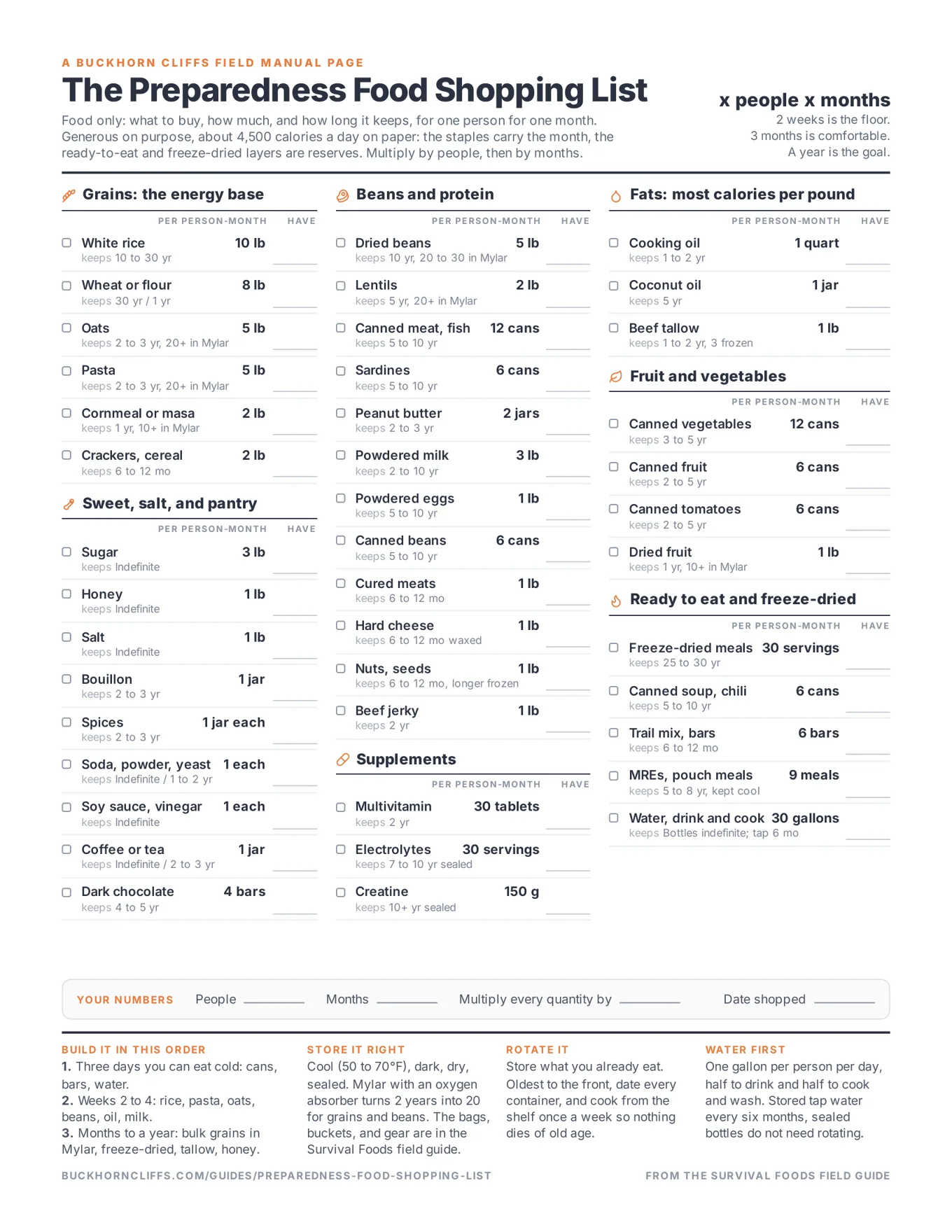
Get the one-page food shopping list
What to store, how much of it for one person for one month, and how long it keeps. One page with checkboxes, built from the Survival Foods field guide. Print it, multiply by your people and months, and take it to the store.
The PDF comes by email, with my newsletter now and then. Already on the list? You still get it. Read the full page.
Which one each thing needs
Every row is a food or supply, the packet it gets, and why. The dry-pack list is the Home Storage Center's long-term list; the moisture limits are Utah State's.
- Oxygen absorber sized to the container, in Mylar, a jar, a PETE bottle or a #10 can.
- No desiccant: the absorber needs a little moisture to work, and these foods are already at 10 to 12 percent. The white rice page says the same.
- Wheat, beans, corn and peas are barely oxygen sensitive; the absorber is mostly there to kill insect eggs. USU fact sheet.
- Whole wheat flour, brown rice, nuts and anything with oil: the Home Storage Center leaves them off the long-term list because the oil goes rancid; Iowa State Extension gives brown rice three to six months on the shelf and up to a year in the fridge, absorber or not. LDS, Iowa State.
- No absorber. It pulls the trace moisture out of sugar and sets it into a brick, and sugar does not go rancid anyway. Ask Extension.
- No desiccant either. Brown sugar needs its moisture; salt and white sugar only need a dry, airtight container.
- Pack them in a jar, a PETE bottle or a bucket with a gasket lid. Mylar is fine but the absorber stays out.
- Only if it snaps when bent: about 10 percent moisture for vegetables. Home-dried fruit runs about 20 percent, so it keeps cool, dry and dark for a year, or in the freezer (NCHFP); that moist, it is never sealed with an absorber.
- Sealed once and left alone: an oxygen absorber in Mylar or a jar. A jar you open often: a 5 g silica gel packet instead, which is what keeps dried food and spices from clumping.
- Never both in one container. The field guide's rule, and the reason: the desiccant pulls the moisture the absorber needs to work.
- Jerky and dried meat sit above 10 percent moisture and the Home Storage Center leaves them off the long-term list: a jar in the fridge for weeks, the freezer for longer, no absorber.
- Oxygen absorber in Mylar or a jar, the light-food size: about twice the cc of grains for the same container, rounded up to the packets sold, because the food is mostly air.
- A jar you open and reseal repeatedly gets a desiccant instead of an absorber; Virginia Tech suggests a moisture pouch for that case.
- Factory cans are already low oxygen; leave them sealed until you need them.
- Desiccant, no absorber: seeds breathe. A 5 g silica gel packet per quart jar, cool and dark.
- The old rule from Delaware Extension: temperature in °F plus humidity in percent under 100; 40°F and 30 percent for the long haul. University of Delaware.
- Indicating beads tell you when to swap or dry them.
- Keep the packet the maker put in the bottle, or add a small silica gel packet to the jar you repack into; pharmaceutical packaging uses silica gel and clay for exactly this.
- No oxygen absorber: it does nothing for most tablets and confuses the bottle.
- The vacuum-sealing medications page covers the rest, including light and heat.
- Silica gel or clay, sized to the can: about 31 g per cubic foot of empty space, so 10 g covers a .50 cal can and 5 g a .30 cal. A 40 to 50 g pack, the ammo page's choice, just lasts longer between checks.
- Indicating beads or a canister for a safe or a tool chest; dry them in the oven and put them back.
- No absorber. Oxygen is not the problem; humidity is, and the thresholds above are the Canadian Conservation Institute's.
- A modest desiccant in a sealed box: about 31 g per cubic foot, then check with a cheap hygrometer and pull some out if it reads under 30 percent. National Archives.
- No absorber.
- Silica gel in the jar with baking soda, citric acid, borax, calcium hypochlorite and the rest; caking is the failure, and a damp oxidizer is a dangerous one.
- No absorber in a powdered compound jar. Several of these compounds react with iron or give off gas; the storing-your-compounds page has the container for each.
- Absorber in a jar or Mylar slows rancidity, but brown rice is a few months to a year on the shelf whatever you do, and nuts are about the same; the freezer is what buys years.
- Granola, nuts and some baking mixes can also sit above the 10 percent moisture line; only pack an absorber with the ones you know are dry.
- No desiccant: they are already dry and a desiccant does not slow oil.
- The Home Storage Center leaves them off the long-term list for this reason.
- An absorber outside a sealed wrapper does nothing for what is inside it, and canned food and retort pouches are already sealed for a long shelf life.
- Mylar or a bucket around them still earns its place for light, pests, crushing and keeping a kit organized; it just does not add years.
- The shelf life is whatever is printed on the package, kept cool.
- Low oxygen plus moisture is the condition botulism needs, so moist food in an absorber bag is a hazard, not storage. The Home Storage Center says the same of any moist product in oxygen-reduced packaging.
- Dehydrate until it snaps or freeze-dry it first, then it moves up this list; otherwise the fridge, the freezer or the home canning guide.
- If you are not sure a food is at about 10 percent moisture or under, leave the absorber out.
The rule for anything not on this list: if it would go rancid or buggy, absorber; if it would rust, cake, mold or go limp, desiccant; if it needs its moisture to stay what it is, neither. When in doubt the shelf life table says what each item is afraid of.
Containers compared
A packet only works inside a container that keeps the enemy out. Here is each container the book, the field guides and this site use, what it stops, what it lets through, and what goes in it.
Mylar bag, foil laminate, 5 mil or heavier
Glass jar with a gasket lid
#10 can, commercially packed
PETE bottle, 2-liter, washed and bone dry
HDPE bucket, food grade, gasket or gamma lid
Vacuum-seal bag
Ammo can, steel, gasket latched
Plain plastic bag, zip bag, cereal box
Using absorbers right
Absorbers fail for three reasons: the packet was dead before it went in, the bag was not a barrier, or the food was too wet. Each step below closes one of those.
- Dry food, dry day, cool foodAt or under 10 percent moisture, and at room temperature. Rice from the freezer sweats inside the bag. Snap-test dehydrated food.
- Fill first, open the absorbers lastLine, fill, tamp, and have the sealer hot before the absorber bag is cut. The clock starts at the first breath of air.
- Work in minutesUtah State says 15 minutes, the makers say 30. Drop one packet per container and seal as you go, not after the whole row is filled.
- Jar the spares at onceLeftovers go in the smallest glass jar that fits, lid on, within minutes. Fill any gap with rice so there is less air for them to eat. Zip bags do not work. Good for about six months this way.
- Seal clean, seal twiceA clothes iron or hair straightener on a board, or an impulse sealer, two passes, no wrinkles or food in the seam: the seal should look smooth and continuous end to end. Leave an inch above the seal so the bag can be cut and resealed later.
- Wait a day, then lookA Mylar bag pulls in around the food and a jar lid pops down within hours and is finished by 24 to 48 hours. A bag still loose on day two was not sealed, or the absorber was spent. Open it, new absorber, reseal.
- Label and shelveFood, weight, date, absorber size. Cool, dark, off the floor, in a bucket if it is Mylar. Inspect yearly; a bag that has gone soft gets a new absorber.
Using desiccants right
Silica gel is the one to own: it is food safe, it holds up to a third of its weight in water, it tells you when it is full if you buy the indicating kind, and a low oven brings it back. Clay works the same way at a lower price and lower capacity. Calcium chloride (the tub products) dissolves into brine and is not reusable or food safe.
- Beads or packets, from 1 g to canisters.
- Holds 22 percent of its weight at 40 percent humidity, 33 percent at 80.
- Food and drug contact allowed; buy orange indicating, not the blue cobalt kind, for anything near food.
- Regenerate: 200 to 250°F for one to two hours on a sheet pan, until the beads are back to orange; never above 325°F.
- Loose or in Tyvek bags.
- About 25 percent of its weight; works at low humidity.
- The one for cans, tools and safes; silica gel is the one to buy for anything near food.
- Regenerates in a low oven and goes back to work.
- DampRid and the like.
- Pulls hard, then turns to liquid brine that is poured away.
- Harmful if swallowed; never in a food or medication container.
- For a damp closet or basement, not a sealed box.
- Pulls a sealed space to about 1 percent humidity.
- Over-dries food and paper.
- Right for electronics and optics in a case, wrong for almost everything else on this page.
- Size it to the empty spaceAbout 31 g of silica gel per cubic foot of air, the calculator above does the arithmetic. A full can needs less, so round up without worrying.
- Put it where air movesOn top of the contents, or in a breathable pouch where you can reach it. Buried under forty pounds of tools it still works, just slower.
- Indicating beads, or a hygrometerOrange beads turn clear or green at about 6 percent water. A $10 hygrometer in the safe or the document box reads the room: under 50 percent for clean steel, 30 to 50 for paper, 30 or lower for seeds.
- Dry it and put it backSilica gel: a sheet pan at 200 to 250°F for one to two hours, or until orange again; never above 325°F. Clay the same. Tyvek packets melt at 250°F, so cut the beads out or stay at 200.
- Check at every inspectionTwice a year for a sealed can, with the ammo inspection; every few months for a safe or a chest you open. Swap or dry at the color change, not after.
Keeping the packets alive
Both kinds die on the shelf if they are left open. A dead packet looks like a live one, which is why most failures trace back to the packets, not the food.
What goes wrong
From the extension notes and the makers' complaint lines, in the order they happen.
Right it will keep
- Bag pulled in tight by the next daythe absorber was live and the seal holds
- Food that snapped before it went indehydrated at 10 percent or under
- A jar of spares with a date on the lidopened less than six months ago
- Foil laminate Mylar inside a bucketbarrier plus armor
- Orange beads still orangethe can is dry
Wrong fix it before it costs the food
- Bag still soft on day twodead absorber or a leaking seal; open, replace, reseal
- Absorber in sugar or brown sugara brick, or dried-out sugar
- Absorber loose in a bucket with no lineroxygen walks back in through the plastic
- Desiccant and absorber in one containerthe desiccant starves the absorber
- Leathery fruit or jerky sealed with an absorberbotulism territory; fridge or freezer instead
- Spares in a zip baga zip bag is not a barrier
- Blue cobalt beads loose in a spice jara sensitizer where it does not belong
Questions this answers
Tap a question for the short answer.
Why you should never swap an oxygen absorber for a desiccant
An oxygen absorber is iron powder that rusts and eats the oxygen in a sealed container; it protects dry food from rancidity and kills insect eggs. A desiccant is silica gel or clay that holds water vapor; it protects against rust, mold, caking and dead seeds. One removes oxygen, the other removes moisture, and they are not swapped for each other.
How many cc of oxygen absorber you should use
The Home Storage Center rule is 300 cc for a gallon of dense dry food (rice, wheat, beans) in a Mylar pouch, PETE bottle or #10 can, and Utah State's is 50 cc per quart and three 500 cc packets per 5-gallon pail. Rounded up to the packets sold, that is 100 cc for a quart jar or 2-liter bottle, 300 cc per gallon and 1500 cc for a 5-gallon liner. Light foods like pasta, oats and freeze-dried need about twice the cc for the same container: 500 cc for a gallon bag, 2000 cc for a 5-gallon liner. More is never a problem.
Why you should never put a desiccant and an oxygen absorber in one container
No, not in the same container: the desiccant pulls the moisture the absorber needs to work, so one starves the other. One packet per job. Dry food sealed once and left alone gets the absorber; a jar you open often, seeds, medications and anything that rusts get the desiccant; sugar and salt get neither.
Why you should leave the absorber out of some foods
Sugar, brown sugar, salt and honey (the absorber bricks sugar and does nothing for the rest), anything over about 10 percent moisture such as leathery dried fruit or jerky (botulism risk in low oxygen), and seeds you mean to plant. Oily foods like nuts and brown rice can take one but the oil still goes rancid within about a year.
How much silica gel you should put in an ammo can
About 31 g of silica gel per cubic foot of empty space, the military packaging rule. A .50 cal can is about a quarter of a cubic foot, so 10 g is enough and a 40 to 50 g pack just lasts longer between checks; a .30 cal can needs about 5 g. Dry the beads at 200 to 250°F for one to two hours when the indicator changes and put them back.
How fast you should use oxygen absorbers once the bag is open
Minutes in open air: Utah State says use them within 15 minutes, the makers say seal within 30. Leftovers go straight into the smallest glass jar that fits, lid tight, and keep about six months that way. Unopened in the maker's vacuum bag they last six months to a year; a puffy bag means they are spent.
How you should check whether an oxygen absorber is still good
A fresh packet is loose pink or gray powder; a spent one has turned brown and clumped, and a working one feels slightly warm. The real test is the container: a Mylar bag pulls in tight around the food and a jar lid pops down within 24 to 48 hours. If it is still loose on day two, the absorber was dead or the seal leaks.
Why you should never rely on an absorber in a bare plastic bucket
Not on its own. HDPE lets oxygen through over months, and BYU could not hold a sealed bucket of wheat under 1 percent oxygen. Line the bucket with a foil Mylar bag, put the absorber in the bag and heat seal it; the bucket then does the job it is good at, keeping rodents, light and knocks off the bag.
Why you should insist on food grade plastic
Plastic formulated and tested so nothing harmful leaches into food, which is a regulatory standard, not a recycling number. HDPE buckets marked food grade with a gasket lid, PETE bottles that held food, and glass are the containers extension services name. A bucket that held paint or chemicals is not food grade whatever its code.
How you should regenerate silica gel
Spread the beads on a sheet pan and hold them at 200 to 250°F for one to two hours, or until indicating beads turn back to orange; never above 325°F or the gel is damaged. Tyvek packets melt at 250°F, so cut them open or stay at 200. Clay regenerates the same way; calcium chloride cannot be regenerated.
Why you should use orange, not blue, indicating silica gel near food
Use the orange kind. Blue indicating silica gel is dyed with cobalt chloride, a sensitizer, and the makers say not to use it in contact with food or drugs. Plain white silica gel and orange indicating gel are the food-contact grades.
What you should store in Mylar bags
Dry, low-fat food at about 10 percent moisture or under: white rice, wheat, dry beans, lentils, split peas, rolled oats, pasta, potato flakes, nonfat dry milk, white flour, and freeze-dried or snap-dry dehydrated food you pack yourself. With the right absorber, kept cool and dark, the grains and beans run 25 to 30 years on the Home Storage Center list. Oily food (brown rice, nuts, whole wheat flour) gains months, not decades, and sugar and salt want a dry container with no absorber at all.
What thickness of Mylar bag you should buy
5 mil foil laminate is the standard for food. 7 mil adds puncture resistance, 8 mil holds up better to packing and handling, 10 and 12 mil are for sharp or dense loads like pasta and rough handling, and 14 mil and up is industrial grade, more than a pantry needs. Thickness is about handling; the foil layer is what blocks oxygen, so metallized balloon film is out at any thickness.
How you should heat seal a Mylar bag
A clothes iron or a hair straightener on a flat board, or an impulse sealer. Fill, tamp, drop the absorber in last, then make one smooth, continuous seal across the top with no wrinkles or food in the seam; two passes closes any gap the first one left. Leave an inch above the seal so the bag can be cut open and resealed later. The bag should pull in tight within a day or two; a bag still soft on day two gets a new absorber and a new seal.
What you should pack in Mylar first
For a new long-term pantry, in this order: white rice, dry beans, rolled oats, pasta, wheat, then bulk freeze-dried vegetables or meals. They give calories, protein and decades of shelf life with the least fuss, and every one of them takes the standard absorber in a Mylar bag, a jar, a PETE bottle or a bucket liner.
Why you should not count on vacuum sealing for the long term
No. A vacuum sealer leaves oxygen behind and plastic bags let more back in over a year or two, so extension services call vacuum sealing a short-term method, not preservation. The Home Storage Center says absorbers remove oxygen more effectively. For moist food, vacuum sealing also raises the botulism risk, so it goes in the freezer or the fridge.
Keep going
Related to this
Membership · $49.95 per year
Everything on this site, open, printable, and yours on paper
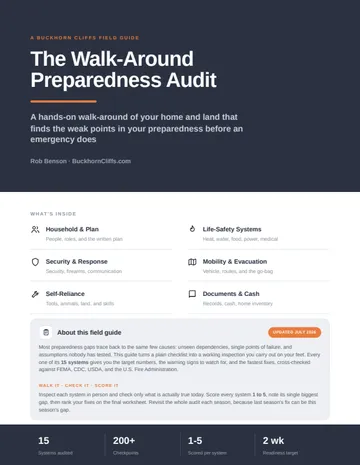
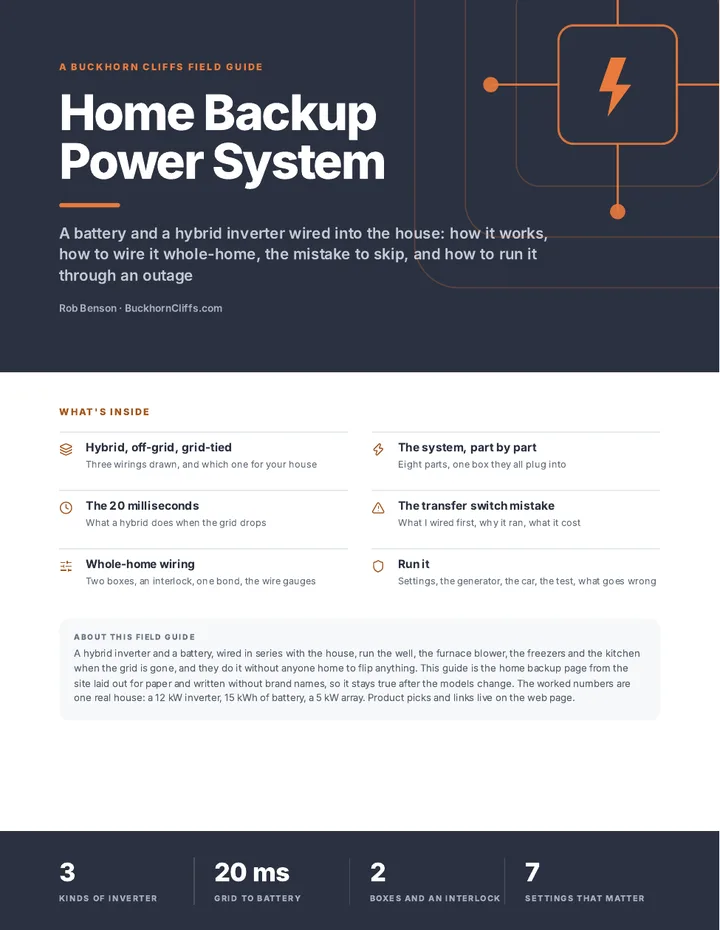
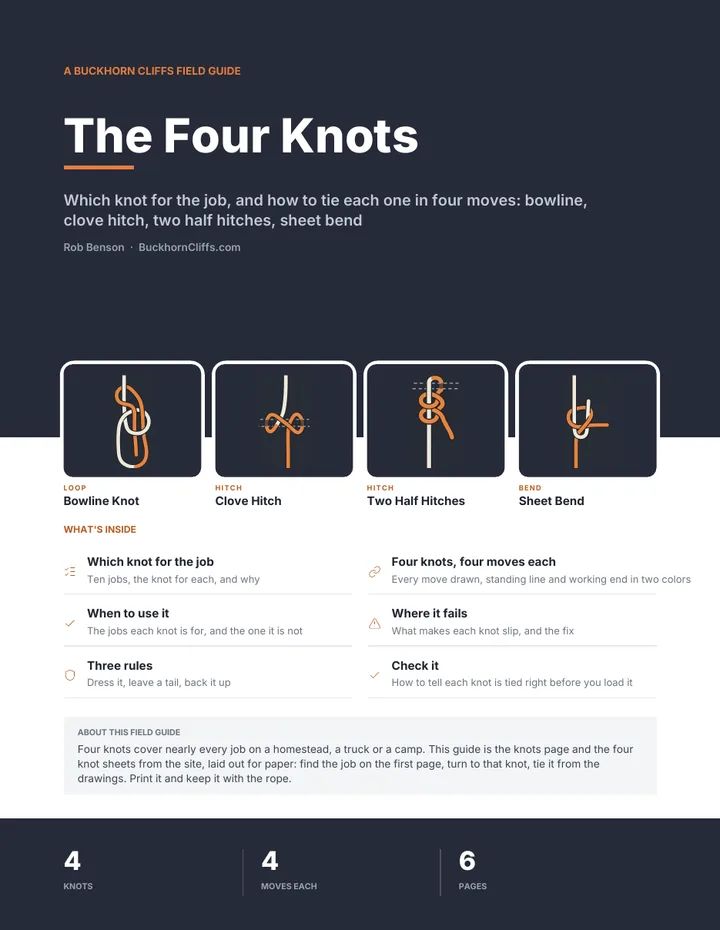
When the grid goes down, this site goes with it. Paper does not. Membership opens every member page and every recipe from the book, hands over all thirteen field guides as PDFs, and builds a binder from the pages your household uses.
- 158member pagesopen in full, every amount and every step
- 138recipeswith exact amounts, from the book and beyond it
- 13field guides304 pages of PDFs, $130 bought one at a time
- 1manual of your ownbuilt from any page here, printed with your cover
- Every member page in full. the exact amounts, every step, every parts list
- Every recipe and resource from the book. all 138 from the Prepper's Chemical Survival Guide, searchable here
- All 13 field guides. read them here or download the PDFs, 304 pages
- My Manual. save any page, recipe or whole guide, order it, print one binder with your own cover
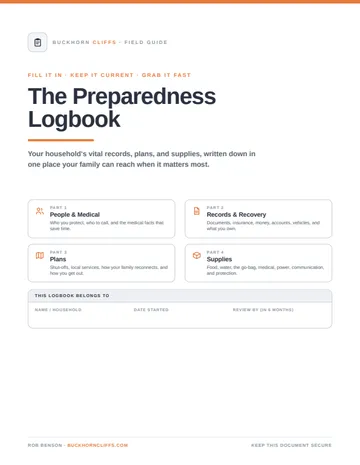
- The audit and the logbook, saved. your scores and checklists on every device
- Print and Save as PDF on every page. and no ads
- One payment, $49.95 per year. Cancel any time and keep access to the end of the year you paid for.
- Sign in by email. No password, and the sign-in renews itself on every visit.
- Most of the site stays free. Membership is for the depth, the PDFs and the paper.




Stay Ready
New entries, updates, and useful instruction.
Stay one step ahead on your preparedness journey.