FREE PDF4 PHASES33 COMPOUNDS
Quick facts
- Phase 1, five compounds
- Baking soda 5 lb
- non-iodized salt 5 lb
- calcium hypochlorite 1 lb
- white vinegar 1 gallon
- hydrogen peroxide 3% four bottles
- Phase 2, six: food storage, pests, antimicrobials
- Activated charcoal 8 oz
- calcium hydroxide 2 lb
- borax 4 lb
- isopropyl alcohol 70% two bottles
- Epsom salt 4 lb
- citric acid 2 lb
- Phase 3, nine: soap, fire, fallout
- Lugol's iodine 2 oz
- lye 2 lb
- diatomaceous earth 4 lb
- potassium permanganate 8 oz
- glycerin 16 oz
- beeswax 1 lb
- camphor 8 oz
- petroleum jelly 1 tub
- washing soda 3½ lb
- Phase 4, twelve: specialized
- Sulfur 1 lb
- potassium nitrate 1 lb
- sodium nitrate 1 lb
- boric acid 1 lb
- castile soap 4 bars
- cornstarch 2 lb
- paraffin 5 lb
- ascorbic acid 1 lb
- creatine 1 lb
- electrolytes 4 canisters
- ethanol 750 mL
- bentonite clay 2 lb
- Buy in this order
- 1 Salt
- 2 baking soda
- 3 vinegar
- 4 calcium hypochlorite
- 5 peroxide
- 6 alcohol
- 7 Epsom salt
- 8 charcoal
- specialty compounds last
- Where to buy
- Farm supply
- pool shop
- pharmacy
- hardware store
- grocery
- online
- The ruleMaster Phase 1 before moving on. What you know matters more than how much you have
You do not need all 33 compounds at once, and buying them all at once is how people end up with a shelf of chemicals and no idea what to do with any of them. The book builds the supply in four phases, starting with five compounds that cover the most ground, then growing as budget, storage and skill allow. This page is that plan from pages 17 to 19 of the book, with every compound linked to its page on this site and two recipes to make with it, where to buy each one, and the order to buy in.
The quantities are a sensible first buy for one household, not a lifetime supply. Every one of them keeps for years stored right, which is what storing your compounds covers. The sheet at the bottom of the box below is this whole page on one printed page, with checkboxes.
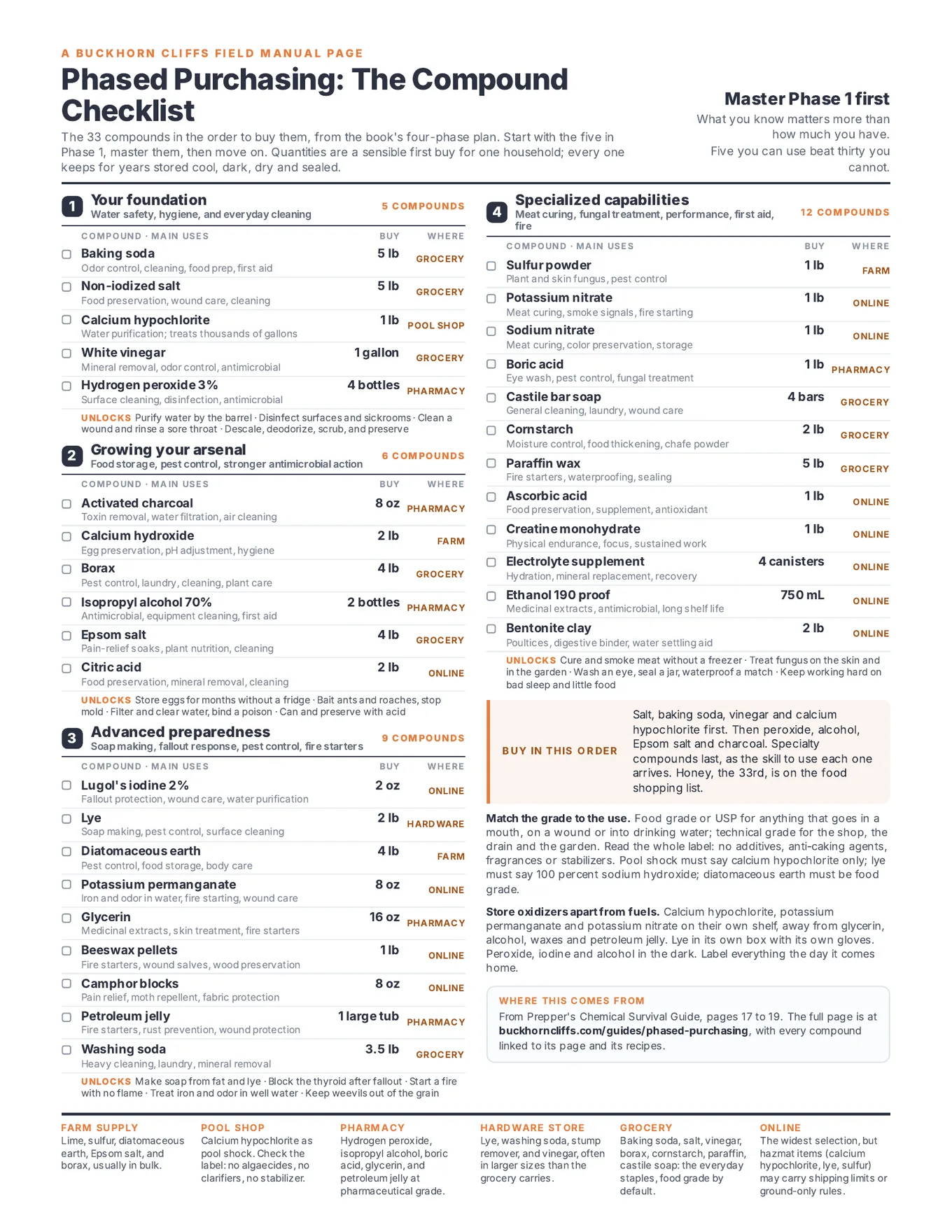
Free download
Get the one-page compound checklist
All four phases on one printed page: every compound with how much to buy and what it is for, checkboxes to tick off, and where to buy each one. Built from the book's phased purchasing plan. Print it and take it to the store.
The PDF comes by email, with my newsletter now and then. Already on the list? You still get it. Read the full page.
The four phases at a glance
Each phase is a shopping trip or two, not a project. Finish one before starting the next, and master Phase 1 before you spend a dollar on Phase 3.
The rule that runs this page: what you know matters more than how much you have. Five compounds you can use beat thirty you cannot.
Phase 1: Your foundation
Phase 1 · 5 compounds
Water safety, hygiene, and everyday cleaning
Five compounds that cover the most ground. With these on the shelf you can make drinking water safe, disinfect a kitchen or a wound, clean almost anything, and preserve food. Everything else on this page is built on top of them.
The most-used compound in the book: 33 recipes touch it. Buy the big bag.
Keeps forever, costs almost nothing, and every preserving method runs on it. Non-iodized, no anti-caking agents.
The one pound that replaces a shelf of bleach. Plain pool shock, no algaecide, no clarifier, no stabilizer.
Nineteen recipes on the site use it. Five percent distilled white; the cleaning strength is for the shop, not the kitchen.
Brown bottles, kept dark. It loses strength once opened, which is why four small bottles beat one big one.
With Phase 1 on the shelf you can
- Purify water by the barrel
- Disinfect surfaces and sickrooms
- Clean a wound and rinse a sore throat
- Descale, deodorize, scrub, and preserve
Phase 2: Growing your arsenal
Phase 2 · 6 compounds
Food storage, pest control, stronger antimicrobial action
Six more, and the shelf starts covering the garden, the pantry, and the first aid kit. Nothing here is exotic; most of it is in a farm store aisle.
Food grade, powdered or granular. The binder for a poisoning and the heart of a field water filter.
Hydrated lime, food grade for the eggs. A bag at the farm store; the pickling-lime jar at the grocery is the same thing, smaller.
The laundry aisle box. Eight recipes, from the bait that ends an ant problem to flux for soldering.
Seventy percent kills more than ninety-one, because the water keeps it on the surface long enough to work.
Magnesium sulfate. The soak after a hard day and the fix for yellowing tomato leaves, from one bag.
Food grade, in the canning aisle or online by the pound. Acid for the canner and the descaler that does not smell like vinegar.
With Phase 2 on the shelf you can
- Store eggs for months without a fridge
- Bait ants and roaches, stop mold
- Filter and clear water, bind a poison
- Can and preserve with acid
Phase 3: Advanced preparedness
Phase 3 · 9 compounds
Soap making, fallout response, pest control, fire starters
Nine compounds that take real skills with them: soap from scratch, a thyroid block, a fire with no match, water with the iron taken out. Buy them as you learn to use them.
Two ounces goes a long way. The dosing is on its page and in the book; do not guess it.
Sodium hydroxide, 100 percent, no aluminum flakes. The one compound on this page that earns gloves and goggles every time.
Food grade only; pool-filter DE is a different product and a lung hazard. A dusting in the wheat bucket keeps it clean for years.
Purple crystals that do three unrelated jobs. Stored dry and apart from the glycerin it starts fires with.
Vegetable glycerin, USP. The alcohol-free way to make a tincture for kids, and half of the fire trick above.
Pellets melt evenly and measure by the spoon. A local beekeeper beats the internet on price and smell.
The smell of an old tool chest, for a reason: a block in the drawer keeps the rust and the moths off.
Cotton balls and a thumb of jelly: the most reliable fire starter there is, and it never goes bad.
Sodium carbonate, baking soda's stronger cousin. Bake baking soda on a sheet pan for an hour and you have made it yourself.
With Phase 3 on the shelf you can
- Make soap from fat and lye
- Block the thyroid after fallout
- Start a fire with no flame
- Treat iron and odor in well water
- Keep weevils out of the grain
Phase 4: Specialized capabilities
Phase 4 · 12 compounds
Meat curing, fungal treatment, performance, first aid, fire
Twelve compounds for specific jobs. None of them is urgent; each one closes a gap. Pick the ones that match your place: the curing salts if you raise meat, the sulfur if you garden, the creatine and electrolytes if the plan involves hard work.
Garden sulfur from the farm store is fine for the dust; the ointment wants a finer, cleaner grade.
Sold as stump remover at the hardware store; read the label for 100 percent potassium nitrate. Stored apart from everything that burns.
The curing salt for long cures. Measured by the gram, never by the handful; the page has the ratios.
USP grade if it is going near an eye; the roach powder can be the cheaper one.
Pure olive-oil soap, unscented. Four bars grate into gallons of liquid soap, shampoo and wound wash.
Already in the kitchen. Here because it is the base for a chafe powder, a dry shampoo and a sauce from thin soup.
The canning-aisle block. Five pounds is a winter of fire starters and every jar sealed.
Vitamin C powder, food grade. A pinch takes the chlorine out of treated water and the brown off cut apples.
Five grams a day. The cheapest supplement that does anything, and it keeps for a decade sealed.
Sodium, potassium and magnesium for sweat and hard work; water alone is not enough. I make my own; it is on the food shopping list too.
Grain alcohol from the liquor store where it is legal to sell; the tincture solvent that is also drinkable, which denatured alcohol never is.
Food grade, sodium bentonite. A spoon settles a bucket of muddy water; a paste draws a sting.
With Phase 4 on the shelf you can
- Cure and smoke meat without a freezer
- Treat fungus on the skin and in the garden
- Wash an eye, seal a jar, waterproof a match
- Keep working hard on bad sleep and little food
The 33rd compound
Honey is the one compound in the book that is not in a phase, because it is food and belongs on the food shopping list. Buy it there, raw and local if you can, and keep a jar with the first aid kit: it dresses a burn, calms a cough and never spoils. Its compound page has the five recipes.
Where to buy each one
Smart buying matters as much as smart storage. Get the right grade from the right place, and the six places below cover all 33. The tag on each card above says which.
Lime, sulfur, diatomaceous earth, Epsom salt, and borax, usually in bulk.
Calcium hypochlorite as pool shock. Check the label: no algaecides, no clarifiers, no stabilizer.
Hydrogen peroxide, isopropyl alcohol, boric acid, glycerin, and petroleum jelly at pharmaceutical grade.
Lye, washing soda, stump remover, and vinegar, often in larger sizes than the grocery carries.
Baking soda, salt, vinegar, borax, cornstarch, paraffin, castile soap: the everyday staples, food grade by default.
The widest selection, but hazmat items (calcium hypochlorite, lye, sulfur) may carry shipping limits or ground-only rules.
Buy in this order
- The broadest utility first: salt, baking soda, vinegar, and calcium hypochlorite.
- Then the antimicrobials and the garden: hydrogen peroxide, isopropyl alcohol, Epsom salt, and activated charcoal.
- Specialty compounds last, as the skill to use each one arrives.
- Alongside the compounds, the basic toolkit: a scale, measuring spoons, spray bottles, glass jars, gloves and goggles. Tools and equipment lists every tool and what it is for.
Before you trust it: match the grade to the use
Food grade or USP for anything that goes in a mouth, on a wound or into drinking water. Technical grade is fine for the shop, the drain and the garden. Read the whole label: additives, anti-caking agents, fragrances and stabilizers are what turn a useful compound into the wrong product. The sourcing checklist is the in-store version, and the 33 compounds at a glance table has the grade each one needs.
Master Phase 1 before moving on
Five compounds, four things to actually do with them this month. Each one is a free recipe on this site; each takes an afternoon and teaches more than another trip to the store would.
When those four are habit, Phase 2 is obvious: the charcoal and the lime extend the water and the food skills you already have, and the borax and alcohol extend the cleaning ones.
Storing what you bought
Everything on this page keeps for years in the same four conditions: cool, dark, dry and sealed, in a container that says what is in it. The exceptions are the ones that want to be apart from each other, and that is a short list worth memorizing.
Storing your compounds has the containers and conditions for each one, handling and safety covers gloves, goggles and what to do if something spills, and storage, shelf life and inventory is the inventory sheet.
Where this fits in the rest of the plan
This page is the buying order for the compounds. Around it: the 33 compounds at a glance table is the quick reference with grade and shelf life for each, find a recipe by need goes the other direction, from the problem to the compound, and emergency scenarios says which compounds matter in which crisis. The what-to-stock master list covers everything that is not a compound, and the food shopping list is its one-page partner for the pantry.
Every compound page on this site is free. The recipes with their exact amounts are members' only, and all 138 of them come from the book, which works when the grid does not.
Membership
Every recipe on this page, with the exact amounts
The 33 compounds are free to read. The 138 recipes that use them, with every amount and every step, open with membership. $49.95 per year. One price, everything below, cancel any time.
- Every member article in fullAll 158 member pages, open: exact amounts, every step, every parts list.
- Every recipe and resource in the bookAll 138 recipes and 33 compounds from Prepper's Chemical Survival Guide, with exact amounts, every step, every warning, and the reference charts.
- My Manual: build your own field manualSave any page, recipe, chart, or whole field guide, arrange them in the order you want, and print one manual with your name on the cover. Or keep it as a PDF that opens with no signal.
- All nine field guides, on screen and as PDFsStockpile Essentials, Survival Foods, Chemical Compounds, Spare Parts, the Audit, the Logbook, Portable Solar Power, Home Backup Power, and The Four Knots. Read every one here, download the PDFs. $90 if bought one at a time.
- A clean PDF of any articleOne click gives a one-page sheet in the field guide layout, ready to print or save.
- Audit scores and checklists that follow youSaved to the account, so the phone, the laptop, and the shop computer all match.
- No adsMembers read the whole site without a single ad.
My Manual · included
Build your own field manual
The most useful thing a membership gives you. Save any page on this site, recipes, charts, and whole field guides included. Arrange them in the order you want, name it, and print one manual with a cover and contents, or keep it as a PDF that opens with no signal.
- It works when this site does not
- Only your pages
- Anyone in the house can use it
- One current copy, not a pile of printouts
- The house binder
- A copy for the bug-out bag or truck
- A copy for family
- An offline PDF
Prefer paper? Every recipe is in Prepper's Chemical Survival Guide, 230 pages in print, for when the grid is down.
Questions this answers
Tap a question for the short answer.
Which chemical compounds should I buy first?
Five: baking soda, non-iodized salt, calcium hypochlorite (plain pool shock), white vinegar and 3 percent hydrogen peroxide. Between them they purify water, disinfect surfaces and wounds, clean nearly anything and preserve food, and most of the recipes on this site start with one of them. Salt, baking soda, vinegar and calcium hypochlorite are the first four to the cart, in that order of breadth.
How much of each compound should I stock?
A sensible first buy, from the book: 5 lb baking soda, 5 lb salt, 1 lb calcium hypochlorite, a gallon of vinegar and four bottles of peroxide for Phase 1; then 8 oz charcoal, 2 lb lime, 4 lb borax, two bottles of alcohol, 4 lb Epsom salt and 2 lb citric acid. Phases 3 and 4 run from 2 oz of Lugol's iodine to 5 lb of paraffin. The full table is on the page and on the one-page PDF.
Where do I buy calcium hypochlorite and lye?
Calcium hypochlorite is pool shock at the pool shop or hardware store; the label must say calcium hypochlorite with no algaecide, clarifier or stabilizer. Lye is sodium hydroxide, sold as drain cleaner at the hardware store; it has to say 100 percent sodium hydroxide, not a blend with aluminum flakes. Both may be ground-shipping only when bought online.
What are the four phases of buying compounds?
Phase 1, the foundation: water safety, hygiene and everyday cleaning, five compounds. Phase 2, growing the arsenal: food storage, pest control and stronger antimicrobials, six more. Phase 3, advanced preparedness: soap, fire, fallout and pest control, nine. Phase 4, specialized: meat curing, fungal treatment, performance and first aid, twelve. Master each before the next.
Do I need all 33 compounds?
No. Most households never need Phase 4, and a shelf of chemicals nobody knows how to use is a hazard, not a supply. Five compounds you can use beat thirty you cannot. Buy the phase that matches your place and your skills, learn it, then decide about the next.
What can I make with the first five compounds?
Drinking water by the barrel, a bleach solution for surfaces and sickrooms, a wound rinse and a sore-throat gargle, an antacid, a descaler for kettles and a rust bath for tools, a surface scrub, and cured meat. Every one of those is a recipe on this site, and four of them are free.
What grade of compound do I need?
Food grade or USP for anything that goes in a mouth, on a wound or into drinking water: salt, baking soda, calcium hydroxide for eggs, boric acid for an eye wash, glycerin, ascorbic acid, bentonite clay. Technical grade is fine for the shop, the drain and the garden. Read the whole label for additives; the sourcing checklist is the in-store version.
Is there a printable compounds shopping list?
Yes. The four phases with every compound, its quantity and its main uses, plus where to buy, on one letter-size page with checkboxes. It is free for subscribers through the form on the page, and members can print it from the page or add it to My Manual.
Keep going
Related to this
Membership · $49.95 per year
There is a lot more behind the lock
Every recipe and resource from the Prepper's Chemical Survival Guide, all nine field guides to read here and download, the full audit and logbook, all twelve reference charts, and no ads.
My Manual · included
Build your own field manual
The most useful thing a membership gives you. Save any page on this site, recipes, charts, and whole field guides included. Arrange them in the order you want, name it, and print one manual with a cover and contents, or keep it as a PDF that opens with no signal.
- It works when this site does not
- Only your pages
- Anyone in the house can use it
- One current copy, not a pile of printouts
- The house binder
- A copy for the bug-out bag or truck
- A copy for family
- An offline PDF







Stay Ready
New entries, updates, and useful instruction.
Stay one step ahead on your preparedness journey.