Quick facts
- .22LR
- 30-40 grains
- rimfire
- varmint < 50 lbs
- low recoil
- 9mm
- 115-147 grains
- pistol
- personal defense
- .45 ACP
- 68-300 grains
- pistol
- 356-829 ft-lbf
- .357 Magnum
- 100-200 grains
- varmint
- medium game
- personal defense
- .308100-240 grains, rifle, large game, 2,588-2,668 ft-lbf
- AR-15 ammoTypically a standard 55-grain bullet
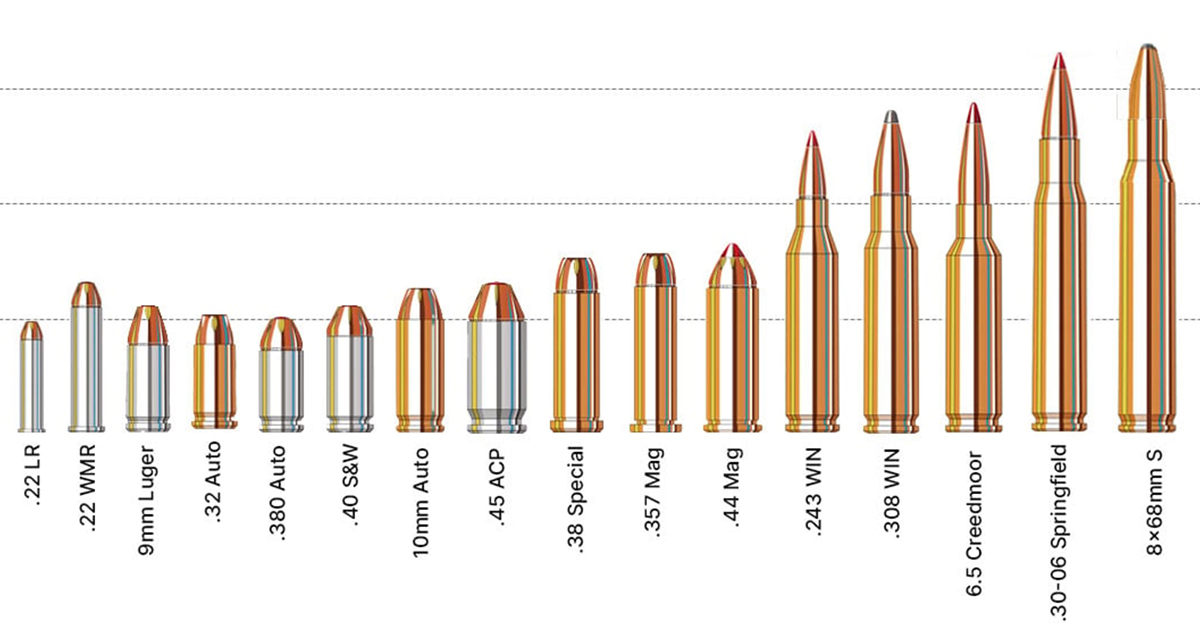
Caliber is the first thing on the box and the first thing people ask about. This page is the chart: the ten calibers you will actually run into, in order by bullet size, with what each is built for, how heavy the bullet is, how fast it leaves the barrel, how hard it hits, and how much it kicks. Below the chart I cover what the name on the box means and how to pick a bullet weight for the job.
Velocity and energy are ranges across common factory loads, so a given box will land somewhere inside them. Image and load concepts from Sportsman's Warehouse.
What caliber means
Caliber is the diameter of the bullet, which is also the inside diameter of the barrel it fits. It is written in inches, like .45, or in millimeters, like 9mm. That is the whole idea, and the confusion comes from the names: some cartridge names round the number, some carry a heritage number that does not match the bullet at all, and some add a maker's initials. A .38 Special and a .357 Magnum fire the same .357 inch bullet. A 9mm and a .380 ACP both use a .355 inch bullet. So read the chart by the bullet diameter column, not by the name.
The ammo caliber chart, smallest to largest
Sorted by bullet diameter. Two rimfires first, then the one rifle round, then the handgun rounds from 9mm up to .45 ACP.
| Caliber | Bullet diameter | Type | Bullet weight | Velocity | Energy | Recoil | What it is for |
|---|---|---|---|---|---|---|---|
| .22LR | .22 in | Rimfire | 30 to 40 gr | 1,200 to 1,640 ft/s | 131 to 191 ft-lbf | Low | Small game and varmints under 50 lb, practice |
| .22 WMR | .22 in | Rimfire | 30 to 50 gr | 1,530 to 2,300 ft/s | 300 to 324 ft-lbf | Low | Varmints, personal defense in a pinch |
| .308 Winchester | .308 in (7.8 mm) | Rifle | 100 to 240 gr | 2,510 to 3,100 ft/s | 2,588 to 2,668 ft-lbf | Moderate | Deer, elk, moose, black bear. Not a dangerous-game round |
| 9mm Luger | .355 in (9 mm) | Pistol | 115 to 147 gr | 1,180 to 2,010 ft/s | 355 to 501 ft-lbf | Low to moderate | Personal defense, the most common handgun round |
| .380 ACP | .355 in | Pistol | 45 to 100 gr | 1,025 to 1,835 ft/s | 203 to 337 ft-lbf | Low | Concealed carry, personal defense |
| .38 Special | .357 in | Revolver | 110 to 158 gr | 900 to 1,150 ft/s | 264 to 333 ft-lbf | Low to moderate | Personal defense, the classic revolver round |
| .357 Magnum | .357 in | Revolver, carbine | 100 to 200 gr | 1,080 to 1,450 ft/s | 539 to 583 ft-lbf | Stout | Varmints, medium game 50 to 300 lb, personal defense |
| .40 S&W | .400 in | Pistol | 105 to 200 gr | 1,050 to 1,130 ft/s | 468 to 490 ft-lbf | Moderate | Personal defense, law enforcement |
| .44 Magnum | .429 in (10.9 mm) | Revolver, rifle | 180 to 340 gr | 1,180 to 1,475 ft/s | 741 to 1,533 ft-lbf | Heavy | Deer and black bear, elk at short range from a carbine, personal defense |
| .45 ACP | .451 in | Pistol | 68 to 300 gr | 835 to 2,036 ft/s | 356 to 829 ft-lbf | Moderate | Personal defense |
Ammo calibers in order by size
The same ten, as a plain list from smallest bullet to largest, with the ones that share a diameter side by side:
- .22LR and .22 WMR (.22 in)
- .308 Winchester (.308 in)
- 9mm Luger and .380 ACP (.355 in)
- .38 Special and .357 Magnum (.357 in)
- .40 S&W (.400 in)
- .44 Magnum (.429 in)
- .45 ACP (.451 in)
Bullet diameter is not power. The .308 sits third on this list and hits harder than everything below it, because the case behind the bullet is a rifle case holding far more powder. Size tells you what fits the gun; the energy column tells you what it does.
How to read the name on the box
A few words cover nearly every box you will pick up.
Bullet weight: what it changes
One caliber comes in many bullet weights. .308 bullets run from about 125 to over 185 grains, 9mm from 60 to 160 grains, and the standard AR-15 load is a 55 grain bullet. Weight changes four things:
Choosing a bullet weight
Prep hard, people.
Questions this answers
Tap a question for the short answer.
What are the ammo calibers in order by size?
By bullet diameter, smallest to largest: .22LR and .22 WMR (.22 in), .308 (.308 in), 9mm and .380 ACP (.355 in), .38 Special and .357 Magnum (.357 in), .40 S&W (.400 in), .44 Magnum (.429 in), .45 ACP (.451 in). Size is not power: the .308 is a rifle round and hits harder than every handgun round below it.
What does caliber mean?
Caliber is the diameter of the bullet, which is also the inside diameter of the barrel it fits. It is written in inches, like .45, or millimeters, like 9mm. Some cartridge names do not match the actual bullet diameter, which is where the confusion comes from: a .38 Special and a .357 Magnum fire the same .357 inch bullet.
What is an ammo caliber chart?
A table of cartridges with the numbers that matter: bullet diameter, type, bullet weight in grains, velocity, energy and recoil, plus what each is used for. The chart on this page covers the ten common calibers from .22LR to .45 ACP, sorted by bullet size.
What are the most common ammo calibers?
My top 10 most used are 9mm, .22LR, .45 ACP, .308, .380 ACP, .40 S&W, .357 Magnum, .38 Special, .44 Magnum and .22 WMR. 9mm leads for personal defense and law enforcement, and .22LR is the cheapest for practice and small game.
What do the letters on an ammo box mean?
LR and WMR are the two .22 rimfires (Long Rifle, Winchester Magnum Rimfire). ACP is Automatic Colt Pistol, a rimless case for semi-automatics. S&W, Winchester and Luger name the maker or designer. Special and Magnum are revolver rounds, Magnum being the longer, higher pressure one. Gr is bullet weight in grains. FMJ, JHP and SP describe the bullet: full metal jacket for practice, hollow point for defense, soft point for hunting.
What is the difference between 9mm and .45 acp?
Both are pistol rounds for personal defense. 9mm uses a .355 inch bullet of 115 to 147 grains at 1,180 to 2,010 ft/s for 355 to 501 ft-lbf. .45 ACP uses a .451 inch bullet across a much wider 68 to 300 grain range at 835 to 2,036 ft/s for 356 to 829 ft-lbf. 9mm is lighter, faster and cheaper, and a pistol holds more of it; .45 is bigger and slower with more energy at the top of its range.
Can a .357 magnum shoot .38 special?
Yes. Both use a .357 inch bullet and the Magnum case is simply longer, so a .357 Magnum revolver fires .38 Special fine. Never the other way around: a .38 Special revolver must not be loaded with .357 Magnum.
What caliber is good for large game?
Of the ten here, the .308 Winchester: 100 to 240 grain bullets, 2,588 to 2,668 ft-lbf, moderate recoil, and rated for deer, elk, moose and black bear. It is not a dangerous-game cartridge. The .44 Magnum covers deer and black bear, and elk at short range from a carbine.
How does bullet weight affect recoil?
Heavier bullets usually produce more recoil, since every action has an equal and opposite reaction. Gun weight and the powder charge matter as much as the bullet. For practice, the lighter common weight kicks less and costs less.
What grain bullet should I choose for self-defense?
A quality expanding load built for defense that meets the FBI penetration standard of 12 to 18 inches in gelatin. In 9mm that is usually a 124 or 147 grain hollow point. Bullet design matters more than the weight: heavier bullets drive deeper and kick more, lighter ones fly faster and flatter.
Keep going
Related to this
Membership · $49.95 per year
There is a lot more behind the lock
Every recipe and resource from the Prepper's Chemical Survival Guide, all six field guides to read here and download, the full audit and logbook, all twelve reference charts, and no ads.
My Manual · included
Build your own field manual
The most useful thing a membership gives you. Save any page on this site, recipes, charts, and whole field guides included. Arrange them in the order you want, name it, and print one manual with a cover and contents, or keep it as a PDF that opens with no signal.
- It works when this site does not
- Only your pages
- Anyone in the house can use it
- One current copy, not a pile of printouts
- The house binder
- A copy for the bug-out bag or truck
- A copy for family
- An offline PDF
Stay Ready
New entries, updates, and useful instruction.
Stay one step ahead on your preparedness journey.