Quick facts
- Trades best
- Lighters
- batteries
- coffee
- tobacco
- alcohol
- soap
- toilet paper
- salt
- seeds
- fuel
- Medical
- Bandages
- over-the-counter pain
- allergy and stomach medicine
- wound care
- SkillsRepair, medical, sewing, butchering, canning, engine work trade better than goods
- Compounds
- Calcium hypochlorite
- vinegar
- baking soda
- salt
- activated charcoal
- Keep out of the pileYour own medication, most of your ammunition, anything that shows how much you have
- Price itAgainst anchor goods (a lighter, a can of beans, a bar of soap) or an hour of work
When the stores close and cash buys less every day, trade goes back to what it always was: something I have that you need, for something you have that I need. The people who do well are not the ones with the most stuff. They are the ones with small, cheap, consumable things everyone runs out of, a skill someone else lacks, and the sense to trade without showing their hand. This page is what to stock for that, what to keep out of the pile, and the rules that keep a trade from going wrong.
Stock your own household first, two weeks deep and then longer, from the what to stock guide. The trade layer is separate, bought cheap now in small units, and stored apart from what you eat, so nothing you trade ever comes out of your family's supply.
What actually trades
Every documented shortage, from Sarajevo in the nineties to Venezuela and Argentina, produced the same list. Not the exotic gear; the small things people use every day, run out of in a week, and cannot make in a kitchen.
Disposable lighters by the case, matches, candles, AA and AAA batteries, small flashlights. A lighter costs a quarter today and trades for a meal later.
Instant coffee, tea, tobacco by the carton, small bottles of liquor, chocolate and hard candy. People trade food for these; that is not a judgment, it is history.
Bar soap, toothpaste and brushes, toilet paper, feminine products, diapers and wipes, razors. Cheap by the case now, and the first thing families run out of.
Salt, sugar, cooking oil, rice and beans in small bags, canned meat, freeze dried pouches, and garden seeds in sealed packets. Seeds are the trade item that turns into a summer of food for whoever gets them.
Purification tablets, small filters, bleach, and the know-how to use them. A pound of calcium hypochlorite treats thousands of gallons; repackaged into small labeled jars it is a hundred trades.
Gasoline and diesel in small cans, 1 lb propane, kerosene, a solar charger. Very valuable and very hard to keep; trade it early and locally. Store it as propane where you can.
What traded, where: the record
None of this is theory. Every modern shortage left a record of what people actually swapped, and the lists agree with each other to a degree that should settle the question of what to stock.
| Where and when | What money did | What traded |
|---|---|---|
| Prisoner of war camps, 1940s | None inside the wire | Cigarettes became the currency: prices for bread, jam, razor blades and chocolate were quoted in cigarettes, and an economist who lived it wrote the classic account. Non-smokers held them as money. |
| Sarajevo, 1992 to 1995 | Worthless; the city was cut off for nearly four years | Cigarettes, coffee, cooking oil, candles, batteries, lighters, soap, salt, sugar, alcohol, medicine, and anyone who could fix a stove or pull a tooth. Survivors say the same three things over and over: lighters, coffee, cigarettes. |
| Argentina, 2001 to 2002 | Bank accounts frozen, peso collapsed | Barter clubs sprang up in every town and millions of people joined; food, clothing, repairs, haircuts and professional work changed hands for club scrip. The clubs collapsed when scrip was counterfeited and over-issued, which is the lesson about paper IOUs. |
| Venezuela, 2016 on | Hyperinflation; a wheelbarrow of notes for a chicken | Medicine above everything, then diapers, formula, flour, rice, cooking oil, soap and toilet paper, traded through neighborhood groups on phones. Skills traded steadily: nursing, mechanics, sewing. |
| Cuba, the 1990s | Money existed; the shops were empty | Fuel, soap, cooking oil, coffee, spare parts and the ability to fix a forty-year-old car. Garden produce and eggs bought what stores could not sell. |
| United States, spring 2020 | Fine; the shelves were not | Toilet paper, yeast, flour, hand sanitizer, masks and disinfectant traded between neighbors for weeks. A small preview: the things that ran out were cheap, consumable and impossible to make at home. |
The pattern in every row: consumables everyone uses, luxuries people will not give up, medicine, and skills. Not gold, not gear.
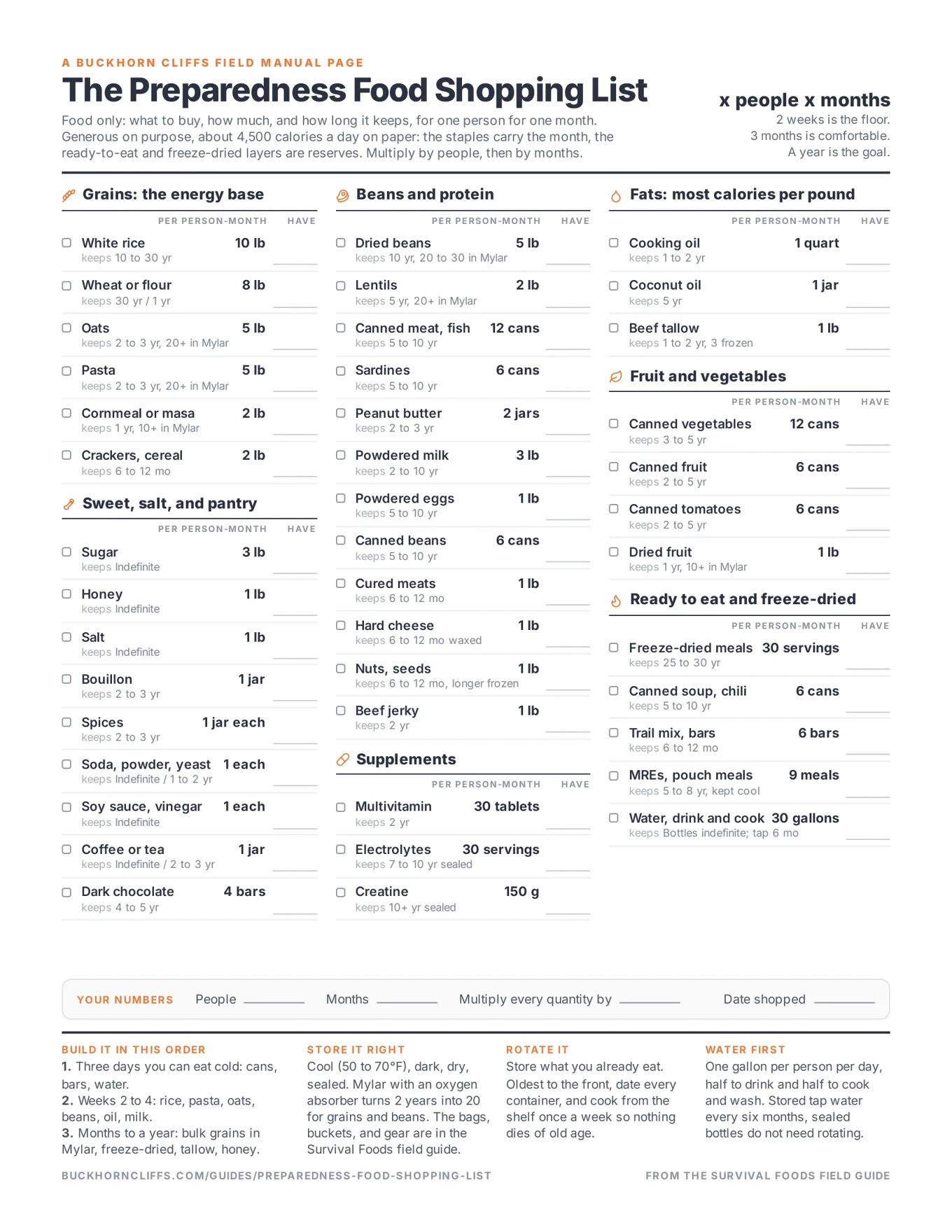
Free download
Get the one-page food shopping list
What to store, how much of it for one person for one month, and how long it keeps. One page with checkboxes, built from the Survival Foods field guide. Print it, multiply by your people and months, and take it to the store.
The PDF comes by email, with my newsletter now and then. Already on the list? You still get it. Read the full page.
Pricing without prices
The first question in a barter is what a thing is worth, and there is no tag. Three ways to answer it that have worked everywhere.
Every barter economy invents IOUs and scrip within weeks, and every one of them fails the same way: someone issues more than they can back, or forges them. Take a note only from someone whose word you would take anyway, for an amount you can afford to lose, and settle it fast.
Medical and repair
The compounds
A few cheap chemicals do the jobs that matter most and keep for years, which makes them trade goods that never spoil. Repackage bulk into small labeled containers with the dose written on the label; a trade partner who cannot use it correctly does not come back.
- Calcium hypochlorite. Makes water safe by the thousand gallons and keeps ten years dry. The formula is what to write on the jar.
- Salt. Preserving meat, curing, electrolytes, seasoning, and livestock. Buy it in 25 pound bags now for pennies a pound.
- Vinegar. Pickling, cleaning, descaling, a dozen remedies. Keeps indefinitely.
- Baking soda. Cooking, cleaning, deodorizing, antacid, toothpaste. Keeps indefinitely dry.
- Activated charcoal. Water filtration, odor, and it binds some swallowed poisons (not alcohol, metals, lye or fuel; call Poison Control, 1-800-222-1222, first).
The full list of what to keep and why is on the chemical compounds field guide.
Skills trade better than goods
Goods run out. A skill trades every week for as long as the shortage lasts, and nobody can steal it. The ones that were worth the most in every real shortage: fixing small engines and generators, basic medical and dental care, sewing and boot repair, butchering and smoking meat, canning and preserving, welding, well and pump repair, midwifery, and knowing how to make water safe. Pick one you do not have and learn it now; it costs nothing to store.
Build the trade layer in a weekend
Buy in small units, because you trade a lighter, not a case, and keep it in its own bins so it never mixes with what you eat. A few hundred dollars covers this list at normal prices, and none of it spoils for years.
- 200 disposable lighters
- 10 boxes of strike-anywhere or stormproof matches
- 100 AA and 100 AAA batteries, dated, rotated yearly
- 50 tea lights and 20 tall candles
- Instant coffee, 20 small jars, and 5 boxes of tea
- Tobacco, 5 cartons, sealed
- Small bottles of liquor, 24, and a case of hard candy and chocolate
- Bar soap, 50 bars; toothpaste and brushes, 25 each
- Toilet paper, 2 cases; feminine products, 10 boxes; diapers in two sizes; wipes
- Salt, 50 pounds in 1 pound bags; sugar, 50 pounds in 2 pound bags; cooking oil, 12 bottles
- Garden seeds, 100 packets, in a sealed can with a desiccant
- Water purification tablets, 20 bottles; calcium hypochlorite repacked in 20 small labeled jars
- Over-the-counter pain, allergy, stomach and cold medicine in blister packs, 10 of each
- Bandages, gauze, tape and antiseptic in small kits, 10
- Fishing hooks and line, sewing needles, safety pins, zip ties, duct tape, paracord in 25 foot hanks
- Reading glasses in three strengths, 12 pairs
- A dozen pairs of work gloves and wool socks
Reading glasses are the sleeper on the list: cheap by the dozen, and in every long shortage the people who could not read a label or thread a needle traded well for them.
The barter kit
The trade layer is the stock. The kit is what goes to the meeting.
- A small digital scale and a set of measuring cups, for splitting bulk goods honestly
- Zip bags in three sizes, small jars, and a marker for labels
- The dose written on every jar of a compound, so what you trade gets used right
- A notebook and pencil: the ledger
- A magnet and a coin scale if metals come into it; silver is not magnetic and pre-1965 US dimes weigh 2.5 grams
- A bag that holds only what you are trading today
- A second person
Practice now
Nobody makes their first trade well. The people who did best in every shortage were the ones who already traded: eggs for firewood, a weekend of labor for a side of beef, a repair for a favor. They knew what things were worth, who dealt straight, and how to say no without an argument. That is a skill, and it is learned in normal times.
Keep out of the trade pile
- Most of your ammunition. Common calibers trade for anything, and every round you trade arms the person across from you and leaves you one short. Trade it only with people you already know, in small amounts, never to a stranger, and never from the main stock. Ammunition by caliber covers what to keep for yourself and how to store it.
- Your own medication. Prescription medicine is for your household, and trading it is illegal in ordinary times and dangerous in any time.
- Firearms. Never.
- Anything that shows your depth. A trade partner who sees a full shelf tells someone. Bring what you are trading and nothing else.
- Gold and silver, at first. Nobody can verify it or make change in the first months. If you hold some, pre-1965 US silver coins are the practical form: small, recognizable, self-verifying.
How to trade
Start now, while it is easy: buy the trade layer in small units over a few months, label the compounds, and get to know who on your road can fix what. The Stockpile Essentials field guide has a page for it.
Questions this answers
Tap a question for the short answer.
What are the best items to stock for bartering?
Small, cheap, consumable things that everyone uses, runs out of, and cannot make at home: lighters, AA and AAA batteries, instant coffee, tobacco, small bottles of liquor, bar soap, toothpaste, toilet paper, feminine products, diapers, salt, sugar, garden seeds, water purification tablets, fishing hooks and line, sewing needles, and fuel in small cans. A case of lighters costs less than a tank of gas and trades one at a time for months.
What will be valuable to trade if money loses its value?
Whatever people are out of and cannot replace. In every documented shortage, from the Balkans in the nineties to Venezuela, the same things came up: lighters and matches, batteries, candles, coffee, cigarettes, alcohol, soap and hygiene supplies, salt and sugar, cooking oil, medicine for pain and stomach trouble, fuel, and anyone who could fix an engine, stitch a wound or pull a tooth. Gold and silver traded too, but at a steep discount, because nobody could make change and nobody could verify it.
What should I stock up on for trade in a collapse?
Stock for your own household first, two weeks deep, then add a trade layer of things that are cheap now: a few cases of lighters, a brick of batteries, a case of instant coffee, cartons of tobacco, a case of small liquor bottles, bar soap by the dozen, salt in bulk, a few hundred dollars of garden seeds in sealed packets, and water purification tablets. Buy in small units, because you trade a lighter, not a case. Keep it separate from the household supply so what you trade never comes out of what you eat.
Is ammunition a good barter item?
It is the most valuable and the most dangerous. Common calibers, 22 LR, 9mm, 12 gauge, 5.56 and 308, trade for almost anything. But trading it arms the person across from you, and every round you trade is one you no longer have. Trade ammunition only with people you already know and trust, in small quantities, never to a stranger, and never from your main stock. The ammo by caliber page covers what to keep for yourself.
What chemical compounds are good for bartering?
The ones that make water safe and keep food: calcium hypochlorite, which treats thousands of gallons per pound and keeps ten years dry; salt, for preserving and for the body; vinegar and baking soda for cleaning, cooking and a dozen remedies; activated charcoal; and bleach, though it loses strength in a year. Repackage bulk into small labeled containers with the dose written on them. The compounds index on this site covers each one.
How do I barter safely?
Never reveal what you have; bring only what you are trading. Trade at a neutral place, not your home, and not alone. Trade small, often, and with people you know before people you do not. Agree the whole deal before anything changes hands. Do not trade what you cannot spare, do not trade from your household stock, and do not trade anything that can be turned on you. The best trades are the ones where both people come back next week.
Is gold or silver good for bartering?
Not in the first months. In a real shortage nobody can verify it, nobody can make change, and nobody is selling food for a coin they cannot eat. Pre-1965 US silver dimes and quarters are the most practical form if you want some, because they are small, recognizable and self-verifying. A case of lighters and a brick of batteries will do more for you in the first year than any amount of metal.
Keep going
Related to this
Membership · $49.95 per year
There is a lot more behind the lock
Every recipe and resource from the Prepper's Chemical Survival Guide, all six field guides to read here and download, the full audit and logbook, all twelve reference charts, and no ads.
My Manual · included
Build your own field manual
The most useful thing a membership gives you. Save any page on this site, recipes, charts, and whole field guides included. Arrange them in the order you want, name it, and print one manual with a cover and contents, or keep it as a PDF that opens with no signal.
- It works when this site does not
- Only your pages
- Anyone in the house can use it
- One current copy, not a pile of printouts
- The house binder
- A copy for the bug-out bag or truck
- A copy for family
- An offline PDF






Stay Ready
New entries, updates, and useful instruction.
Stay one step ahead on your preparedness journey.