Quick facts
- Layer orderDeter, detect, delay, deny. Each layer buys time for the next.
- Fix firstDoors, hinges, and strike plates. The shop, barn, or shed is often hit first, so secure those too.
- Fire escape timeAs little as two to three minutes once the alarm sounds.
- Smoke alarmsTest monthly, change batteries yearly, replace the units every ten years.
- Firearm storageAudit: locked against the wrong hands, in reach of the right ones. Ammo guide: ammunition apart from guns.
- Stored ammoSealed can plus a desiccant pack. Stored well it can last 50 years or more.
- First to failMagazines and their springs on a firearm. The latch spring on a door.
Security is mostly deterrence, early warning, and staying out of trouble before it gets to the house. This page walks the layers from the property edge inward, then covers firearms as the last layer: training, storage, ammunition, and upkeep. Start with the steps for right now, then build in the order below.
Something feels wrong: what to do nowSecurity from the outside inWhat to build firstDeterrents and defensive tools side by sideFirearms as the last layerAmmunition storage: containers and what goes in themCommon situationsRecipes that fit this topicThe deeper pagesSpare parts, skills, the audit, and the logbookWhat goes wrong
Something feels wrong: What to do now
The goal in every phase is the same: buy time to observe, decide, and act deliberately. Delay before you confront.
First minutes at the house
- Stop and look before you move, and take the feeling that something is off seriously. Keep the door shut until you know who is there: you set the distance and the conversation.Warning signs show up long before the problem does. Control the point of contact every single time.Personal resilience checklist: privacy, money, records and security
- Lock the exterior doors and send everyone to the room you agreed on.Barriers buy time. Movement without a plan creates chaos.Audit: Firearms as a Defensive Tool
- If someone is breaking in or anyone is in danger, call 911 as soon as you are somewhere safe.My audit asks who calls for help. Settle that ahead of time so the call is not left to chance.
- Switch on the exterior lights you control, and check that no light behind you shows your outline.Lighting should show the approach, not silhouette you.Audit: Security & Awareness
- Make noise if it helps: alarm, whistle, air horn, the dog.Light and noise turn most people away, with no weapon involved.Security checklist
- Delay and disengage before you confront. Retreat if that ends it.Force is the last layer. The encounter you avoid is the one you win.
The first hour
- Watch the approach routes: the driveway, trails, and fence lines.Those are the natural funnels. Spotting someone early lowers the odds of a confrontation.Audit: Security & Awareness
- Look from a distance with binoculars, a monocular, or the drone camera.Distance is the first layer. See trouble before it arrives.Security checklist
- Confirm the shop, barn, shed, and gates are locked.An outbuilding is often hit before the main house.
- Tell your neighbors what you saw and ask what they saw.A street of prepared houses is harder to hit than one house alone.Audit: Firearms as a Defensive Tool
- Hand out flashlights and headlamps, and get the radios out.My security audit asks for handheld and head-mounted lights inside and exterior lighting that does not need the grid. Radios let you talk without cell towers.Communicate without cell service or internet (GMRS radios)
- If a firearm is part of your plan, only trained people handle it, and the four rules apply.Owning a firearm without training and a plan is false confidence.
A wider emergency: first 45 minutes to day 3
- Fill every container with water, confirm the scope, and stay out of the stores.That is the first 45 minutes in my field guide. My audit asks whether you have plans to avoid contact. Staying home is one.Stockpile Essentials field guide: The First Days
- Eat from the fridge, then the freezer. Keep the freezer door shut.The fridge holds about 4 hours. A full freezer lasts about 48 hours, a half-full one about 24.
- Shrink to one room.It is one of the first 3 days moves in my field guide.Staying warm with limited gear (mild or warm climates)
- Run power in short rotations, and turn exterior lights on or off selectively.The light that deters can also show an observer where you are.Audit: Security & Awareness
- Put a CO detector in every heated room.Any indoor combustion can kill in minutes.
- Run a generator outdoors only, 20 feet or more from the house, exhaust aimed away from it, with a battery CO alarm on each level indoors. It never goes in a garage, a basement, or on a porch, not even with the doors open.Outdoors only is the rule that prevents carbon monoxide poisoning.Home emergency readiness (power, water, comms, security)
Beyond day 3, and after any incident
- Turn water into a system, ration power, and decide calmly whether to stay or go.That is the shape of a long event in my field guide. The work you did before it decides it.Stockpile Essentials field guide: The First Days
- Keep the vehicle fueled and squared away.A prepared vehicle prevents desperation and bad decisions.Personal resilience checklist: privacy, money, records and security
- Keep your schedule and your supplies to yourself.What people do not know about you cannot be used against you.
- After a defensive event, follow the roles you set ahead: one person calls for help, one renders aid.My audit asks who calls, who renders aid, and what information is shared and what is not. Decide before, not during.Audit: Firearms as a Defensive Tool
- Pass the information to your trusted circle quickly and quietly.Community multiplies security, and my firearms audit asks whether information can be shared quickly.
Security from the outside in
Walk your place in this order. Every layer gives the next one more time to work.
Property edge
Distance and early warning: see people before they reach the house.
- Check that you can see every approach route by day and by night.
- Note the natural funnels: driveways, trails, fence lines.
- Find the blind spots made by buildings, parked vehicles, landscaping, terrain, and vegetation. Clear what you can.
- Decide whether each gate is functional or symbolic. Keep padlocks, keys, and blanks for gates, sheds, and outbuildings.
- Secure the shop, barn, and shed. They should not be easier to enter than the house.
- Add exterior lighting that runs without the grid and that you can switch on or off selectively.
- Early warning tools: a dog, binoculars or a monocular, a drone with a camera.
Audit: Security & Awareness Spare parts: Doors, Windows & Locks Member Security checklist
The shell of the house
Barriers that slow an entry and buy time and noise.
- Exterior doors solid core or reinforced, with hinges and strike plates secured properly.
- Windows that lock, reinforced where it makes sense. Window film and bars make the easy way in hard. Bars on a bedroom or escape window need a release that opens from the inside without a key. A filmed window still has to open, because filmed glass cannot be broken out.
- Motion lights and alarms.
- Security cameras that record locally, not only to the cloud.
- Spare deadbolts, strike plates, hinges, and one or two universal locksets on the shelf.
- Glass or acrylic sheet to board or reglaze a broken window.
Audit: Security & Awareness Security checklist Personal resilience checklist: privacy, money, records and security Spare parts: Doors, Windows & Locks Member
Inside
A place to go, doors that lock fast, and light in every hand.
- Pick a safe room or defensible position, and check that its door locks quickly.
- Know what gives cover and what only gives concealment. Cover can stop a bullet. Concealment only hides you.
- Handheld and head-mounted lights inside the house.
- Smoke alarms and an A-B-C extinguisher in place. Placement is under What to build first.
- Firearm storage that passes my audit's test: locked so the wrong hands cannot use it, close enough that the right ones can. My ammo storage guide's rule: ammunition sits apart from the firearms, out of reach of children and unauthorized people, cool and dry.
- Backup electronics and drives in Faraday bags, records on an encrypted offline drive.
Audit: Firearms as a Defensive Tool Audit: Security & Awareness Ammunition storage for long shelf life Faraday-protected emergency electronics: the sling bag and the grab-and-go kit
The people
Everyone knows where to go, who does what, and how to talk to each other.
- Settle who is trained with firearms, who is not, and who should never have access.
- Decide who handles defense, communication, and the children before a crisis. My audit keeps those roles in Household and Plan, section 01.
- Practice communication as well as shooting. Own GMRS or ham radios and keep backup power for them.
- Routine discipline: no schedules to strangers, no vacation posts in real time, location services off when you do not need them.
- Know your neighbors, set up informal mutual observation, and build a small trusted circle.
- Keep your mindset calm, not angry or reckless. Your brain is the first line of defense.
Audit: Firearms as a Defensive Tool Communicate without cell service or internet (GMRS radios) Personal resilience checklist: privacy, money, records and security
What to build first
This starts with the first quick fix in my security audit and works through the rest, with outbuildings, fire, the people, and the last layer added.
- Doors, hinges, and strike platesThe first quick fix in my audit. A hollow door is the easy path. Make exterior doors solid core or reinforced and secure the hinges and strike plates properly. Audit: Security & Awareness
- Outbuildings, gates, and windowsAn outbuilding is often the first place hit. Lock the shop, barn, and shed, make gates work, and make sure every window locks. Spare parts: Doors, Windows & Locks Member
- SightlinesClear what blocks your view, and write down the funnels and blind spots that remain so everyone in the house knows them. Audit: Security & Awareness
- Independent, switchable lightingExterior lights that work without the grid and that you can turn on or off selectively. Inside, handheld lights and headlamps. Audit: Security & Awareness
- Smoke alarms and an extinguisherFire is the threat most homes actually face. Alarms go on each level and outside each sleeping area, tested monthly, with an A-B-C extinguisher staged where a fire would likely begin. Audit: Security & Awareness
- Early warning habits and neighborsBuild the habit of noticing who is watching or showing up repeatedly. Know your neighbors and agree to watch for each other. Personal resilience checklist: privacy, money, records and security
- A household plan and a way to talkWhere everyone goes, who does what, and radios with backup power. Get the GMRS license ahead of time so your practice on the air is legal. Communicate without cell service or internet (GMRS radios)
- The last layer, done properlyA firearm only after training, stored the way my audit asks: locked away from the wrong hands and reachable by the right ones. My ammo storage guide stores ammunition separately from firearms. Get a clear read of your local law, and add less-lethal pepper spray for when a firearm is not appropriate. Audit: Firearms as a Defensive Tool
Deterrents and defensive tools side by side
These are the items on my Defense and Security checklist, with what each one does and what to watch.
Locks and door reinforcement
- Checklist group
- Deter
- What it does
- Slows an entry, buys time and noise
- Stock type
- DURABLE
- What to watch
- Latch springs wear out. Keep one or two universal locksets.
Motion lights and alarms
- Checklist group
- Deter
- What it does
- Light and noise turn most people away
- Stock type
- DURABLE
- What to watch
- Power it without the grid. Be able to switch it off.
Window film and bars
- Checklist group
- Deter
- What it does
- Makes the easy way in hard
- Stock type
- DURABLE
- What to watch
- Escape windows: bars need a no-key inside release. A filmed window still has to open.
A dog
- Checklist group
- Deter
- What it does
- The best early-warning system there is
- Stock type
- DURABLE
- What to watch
- Early detection reduces the need for confrontation.
Bear and pepper spray
- Checklist group
- Protect
- What it does
- Less-lethal. Legal in most places.
- Stock type
- ROTATE
- What to watch
- Pepper spray works at close range. Know local law. Train with inert units if you can.
Firearm and ammunition
- Checklist group
- Protect
- What it does
- Protection for the family when deterrence has failed
- Stock type
- DURABLE
- What to watch
- False confidence without training, safe storage, and the law.
Optic, light and batteries
- Checklist group
- Protect
- What it does
- See and identify the threat
- Stock type
- ROTATE
- What to watch
- Match spares to your red dot, scope, and weapon light.
Binoculars, monocular, drone
- Checklist group
- Stay aware
- What it does
- See trouble before it arrives. Scout from the air.
- Stock type
- DURABLE
- What to watch
- Pair with cleared sightlines and known blind spots.
Half-mask respirator and filters
- Checklist group
- Stay aware
- What it does
- Smoke, dust, and particulates when you move
- Stock type
- ROTATE
- What to watch
- For chemical agents my guide calls for a full-face CBRN respirator.
The DURABLE and ROTATE tags are from my checklist. The full list with the whistle and air horn is on the category checklist. The window exit rule is my addition.
Firearms as the last layer
My audit treats a firearm as a responsibility, not a purchase. Work through these before you count on one.
Ammunition storage: Containers and what goes in them
Extreme heat degrades powder and moisture corrodes cases and primers. Cold has minimal impact. Pick the container for where it will sit.
| Option | Best for | Weak point | What to do |
|---|---|---|---|
| Metal ammo can | Long-term storage and harsh conditions. Often the better seals. | Can rust if exposed to high humidity | Inspect the rubber gasket. A damaged seal lets humidity in. |
| Plastic ammo can | Indoors in a controlled space. Lightweight and rust-resistant. | Warps under a heavy load or in high heat | Keep it indoors and away from heat sources |
| Original box inside a can | Tracking lot numbers, dates, and caliber. Stops rounds shifting. | Not mandatory. I store both boxed and loose. | Label each can with the purchase date |
| Silica gel desiccant pack | Humid climates and long-term storage. One in each container. | Loses effectiveness over time | Replace or recharge it periodically |
| Padlock or locked cabinet | Keeping ammunition apart from firearms and away from children and unauthorized people | Storage spot still has to be cool and dry | No heat sources, open flame, or solvents nearby |
Keep cans off the floor. Check for corrosion or damage every few months and discard any round that shows it. Use the oldest ammunition first. Stored well, modern ammunition can last 50 years or more.
Common situations
Recipes that fit this topic
Three formulas fit this topic. The two rust protection recipes are for members.
Rust protection for stored gear
- Camphor blocks for tool and storage protectionReal camphor vapor slows rust in ammo cans and toolboxes
- Petroleum jelly preservation and protectionRust barrier for steel. Never on ammo or left in a bore.
Nuclear release
- Thyroid blocking with Lugol's iodineOnly when officials call for it and KI is unavailable
The deeper pages
Personal resilience checklist: privacy, money, records and security
A long checklist of habits that make you harder to target: cash at home, digital privacy, local-recording cameras, document copies, legal awareness, radios, routine discipline, door control, and training.
- Photograph serial numbers and important gear to prove ownership
- Strong passcodes, not biometrics only
- Know who is there before the door opens
- Skills matter more than gear
- For a police stop: learn what officers can and cannot do, practice asking for a lawyer before you answer questions, and stay brief, calm, and respectful
Ammunition storage for long shelf life
How to keep ammunition reliable for decades: a cool stable spot, sealed metal or plastic cans, a desiccant pack in each, regular inspection, and rotation by purchase date.
- Stored well, 50 years or more
- Temperature swings cause condensation inside unsealed containers
- Inspect every few months
- Store ammunition locked and separate from firearms
Spare parts: Firearms and Maintenance Member
The 13 consumables and small parts that keep a firearm clean, working, and fed, from CLP and patches to firing pins, extractors, and batteries.
- Magazines and their springs fail first
- Keep thread locker for sight screws that back out
- Snap caps for safe dry practice, chamber flags for safe storage
Spare parts: Doors, Windows and Locks Member
The 10 pieces of moving hardware that wear out with daily use and leave a door stuck, drafty, or unsecured.
- The door latch spring fails first: keep one or two universal locksets
- Deadbolts and strike plates wear with use
- Leave high-tension garage door springs to a pro
Ammunition by caliber (.22LR to .308)
A reference to ten common calibers: bullet weight, type, usage, velocity, and energy for each, and what a heavier or lighter bullet does to trajectory and recoil.
- 9mm is the common pick for defense and police use
- Lighter bullets fly flatter but wind moves them more
- Choose a load built for the job over the heaviest bullet
Everyday carry tactical sling: my setup
My daily Eberlestock Fade Flex sling and what rides in it: a Springfield Hellcat 9mm with two spare magazines, a Toor Mullet T fixed blade, an Olight Warrior 3S, and ASP pepper spray.
- Pepper spray is for when a firearm would be wrong or unlawful
- Consistent placement means consistent performance under stress
- Check the gear before each day of use
Two-rifle starter setup (.308 Win and .22LR) with case
A beginner hunting pair with a scope pick for the .308 and a Pelican V800 double rifle case. It is a sport and food setup, so run it past the audit question on suitability for defense.
- .308 Win for medium to large game, most shots within 300 yards
- .22LR for small game and for predators around small livestock
- Case interior: 53.00 x 16.00 x 6.00 inches
Faraday-protected emergency electronics
Two builds for a protected electronics kit. One is a Faraday Defense 10L sling bag. The other is a Milwaukee Packout case where each device gets its own Faraday bag or jacket.
- GMRS and FRS radios, hand crank radio, backup phone loaded with maps and documents
- Anker 548 power bank, 60,000mAh
- Solar panel is stored outside the Faraday bag
Emergency backup laptop in a Faraday case
What threatens a backup laptop and what to load on it: ID scans, insurance policies, offline maps, plans, and survival references.
- Store it powered off, cool and dry, at about half charge
- Top the battery back up to 50% every six months
- Encrypt sensitive files and keep the laptop out of sight
Portable SSD backup for home inventory and documents
How to document what you own for an insurance claim and keep it on a portable SSD with redundant copies.
- Shoot each item from several angles, close in on the serial number, and show it in your home
- Copies on the computer, the SSD, encrypted cloud, and an off-site duplicate
- Faraday jacket paired with a fireproof bag
Chemical weapon types and their effects
Six families of agents, their first signs, and one first response for all of them: get away, get it off, get clean. Riot control agents are the ones you are most likely to meet.
- Riot control symptoms ease in 15 to 30 minutes once you reach clean air and rinse off
- Do not shelter low: chlorine, phosgene, sarin, and mustard all sink
- A mask protects eyes and lungs, not skin
Spare parts, skills, the audit, and the logbook
The full item checklist lives on the Security category page. These are the pieces around it.
- Door and lock spares: hinges and pins, locksets, deadbolts and strike plates, padlocks with keys and blanks, glass or acrylic sheet.
- Firearm spares: several magazines per firearm, magazine and recoil springs, firing pin and extractor, sight screws, sling hardware, batteries for optics and lights.
- Cleaning stock: solvent and CLP, bore brushes, jags and rods, patches, gun oil and grease, desiccant and rust preventer.
- Fasteners: one graduated assortment bin of screws, bolts, nuts, and washers covers most door and gate repairs.
- Skills: fundamentals training, storage that is secure and legal, and gear upkeep.
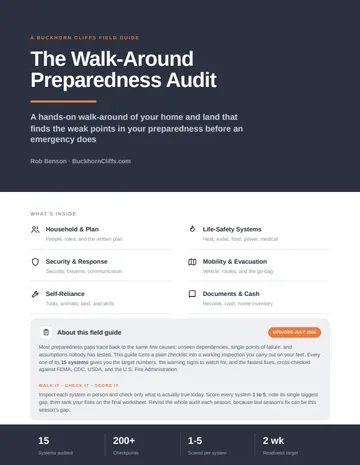
- Audit: rate your Security and Awareness readiness from GAP 1 to SOLID 5, then work the firearms section group by group.
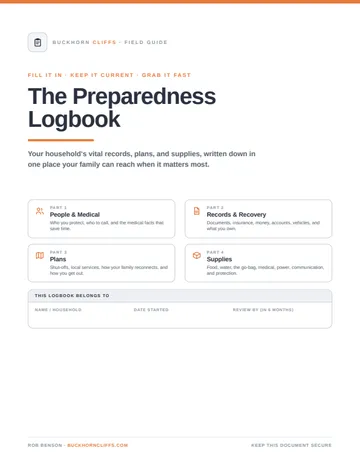
- Logbook: contact numbers on paper, plans for communication, evacuation, and emergency response. Separately, keep an ammunition log by caliber and label each can with its purchase date.
- Paper backups: printed maps, a physical address book, and printed instructions for critical tasks.
Defense and Security checklistAudit: Security and AwarenessAudit: Firearms as a Defensive ToolSpare parts: Doors, Windows and LocksSpare parts: Firearms and MaintenanceSpare parts: Fasteners and HardwarePreparedness LogbookCommunicating with no cell or internetNever-mix checker for household chemicals
What goes wrong
For what the calibers are and how they compare, use the ammo calibers chart.
Questions this answers
Tap a question for the short answer.
What is the first layer of home security
Distance. My audit puts the layers in this order: distance first, then barriers that buy time, then awareness that prevents surprises, with force as the last resort. Professionals describe the same idea as deter, detect, delay, and deny. Each layer buys time for the next one, and time is what lets you make calm, deliberate decisions.
What should I reinforce first on my house
Start with exterior doors, hinges, and strike plates: that is the first quick fix in my audit. Intruders go for whatever is easiest: a shop left unlocked, a hollow door, a dark corner nobody can see. The shop, barn, or shed is often hit before the main house, so lock those too, then check that windows lock and gates actually work.
How should exterior lighting be set up for security
Exterior lights should run without grid power and switch on or off selectively from your side. A light can deter, and the same light can give you away, so check whether each one shows you the approach or puts you in silhouette. Inside, keep a handheld light and a head-mounted light ready for the people in the house.
What do I do when someone is at my door and something feels wrong
Do not open the door until you know who it is. You control the point of contact, the distance, and the conversation, not the stranger. Decide ahead of time what you will say and what you will not. Trust the feeling that something is off, use your lights and cameras, and delay before you ever confront.
How should a defensive firearm be stored
My audit's test for a defensive firearm is secure plus ready: locked against the wrong hands and within reach of the right ones. Decide who is trained, who is not, and who should never have access. My ammo storage guide gives its own rule: ammunition is stored separately from firearms, where children and unauthorized people cannot get to it. Chamber flags help with safe storage.
What are the four firearm safety rules
One: treat every firearm as loaded. Two: never point it at anything you are not willing to destroy. Three: finger off the trigger until the sights are on target and you have decided to fire. Four: be sure of your target and what is beyond it. The rest of my firearms audit assumes all four are second nature for every user.
How long does stored ammunition last
Stored well, modern ammunition stays reliable for decades and can still work as designed after 50 years or more. That means a cool, stable spot, a sealed metal or plastic can, and a silica gel desiccant pack in each container. Keep cans off the floor, inspect every few months, label purchase dates, and shoot the oldest first.
Which firearm spare parts fail first
Magazines and their springs. They cause more stoppages than the firearm itself, so keep several spare magazines for each firearm you rely on and a spring for each one. After that come recoil springs, the firing pin and extractor, sight screws with thread locker, and batteries matched to your red dot, scope, and weapon light.
How does a household communicate when cell service is down
Own GMRS or ham radios and practice with them before you need them. GMRS needs an FCC license with a ten-year term, and one license covers the whole family. Ham needs a license earned by exam. Keep backup power for phones and radios, and written contact numbers. My checklist adds a whistle or air horn to signal without a weapon.
How do I protect household records from theft or loss
Copy your titles, IDs, medical records, prescriptions, and receipts, and photograph serial numbers on important gear to prove ownership. Put the digital set on an encrypted drive and leave it offline. My SSD guide adds redundancy: computer, portable SSD, encrypted cloud, and a duplicate SSD off site, with the drive in a Faraday jacket and a fireproof bag.
Does a faraday bag protect electronics from an emp
A well-made Faraday bag, closed all the way, gives electronics the best odds against the short radio-frequency burst of a nuclear EMP. My backup laptop guide adds the catch: the device has to be unplugged and the closure fully shut, or the bag does nothing. A solar storm is a different threat that damages the grid, not unplugged handheld devices.
What is the biggest security threat most homes face
Fire. Modern furnishings burn fast, so the window to escape after the alarm can be as short as two to three minutes. Fit a smoke alarm on each level and outside each sleeping area. Test monthly, swap batteries yearly, replace the units at ten years. Stage an A-B-C extinguisher where a fire is likely to start and learn PASS: pull, aim, squeeze, sweep.
Keep going
Related to this
Membership · $49.95 per year
There is a lot more behind the lock
Every recipe and resource from the Prepper's Chemical Survival Guide, all six field guides to read here and download, the full audit and logbook, all twelve reference charts, and no ads.
My Manual · included
Build your own field manual
The most useful thing a membership gives you. Save any page on this site, recipes, charts, and whole field guides included. Arrange them in the order you want, name it, and print one manual with a cover and contents, or keep it as a PDF that opens with no signal.
- It works when this site does not
- Only your pages
- Anyone in the house can use it
- One current copy, not a pile of printouts
- The house binder
- A copy for the bug-out bag or truck
- A copy for family
- An offline PDF




Stay Ready
New entries, updates, and useful instruction.
Stay one step ahead on your preparedness journey.