INDEFINITEHandle with careWorks without power
Quick facts
- Works byAbsorbs and binds
- FormFine gray powder
- Hazard classLow; dust
- Shelf lifeIndefinite
- StorageSealed glass or plastic
- What to avoidMoisture, untested brands
See everything bentonite clay must never touch
What it's good for
Settling aid
Helps clumps settle
Poultices
Drawing skin packs
Binding
Binds some toxins
Caution
Limited internal use
It swells in water and holds a negative charge, so it binds positively charged particles and, with a coagulant, helps fine sediment settle.
Good to know
A clay that swells and grabs. In water bentonite's stacked mineral sheets drink in liquid and balloon, exposing surfaces that carry a negative charge, which grab onto positively charged particles such as certain proteins and metal ions. That makes it a binder and a coagulant aid, a helper in clearing cloudy water rather than a stand-alone fix, since its negative charge actually repels the like-charged silt in muddy water. Popular 'detox' claims outrun the evidence, and some clays carry lead, so treat internal use with genuine caution.
Handling and safety
Limited internal use
Choose tested food-grade clay, keep internal use occasional, and not for poisoning.
A settling aid, not a fix
With a coagulant it helps clumps settle, but alone it will not clear muddy water.
The metal rule is overblown
A brief metal-spoon stir will not ruin it; just do not store wet clay against bare metal, which can rust.
A simple drawing poultice
On skin it can draw out moisture and bind some irritants.
Recipes for bentonite clay
Questions this answers
Tap a question for the short answer.
What is bentonite clay used for?
It is an absorbent clay that binds. Main uses are drawing poultices that pull moisture and bind some irritants on skin, and as a settling aid that, with a coagulant, helps clumps settle in cloudy water. Alone it will not clear muddy water, and internal use should stay occasional, with tested food-grade clay.
How long does bentonite clay last in storage?
Bentonite clay has an indefinite shelf life. Keep the dry powder sealed in glass or plastic and away from moisture, and it stays usable for as long as you store it.
How do I store bentonite clay?
Keep the dry powder in a sealed glass or plastic container, away from moisture. A quick stir with a metal spoon will not ruin it, but do not store wet clay against bare metal, which can rust.
Keep going
Related to this
Membership · $49.95 per year
There is a lot more behind the lock
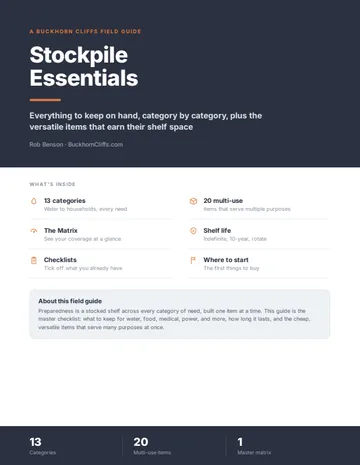
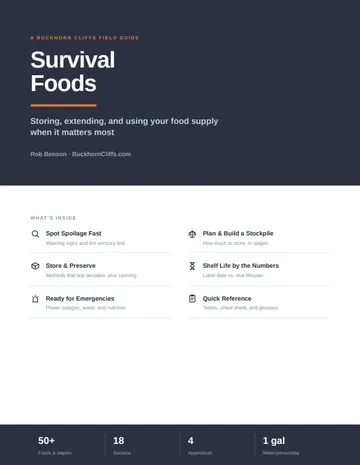
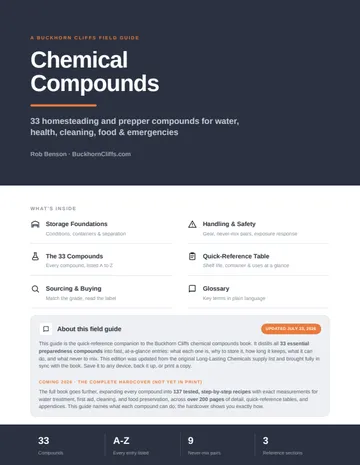
Every recipe and resource from the Prepper's Chemical Survival Guide, all six field guides to read here and download, the full audit and logbook, all twelve reference charts, and no ads.
My Manual · included
Build your own field manual
The most useful thing a membership gives you. Save any page on this site, recipes, charts, and whole field guides included. Arrange them in the order you want, name it, and print one manual with a cover and contents, or keep it as a PDF that opens with no signal.
- It works when this site does not
- Only your pages
- Anyone in the house can use it
- One current copy, not a pile of printouts
- The house binder
- A copy for the bug-out bag or truck
- A copy for family
- An offline PDF


Stay Ready
New entries, updates, and useful instruction.
Stay one step ahead on your preparedness journey.