Works without power
Quick facts
- Weather162.400 to 162.550 MHz, seven channels
- Talk with no license
- CB 9
- FRS
- MURS
- Talk with a licenseGMRS 20, ham 146.520 and 446.000
- On the waterMarine 16, 156.800 MHz
- In the air121.5 MHz, AM
- Listen only
- Police
- fire
- EMS
- SAR
- federal
There isn't one emergency frequency. There are a few dozen, each run by a different service for a different job, and on most of them your part is to listen. This page has the ones worth programming into a radio or a scanner, what you'll hear on each, and who's allowed to talk there. I checked every one against the agency that runs it.
Where this information comes from
- National Interoperability Field Operations GuideCISA: police, fire, rescue, federal, aircraft, and ham
- National Weather ServiceThe seven NOAA weather channels
- U.S. Coast GuardEvery marine channel
- FCC rules, Parts 90 and 95Who can talk on each service
- Bob Witte, K0NRHis 2025 review of the chart checked below
Which radio page you need
For knowing what's happening
Emergency Radio Frequencies- What to program into a radio or a scanner
- Weather, marine, aircraft, and police and fire mutual aid
- Who can talk on each one
- What your radio can and can't hear
- The chart that gets passed around, checked row by row
For reaching your own people
The 3-3-3 Radio Plan- When to turn the radio on, and for how long
- Which channel, and what to say
- The frequencies your group talks on
- How weather and county alerts reach the radio
- A two-page card to keep with the radios
The twelveFind a frequencyThe chartWhat your radio hearsWho can talkProgram it
Start with these twelve
If you program nothing else, program these. They cover the weather, the three services you can talk on, the calling frequencies hams watch, and the channels that come alive when something big happens. The label on each card says who can talk there.
The first six are the ones you might key up on. The last six are for listening, and listening is most of what a radio is good for in the first hours: you find out what's happening before anyone tells you.
Find a frequency
Every frequency on this page, grouped by service. Type part of a frequency or a word to narrow it, or pick who can talk.
Tap a service to open it. Searching opens the ones that match.
NOAA weatherMore than 1,000 transmitters; one of these seven covers your countyListen only7
- WX1162.550 FMForecasts, watches, warnings, and civil alerts for the area around each transmitter
- WX2162.400 FM
- WX3162.475 FM
- WX4162.425 FM
- WX5162.450 FM
- WX6162.500 FM
- WX7162.525 FM
National Weather Service. Radios number these differently, so go by the frequency.
CB40 channels, 4 W AM, 12 W sideband; needs its own radioNo license3
- 927.065 AMEmergencies and traveler assistance only, reserved by rule
- 1927.185 AMThe highway channel truckers use, by habit: road closures, wrecks, weather
- 326.985 AMThe 3-3-3 channel on CB
FRSAll 22 channels with a certified FRS radio, 2 W on mostNo license2
- 3462.6125 FMThe 3-3-3 calling channel
- 17462.600 FMA second group channel, shared with GMRS
GMRS vs FRS has all 22
MURSFive VHF channels, 2 W; carries through trees better than UHFNo license5
- 1151.820 FM
- 2151.880 FM
- 3151.940 FMThe 3-3-3 channel on MURS
- 4154.570 FMShared with businesses that move around
- 5154.600 FMShared with businesses that move around
GMRS$35, ten years, covers the immediate familyGMRS license2
- 20462.675 FM, 141.3 Hz toneThe travel and emergency convention; repeater input 467.675
- AnyAll GMRS channelsEmergency traffic has priority on every channel, by rule
Ham: VHF and UHFTechnician license: 35 questions, 26 to passHam license4
- 2 m146.520 FMNational simplex calling; the Wilderness Protocol frequency
- 70 cm446.000 FMNational simplex calling
- 6 m52.525 FMSimplex calling; reaches far when the band opens
- 1.25 m223.500 FMSimplex calling
Ham: the long-range netsGeneral license to talk; a shortwave receiver with sideband to listenHam license3
- 20 m14.300 USBMaritime Mobile Service Net: boats and travelers far from shore
- 20 m14.325 USBHurricane Watch Net, daytime, when a storm is near land
- 40 m7.268 LSBHurricane Watch Net, night
Marine VHFTalk from a boat with a marine radio; from land, listenListen only7
- 16156.800 FMDistress, safety, and calling. The Coast Guard and most ships keep a watch here
- 22A157.100 FMCoast Guard liaison and safety broadcasts, announced first on 16
- 9156.450 FMBoater calling
- 13156.650 FMBridge to bridge: ships telling each other where they are going
- 6156.300 FMShip to ship safety
- 68, 69, 71, 72156.425, 156.475, 156.575, 156.625 FMRecreational boats talking to each other
- 70156.525Digital distress calling. No voice, so nothing to hear
AircraftAM, so a plain FM handheld won't hear itListen only5
- Guard121.500 AMEmergency and distress for civil aircraft
- Mil243.000 AMThe military counterpart to 121.5
- SAR123.100 AMSearch and rescue aircraft
- SAR 2122.900 AMSearch and rescue, secondary and training
- Beacon406.0 to 406.1Aircraft, boat, and personal locator beacons talking to satellites. Digital, nothing to hear
Police, fire, and EMS mutual aid: VHFThe national channels agencies share on a big incident; 156.7 Hz toneListen only11
- VCALL10155.7525 FMCalling: where arriving units check in
- VTAC11151.1375 FMTactical
- VTAC12154.4525 FMTactical
- VTAC13158.7375 FMTactical
- VTAC14159.4725 FMTactical
- VFIRE21154.280 FMFire mutual aid
- VFIRE22154.265 FMFire mutual aid
- VFIRE23154.295 FMFire mutual aid
- VMED28155.340 FMAmbulance to hospital
- VLAW31155.475 FMLaw enforcement mutual aid
- VSAR16155.160 FMSearch and rescue; licensed team by team
Mutual aid: low band, UHF, and federalLess common; worth having if your scanner has the roomListen only10
- LLAW139.460 FMLaw enforcement, low band
- LFIRE239.480 FMFire, low band
- LLAW345.860 FMLaw enforcement, low band
- LFIRE445.880 FMFire, low band
- UCALL40453.2125 FMCalling, UHF
- UTAC41453.4625 FMTactical, UHF
- UTAC42453.7125 FMTactical, UHF
- UTAC43453.8625 FMTactical, UHF
- NC 1169.5375 FMFederal incident response, calling
- LE A167.0875 FMFederal law enforcement, calling
Nothing on this page matches that. Try fewer digits, or one word.
The chart that gets passed around
You've probably seen a chart titled "Ham Radio Emergency Frequencies." It was published by Stryker Radios, it gets shared every time there's a storm, and it's on a lot of prepper sites. I went through all 25 rows. Two of them are ham frequencies. The rest are police, fire, marine, aircraft, and federal channels, and some of what it says about them hasn't been true for decades.
| The chart says | Verdict | What's true |
|---|---|---|
| 34.90National Guard emergency channel | Can't confirm | It isn't in the FCC's public safety table or the federal interoperability guide. Military either way, so it would be listen only. |
| 39.46Local and state police emergency | Right | This is LLAW1, the low-band law enforcement mutual aid channel. Few departments still use low band. |
| 47.42Red Cross relief operations | Right, with a catch | The FCC reserves it for national disaster relief organizations. I couldn't confirm how much it's used today. |
| 52.525Ham six-meter FM calling | Right, with a catch | Correct, but it's a calling frequency, not an emergency channel, and it takes a ham license. |
| 121.50International aeronautical emergency | Right | Correct. It is AM, so most handhelds can't hear it. |
| 138.225Primary FEMA disaster relief channel | Can't confirm | A federal frequency. It isn't in the federal interoperability guide, and I couldn't find anything official that says FEMA uses it. |
| 146.52Ham two-meter non-repeater frequency | Right, with a catch | Correct: the national simplex calling frequency. It takes a ham license. |
| 151.625Mobile businesses; also 154.57 and 154.60 | Right, with a catch | The description is right, and that's the catch: it's a business channel for crews that move around, not an emergency frequency. The useful part is buried: 154.570 and 154.600 are MURS 4 and 5, which you can talk on with no license. |
| 154.28Local fire emergency; also 154.265 and 154.295 | Right | Correct. These are VFIRE21, 22, and 23, the fire mutual aid channels. |
| 155.160Search and rescue | Right | Correct. Many SAR teams are licensed here. |
| 155.475Local and state police emergency | Right | Correct. This is VLAW31, available nationwide for police emergency networks. |
| 156.75International maritime weather alerts | Wrong | This is marine channel 15, a receive-only channel once used by old emergency beacons. Marine weather is on the NOAA channels. |
| 156.80Maritime distress, calling, and safety | Right | Correct. Marine channel 16. |
| 162.40 to 162.55NOAA weather; also 163.275 | Right, with a catch | The seven NOAA channels are right. 163.275 isn't one of them and isn't on the Weather Service's list. |
| 163.4875National Guard emergency channel | Can't confirm | A federal frequency that isn't in the federal interoperability guide. |
| 163.5125Armed forces disaster preparedness | Can't confirm | Same: federal, and not in the guide. |
| 164.50Department of Housing and Urban Development | Can't confirm | Federal. I couldn't find anything official tying it to HUD today. |
| 168.55Federal civilian agency emergencies; also 243.00 | Right, with a catch | The best reference I found lists 168.55 for smokejumpers on wildfires, not general emergencies. 243.0 is right: it's the military air emergency frequency, tucked into the wrong row. |
| 259.70 and 296.80Space Shuttle re-entry and landing | Gone | The Shuttle last flew in July 2011. |
| 311.00 and 319.40Air Force in-flight channels | Can't confirm | Military air band, AM. A handheld won't receive it. |
| 317.70 and 317.80Coast Guard aviation | Can't confirm | Same band, same problem. |
| 340.20Navy aviation | Can't confirm | Same. |
| 409.20Interstate Commerce Commission | Gone | Congress abolished the ICC at the end of 1995. |
| 409.625Department of State | Can't confirm | Federal. Nothing official I could find. |
| 462.675GMRS emergency and traveler assistance | Right, with a catch | GMRS channel 20. It's a convention with the 141.3 Hz tone, not a rule, and it takes the GMRS license. |
Even the rows that are right leave out the thing you need to know. A list of who uses a frequency is a list of who's allowed to talk on it, and for most of that chart it isn't you. That's why every frequency on this page carries a label.
What your radio can hear
A frequency only helps if the radio in your hand can receive it. Check yours against this before you spend an evening programming.
| Radio | Hears | Misses |
|---|---|---|
| FRS or GMRS handheld | The 22 FRS and GMRS channels | Everything else on this page |
| GMRS handheld with weather channels | FRS, GMRS, and the seven NOAA channels | Marine, aircraft, police and fire, ham |
| Ham handheld, two-band | Most cover 136 to 174 and 400 to 520 MHz in FM: NOAA, marine, MURS, the VHF and UHF mutual aid channels, FRS and GMRS, and the ham bands | Aircraft (AM) on most models, CB, anything digital |
| Analog scanner | All of the above plus aircraft, and it scans them for you | Digital and trunked systems, which is how many counties dispatch now |
| Digital scanner | Analog, plus digital and trunked systems | Encrypted channels. Nothing hears those |
| CB radio | The 40 CB channels | Everything else |
| Shortwave receiver with sideband | The long-range ham nets, CB, and foreign broadcasters | VHF and UHF |
If you want one radio for listening, an analog scanner covers the most ground for the least money. If your county has gone digital, it takes a digital scanner to follow local dispatch, and nothing follows an encrypted channel.
Who can talk where
Anyone can listen to anything on this page. Talking is what the license covers.
Calling for help works best on the service where someone is listening for you: 911 while the phones work, your own group on the channel you agreed on, a ham repeater, CB 9 on the highway, or marine 16 on the water. A stranger's police channel isn't on that list. The ham rules do say that nothing in them stops a ham station from using any means it has when a life is in immediate danger and normal communication is out. That's a last resort for the worst hour, and it isn't a plan.
Program it in an evening
In this order.
- 1Find your NOAA transmitterLook up your county at weather.gov/nwr/station_search. Program that frequency first and tape it to the radio.
- 2Program the twelveGive each one a name you'll recognize at 2 a.m.: WX, CB 9, MAR 16, AIR, SAR, VCALL, VFIRE, VLAW.
- 3Lock the ones that aren't yoursOn a radio that can transmit, set every listen-only channel to receive only. In CHIRP that's the Duplex column set to "off."
- 4Add your countyDay-to-day police, fire, and ambulance dispatch isn't on the national channels. Look up your county on RadioReference and add what's listed as analog. If it says digital or trunked, a handheld won't follow it.
- 5Write it downA card with every channel name and frequency, kept with the radio. A radio that gets reset in the field is blank.
- 6Listen on a calm eveningScan for an hour before you need it. You'll learn which channels are alive where you live, and most of the mutual aid channels will be silent. That's normal: they wake up when something big is happening.
Where these come from
Every frequency on this page is from the agency that runs it or the rule that sets it aside.
- National Interoperability Field Operations Guide, version 2.01CISA. The mutual aid channels, the federal channels, aircraft, and the ham calling frequencies and nets.
- NOAA Weather RadioNational Weather Service. The seven frequencies and the transmitter lookup.
- U.S. VHF channel informationCoast Guard Navigation Center. Every marine channel and what it is for.
- 47 CFR Part 90, the Public Safety PoolFCC. The police, fire, and disaster relief frequencies and who they are reserved for.
- 47 CFR Part 95FCC. The FRS, GMRS, MURS, and CB rules, including CB channel 9.
- Erroneous Prepper Frequency ListsBob Witte, K0NR. A ham in Colorado who went through the same chart in 2025.
Questions this answers
Tap a question for the short answer.
What is the emergency radio frequency?
There isn't one for everything. On the highway it's CB channel 9 (27.065 MHz), on the water it's marine channel 16 (156.800 MHz), and in the air it's 121.5 MHz. Hams call on 146.520 MHz, and GMRS users treat channel 20 (462.675 MHz with a 141.3 Hz tone) as the travel and emergency channel. Weather and civil alerts come over the seven NOAA channels.
What are the noaa weather radio frequencies?
There are seven: 162.400, 162.425, 162.450, 162.475, 162.500, 162.525, and 162.550 MHz. One of them covers your county. Look up the transmitter at weather.gov/nwr/station_search and program that one first.
Is there a ham radio emergency frequency?
Not an official one. Hams use calling frequencies, and the one most people watch is 146.520 MHz on 2 meters. Under the Wilderness Protocol, hams in the backcountry listen there for five minutes every three hours starting at 7 a.m. On the long-range bands, the Hurricane Watch Net meets on 14.325 MHz and the Maritime Mobile Service Net on 14.300 MHz.
Can I talk on police or fire frequencies in an emergency?
Those channels are licensed to the agencies that use them, so plan on listening. To call for help, use the service where someone is listening for you: 911 while phones work, your own group's channel, a ham repeater, CB 9, or marine 16 on the water.
What is 121.5 mhz?
The emergency and distress frequency for civil aircraft. It's AM, so a plain FM handheld won't hear it, but a scanner will. The military counterpart is 243.0 MHz.
What frequencies can a ham handheld listen to?
Most two-band ham handhelds receive 136 to 174 MHz and 400 to 520 MHz in FM. That covers the NOAA weather channels, marine VHF, MURS, FRS and GMRS, the ham bands, and the analog police and fire mutual aid channels. Most can't hear aircraft, which use AM, or anything digital.
Is the ham radio emergency frequencies chart accurate?
Partly. Of its 25 rows, 6 are right as written and 7 are right with a catch. Two point to things that no longer exist (the Space Shuttle and the Interstate Commerce Commission), one is wrong, and I couldn't confirm the other 9. Only two rows are ham frequencies, and most of the others are listen only.
What I use for this
Gear from my recommended list
Keep going
Related to this
Membership · $49.95 per year
Everything on this site, open, and your own manual that works with no internet
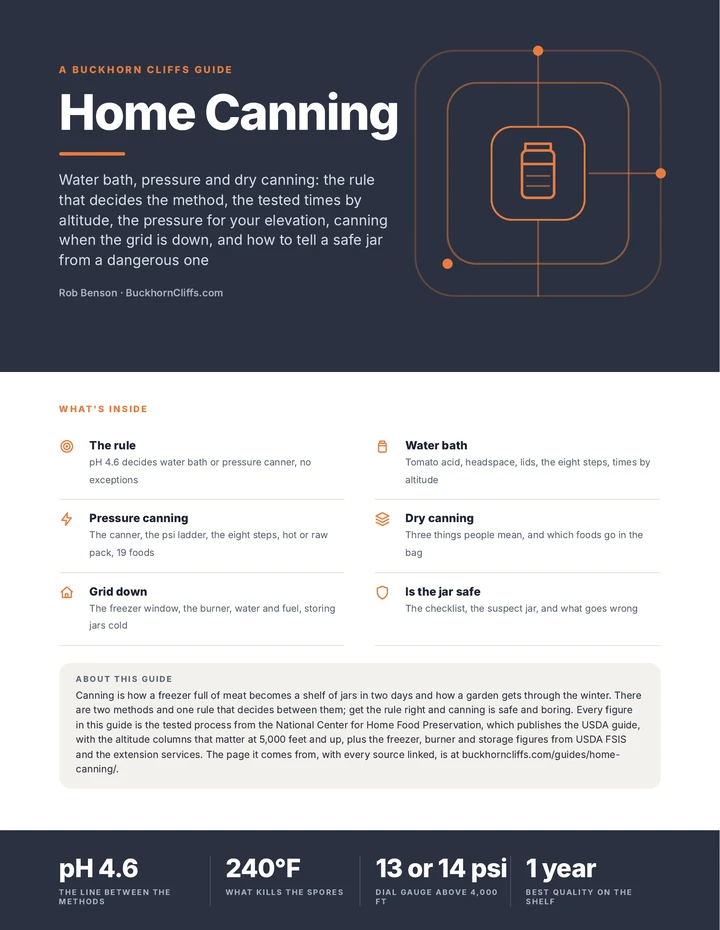
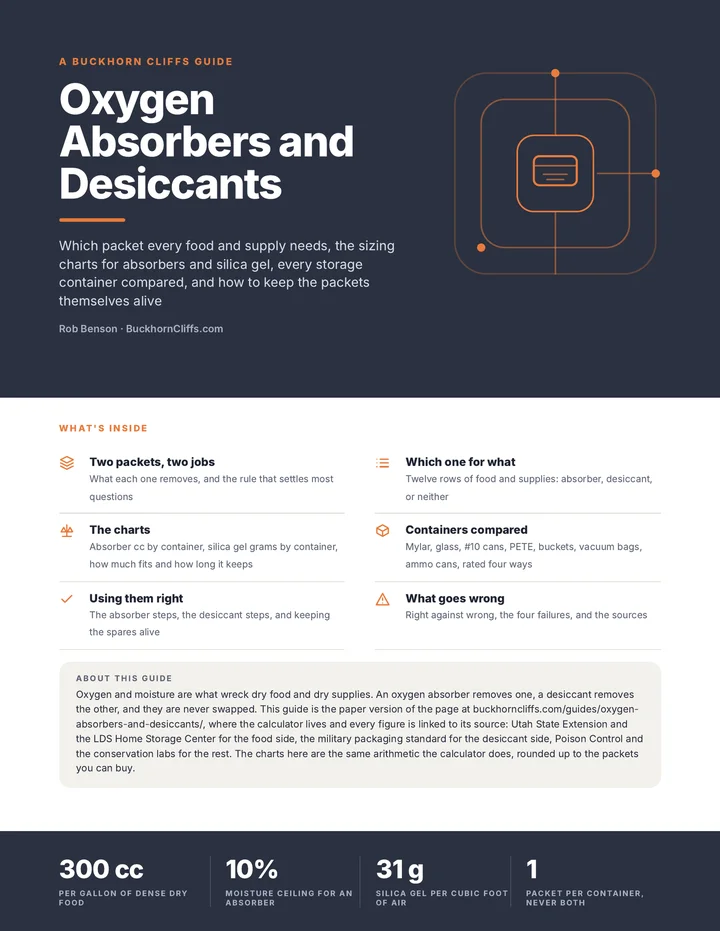
When the grid goes down, this site goes with it. Membership opens every member page and every recipe from the book, hands over all thirteen field guides as PDFs, and gives you your own manual built from the pages your household uses: searchable on your phone with no internet, and printable as one binder.
- 158member pagesopen in full, every amount and every step
- 138compound recipesfrom the hardcover book, exact amounts. Pick any and add them to your manual
- 13field guides304 pages of PDFs, $130 bought one at a time
- 9military field guidesUS Army manuals cut to 66 pages and laid out to use
- Offlineyour own manualbuilt from any page here, searchable on your phone with no internet
- Build your own manual on this site. pick any page, recipe, chart or whole field guide and put them in your order
- Download it and use it with no internet. it opens like an app on your phone or computer, searchable, with no power grid and no signal
- Print it or save it as one PDF. your cover, a contents page and every page you picked, laid out for paper
- All 138 recipes from my hardcover book. exact amounts for pool shock water purification, Lugol's iodine antiseptic, water glassing eggs, laundry powder and the rest
- All 13 field guides, 304 pages. Stockpile Essentials, Survival Foods, Bug-Out Bag, Home Canning, Solar Power and more, to read here or download
- 9 military field guides. Survival, First Aid, Mountaineering and the other US Army manuals, each cut to its most useful pages
- 158 how-to pages in full. medical, hygiene, tools and repair, garden and livestock, food, water and more
- The audit, the logbook and the checklists. all 200 audit checkpoints, saved to your account on every device
- One payment, $49.95 per year. Cancel any time and keep access to the end of the year you paid for.
- Sign in by email. No password, and the sign-in renews itself on every visit.
- Most of the site stays free. Membership is for the depth, the PDFs and your own offline manual.
Stay Ready
New entries, updates, and useful instruction.
Stay one step ahead on your preparedness journey.