Quick facts
- ChannelsBoth use channels 1 to 22; FRS and GMRS radios talk to each other on all of them
- FRS2 watts (0.5 on 8 to 14), fixed antenna, no repeaters, no license, about $30 to $120 a pair
- GMRS
- Up to 5 watts handheld
- 50 watts mobile or base
- external antennas
- repeater channels
- $35 license
- License$35 for 10 years, covers you and your immediate family, no test, apply online in 20 minutes
- Real rangeHandheld to handheld, either service: 1 to 2 miles in terrain, more across water or from a ridge. GMRS mobile with a good antenna or a repeater: 5 to 25 miles
- Rule of thumbFRS for the campsite and the trail; GMRS for the property, the convoy and the emergency plan
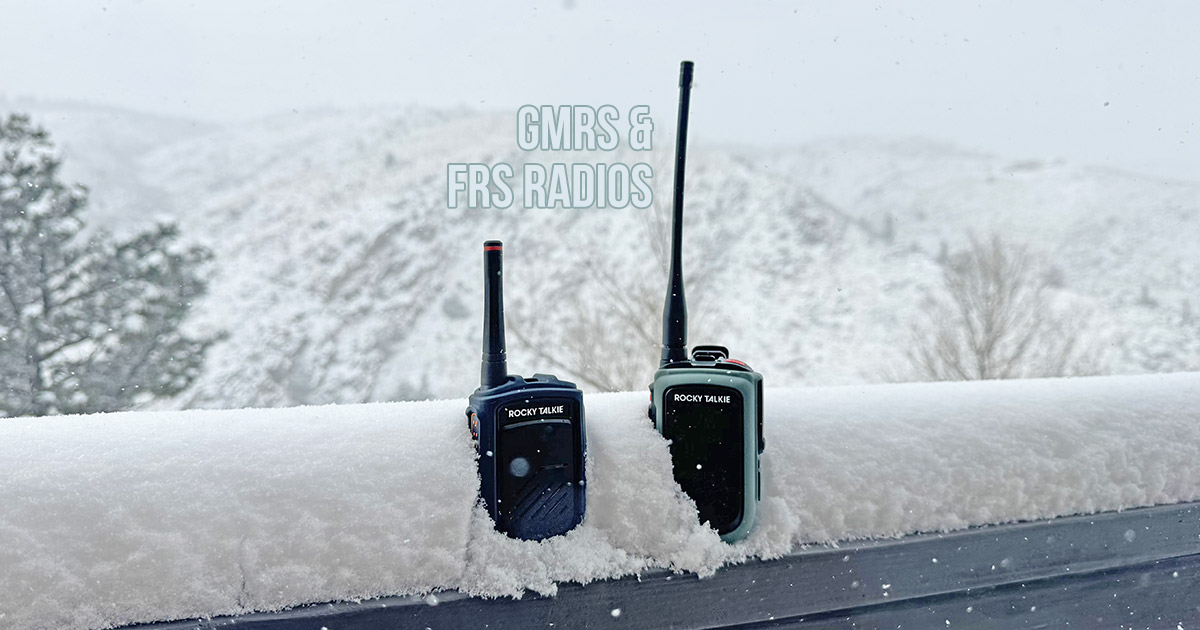
The radios in the blister pack at the sporting goods store and the radios in a serious emergency plan use the same 22 channels. What separates them is the rule book: how much power, what antenna, whether you can use a repeater, and whether you need the $35 license. Once you know which side of that line you need to be on, the radio picks itself.
Side by side
| FRS | GMRS | |
|---|---|---|
| Channels | 1 to 22 | 1 to 22, plus 8 repeater channels |
| Power | 2 W; 0.5 W on channels 8 to 14 | 5 W handheld typical; up to 50 W mobile and base on channels 15 to 22; 5 W on 1 to 7; 0.5 W on 8 to 14 |
| Antenna | Fixed, non-removable | Removable; roof, mast and vehicle antennas allowed |
| Repeaters | No | Yes |
| License | None | $35, 10 years, covers immediate family, no exam |
| Handheld range, real terrain | 1 to 2 miles | 1 to 2 miles simplex; far more with a repeater or from a mobile |
| Price | $30 to $120 a pair | $60 to $200 a handheld; $150 to $400 a mobile |
| Best at | Camp, trail, ski hill, kids, events | Property, convoy, emergency plan, anything past a mile |
What range really is
The 30-mile range on the box is two radios on two mountaintops with nothing between them. Real range is decided by antenna height and terrain, and watts come a distant third.
The license, in two minutes
GMRS is the easiest license the FCC issues. No exam, no equipment check. Create an FCC account, file the application online, pay $35, and the license with your call sign arrives by email within a couple of days. It is good for ten years and covers your spouse, children, grandchildren, parents, grandparents, siblings and in-laws on your one call sign. Say the call sign every so often while you talk, and that is the whole obligation. The step-by-step license page has every screen.
FRS radios are legal out of the box for anyone. Mixed groups work fine: everyone on the same simplex channel and privacy code, and the GMRS radios use repeaters only among themselves.
Which one you need
What I hand people
Rocky Talkie started in the climbing world and it shows: shatterproof screens, a leash, glove-friendly controls, a battery that lasts days, and a radio that keeps working after a fall. Both of these ride in my kits.
Rocky Talkie 5 watt GMRS radio
My GMRS pickThe full 5 watts, repeater capable, a removable antenna, and 4 to 6 days on a charge in normal use. For anyone who will get the license, which is anyone building a plan.
Rocky Talkie FRS Mountain Radio
My FRS pickThe same build at 2 watts with no license needed, 3 to 5 days on a charge. This is the one for the family members and friends who will never apply for a license, and it talks to the GMRS radio on every shared channel.
The next step past a handheld is a 20 to 50 watt GMRS mobile in the truck with a roof antenna, a base station at the house, and a repeater if you have a hill: the no-cell communication guide is that whole setup, with the channel plan.
Questions this answers
Tap a question for the short answer.
What is the difference between gmrs and frs radios?
The same 22 channels with different rules. FRS is the license-free service: 2 watts at most, half a watt on channels 8 through 14, a fixed antenna, and no repeaters. GMRS uses the same channels at up to 5 watts on a handheld and 50 watts on a mobile or base station, allows external antennas, adds eight repeater channels, and requires a $35 license. In practice: an FRS radio is a good walkie-talkie, and a GMRS radio is a communication system you can grow.
Do I need a license for gmrs?
Yes, in the U.S., to transmit. It is the easiest license the FCC issues: no test, $35, ten years, applied for online through the FCC's licensing system in about twenty minutes, and it covers your spouse, children, parents, siblings and in-laws. You get a call sign to identify with every so often on the air. FRS needs nothing. The <a href="/skills/how-to-get-a-gmrs-license/">GMRS license page</a> walks through the application click by click.
How much does a gmrs license cost?
$35, once, for ten years, and it covers the whole immediate family under one call sign. That is $3.50 a year for the right to run 50 watts and repeaters. There is no exam and no equipment inspection; you fill in the FCC form, pay, and the license arrives by email within a day or two.
Can gmrs radios talk to frs radios?
Yes. Channels 1 through 22 are the same frequencies in both services, so an FRS handheld and a GMRS handheld on channel 3 with the same privacy code hear each other. What the FRS radio cannot do is reach the GMRS repeater channels (15 through 22 on the repeater inputs), so a group with mixed radios works simplex on a shared channel, and the GMRS side gets the extra reach only among itself.
How far can a gmrs radio reach?
Handheld to handheld, in real terrain with trees and hills, 1 to 2 miles; across a lake or from a ridge to a valley floor, 5 or more; the 30-mile number on the package is a straight line between two mountaintops. A 15 to 50 watt mobile in the truck with a roof antenna talking to a base with an antenna on the roof of the house: 5 to 15 miles depending on the ground between them. Through a repeater on a high point, 20 to 50 miles for everyone in its footprint, including handhelds. Radio range is antenna height and terrain first, watts second.
What is the best gmrs or frs radio?
For most people, the two Rocky Talkies: the 5 watt GMRS radio for anyone who will get the license, and the FRS Mountain Radio for the family and the friends who will not. Both are built for the backcountry (the company started in climbing), with a shatterproof screen, a leash, a battery that lasts days, and controls you can work in gloves. For the truck and the house, a 20 to 50 watt GMRS mobile with a proper antenna is the next step, and the <a href="/guides/how-to-communicate-no-cell-or-internet/">no-cell communication guide</a> is the full setup.
Is gmrs worth it over frs?
If your radios are for the campsite, the ski hill and keeping track of kids on a hike, FRS is enough and the license is a formality you can skip. If they are part of an emergency plan, cover a property or a convoy, or need to reach across a town, GMRS is worth every dollar: five to ten times the power, an antenna on the roof, and repeaters that turn a handheld into a county-wide radio. The $35 buys the family ten years of the option.
What is a gmrs repeater?
A radio on a high point that hears your handheld on one frequency and rebroadcasts it at high power from a tall antenna on another. Your 5 watt handheld in a valley becomes a 50 watt signal from the ridge, and everyone in the repeater's footprint hears it. Many repeaters are run by clubs and individuals who share access on request; some are open. GMRS has eight repeater channel pairs. Setting one up on your own property, with a tower or a tall tree, is the single biggest upgrade a rural family can make to their communication plan.
Keep going
Related to this
Membership · $49.95 per year
There is a lot more behind the lock
Every recipe and resource from the Prepper's Chemical Survival Guide, all nine field guides to read here and download, the full audit and logbook, all twelve reference charts, and no ads.
My Manual · included
Build your own field manual
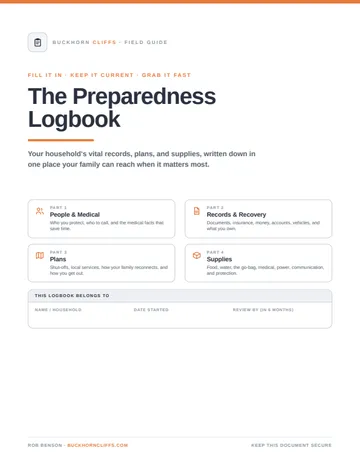
The most useful thing a membership gives you. Save any page on this site, recipes, charts, and whole field guides included. Arrange them in the order you want, name it, and print one manual with a cover and contents, or keep it as a PDF that opens with no signal.
- It works when this site does not
- Only your pages
- Anyone in the house can use it
- One current copy, not a pile of printouts
- The house binder
- A copy for the bug-out bag or truck
- A copy for family
- An offline PDF
Stay Ready
New entries, updates, and useful instruction.
Stay one step ahead on your preparedness journey.