Works without power
Quick facts
- The plan
- every 3 hours
- 3 minutes
- channel 3
- The windows
- noon
- 3
- 6
- 9
- midnight
- 3
- 6
- 9
- local time
- No license
- FRS
- CB
- MURS
- GMRS
- $35
- ten years
- the immediate family
- Reserved by ruleCB 9: emergencies and travelers only
- Listen onlySAR 155.160, marine 16 and 72, business bands
A radio plan is what makes a handful of handhelds into a net. The 3-3-3 plan is the simplest one that works, it is the one my household and the people I talk to use, and it fits on a card: turn the radio on every three hours, listen for three minutes, on channel 3. Below it is the frequency chart, every service a preparedness group might use, with the one column most charts leave out: who is allowed to transmit there. Members print both as a two-page card; the emergency side, how the weather and civil alerts reach the radio and where the local updates come from, is at the bottom and on the GMRS weather and emergency updates page.
The two-page card
Members print this page as a two-page card in the field guide format: page one is the plan with the clock, the four rules, the check-in script and a plan to fill in; page two is the frequency chart with the who-may-transmit column and the emergency updates. It lives with the radios. The Print and Save as PDF buttons on this page open it; the membership is $49.95 a year and includes every field guide and card.
The planRunning a windowSetting it upThe chartEmergency updatesWhat goes wrong
Part of the GMRS pages
The main GMRS page has the whole planWhy GMRS, the range you can expect, repeaters, the ten-minute license, the radios I use, and the plan you agree on before you need it, with every GMRS page linked from the top.The 3-3-3 radio plan
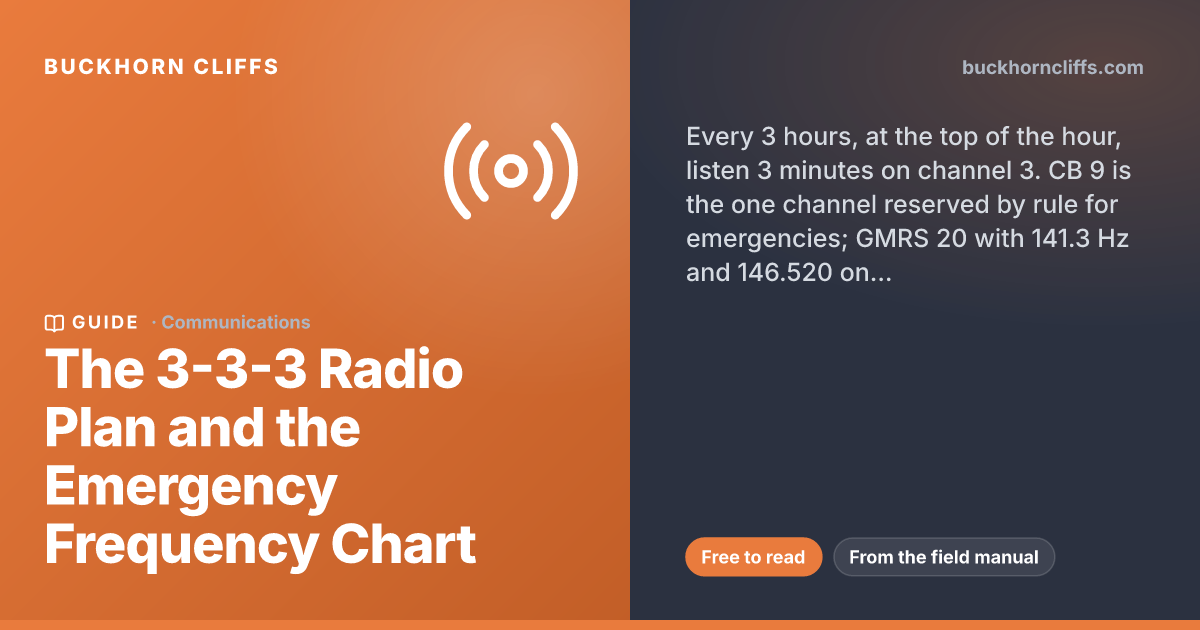
Every 3 hours. For 3 minutes. Channel 3.
When the phones are down, turn the radio on at the top of every third hour, listen for three minutes, and make a short call if you need to. Everyone in the group does the same, so you are on the air at the same moments without draining a battery all day. It rests on the rule of threes everyone already knows, and it is the schedule on most prepper frequency cards because it is the one people remember under stress. Groups that run their own nets keep their own windows; the point is that everyone in yours keeps the same one.
The eight windows, local time
Radio on at the top of each, listen three minutes, off until the next.
- Noon, 3, 6, 9, midnight, 3, 6, 9
- Eight windows a day: enough to be found, few enough to rest and to keep a battery alive for a week
- Three hours is also about eight miles on foot, so a walker gets a window before and after any move
- Someone may be trying to reach you, or may need help
- Checking in: "This is the house, checking in," then listen
- If the battery allows, or you have not connected in a while, listen fifteen minutes instead of three
- Channel 3 on FRS, GMRS, CB and MURS: the same number on every handheld, so nobody has to remember a frequency
- If your family net already has a channel and a privacy code, that channel is your channel 3
- Ham operators use the 2 m calling frequency, 146.520, the same way
- Set every watch and radio clock together, and again whenever people meet
- Not sure of the time? Leave the radio on longer before and after the hour
- No watch: an AM broadcast station identifies itself near the top of every hour
Why it works
Everyone remembers it, so everyone does it. The radios are off for most of the day, so batteries last a week instead of a night. The whole group is on the air at the same minute instead of calling into an empty channel. Transmissions stay short, which is what gets through and what keeps you hard to find. And three hours is long enough to sleep, work or walk between windows.
Running a window
What the three minutes look like when you run them, so the whole group does it the same way.
- 1Five minutes before the hourRadio on, volume up. On a radio with a squelch control, set it just past where the hiss stops. Channel 3, or your channel, with the privacy code set. If the watches might disagree, start ten minutes early.
- 2At the hour: listen firstSay nothing for the first thirty seconds. Someone with an emergency goes first, and they may already be calling.
- 3Check in, one sentence"This is the house, checking in." Each station in the agreed order: the house, the barn, the truck, the neighbor. A reply is one sentence too: "The truck, copy, nothing new."
- 4Traffic in orderHelp needed first, then roads and water, then everything else. Each transmission under fifteen seconds; a reply has to fit between them. A conversation that needs more moves to the fallback channel so channel 3 stays open.
- 5The NOAA relayWhoever has the radio with alert monitoring reads the last alert: what, where, until when. If there was none, say so; silence and no alert are different things.
- 6Minute three: close and switch off"The house, clear until nine." Radio off, or standby if the battery can afford it. The next window is in three hours; the watch says when.
Setting the plan up in an evening
The plan takes an evening to set up, and the setting up is most of the value. In this order.
- Pick the radio and the channelOne service for the whole group (FRS and GMRS talk to each other; CB and MURS do not). Channel 3, or the family channel, with a privacy code. Write it on tape on every radio.
- Pick the fallbackA second channel for conversations that run long, written under the first.
- Set the clocks togetherEvery watch and every radio clock, tonight, and again whenever people meet.
- Name the relay and the orderWho checks in first, who relays for the far station, who holds the NOAA radio.
- Decide what a missed window meansOne missed: wait. Two missed: someone goes. Put the number on the card.
- Run it onceA full window on a calm evening, every station, with the NOAA relay. The plan only exists after it has been run.
The emergency frequency chart
Every frequency people in the preparedness world have settled on, by rule or by habit, grouped by service. The colored label on each card is the one to read before you key up: green needs no license, orange needs the GMRS license, blue needs a ham license class, red is listen only. Every one is legal to listen to on a scanner or a radio that receives it.
- 3462.6125 FMThe 3-3-3 calling channel
- 17462.600 FMA second group channel, shared with GMRS
- 20462.675 FM, 141.3 Hz toneThe travel and emergency convention, not a rule; repeater input 467.675
- 17462.600 FMThe same group channel at GMRS power
- 3151.940 FMThe 3-3-3 channel on MURS
- 326.985 AMThe 3-3-3 channel on CB
- 927.065 AMEmergency and traveler assistance only, the one channel reserved by rule
- 36, 3727.365, 27.375 USBSideband, the longer-reaching CB mode
- 2 m146.520 FMNational simplex calling; the ham channel 3
- 2 m146.420, 146.550 FMTwo more simplex channels for a group
- 70 cm446.000 FMNational simplex
- 10 m28.305 USBThe one HF band a Technician may talk on (Technician)
- 20 m14.242 USBDaytime, across the country
- 40 m7.242 LSBRegional nets, day and night
- 60 m5.357 USBNight regional; channel 3 was eliminated in February 2026 and the frequency sits in a 9.15 W ERP sub-band
- 75 m3.818 LSBNight regional nets
- SAR155.160 FMSearch and rescue coordination, licensed agencies only
- Marine 16156.800 FMDistress, safety and calling on the water; boats afloat, not from land (a ship's handheld beside its own boat is the one exception)
- Marine 72156.625 FMBoat to boat, non-commercial
- Low band33.400 FMA business frequency some charts list; licensed businesses only
How to get emergency updates
The plan is how you reach each other. Updates about the weather and the county come from two places, and both are covered in full on the GMRS weather and emergency updates page; here is the short version for the card.
Weather and civil alerts: turn them on
| Radio | Weather channels | Listen to the broadcast | Turn on alerts |
|---|---|---|---|
| Rocky Talkie Expedition5 W GMRS | 11 (7 are the US NOAA frequencies) | Hold Volume Up until the cloud icon flashes; pick the channel with the flipper; PTT to leave | Hold Volume Up while powering on; the cloud icon means it is on |
| Wouxun KG-935G Plus5.5 W GMRS | 7 | Hold AREA two seconds; the knob steps 1 to 7; hold AREA again to leave | pick your weather channel first, then Menu 07 WX-ALERT to ON; Menu 23 picks how you are told |
| Rocky Talkie Mountain, Wouxun KG-805GFRS 2 W; GMRS 5 W | None | No weather channels. One radio with NOAA per household, alerts on, and it relays at the next 3-3-3 window | |
First, every radio: look up the transmitter for your county at weather.gov/nwr/station_search and tape the frequency to the radio. NOAA carries the civil alerts too: AMBER alerts, chemical releases, 911 outages. NOAA carries evacuation and shelter-in-place alerts too; the county's own briefings go out on AM/FM, which needs an FM receiver (both Wouxuns have one; the Rocky Talkies do not) or a hand-crank radio.
Where the local updates come from
- 1The family channelChannel 3 with a privacy code, a fallback channel, and the 3-3-3 windows. The NOAA listener relays each alert here: what, where, until when.
- 2The nearest repeaterFind it on myGMRS or RepeaterBook. Program the channel and tones now, read the listing notes, request access when in doubt, and key it once to confirm. A repeater on a hill turns a handheld's few miles into a county, and that is where organized local updates run.
- 3Neighborhood and CERT netsAsk the county emergency manager or CERT whether a radio plan exists. Palo Alto, for one, assigns FRS channels by neighborhood and keeps them off 17 and 20 to 22, which share frequencies with GMRS repeater outputs. If none exists, your street is where one starts, and a weekly practice net is what makes it work on the day.
- 4GMRS 20 with 141.3, and CB 9The two places a stranger might be listening: GMRS channel 20 with the travel tone by convention, CB channel 9 by rule. Worth monitoring on the road; never the only plan.
If you have to call for help
Say who you are, where you are in terms a stranger can use, what happened, and what you need, then stop and listen. Short transmissions leave room for a reply. Try the family channel at the next window, then the repeater, then GMRS 20 with the 141.3 tone, then CB 9 if you have CB, and keep repeating at intervals. Any GMRS channel may be used for emergency traffic and everyone else must yield to it.
What goes wrong
Right the net works
- Every watch set togetherand reset whenever people meet
- Channel 3 and the code on tape on every radiowith the fallback written under it
- One NOAA listener per household, alerts onrelaying at the next window
- Repeater keyed once this monthtones right, access confirmed
- A practice window every weekthe plan only works if it has been run
Wrong fix it before the day
- Radios left on all daydead by the second night; the windows are the point
- A different channel 3 on every radioFRS 3, CB 3 and MURS 3 are different services; agree on the radio and the channel
- Transmitting on a listen-only rowSAR, marine and business frequencies are not yours; a ham band needs the license
- Counting on GMRS 20 or CB 9a stranger may be listening; the family net is the plan
- No timekeepingten minutes off is a missed window
Questions this answers
Tap a question for the short answer.
What is the 3-3-3 radio plan
Turn the radio on every three hours, at the top of the hour local time (noon, 3, 6, 9, midnight, 3, 6, 9), listen for three minutes, on channel 3. Everyone in the group does the same, so you are on the air at the same moments without running a battery down all day. It rests on the rule of threes and it is the schedule on most prepper frequency cards because people remember it under stress; a group with its own net keeps its own windows.
What channel is channel 3 in the 3-3-3 plan
Channel 3 on whatever license-free radio your group carries: FRS 3 is 462.6125 MHz, CB 3 is 26.985 MHz AM, MURS 3 is 151.940 MHz. They are different services, so agree on the radio as well as the number. A group with its own family channel and privacy code uses that instead, and ham operators use the 2 m calling frequency, 146.520 MHz, the same way.
Which frequencies can I legally transmit on without a license
FRS (all 22 channels, with a certified FRS radio), CB (40 channels, 4 W AM or 12 W sideband), and MURS (five VHF channels at 2 W). GMRS needs the $35 ten-year license that covers the immediate family. The amateur bands need a Technician license for 2 meters, 70 centimeters and 10 meter phone, and a General for 20, 40, 60 and 75 meters. Public safety, search and rescue, marine and business frequencies are listen-only for everyone else.
Is there an emergency channel on cb or gmrs
CB channel 9 (27.065 MHz) is reserved by FCC rule for emergency communications and traveler assistance and nothing else. GMRS has no rule-designated channel; channel 20 (462.675 MHz) with the 141.3 Hz tone is a convention some groups monitor, and the rule lets you use any GMRS channel for emergency traffic. The 3-3-3 window on your own channel is where a call is most likely to be heard, because that is when your group is listening.
Why are the freeband and pmr446 frequencies left off
The "freeband" frequencies between and above the CB channels (27.368, 27.378, 27.425 MHz) are not channels at all, and no US service authorizes transmitting there. PMR446 is the European license-free service; its channels sit inside the 70 cm amateur band here, so a PMR446 handset is not legal in the United States. Both appear on charts that circulate; neither belongs in a plan.
How do I get emergency updates on the radio
Two ways. NOAA Weather Radio carries warnings and the civil alerts (AMBER, chemical releases, 911 outages); a GMRS radio with weather channels, like the Rocky Talkie Expedition or the Wouxun KG-935G Plus, listens with alert monitoring on, and the household's listener relays at the next 3-3-3 window. Local updates come from people: the family channel, the nearest repeater, a neighborhood or CERT net, and GMRS 20 or CB 9 as the last try. The county's own briefings go out on AM/FM, so keep a hand-crank radio beside the handhelds.
What I use for this
Gear from my recommended list
Keep going
Related to this
Membership · $49.95 per year
Everything on this site, open, printable, and yours on paper
When the grid goes down, this site goes with it. Paper does not. Membership opens every member page and every recipe from the book, hands over all thirteen field guides as PDFs, and builds a binder from the pages your household uses.
- 158member pagesopen in full, every amount and every step
- 138recipeswith exact amounts, from the book and beyond it
- 13field guides304 pages of PDFs, $130 bought one at a time
- 1manual of your ownbuilt from any page here, printed with your cover
- Every member page in full. the exact amounts, every step, every parts list
- Every recipe and resource from the book. all 138 from the Prepper's Chemical Survival Guide, searchable here
- All 13 field guides. read them here or download the PDFs, 304 pages
- My Manual. save any page, recipe or whole guide, order it, print one binder with your own cover
- The audit and the logbook, saved. your scores and checklists on every device
- Print and Save as PDF on every page. and no ads
- One payment, $49.95 per year. Cancel any time and keep access to the end of the year you paid for.
- Sign in by email. No password, and the sign-in renews itself on every visit.
- Most of the site stays free. Membership is for the depth, the PDFs and the paper.
Stay Ready
New entries, updates, and useful instruction.
Stay one step ahead on your preparedness journey.