US Army · ATP 4-25.12 · April 2014, with changes through August 2025
How the Army keeps a camp from making its own people sick: 174 pages on water, food, waste, latrines, pests, heat, cold and noise.
The Army PDF is free and in the public domain. The field guide comes with membership, or it's $10 as a PDF. All 9 manuals
- 174pages
- 11chapters
- 2people on a team
- 40hours of training
- 300 ftlatrines from the kitchen
Searches all 174 pages of the Army PDF and opens it at the page you pick.
Two versions of this manual
The official Army PDF
ATP 4-25.12 exactly as the US Army published it. It's a work of the US government, so it's in the public domain, and it's marked "Approved for public release; distribution is unlimited."
- All 174 pages: 11 chapters
- Written to train the two-person team in every company
- The Army's file, unedited
The Buckhorn Cliffs field guide
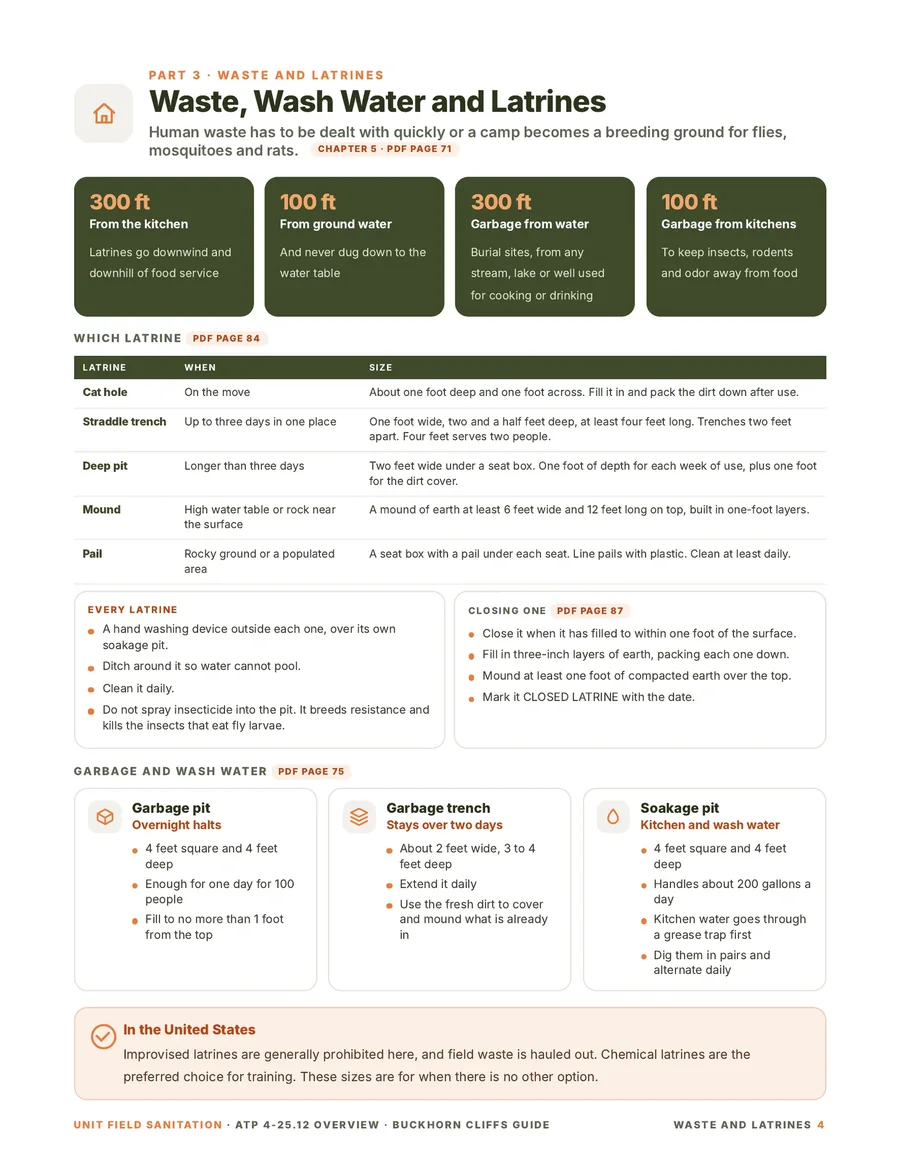
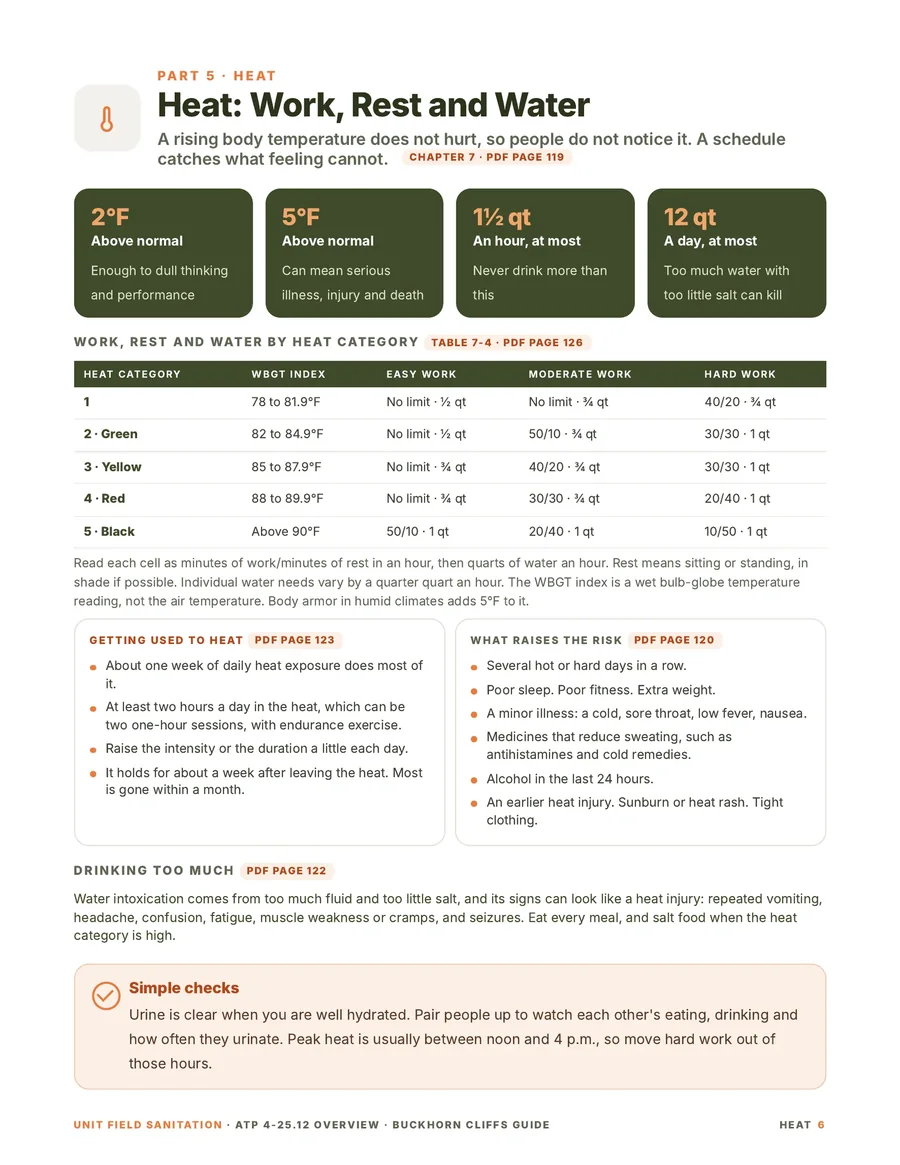
My 7-page overview of the same manual: the team, water, waste and latrines, pests, heat, and cold, noise and food. It's written from the Army's text and is not an Army publication.
- 7 pages in place of 174
- Latrine sizes and distances in one table
- The heat work, rest and water table
- Leaves out chlorine dose tables and pesticide mixing
- Boxes, charts, steps and checklists you can use at a glance
- Every section gives the page in the Army PDF
- Downloads as a PDF and saves to My Manual
Only want this one? Buy the field guide PDF for $10. This page is the free breakdown of the Army PDF. The field guide is the short version to print and keep.
- Real numbers: distances, pit sizes, water per person, work and rest by heat category.
- It scales. The same rules work for a family, a crew or a neighborhood.
- The pest chapter puts sanitation ahead of chemicals.
- The base edition is from 2014, with changes through 2025.
- Parts of it assume Army equipment and contracted latrines.
- It says itself that improvised latrines are generally prohibited in the United States.
- You may have to set up a camp or shelter for a group.
- You want numbers for water, waste and heat.
- You have read the short hygiene manual and want the detail.
How the 174 pages break down
Pest management, water supply and waste management are the three longest chapters. Each bar opens the PDF at that part.
Part by part
Unit Field Sanitation Teams
4 pages, starts on PDF page 15
Why the teams exist, what they do, and how they are trained.
Health Threats to Soldiers in the Field
20 pages, starts on PDF page 19
What each person and each leader is responsible for.
Unit Water Supply
24 pages, starts on PDF page 39
How much water, which class of water for which job, waterborne disease, and how bulk water is disinfected and stored.
Food Service Sanitation
8 pages, starts on PDF page 63
Foodborne pathogens, hand washing, and moving prepared food safely.
Waste Management
22 pages, starts on PDF page 71
Garbage, wash water and human waste, with drawings and dimensions for every field latrine.
Pest Management
26 pages, starts on PDF page 93
Rodents and biting insects: the diseases they carry, sanitation controls, pesticide safety and the repellent system.
Heat Injury
10 pages, starts on PDF page 119
Types of heat injury, getting used to heat, and the work, rest and water table.
Cold Injury
14 pages, starts on PDF page 129
Chilblains, trench foot, frostbite and hypothermia, with prevention for each.
Toxic Industrial Material Hazards
8 pages, starts on PDF page 143
Common toxic gases and liquids and how exposure happens.
Noise Hazards
8 pages, starts on PDF page 151
How noise damages hearing and how to protect it.
Sickle Cell Trait
4 pages, starts on PDF page 159
Exercise collapse associated with sickle cell trait.
Numbers worth knowing
These are the manual's own figures. Each tile opens the page it comes from.
Which latrine, and how big
Chapter 5 draws each improvised latrine and gives its size.
| Latrine | When | Size |
|---|---|---|
| Cat hole | On the move | About one foot deep and one foot across |
| Straddle trench | Up to three days | One foot wide, two and a half feet deep, at least four feet long |
| Deep pit | Longer than three days | Two feet wide. One foot of depth per week of use, plus one foot for cover |
| Mound | High water table or rock | A mound at least 6 feet wide and 12 feet long on top |
| Pail | Rocky ground or a populated area | A seat box with a pail under each seat |
Open improvised latrines, PDF page 84 · Hygiene and Sanitation on this site
Work, rest and water in heat
Table 7-4 sets minutes of work and rest in each hour, and quarts of water an hour, by heat category. The heat categories use a wet bulb-globe temperature reading, not the air temperature.
| Heat category | WBGT index | Hard work | Water |
|---|---|---|---|
| 1 | 78 to 81.9°F | 40 work, 20 rest | ¾ quart an hour |
| 2 | 82 to 84.9°F | 30 work, 30 rest | 1 quart an hour |
| 3 | 85 to 87.9°F | 30 work, 30 rest | 1 quart an hour |
| 4 | 88 to 89.9°F | 20 work, 40 rest | 1 quart an hour |
| 5 | Above 90°F | 10 work, 50 rest | 1 quart an hour |
Edition and history
ATP 4-25.12, Unit Field Sanitation Teams, was published in April 2014 and has been changed twice since, most recently in August 2025. It replaced FM 4-25.12 of January 2002.
As of November 10, 2026 the Army lists it as the current edition.
ATP 4-25.12 is a US Army publication, in the public domain as a work of the US government and marked "Approved for public release; distribution is unlimited." The Buckhorn Cliffs field guide is my own summary of it and is not an Army publication. BuckhornCliffs.com is not affiliated with or endorsed by the US Army or the Department of Defense.
Questions this answers
Tap a question for the short answer.
How far should a latrine be from a kitchen
The Army manual says at least 300 feet downwind and downhill from food service, and at least 100 feet from any ground water source.
How deep should a field latrine be
For a deep pit latrine the Army figure is one foot of depth for each week of use, plus one foot for the dirt cover.
What is atp 4-25.12
Unit Field Sanitation Teams, the Army manual on keeping a camp healthy. It is 174 pages, public domain, and free.
Keep going
Related to this
Membership · $49.95 per year
Everything on this site, open, printable, and yours on paper
When the grid goes down, this site goes with it. Paper does not. Membership opens every member page and every recipe from the book, hands over all thirteen field guides as PDFs, and builds a binder from the pages your household uses.
- 158member pagesopen in full, every amount and every step
- 138compound recipesfrom the hardcover book, exact amounts. Pick any and add them to your manual
- 13field guides304 pages of PDFs, $130 bought one at a time
- 9military field guidesUS Army manuals cut to 66 pages and laid out to use
- 1manual of your ownbuilt from any page here, printed with your cover
- Every member page in full. the exact amounts, every step, every parts list
- Every recipe and resource from the book. all 138 from the Prepper's Chemical Survival Guide, searchable here
- All 13 field guides. read them here or download the PDFs, 304 pages
- A field guide for each of 9 Army manuals. the survival, first aid and other US Army manuals, each cut to 10 pages or fewer
- My Manual. save any page, recipe or whole guide, order it, print one binder with your own cover
- The audit and the logbook, saved. your scores and checklists on every device
- Print and Save as PDF on every page. and no ads
- One payment, $49.95 per year. Cancel any time and keep access to the end of the year you paid for.
- Sign in by email. No password, and the sign-in renews itself on every visit.
- Most of the site stays free. Membership is for the depth, the PDFs and the paper.

Stay Ready
New entries, updates, and useful instruction.
Stay one step ahead on your preparedness journey.