BUCKHORN CLIFFS

Water · Guide

Water purification methods

An overview of making water safe: calcium hypochlorite treatment, well water risks, water testing tools, and what to do when city water is cut off.

Quick facts

Water per person
1 gallon per day; three days minimum, two weeks the target
Hypochlorite shelf life
up to 10 years
Hidden water sources
water heater tank, toilet tank (not the bowl)
Smell test
slight chlorine odor; no smell may need another dose
Private wells
not regulated by the EPA; test and treat it yourself
Most accurate test
mail-in samples to a professional laboratory

When it comes to preparing for the unexpected, one truth is universal: water is life. Whether you're facing a natural disaster, planning an off-grid adventure, or simply ensuring your family's safety in uncertain times, the ability to access and purify water is paramount.

In this blog post, I cover the world of water purification, exploring a spectrum of methods and tools that span from ancient techniques to cutting-edge technology. I'll guide you through primitive water purification practices that utilize nature's resources, discuss the convenience and efficiency of modern portable devices designed for individual use, and more.

How Water Can Become Unsafe: Understanding Contamination Risks

Understanding these diverse methods is crucial, as each one offers unique benefits tailored to different scenarios. Whether you're boiling water over a campfire, using UV light to sterilize your drinking supply, or setting up a whole-house filtration system, the goal remains the same: ensuring that every sip of water is as safe and clean as possible. So, here are the life-saving details of water purification, equipping you with the knowledge to stay hydrated and healthy, no matter what challenges you may face.

There are affiliate links on this page and website.


Purification of Water Without a Filter Using Calcium Hypochlorite

View the full blog post on this method: How-To Purify Water Without a Filter

  1. Objective: The process focuses on disinfecting and purifying water without reliance on conventional filtration systems, utilizing calcium hypochlorite as a primary agent due to its long shelf life and effectiveness in neutralizing pathogens.
  2. Chemical Basis: Calcium hypochlorite, a compound with potent oxidizing properties, serves as the active ingredient. When dissolved in water, it yields a disinfectant that kills bacteria, viruses, and Giardia. It does not kill Cryptosporidium, a chlorine-resistant parasite, so filter or boil when that is a risk.
  3. Preparation of Disinfectant Solution:
    • Materials Required: Calcium hypochlorite and clean, sediment-free water.
    • Make a stock solution from the granules, then dose the drinking water from that stock and wait 30 minutes. Exact amounts are in Purify water with calcium hypochlorite, which follows the book., which follows the book.
  4. Application for Water Purification:
  5. Post-Treatment Adjustments:
    • Smell Test: Confirm effective disinfection by the presence of a slight chlorine odor. Absence of the smell may necessitate an additional dose.
    • For amounts, see Purify water with calcium hypochlorite, which follows the book.
  6. Advantages Over Traditional Bleach: This method underscores the preference for calcium hypochlorite over sodium hypochlorite (liquid bleach) due to the former's extended shelf life (up to 10 years), making it more suitable for long-term storage and emergency preparedness.

I have a deep well, should I care about water purification?

Having a deep well can provide you with a more protected water source compared to surface water, as the depth often shields the water from many contaminants. However, it is not completely immune to pollution. Here are some reasons why you might still consider water purification for a deep well:

1Groundwater ContaminantsWhile deep wells are less susceptible to contamination from surface activities, they can still be affected by substances like heavy metals (such as lead and arsenic), certain minerals (like fluoride and radon), and nitrates/nitrites, which can seep into groundwater.
2Microbial PathogensBacteria, viruses, and parasites can sometimes find their way into a well, particularly if it's been compromised by cracks, a faulty seal, or after flooding.
3Chemical RunoffAgricultural runoff, industrial spills, or improper disposal of chemicals can lead to contamination of groundwater.
4Maintenance and Construction IssuesA well's integrity can be compromised by poor construction, lack of proper maintenance, or damage over time, leading to contamination.
5Natural DisastersEvents like earthquakes and floods can introduce contaminants into well systems that were previously safe.
6Regulatory StandardsPrivate wells are not regulated by the Environmental Protection Agency (EPA), so it's up to the well owner to regularly test and treat the water to ensure it meets health standards.

Are there tools to test my water?

Yes, there are several tools and kits available for testing your water, especially if you're relying on a private well or another source that is not regulated by municipal authorities. Here's a rundown of some common water testing options:

Basic Water Test Kits

These kits are readily available at hardware stores or online and can test for a variety of common contaminants, such as:

  • pH levels
  • Hardness
  • Nitrates and nitrites
  • Chlorine levels
  • Bacteria presence
  • Lead
  • Pesticides

They usually come with strips that change color according to the presence and concentration of specific contaminants. You compare the strip to a color chart provided with the kit to determine the levels of different substances.

Digital Water Testers

These are electronic devices that can provide a more precise measurement of certain water quality indicators like pH, total dissolved solids (TDS), and sometimes even specific chemicals. They are typically more expensive than basic test kits but offer more accurate readings.

Mail-In Testing Services

For a comprehensive analysis, you can collect samples of your water and send them to a professional laboratory. They can test for a wide range of potential contaminants, including bacteria, heavy metals, organic compounds, and others that may require more sophisticated detection methods. This is often considered the most accurate way to test water quality.

Water Testing Meters

These meters are more advanced and can provide instant readings for specific contaminants. Some are designed for home use and can measure things like TDS, pH, and conductivity. Others are more specialized and may be used by professionals to detect specific chemicals.

County Extension Offices or Local Health Departments

Sometimes, these local resources offer water testing services or test kits for residents. They can also provide advice on what particular contaminants you should test for based on local water quality issues.

Test Strips for Specific Contaminants

If you're concerned about a specific contaminant, such as lead or pesticides, you can purchase test strips designed to detect only that particular substance.

Radon Test Kits

Since radon is a radioactive gas that can contaminate water and is a risk factor for lung cancer, specific radon test kits are available for testing your water if you live in an area where radon is a known problem.

Bacteria Test Kits

These kits allow you to test for coliform bacteria, which are a common indicator of sanitary quality in drinking water.

I'm on city water and it got cut off, what now?

If your city water supply is interrupted, it can be due to various reasons such as maintenance work, infrastructure failure, natural disasters, or other emergencies. Here are steps you can take to ensure you have access to water:

Immediate Actions:

1Check for NoticesSometimes, the city will send out notices about planned interruptions. Check your local government or utility's website or contact them for information.
2Use Your ReserveIf you've prepared for emergencies, you might have bottled water stored. Store 1 gallon per person per day. Three days is the bare minimum and two weeks is the target for a home supply.
3Collect WaterIf there's advance notice, fill bathtubs, sinks, and other containers with water. This water can be used for flushing toilets or for sanitation purposes.
4Water HeaterYour home's water heater can be a source of potable water. Turn off the gas or the breaker first, close the incoming valve, open a hot water faucet somewhere in the house so air can get in, then drain from the spigot at the bottom. Do not turn the gas or power back on until the tank is full again.
5Toilet ReserveThe tank (not the bowl) often holds a couple of gallons you can use in an emergency, but only if the water is clear and the tank has never had drop-in cleaner or bluing tablets. Treat it before drinking.

Longer-Term Solutions:

1Rainwater CollectionSetting up a rainwater collection system can provide a supplementary water source.
2Water PurificationHave on hand water purification methods found in this post.
3Portable Water ContainersKeep large water containers that you can use to transport water from a community center or emergency water distribution site back to your home.
4Alternative SourcesIdentify alternative water sources nearby, such as rivers, lakes, or a neighbor's well. Remember, water from these sources may need to be purified.
Stackable Water Storage Containers
30 Gallon Stackable Emergency Water Storage
Survivor Filter PRO Hydration

Primitive Water Purification Techniques for Survival Situations

In the face of an emergency or in a survival scenario, one of the most critical skills you can possess is the ability to purify water. Without access to modern infrastructure, knowing how to clean and purify water using primitive methods can mean the difference between life and death. Here are some time-tested, primitive water purification techniques that anyone can use in the wild or during a disaster.

Boiling: The Gold Standard of Water Purification

Boiling is the simplest and most effective method to purify water. When you boil water, you kill nearly all harmful pathogens present, including bacteria, viruses, and protozoa. The process is straightforward: bring the water to a rolling boil for at least one minute. If you're at altitudes above 5,000 feet, extend the boiling time to three minutes due to the lower boiling point of water at higher elevations.

Solar Water Disinfection (SODIS): Harnessing the Power of the Sun

SODIS is a method that uses solar energy to disinfect water. Fill clean, clear plastic bottles with clear water, lay them on their sides, and leave them in full sun for at least six hours, or two full days if it is cloudy. Cloudy water has to be settled or filtered first or the sunlight cannot do its job. The ultraviolet radiation, along with the thermal treatment from the sun's heat, works to eliminate pathogens. This method is ideal in sunny climates and requires minimal resources.

Sedimentation: The Art of Patience

Sometimes the simplest way to start purifying water is by letting nature take its course. Sedimentation involves letting heavy particles in the water settle to the bottom naturally. After some time, you can gently collect the clearer water from the top. This method is often used as a preliminary step before further purification.

Sand and Charcoal Filtration: A DIY Filtering Solution

Creating a makeshift filter using layers of sand and charcoal can significantly improve water quality. The sand acts as a physical filter, trapping particulates, while the charcoal soaks up odor, taste, and some chemicals. Germs pass right through, so disinfect what comes out. This method won't make water completely safe for drinking on its own but can be used before boiling or chemical treatments.

Cloth Filtration: A Quick Pre-Filter Option

In situations where you need to remove large sediments quickly, a piece of cloth can serve as an effective pre-filter. Pouring water through a clean cloth can help eliminate larger particles and some pathogens. It's a quick step to prepare water for finer purification methods.

Natural Plant Filtration: Living Filters

Certain aquatic plants, such as cattails and reeds, are natural water purifiers. These plants absorb contaminants from the water, acting as living filters. That cleanup happens slowly in wetlands, over days. Running water through a patch of cattails does not make it safe, so still filter and then boil or disinfect anything collected this way.

Essential Tools for Water Purification in the Wild

When venturing out or preparing for emergency situations, having the right tools to purify water is as important as securing the water itself. Modern tools and equipment designed for water purification are compact, efficient, and easy to use. Here’s a rundown of some basic, yet indispensable tools and equipment that should be part of any survival kit.

Portable Water Filters: Your On-the-Go Purification Companion

Portable water filters are a must-have for any outdoor adventurer or survivalist. These come in various forms, such as handheld pump filters, soft bottle flasks, and straw-style filters. They are designed to remove harmful organisms like bacteria, protozoa, and sometimes even viruses. Lightweight and easy to pack, these filters are ideal for individual use and can provide immediate access to clean water from streams, lakes, or any freshwater source.

Water Filter
Lifestraw

Chemical Disinfectants: The Quick Fix to Waterborne Pathogens

When you need a quick and effective method to make water safe to drink, chemical disinfectants are the answer. Iodine or chlorine tablets and drops kill bacteria and viruses, but neither kills Cryptosporidium. Chlorine dioxide tablets do. Iodine is a short-term tool only: not for pregnancy, thyroid problems, or more than a few weeks of steady use. They are small, easy to carry, and can treat large volumes of water. However, they do have a waiting period for effective disinfection and may leave a slight taste in the water, which can be a trade-off for ensuring water safety.

Calcium Hypochlorite
Potable Aqua Chlorine Dioxide Water Purification Tablets

UV Light Pens: The High-Tech Purifier

UV light pens are a marvel of modern technology in the realm of water purification. These portable devices emit ultraviolet light that destroys the DNA of bacteria, viruses, and protozoa, rendering them harmless. They add no chemicals and work quickly, but only in clear water. Particles in cloudy water shield germs from the light, so pre-filter first. However, they do require battery power, so it’s important to keep spare batteries on hand or opt for models that can be charged via USB.

SteriPEN

Survival Straws: Personal Filtration for Immediate Use

Survival straws have gained popularity for their simplicity and effectiveness. These straws have built-in filters that remove bacteria and protozoa as you drink directly from a water source. Most do not remove viruses or dissolved chemicals, so pair them with a disinfectant when human sewage is a concern. They are incredibly lightweight and are an excellent addition to any personal emergency kit. While they are great for individual use, they are not the best option for purifying water for cooking or for multiple people.

Survivor Filter Portable Water Filter Straw

Ceramic Filters: The Robust and Reusable Option

Ceramic filters, which are often used with a hand pump, provide a reliable way to purify water. The small pores in the ceramic material can filter out bacteria and protozoa. Some ceramic filters are also treated with silver, which acts as a bacteriostatic agent to prevent the growth of mold and algae within the filter. They are durable and can be cleaned and reused multiple times, making them a sustainable choice for regular outdoor activities.

MSR MiniWorks EX Backountry Water Filter

Useful Water Purification Systems for Your Home

Clean water is a cornerstone of healthy living, and for those looking to ensure the highest quality water in their homes, industrial and high-end water purification systems offer unparalleled performance.

Countertop Gravity-Fed Water Filter Systems: The Convenient Purifier

For those seeking a high-end water purification solution without the need for installation, a Stainless Steel Countertop Gravity-Fed Water Filter System is an excellent choice.

Effortless Setup and Use

Unlike whole-house systems that require professional installation, this countertop unit can be set up easily by anyone. It simply needs to be placed on a counter, and it's ready to purify water. Its gravity-fed design means there's no need for electricity or plumbing: you pour water into the upper chamber and let gravity do the rest.

Powerful Filtration with Ceramic Filters: This system typically comes with high-grade ceramic filters capable of removing a wide array of contaminants, including bacteria, parasites, and microplastics, as well as improving the taste and odor of your water. The microscopic pores of the ceramic filters are effective at trapping pathogens, while the natural properties of ceramic can help reduce scale and other mineral deposits.

Gravity-fed Water Filter System
Royal Berkey Gravity-Fed Stainless Steel Countertop Water Filter System

Whole House Water Filtration Systems: Comprehensive Water Quality Management

Whole house water filtration systems are the ultimate solution for those seeking to improve the water quality in every faucet and shower in their home. Installed at the point of entry where water enters your residence, these systems ensure that every drop of water is treated before it circulates through your pipes. They can be customized with various filters to target specific contaminants such as sediment, chlorine, heavy metals, and organic compounds, providing peace of mind and protection for your family's health.

Ultraviolet (UV) Water Purification Systems: The Invisible Protector

Ultraviolet (UV) water purification systems bring the power of industrial-scale water treatment into your home. These systems use UV light to effectively inactivate a wide range of pathogens, including bacteria, viruses, and protozoa, without the use of chemicals. The process is simple yet powerful; as water passes through the system, it is exposed to UV light which disrupts the DNA of microorganisms, rendering them harmless. It's a clean, environmentally friendly way to ensure your water is safe to drink.

Ozone Water Purification: The Eco-Friendly Disinfectant

Ozone water purification is another high-end option that uses ozone gas, a strong oxidant, to disinfect water. Ozone is particularly effective against a broad spectrum of microorganisms and can also reduce the concentration of iron, sulfur, manganese, and other substances. The process also breaks down previously added chlorine, resulting in water that tastes and smells better. Ozone purification systems are known for their efficiency and minimal maintenance, making them a favorite for those who want a set-it-and-forget-it system.

Building Your Emergency Water Purification Kit: Top Tools for Preparedness

When disaster strikes, one of the first resources to become scarce is clean drinking water. Whether you're dealing with the aftermath of a natural disaster or planning for unforeseen emergencies, having a reliable water purification kit is essential. Here's a guide to some of the top tools that should be included in your emergency preparedness kit to ensure access to safe water in any situation.

Lifestraw Family: The Group Lifesaver

The Lifestraw Family is an indispensable tool for providing clean drinking water to a group or family. It's a larger version of the popular personal straw filter, designed to filter out viruses, bacteria, and parasites, providing up to 4,755 gallons (18,000 liters) of clean water. It's ideal for family emergency kits, as it's easy to use and requires no electricity or batteries, making it perfect for situations where you might be off the grid for an extended period.

LifeStraw Family 1.0 Portable Gravity Powered Water Purifier

The Survivor Filter PRO: Essential Gear for Clean Water in Emergencies

This pump filter runs water through three stages: a 0.1 micron pre-filter, an activated carbon filter, and a 0.01 micron ultrafilter. The maker lists 99.999% removal of tested bacteria, protozoa, and virus, plus lead and mercury reduction. Despite its compact and lightweight design, the Survivor Filter PRO is a powerhouse, capable of purifying up to 17 ounces (500 ml) of water per minute, making it an efficient solution for quickly providing clean water to individuals or groups.

The filters are replaceable. The two ultrafilters are rated to 100,000 liters (about 26,000 gallons), but the carbon filter is rated for only 2,000 liters (about 528 gallons), so stock spare carbon cartridges. The simplicity of its operation, assemble, pump, and drink, combined with straightforward maintenance, means that clean water is always within reach without the need for complex procedures.

Katadyn Pocket Water Microfilter: The Durable Dynamo

For those who need a rugged, long-lasting solution, the Katadyn Pocket Water Microfilter is the gold standard. Its durable construction is designed to withstand harsh conditions while providing up to 13,000 gallons (50,000 liters) of clean water. Its silver-impregnated ceramic element is effective against bacteria and protozoa, making it a reliable choice for your emergency kit.

Katadyn Pocket Water Filter

Survival Water Cube: The Convenient Carrier

Collapsible water cubes and bags are a practical way to collect, carry, and treat water. These specialized bags are designed to be filled with water, which can then be treated with purification tablets or drops. They are lightweight, compact when empty, and often come with built-in handles for easy transport. These containers can be a lifesaver when you need to move out quickly and carry your water supply with you.

Water Storage Cube

Questions this answers

Tap a question for the short answer.

How do I purify water without a filter?

Disinfect it with calcium hypochlorite, a strong oxidizer that kills bacteria, viruses, and Giardia. It does not kill Cryptosporidium, so boil when that is a risk. Dissolve it in clean, sediment-free water to make a disinfectant solution, treat your water with that, and check for a slight chlorine smell afterward. No smell may call for another dose. The dry compound stores up to 10 years.

My city water got cut off, what do I do?

Check your utility or local government for notices, then use your stored water. With advance warning, fill bathtubs, sinks, and containers for flushing and sanitation. Your water heater holds usable water, and so does the toilet tank, not the bowl, if it is clear, has never had drop-in cleaner, and you treat it before drinking. Longer term, set up rainwater collection, keep purification methods on hand, and have large containers for hauling water.

Do I need to purify water from a deep well?

A deep well is better protected than surface water, but it is not immune. Heavy metals, radon, nitrates, chemical runoff, and microbes can still get in, especially through cracks, a bad seal, poor maintenance, flooding, or an earthquake. Private wells are unregulated, so testing and treating the water is up to you.

How do I test my well water?

Basic color-strip kits from a hardware store check pH, hardness, nitrates, chlorine, bacteria, lead, and pesticides. Digital testers and meters give more precise readings for things like pH and total dissolved solids. Mailing samples to a lab is the most accurate option, and county extension offices or health departments sometimes offer testing or kits.

Can I drink the water in my water heater in an emergency?

Yes, your home's water heater can be a source of potable water. Turn off the gas or the breaker first, close the incoming valve, open a hot water faucet somewhere in the house so air can get in, then drain from the spigot at the bottom. Do not turn the gas or power back on until the tank is full again. The toilet tank, not the bowl, also holds a couple of gallons, but only if the water is clear and the tank has never had drop-in cleaner, and treat it before drinking.

How much water should I store per person?

Store 1 gallon per person per day. Three days is the bare minimum and two weeks is the target for a home supply. If the supply is cut, your water heater and toilet tank are hidden reserves on top of what you have stored.

Keep going

Read nextHow water becomes unsafe (contamination risks)Explains seven ways water gets contaminated, how to spot problems in stored water, and good practices for storing water at home.Water · Guide

Related to this

Membership · $49.95 per year

There is a lot more behind the lock

158member pages in full
125recipes with exact amounts
6field guide PDFs, 206 pages
1manual of your own, built from any page

Every recipe and resource from the Prepper's Chemical Survival Guide, all six field guides to read here and download, the full audit and logbook, all twelve reference charts, and no ads.

My Manual · included

Build your own field manual

The most useful thing a membership gives you. Save any page on this site, recipes, charts, and whole field guides included. Put them in your order, name it, and print one manual with a cover and contents, or keep it as a PDF that opens with no signal.

  • It works when this site does not
  • Only your pages
  • Anyone in the house can use it
  • One current copy, not a pile of printouts
  • The house binder
  • A copy for the bug-out bag or truck
  • A copy for family
  • An offline PDF

Join for $49.95 per year

Water · GuideLast reviewed 2024-10-03

Membership

Save to My Manual is a member tool

Members build their own manual from the pages that fit their household, then print it or keep it as a PDF.

Why it matters

When the grid goes down, this site goes with it. Paper does not. Membership is how you get the whole manual off the screen and onto the shelf: every page in full, every field guide, and a binder built for your own household.

The field guide library

All six field guides. 206 pages. Included.

The complete Buckhorn Cliffs PDF set, yours to download, print, and keep from the day you join.

$60if bought one at a time

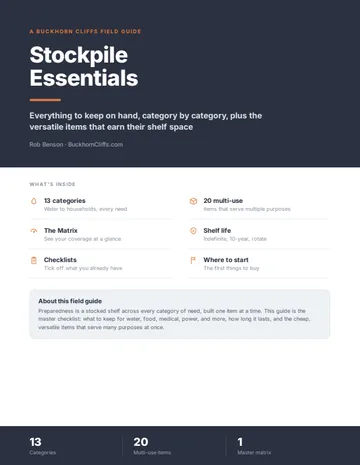
  • Cover of Stockpile Essentials Field GuideStockpile Essentials39 pagesEverything to keep on hand, category by category, plus the 20 multi-use items.
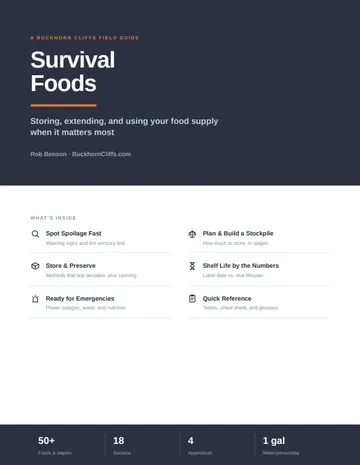
  • Cover of Survival Foods Field GuideSurvival Foods35 pagesStoring, extending, and using the food supply. Real shelf life by the numbers.
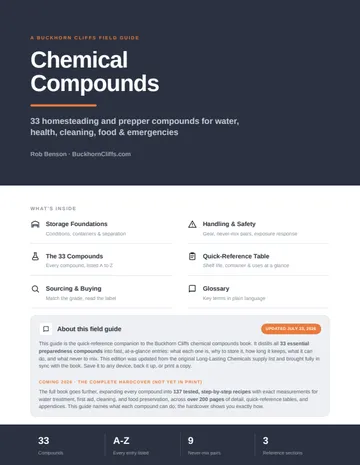
  • Cover of Chemical Compounds Field GuideChemical Compounds29 pagesThe 33 compounds: storage, top uses, hazards, and the never-mix chart.
  • Cover of Spare Parts and Repair Stock Field GuideSpare Parts and Repair Stock40 pagesWhat to keep on hand to fix the home and land when the supply chain breaks.
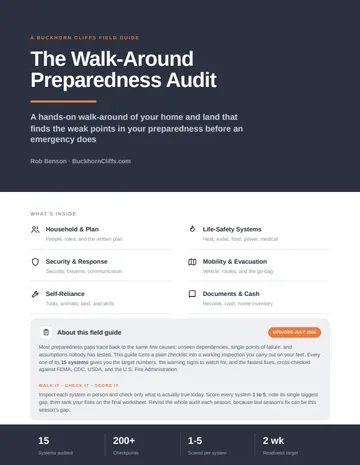
  • Cover of Walk-Around Preparedness AuditWalk-Around Preparedness Audit33 pagesFifteen systems scored 1 to 5, with the printable scorecard.
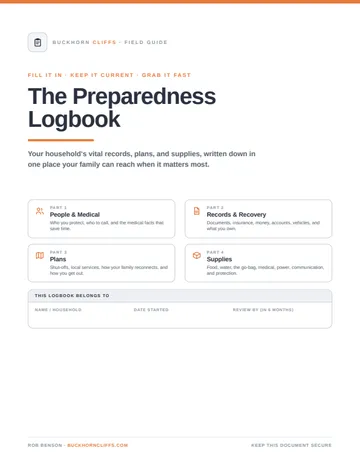
  • Cover of The Preparedness LogbookPreparedness Logbook30 pagesThe household information that needs to be on paper.

My Manual · included

Build your own field manual

The most useful thing a membership gives you. No book fits your household exactly. My Manual does. Save any page on this site, recipes, charts, and whole field guides included, put them in your order, and print one manual with your name on the cover. It holds only what is relevant to you, and nothing you would skip.

Why it matters

  • It works when this site does notNo power and no signal means no website. A printed manual and an offline PDF still open, which is the whole point of writing any of this down.
  • Only your pagesThis site covers every household. Yours needs a fraction of it. Your manual holds the pages that match your water source, your climate, and your gear, so nobody digs through the rest under stress.
  • Anyone in the house can use itThe person who reads this site may not be the one home when it counts. A binder on the shelf, in your order, with a contents page, is something a spouse or a teenager can follow.
  • One current copy, not a pile of printoutsEvery page prints in the same field guide layout with a cover, a contents page, and the print date. Change a page, print again, and the old copy is easy to spot.

What to build with it

  • The house binderYour water source, your climate, your gear. Only the pages you would reach for.
  • A copy for the bug-out bag or truckA short version that travels: water, first aid, comms, and the recipes you rely on.
  • A copy for familyHand a parent or a grown kid a manual built for their house and their supplies.
  • The shop and the barnParts lists, repair skills, and the never-mix chart, kept where the work happens.
  • A recipe book of your ownThe cleaners, fuels, and remedies you make, with exact amounts, in one place.
  • An offline PDFSaved to a phone, a tablet, or a drive in the Faraday bag. It opens with no signal.

How it works

  1. 1Save what fitsPress "Save to My Manual" on any page: a recipe, a chart, a guide, a parts list, or a whole field guide.
  2. 2Put it in your orderOn My Account, drag the pages into the order you want. Name the manual and add your household name.
  3. 3Print it or save a PDFOpen the preview, then print it or save a PDF. It is sized for 8.5 x 11 inch paper, with a cover and a contents page. Field guides go in exactly as the PDFs are laid out. No ads, no photos.
  4. 4Keep it currentAdd a page, pull one out, print again. The cover carries the date, so you always know which copy is the latest.

Also included

  • The entire site, unlockedAll 158 member pages open in full: exact amounts, every step, every warning, every parts list. Nothing held back.
  • Every recipe and resource in the bookAll 138 recipes and 33 compounds from Prepper's Chemical Survival Guide, with exact amounts, every step, every warning, and the reference charts.
  • A clean PDF of any entryOne press turns any page into a field guide sheet for the binder, the truck, or the shop wall.
  • Checklists and audit scores that follow youSaved to the account, so the phone, the laptop, and the shop computer always match.
  • No adsMembers read the whole site without a single ad.
$49.95per year. About 14 cents a day. Cancel any time and keep the year you paid for.