INDEFINITEMULTI-USEWorks without power
Quick facts
- Shelf lifeIndefinite
- For brines and curesNon-iodized, nothing added
- Only enemyMoisture
- Types worth knowing
- table
- ancient sea
- pickling
- kosher
- Himalayan
- curing
- Storage
- Airtight
- with a desiccant
- off bare metal
- NeverUse pink curing salt as table salt, or eyeball a cure
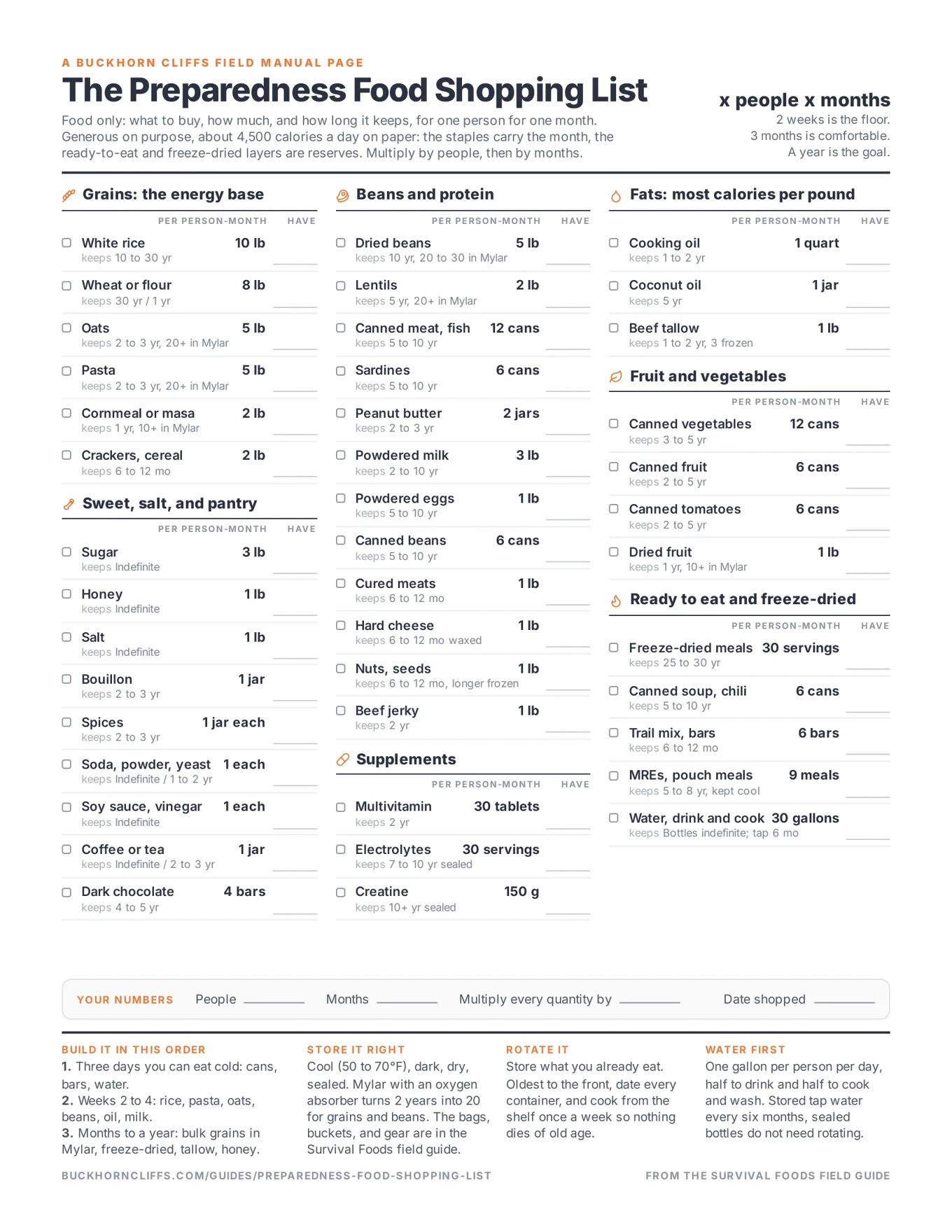
The food shopping list: what to buy, how much, shelf life
See everything salt must never touch
Why the right salt matters
The kind you keep changes how it cures, brines, and stores
A recipe just says salt, but the kind you reach for changes the result. Iodine and anti-caking agents can cloud a brine and stall a ferment, and curing meat needs a salt blended for the job. Keep a few specific salts and you can season, preserve, and treat with the same shelf-stable mineral.
How salt preserves: by pulling water out
What I keep on hand
Read the label before you buy
Two things ruin a batch: iodine and anti-caking agents. Iodine can darken pickles, and anti-caking agents cloud a brine. For any preserving work, use a salt whose label lists only salt.
The six salts
Types, best uses, and what to watch for
Best for: Everyday seasoning at the table and stove.
Watch out: Iodine and anti-caking agents cloud brines and stall fermentation.
Best for: Daily eating and seasoning, and an electrolyte base with water.
Watch out: Coarser and less uniform, so a fine pickling salt dissolves cleaner for brines.
Best for: Brining, fermenting, pickling, and most preserving work.
Watch out: No anti-caking agent, so it clumps in humid air. Keep it sealed.
Best for: Drawing moisture from meat and general cooking.
Watch out: Some brands add anti-caking, and it measures differently by volume.
Best for: Everyday seasoning and finishing.
Watch out: Still almost pure sodium chloride, so the extra minerals are negligible.
Best for: Curing meat safely, where nitrite blocks botulism.
Watch out: Toxic in excess. Use exact, weighed amounts, and never as table salt.
Celtic, Himalayan, and ancient sea salt are close cousins
All three are unrefined salts that keep their natural trace minerals, and for daily eating and finishing they are basically interchangeable. Himalayan pink and ancient sea salt are dry and mined from old sea beds. Celtic (sel gris) is a moist, grey sea salt hand-harvested from French coastal ponds. None of them dissolve as cleanly as a fine pickling salt, so keep them off precise brines, and their trace minerals are too small to matter nutritionally.
Pink means curing salt, not seasoning
Curing salts are dyed pink on purpose, so no one mistakes them for table salt. Keep them labeled, weighed, and well away from the everyday shaker. See Curing salts and safety for the details.
Match the salt to the job
Pick the right salt for the task in front of you
Most jobs want a plain, additive-free salt. A few are specific: curing needs a pink nitrite salt, and preserving eggs needs lime, not salt at all.
| The job | Use this salt | Why |
|---|---|---|
| Daily eating & seasoning | Ancient unrefined sea salt | Clean flavor and trace minerals. My go-to. |
| Finishing a dish | Celtic or Himalayan salt | Coarse mineral crystals for crunch and pop. |
| Electrolytes & hydration | Ancient unrefined sea salt | Sodium plus trace minerals the body sheds. |
| Brining, fermenting, pickling | Pickling or canning salt | Non-iodized and additive-free. Dissolves clear. |
| Curing meat | A pink nitrite curing salt | Nitrite fixes color and blocks botulism. |
| Drawing moisture from meat | Kosher salt | Coarse flakes pull surface moisture well. |
| Oral rinse & gargle | Any plain salt | Dissolved in warm water for a sore throat. |
| Saline wound irrigation | Plain non-iodized salt | Clean salt in boiled, cooled water. |
| Water-glassing eggs | Pickling lime, not salt | Eggs are preserved in a lime solution. |
A common mix-up: eggs use lime, not salt
Long-term egg storage (water-glassing) uses a solution of pickling lime, which is calcium hydroxide, not salt. Salt cures meat and brines vegetables, but it will not preserve eggs.
Free download
Get the one-page food shopping list
What to store, how much of it for one person for one month, and how long it keeps. One page with checkboxes, built from the Survival Foods field guide. Print it, multiply by your people and months, and take it to the store.
The PDF comes by email, with my newsletter now and then. Already on the list? You still get it. Read the full page.
Salt at work
The everyday and long-term jobs one mineral covers
A quick brine to remember
Curing is the exception, weigh it
Seasoning and brining leave room for taste. Curing does not. Nitrite curing salts are dosed by weight to be both safe and effective, so follow a tested recipe and a gram scale.
Curing salts and safety
Nitrite, nitrate, and why the dose is the whole game
Curing salts are table salt blended with a small, exact amount of sodium nitrite or nitrate, then dyed pink so no one confuses them with seasoning salt. The nitrite fixes cured meat's color and, most importantly, blocks botulism. That same power makes them toxic in excess.
The two you will see
How it protects the meat
In curing, bacteria turn the nitrate into nitrite, which fixes the meat's pink color and blocks Clostridium botulinum, the source of botulism. Cure #2 releases its nitrite slowly, which is why it suits meats that age for weeks or months.
Handle it right
- Weigh curing salt on a gram scale
- Follow a tested recipe exactly
- Keep it labeled, pink, and apart from table salt
- Cure at cold, controlled temperatures
- Eyeball it or scale up by feel
- Use curing salt as table salt
- Store it where it could be mistaken
- Assume more nitrite is safer
Toxic in excess, so lock it away
Nitrite is dangerous in large amounts. Curing salts are safe only at weighed, recipe-level doses. Keep them away from children and never substitute them for regular salt.
Storing salt
It never expires, so the whole job is keeping it dry
Plain salt keeps forever. Its only enemy is moisture, not time. Store it dry and sealed and it will outlast almost everything else in your supply.
Keep it dry
Pure salt, two grinds
Pickling salt is the same pure salt as plain granulated, just milled finer, so it dissolves faster in a brine. Either one works. Curing salts also keep indefinitely when sealed and cool, but close them tight since nitrate pulls moisture from the air and cakes.
Salt at a glance
Every salt, its best use, and the catch
| Salt | Best use | Iodine? | Watch for |
|---|---|---|---|
| Table salt | Table seasoning | Usually | Clouds brine, darkens pickles |
| Ancient sea salt | Daily eating, electrolytes | No | Coarse for fine brines |
| Pickling & canning | Brine, ferment, pickle | No | Clumps if left open |
| Kosher salt | Cooking, drawing moisture | Rarely | Measures differently by volume |
| Himalayan pink | Seasoning, finishing | No | Extra minerals are negligible |
| Celtic (sel gris) | Daily eating, finishing | No | Damp and grey, not for fine brines |
| Curing (Prague Powder) | Curing meat only | No | Toxic in excess, weigh it |
Glossary
- Non-iodized
- Salt with no added iodine, so it will not darken pickles or discolor a brine.
- Nitrite
- The active agent in curing salt that fixes color and blocks botulism.
- Anti-caking agent
- An additive that keeps salt free-flowing but clouds a brine. Avoid it for preserving.
- Prague Powder
- A pink-dyed curing salt: #1 is nitrite, #2 adds nitrate for long cures.
- Brining
- Soaking food in a salt-water solution to season and preserve it.
- Desiccant
- A drying agent such as silica gel that pulls moisture inside a sealed container.
- Curing
- Preserving meat with salt, often with nitrite, so it keeps without refrigeration.
- Saline
- A simple salt-and-water solution used to rinse wounds or gargle.
- Osmosis
- The pull that moves water out of food and microbes toward the salt, drying spoilage out.
- Water-glassing
- Preserving unwashed eggs in a lime solution, not salt, for months of storage.
A field reference, not a recipe book
This guide tells you which salt to keep and what each one is for. It does not give curing measurements. For curing, always follow a tested recipe and weigh your curing salt on a gram scale.
Salt for survival: The body, the pocket kit, and the other jobs
What the field guide leaves out, from my Salt for Survival write-up
Why your body needs it
Sodium regulates fluid balance, carries nerve signals, and makes muscles contract, the heart included. Your body does not make it, so it has to come from food, which makes salt an irreplaceable part of food storage. Most people get plenty from everyday eating. That changes fast with hard labor, heat, heavy sweating, or a stored-food diet cooked from scratch, when too little sodium brings fatigue, cramps, dizziness, confusion, and in the worst case hyponatremia. Instead of fearing salt, use it the right way along with potassium and magnesium.
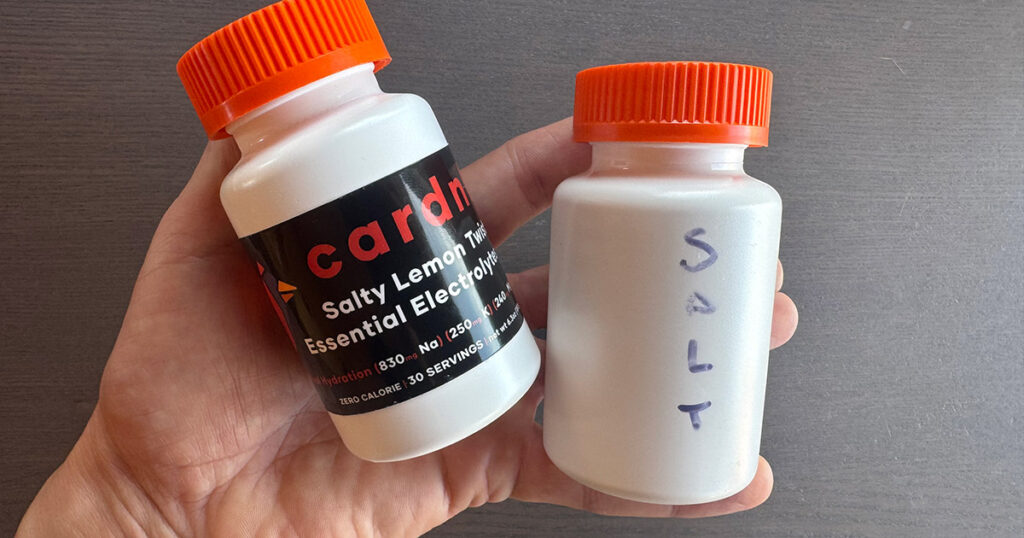
The pocket kit: salt and electrolytes in two supplement bottles
- Use empty supplement bottles. Small, sturdy vitamin bottles seal tightly and are built to keep out moisture, light, and spills.
- Fill one with pure salt. Non-iodized and fine grained.
- Fill the other with electrolytes. Peel the Cardnl label off the pouch and stick it on the bottle. It works perfectly.
- Keep the plastic seal inside the lid. It is the original moisture barrier.
- Add a desiccant pack to each bottle, and label both clearly so there is no confusion under stress.
A small bottle of each is more than enough for a short emergency: 2 to 4 ounces of salt and a few ounces of electrolytes can last weeks. Keep a set at home, in the vehicle, and in the go-bag. Heat and cold in a car do not hurt salt, but humidity from the temperature swings can clump it, so the desiccant matters there. If salt gets wet with clean water, dry it out and it works the same. Discard it only if the water was dirty.
More jobs for plain salt
- De-ices walkways and windshields, and adds grit for traction
- Absorbs odors in the fridge, shoes, and pet bedding
- Scours pots and cutting boards as a mild abrasive
- Lifts sweat and blood stains in laundry
- Controls bacteria while cheese ages
- Packed around ice, chills food faster and makes ice cream (rock salt)
- Hardens homemade soap bars
- Cures and tans hides, and makes salt licks to draw game
- Dehydrates slugs and leeches on contact, and a salt line deters ants
- A warm salt soak eases sore muscles and feet
- A salt paste takes the edge off bites and stings
Grease fire: lid first, then salt, never water
For a small pan fire, turn off the heat and slide a metal lid over the pan. With no lid, pour a lot of salt straight down onto it.
Salt does not make water safe
Salt does not purify or disinfect water. Bring water to a rolling boil for 1 minute, or treat it with unscented bleach at 8 drops per gallon and wait 30 minutes.
Store non-iodized, but mind your iodine
The iodine added to table salt fades over time, so non-iodized salt is the one to store for the long haul. If iodine intake is a concern, keep a few canisters of iodized salt in rotation, or a multivitamin with 150 mcg of iodine. Water purification tablets and potassium iodide radiation tablets are not daily supplements. The ancient sea salt I buy is here on Amazon.
Recipes for salt
Questions this answers
Tap a question for the short answer.
What is salt used for?
Seasoning, curing and brining meat, fermenting and pickling, an electrolyte base, a sore throat gargle, and saline for rinsing a wound. Around the house it also de-ices, deodorizes, scours, and smothers a small grease fire.
How long does salt last in storage?
Plain salt keeps forever. Its only enemy is moisture, not time. Store it dry and sealed and it will outlast almost everything else in your supply.
How do I store salt?
Airtight, with a silica desiccant, and off bare metal, which salt corrodes. Skip oxygen absorbers: salt never spoils, and absorbers can make it clump.
Which salt should I use for pickling and brining?
Pickling or canning salt: pure, fine sodium chloride with nothing added, so it dissolves clear. Iodine can darken pickles and anti-caking agents cloud a brine, so use a salt whose label lists only salt.
What is the difference between cure #1 and cure #2?
Cure #1 (Prague Powder) is salt with about 6.25% nitrite, for short cures you will cook: bacon, sausage, and ham. Cure #2 adds nitrate, which releases nitrite slowly, for long dry-cures that age for weeks: salami and dry sausage. Both are dosed by weight from a tested recipe.
Can I use oxygen absorbers with salt?
No. They do nothing for salt, which never spoils, and they can make it clump. Use a silica desiccant and an airtight container.
What is the best salt for long-term storage?
Non-iodized salt, since the iodine added to table salt fades over time. I keep ancient unrefined sea salt for daily eating, pickling salt for recipes and brines, and pink curing salt only where nitrite is needed.
Why does the body need salt?
Sodium regulates fluid balance, carries nerve signals, and makes muscles contract, and your body does not make it. Hard labor, heat, heavy sweating, or a stored-food diet cooked from scratch raise the need, and too little brings fatigue, cramps, dizziness, and confusion.
How do I carry salt and electrolytes in a go-bag?
Use two empty supplement bottles: one filled with fine non-iodized salt, one with electrolyte powder. Keep the plastic seal inside each lid, add a desiccant pack, and label both. Two to four ounces of salt and a few ounces of electrolytes can last weeks.
Keep going
Related to this
Membership · $49.95 per year
There is a lot more behind the lock
Every recipe and resource from the Prepper's Chemical Survival Guide, all six field guides to read here and download, the full audit and logbook, all twelve reference charts, and no ads.
My Manual · included
Build your own field manual
The most useful thing a membership gives you. Save any page on this site, recipes, charts, and whole field guides included. Arrange them in the order you want, name it, and print one manual with a cover and contents, or keep it as a PDF that opens with no signal.
- It works when this site does not
- Only your pages
- Anyone in the house can use it
- One current copy, not a pile of printouts
- The house binder
- A copy for the bug-out bag or truck
- A copy for family
- An offline PDF


Stay Ready
New entries, updates, and useful instruction.
Stay one step ahead on your preparedness journey.