Quick facts
- Low acid: meat, fish, beans, vegetables, soupsLabel 2 to 5 years; stored well 5 to 10; safe past that in a sound can
- High acid: fruit, tomatoes, juice, picklesLabel 12 to 18 months; stored well 2 to 5 years; rotate these first
- The dateA quality date set by the canner. USDA: not a safety date
- HeatEvery 18°F warmer roughly halves quality life. Over 100°F, USDA calls harmful
- Toss, unopened
- Bulge
- leak
- deep dent
- any dent on a seam
- pitting rust
- spurt or foam on opening
- KeepSmall body dents off the seam, surface rust that rubs off, paneling
- Opened, in the fridgeLow acid 3 to 4 days; fruit and tomatoes 5 to 7; in a covered container
- Home-cannedA year for best quality; safe while sealed; boil low-acid 10 minutes if in doubt
The food shopping list: what to buy, how much, shelf life
A can is cooked food sealed in sterile steel. As long as the seal holds and the metal is sound, the food inside is safe long past the date on the lid. The date was never about safety. What changes over the years is quality, vitamins first, then color, texture and taste, and how fast that happens depends mostly on how warm the room is. I keep a lot of cans, and I get asked about them more than anything else on the shelf, so I put what I know on one page. The pages for each kind of can, from tuna to pumpkin, are linked at the bottom.
Beans against peachesHow long each kind lastsWhat the years doHeat is the enemyThe can itselfReading the stampKeep it or toss itBotulismA shelf that rotates itselfHome-canned jarsThe deeper pages
Free download
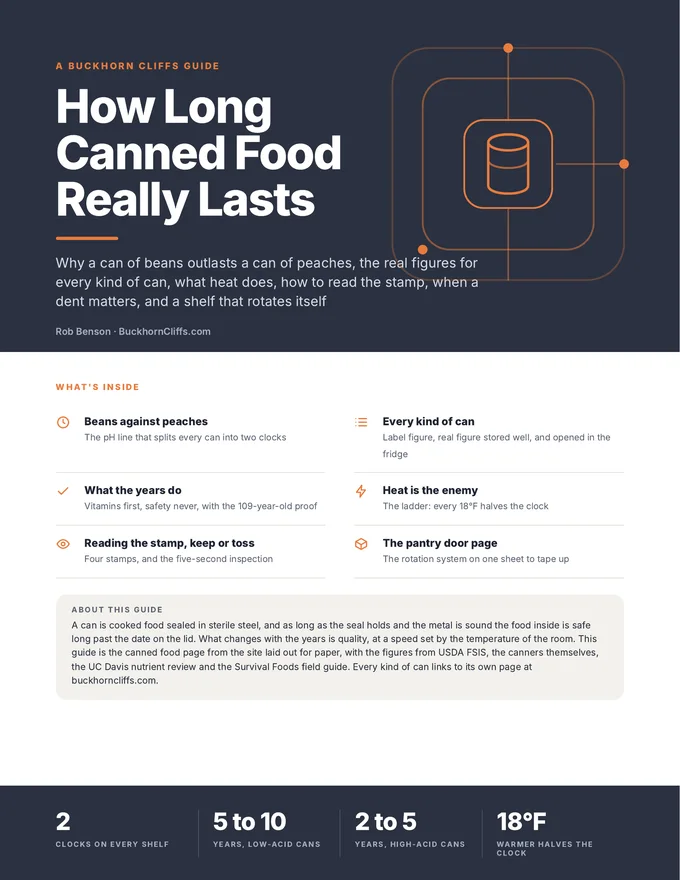
Get the canned food shelf life guide
Eight printed pages: every kind of can with what the label says and what it really does, the heat ladder, how to read the stamp, the keep-or-toss rules for dents, rust and swelling, and the rotation system. Tape the last page inside the pantry door.
The PDF comes by email, with my newsletter now and then. Already on the list? You still get it. Read the full page.
Why a can of beans outlasts a can of peaches
Canned shelf life comes down to acid. Below a pH of 4.6 the spores of Clostridium botulinum cannot grow, so fruit, tomatoes, pickles and juices only need a hot-water process. Above 4.6 the can has to be cooked under pressure at 240°F or more. Both kinds leave the cannery equally safe. What differs on your shelf is what the food does to the can over the years, and that is why a can of beans outlasts a can of peaches on the same shelf.
Low acid: meat, fish, beans, vegetables, soups, stews
- pH
- Above 4.6
- At the cannery
- Pressure cooked in the can at 240°F or more
- Label says
- 2 to 5 years
- Stored well
- 5 to 10 years, and safe well past that
- What ages
- Texture softens, fat can go slightly rancid in a decade
- Shelf
- Lower and cooler. These are the backbone of the canned shelf.
High acid: tomatoes, fruit, juices, pickles, sauerkraut
- pH
- 4.6 or below
- At the cannery
- Hot-water process; the acid does the rest
- Label says
- 12 to 18 months
- Stored well
- 2 to 5 years
- What ages
- Metallic taste, darker color; the acid slowly dissolves tin and works under the lining at the seams
- Shelf
- Eye level, used inside two years. Rotate these first.
Hard rule: a bulging can goes in the trash unopened
There are two kinds of swell. A hydrogen swell is the acid eating the can and releasing gas; a microbial swell is something alive in there making gas. You cannot tell them apart from the outside, so the rule is the same for both. The Codex canning code says grey detinned patches should not be showing inside a can under two years old, and tomato products are the ones that corrode under the lining first.
How long each kind really lasts
Three figures for every kind of can: what the label says, what it really does stored well (a steady 50 to 70°F, dry, dark, off the floor), and how long it keeps in the fridge once it's open. The stored-well figures are the ones my field guide plans around. The label figures are USDA's and the canners' own.
Fat can go slightly rancid in a decade; the meat stays safe.
Oil-packed keeps its texture better over the long haul; no authority gives oil or water a longer life.
Goya prints 5 years on its beans. They soften and darken with age; still food.
Tomato-based soups sit on the high-acid clock: 2 to 5 years.
Safe longer. Texture softens first; corn and pumpkin hold up best.
Same low-acid rules; store it below 100°F.
Expensive, and the only shelf-stable dairy fat that needs no fridge.
Thickens and browns with age. Shake it; if it has separated into curds, toss it.
Darkens to caramel over years; safe while the can is sound.
Metallic taste and dark color are age, not danger.
Fruit in heavy syrup keeps color and texture longer than fruit in water.
The shortest clock on the shelf. Rotate it through the kitchen.
Nitrogen-flushed and dry, so neither clock applies. Mountain House tested 30-year-old product in 2025.
FSIS: pouched tuna 18 months. Thin walls, no steel: more sensitive to heat and punctures than a can.
1.5 years at 100°F. The FSIS table is the clearest heat lesson on the shelf.
USDA's figure. Quality falls from year two. Boil low-acid food 10 minutes before eating if the process is in any doubt.
"Stored well" is doing a lot of work in that list. Every orange figure assumes a steady 50 to 70°F, dry air and no sun. Move the shelf to a garage that hits 95°F in July and you are back to the label figures or worse. The heat section has the arithmetic.
What the years do to a can
The date on the can is the canner's guess at when quality starts to slide. Safety is a different matter. A sound seal on a sound can is sterile, and sterile does not expire. Quality slides in a known order.
Old canned food is not dangerous food. It is just worth less.
Spoilage needs something alive, and commercial canning kills everything in the can and seals it so nothing gets back in. USDA FSIS puts it in one line: canned food stays safe indefinitely as long as the can is sound and it has not frozen or sat above 90°F; the years on the label are about quality. The proof is the Bertrand cans, sealed in 1865 and opened in 1974 with no microbial growth and the protein still high, and a 40-year-old can of corn from a California basement that looked and smelled like new. What those cans had lost was vitamin C and vitamin A, color and texture. So an old can on a sound shelf is a nutrition question, not a safety one: it feeds you, it just carries fewer vitamins than it did. The safety question lives entirely in the can itself, in the keep-or-toss list below.
- Vitamins, and most of that loss is at the canneryThe UC Davis review of canned, frozen and fresh produce (Rickman, Barrett and Bruhn, 2007) found that canning itself costs vegetables an average of 60 percent of their vitamin C and up to two thirds of their thiamin. On the shelf the loss is slower: generally under 15 percent more over 18 months, and green beans lost none at all in two of three studies. Extension figures put the ongoing loss of the fragile vitamins at 5 to 20 percent a year depending on the room.
- Protein, minerals, fiber and fat holdNiacin retention runs above 93 percent, riboflavin 68 to 95. Minerals do not care about time; the only change is a little iron and tin picked up from the can. Fiber stays. Vitamin E is often higher in canned than fresh. Canned tomatoes carry more lycopene than fresh ones, because heat frees it.
- Then color, then texture, then tasteFruit darkens, vegetables soften, meat fibers loosen, sauces separate. None of it is spoilage. A can of ten-year-old green beans is soft, dull and perfectly safe; it belongs in soup, not on a plate.
- Safety, last, and only if the can failsNothing on a shelf of sound commercial cans can grow. The dangers are physical: a seam cracked by a deep dent, a pinhole from rust, a seal split by freezing. Keep the cans dry, cool and off the concrete and the organism never gets in.
The oldest cans ever tested
Heat is the enemy
Heat speeds up everything that happens inside a can. The rule of thumb USDA and Utah State use is that every 18°F (10°C) of warmth cuts quality shelf life roughly in half. The Codex canning code says the same about the can: tin dissolves off the wall about twice as fast for every 10°C. The FSIS table for military rations is the clearest picture anyone has published: 7 years at 60°F, 4.5 at 70°F, 2.5 at 90°F, 1.5 at 100°F, one month at 120°F.
Measure it: swings hurt as much as heat
A shelf that goes from 50°F at night to 90°F in the afternoon pumps the can, stresses the seams, and condenses moisture on the outside that turns to rust. A steady 65°F beats an average of 65°F. Put a cheap min-max thermometer on the shelf for a week in July and you will know which room you have. Never let cans freeze: the contents expand and can split a seam, and USDA says a can that thawed above 40°F is a can to throw out.
The can itself
- A three-piece can is rolled from a sheet with a welded side seam and two ends seamed on.
- A two-piece can is drawn from a cup, no side seam, one end.
- Both are lined, both take the pressure cook, both last the same on a cool shelf.
- The score line is a thinned spot engineered to hold; no study I have found shows it shortens shelf life on a cool shelf.
- Easier to damage in a drop or a tight stack, and useless if the ring snaps.
- Two manual can openers either way.
- By 2018 the Can Manufacturers Institute said at least 90 percent of U.S. food cans had moved to acrylic and polyester linings; extension sources put it over 95 percent now.
- FDA's position is that BPA at the levels found in food is safe.
- The linings in current production are not the ones in a decade-old can at the back of the shelf.
- Retort pouches: lighter, flatter, more sensitive to heat and punctures; 18 months to 3 years on the label, maybe 5 in a cool box.
- Glass does not corrode and shows you the food, but light bleaches it and glass breaks.
- Jars live in a dark cupboard, in their box, off the floor.
Reading the stamp
Most cans now have a printed best-by date. The rest have a packing code, which USDA says is for the canner's own rotation and recalls, not for you. Four kinds of stamp cover nearly every can on the shelf.
My rule: your date beats their code
Write the month and year you bought it on the lid with a marker. Every can, every time. It survives a faded label, it takes two seconds, and it's the date your rotation runs on.
Keep it or toss it
Look at the can before you open it, listen as you open it, smell it before you eat. Five seconds a can, and the call is almost always obvious.
Keep it food, past the date or not
- Small dent on the bodyNot on a seam, no sharp point: cosmetic. USDA and the health inspectors' own classes call it minor.
- Surface rust that rubs offIt's on the outside of the can. Dry the shelf; damp is what put it there.
- PanelingThe body pressed in on itself. The vacuum pulled the wall in, usually from a hot fill. Normal.
- Past the date, clean can, clean smellFood. Taste is for quality only: metallic or flat means old, not dangerous.
- A soft hiss on openingThe vacuum releasing. That is the sound of a seal that held.
Toss it unopened, in a bag
- A deep dent you can lay a finger intoOr a sharp crease. Creased metal can crack the lining and the seal.
- Any dent on a seamThe side seam or either end. USDA's line: the seams are the only places a dent lets air in.
- Rust that pits or will not rub offThe steel is thinning toward a pinhole.
- Swelling, bulging ends, a leak, a sticky canGas or a broken seal. Bag it so nothing can get at it.
- Spurting, foam, a loud hiss, cloudy liquid, a foul smellOn opening: do not taste. Force is not a vacuum releasing.
- Froze and thawed above 40°FOut. Still frozen solid: thaw in the fridge, check it, boil 10 minutes.
The thing you are guarding against is botulism, and botulism has no taste, no smell and no cure outside a hospital, which is why anything on the toss list goes unopened.
Botulism, and why a commercial can is the safe part
Commercial canning is built around killing one organism. Clostridium botulinum spores survive boiling, so low-acid food is cooked in the sealed can at 240°F or hotter under pressure, which no home kitchen reaches without a pressure canner. FSIS calls botulism from a commercial can extremely rare. The CDC's outbreak records tell the other story about jars: in the lower 48 states, 91 percent of botulism outbreaks came from food that was not commercially produced, most often home-canned vegetables.
- Double or blurred vision, drooping eyelids, slurred speech.
- Trouble swallowing, then trouble breathing.
- The antitoxin works best early. Do not wait to see.
- Any swollen, leaking, spurting or foul can or jar goes unopened into a bag and the trash.
- Home-canned low-acid food and tomatoes get boiled 10 minutes before eating if the process is in any doubt; one minute more per 1,000 feet, 20 minutes for spinach and corn.
- Jars at 50 to 70°F, never above 95°F, rings off, lids labeled.
- Ten minutes at a rolling boil destroys toxin already in the food.
- It does not make a bad can good, and USDA does not call it a guarantee.
- Fruit, jams and pickles do not need it.
- The dangers are physical: a seam cracked by a deep dent, a pinhole from rust, a seal split by freezing.
- Dry, cool, off the concrete, and out of the stack that gets dropped.
- Do that and the organism never gets in.
A canned shelf that rotates itself
The canned pantry that works is the one you cook from every week. The field guide's numbers for one person for one month come to about 45 cans. A family of four for three months is that times twelve, four cases of each, which fits on two shelves of a closet.
- Store what you eatTwelve cans of each of the ten things you actually cook with is a deeper store than a hundred cans of one thing nobody likes. Chili, tuna, beans, tomatoes, corn, green beans, peaches, soup: the cans you open every week are the cans that rotate themselves.
- Date every lid the day it comes homeMonth and year in marker. New cases go behind the old ones; shop from the front.
- Two shelves, two clocksFruit, tomatoes and juice at eye level where you see them and use them inside two years. Meat, fish, beans and vegetables below, where the room is cooler and they can sit for five.
- Count by category, not by canA running tally on the pantry door: meat 24, beans 18, vegetables 30. Replace what you used on the next grocery run. That one habit does most of the work, and it costs nothing.
- Pull and cook once a quarterAnything past its stored-well figure for its kind comes to the kitchen counter and gets cooked this week. Cases on a board or a pallet, never on concrete, which sweats and rusts the bottoms.
- Two openers and a way to heatA shelf of cans is stuck without an opener, and a plain steel one lasts forever. Everything on the shelf is cooked and can be eaten cold, but a camp stove and a pot turn a can of beans, a can of tomatoes and a can of meat into a pot of chili with no water and ten minutes of heat.
The garage is not a pantry
If the only room you have is a garage or a shed, insulate a cabinet, keep it off the exterior wall, and treat the label dates as real. Or move the cans into a closet and the Christmas decorations into the garage.
The food shopping list has the per-person amounts for the whole shelf, canned and dry.
Home-canned jars
A home-canned jar runs on the same two clocks, with less margin. The USDA Complete Guide says to use home-canned food within a year for best quality and to store it at 50 to 70°F, out of light, never above 95°F. The National Center for Home Food Preservation adds that until the vacuum seal is broken, nothing can get in, so a jar with a sound seal is not unsafe at year two; it is just not at its best.
- A ring hides a failing seal and traps moisture that rusts the lid.
- Food and date on the lid in marker.
- A sticky jar is a jar that leaked. Eat it now or toss it.
- A lid that flexes or has popped up.
- Liquid that leaked out in storage, or a seal that lifts with a fingernail.
- Spurting, cloudiness or mold on opening. Low-acid food from a suspect jar is thrown away, not boiled.
- Vegetables, meat, beans and tomatoes from home jars.
- One minute more per 1,000 feet of elevation; at my elevation that is 16 minutes. Spinach and corn get 20.
- Fruit, jams and pickles do not need it.
- 50 to 70°F, same as the cans, and never above 95°F.
- Light bleaches the food and fades the color in months; the cardboard case is the cheapest fix.
- Jars on a high shelf fall; keep them below shoulder height.
Where jars win
- See it
- You can see the food and the headspace
- Corrosion
- None. Glass does not care about acid
- Cost
- A lid costs a dime and the jar lasts for decades
- Control
- You know exactly what went in and when
Where cans win
- Breakage
- A dropped can dents; a dropped jar is gone
- Light
- Steel blocks it; light bleaches a jar on an open shelf
- The process
- The cannery reached a temperature a kitchen cannot
- Stacking
- Cases stack to the ceiling; jars do not
The deeper pages
Every canned page on the site.
Canned, by kind
- Canned goods, the overviewthe rules every can shares
- Canned meat and fish5 to 10 years; eat cold from the can
- Canned beefbeef and sea salt, nothing else
- Canned tunathe cheapest canned protein
- Canned sardinesfat, protein, calcium, omega-3
- Canned beansno soak, no fuel
- Canned soupsa hot meal with one pan
- Canned vegetables3 to 5 years; the liquid counts as water
- Canned vegetables and fruitthe two produce clocks
- Canned fruitvitamin C and morale
- Canned tomato saucethe high-acid clock
- Canned pumpkinlabel 1 to 2 years; real 2 to 5
- Freeze-dried foods in #10 cans25 to 30 years
- MREsthe heat table
- The shelf life tableevery staple on the site in one place
- Reduce acidity in canned fooda pinch of baking soda in the pot
Sources: USDA FSIS, Shelf-Stable Food Safety; the USDA Complete Guide to Home Canning; CDC, Botulism and home-canned foods, and Sobel et al., Emerging Infectious Diseases 2004; Rickman, Barrett and Bruhn, Journal of the Science of Food and Agriculture 2007; Codex Code of Practice CAC/RCP 60-2005 on tin in canned foods; Utah State University Extension on storage temperature; the FDA on BPA in food contact; Can Manufacturers Institute; Del Monte, Goya, Hormel, Carnation, Red Feather and Mountain House published shelf life statements; the Bertrand analysis as reported by the National Food Processors Association and FDA Consumer. Stored-well figures are the Survival Foods field guide's.
Questions this answers
Tap a question for the short answer.
How long does canned food really last
Two clocks. Low-acid cans (meat, fish, beans, vegetables, soups) are labeled 2 to 5 years and keep 5 to 10 stored cool and dry; high-acid cans (fruit, tomatoes, juice, pickles) are labeled 12 to 18 months and keep 2 to 5 years, because the acid slowly works on the can. Both are safe past those figures as long as the can is sound. Heat is what shortens them: every 18°F warmer roughly halves the clock.
Is canned food safe after the expiration date
Yes, if the can is sound. The date is the canner's quality estimate, not a safety date, and USDA says exactly that. What changes with age is vitamins, color, texture and taste, not safety. Food from cans sealed in 1865 was tested in 1974 with no microbial growth. The can has to pass inspection: no bulge, leak, deep dent, seam dent or pitting rust, and no spurt or foul smell on opening.
Is a dented can safe to eat
A small dent on the body of the can, away from the seams and without a sharp point, is cosmetic. A deep dent you can lay a finger into, a dent with a sharp crease, or any dent on the side seam or either end seam means the can goes, because a creased seam can crack and let air in. That is USDA's rule and the health inspectors' classification.
Why does canned fruit go bad faster than canned meat
Acid. Fruit, tomatoes, juice and pickles sit below pH 4.6, and that acid slowly dissolves tin from any bare metal and works under the lining at the seams. The food picks up a metallic taste and darkens, and the can can swell with hydrogen. Meat, fish, beans and vegetables are low acid and leave the can alone, so they sit at near full quality for years.
What temperature should canned food be stored at
Between 50 and 70°F, dry, dark and off the floor. USDA says keep cans below 85°F and calls anything over 100°F harmful. The rule of thumb is that every 18°F of warmth halves quality shelf life, so a five-year can in a 60°F basement is a two-and-a-half-year can in a 90°F garage. Never let cans freeze.
How do I read the date code on a can
Most cans now print a best-by date in plain English, which is a quality date. Codes without one are usually a Julian day (1 to 365) with a year: 248-20 is September 5, 2020. A letter or number block in front is the plant and line. USDA says packing codes are for the canner's rotation and recalls, not for you, so write your own purchase date on the lid in marker.
Can you get botulism from canned food
From a commercial can, FSIS calls it extremely rare: low-acid food is cooked in the sealed can at 240°F or more, which kills the spores. The real risk is home canning; the CDC found 91 percent of botulism outbreaks in the lower 48 came from food that was not commercially produced, most often home-canned vegetables. Never taste a swollen, leaking or spurting can or jar, and boil home-canned low-acid food 10 minutes if the process is in doubt.
How long does home canned food last
USDA says use it within a year for best quality and store it at 50 to 70°F, out of light. The National Center for Home Food Preservation adds that until the vacuum seal is broken nothing can get in, so a sealed jar is not unsafe at year two; it is past its best. Take the rings off, label the lids, and treat any jar with a lifted lid, leaked liquid or a lifting seal as spoiled.
Do pop top cans last as long
On a cool shelf, as far as anyone has shown, yes: the score line is a thinned spot engineered to hold, and I have found no study showing it shortens shelf life. It is easier to damage in a drop or a tight stack, and useless if the ring snaps. I keep pop-tops for the kitchen rotation and plain ends for the deep shelf, with two manual openers.
Do old cans lose nutrition
Some. Most of the vitamin loss happens at the cannery: canning costs vegetables an average of 60 percent of their vitamin C. On the shelf the loss is slower, generally under 15 percent over 18 months and 5 to 20 percent a year for the fragile vitamins depending on the room. Protein, minerals, fiber, niacin and carotenoids hold; canned tomatoes have more lycopene than fresh. A multivitamin covers the gap in a long stretch on cans.
Can canned food freeze
It should not. The contents expand and can split a seam. USDA's rule: if a frozen can has thawed above 40°F, or thawed and refrozen, throw it out. If it is still frozen solid, thaw it in the refrigerator, check that it looks and smells normal, and boil the contents 10 minutes before using.
How long does an opened can last in the fridge
In a covered container: 3 to 4 days for low-acid food like meat, beans and vegetables, 5 to 7 for fruit and tomatoes, and a week or two for sweetened condensed milk. Leaving it in the open can is safe but the food picks up a metallic taste; glass or plastic keeps it better.
What I use for this
Gear from my recommended list
Keep going
Related to this
Membership · $49.95 per year
There is a lot more behind the lock
Every recipe and resource from the Prepper's Chemical Survival Guide, all eleven field guides to read here and download, the full audit and logbook, all twelve reference charts, and no ads.
My Manual · included
Build your own field manual
The most useful thing a membership gives you. Save any page on this site, recipes, charts, and whole field guides included. Arrange them in the order you want, name it, and print one manual with a cover and contents, or keep it as a PDF that opens with no signal.
- It works when this site does not
- Only your pages
- Anyone in the house can use it
- One current copy, not a pile of printouts
- The house binder
- A copy for the bug-out bag or truck
- A copy for family
- An offline PDF

Stay Ready
New entries, updates, and useful instruction.
Stay one step ahead on your preparedness journey.