BUCKHORN CLIFFS

Garden and Livestock · Formula · Book recipe 9.16

Soil pH quick test with baking soda and vinegar

Professional soil tests cost money and take time, but a quick two-ingredient home check can reveal whether your soil is strongly acidic, strongly alkaline, or somewhere in the workable middle.

Handle with careWorks without power

How it works

Split sampletwo small bowls
Add vinegarfizz = alkaline soil
Add wet sodafizz = acidic soil
Soil directionplan amendments
Test several spotspH varies across a garden
Direction only, not exactno fizz either way = near neutral

Quick facts

Sample
2 tbsp, 4-6 in deep
Acid test
vinegar fizz
Alkaline test
wet soda fizz
Reads
direction, not exact pH
Tip
test several spots

Hazard

This gives a general direction only (acidic, alkaline, or neutral), not an exact pH or a nutrient reading. Use a test kit or lab test before making major amendments.

Knowing this before planting prevents wasted seeds and amendments by matching crops to your actual soil chemistry. The test takes less than five minutes and needs only baking soda, vinegar, and two bowls, but you trade precision for speed: it reliably flags soil at the extremes yet can miss the mildly acidic conditions that still matter to sensitive plants.

What you'll need

  • Baking soda (sodium bicarbonate)
  • White vinegar (5% acidity)
  • Clean water

Steps

  1. Collect about 2 tablespoons of soil from the root zone, 4 to 6 inches below the surface. Place 1 tablespoon in each of two separate bowls and moisten each sample slightly with clean water.
  2. In the first bowl, add 1 tablespoon of white vinegar and watch for fizzing. Vigorous bubbling means the soil is alkaline (roughly pH above 7.5) and contains free carbonates. In the second bowl, add 1 tablespoon of baking soda onto the damp soil and watch for fizzing. Bubbling here means the soil is strongly acidic (roughly pH below 5). If neither bowl reacts, the soil sits somewhere in the 5 to 7.5 range where most garden plants grow, though this test cannot tell you exactly where.
  3. Test several spots across your garden, since soil pH can vary a lot even over a small area. For mildly acidic or neutral soil, and for tracking changes after amendments, use an inexpensive digital pH meter or a laboratory test kit; both are far more informative than this simple screen. Wait at least 4 to 6 weeks after adding compost, lime, or any other amendment before retesting. Once you know which way the soil leans, correct it: raise an acidic soil with lime using Recipe 8.3, or lower an alkaline one for acid-loving plants with elemental sulfur using Recipe 26.4.

Garden use

See Appendix J, Garden Uses, for the symptom chart, key rates, and cross-recipe cautions.

Warnings

This test gives a general reading only: it tells you the direction (strongly acidic, strongly alkaline, or somewhere in between) but not the exact pH, and a non-reaction does not mean the soil is ideal for every plant. For precise measurements, use a laboratory test kit or a digital pH meter, commonly available for under 20 dollars. Watch carefully for subtle fizzing rather than expecting a dramatic reaction, and test a fresh sample from a different spot if the result is unclear.

Storage and shelf life

Store baking soda and vinegar in sealed containers; both last indefinitely with proper storage. Keep enough on hand for routine garden testing through the growing season. Best container: sealed HDPE container or glass jar, keep moisture-free. Avoid metal in humid conditions (promotes corrosion). See the Containers section.

Questions this answers

Tap a question for the short answer.

How do I test soil ph without a kit?

Try baking soda and white vinegar on two damp soil samples. Fizzing with vinegar points to alkaline soil, fizzing with baking soda points to strongly acidic soil, and no reaction in either bowl means the soil sits in the workable middle. It shows direction, not exact pH.

How do I test soil with vinegar and baking soda?

Take about 2 tablespoons of soil from 4 to 6 inches deep, put 1 tablespoon in each of two bowls and dampen with clean water. Add 1 tablespoon of white vinegar to one and 1 tablespoon of baking soda to the other, then watch each for fizzing.

What does it mean if my soil fizzes with vinegar?

Vigorous bubbling with vinegar means the soil is alkaline, roughly above pH 7.5, and contains free carbonates. You can lower it for acid-loving plants with elemental sulfur.

How deep should I take a soil sample?

Dig 4 to 6 inches below the surface, into the root zone, and collect about 2 tablespoons. Test several spots, because soil pH can vary a lot even across a small garden.

What is the best soil ph for most crops?

Most garden plants grow in the 5 to 7.5 pH range, which is where soil sits when neither bowl fizzes. This quick test cannot say exactly where in that range you are, so get an inexpensive digital pH meter or a lab test kit for precision.

Keep going

Read nextColorado high-elevation vegetable gardeningHow to plan a vegetable garden for Colorado's short, high-altitude season: zones, weather, crop choices, site and soil prep, beds and frost dates.Garden and Livestock · Guide

Related to this

Membership · $49.95 per year

There is a lot more behind the lock

158member pages in full
125recipes with exact amounts
6field guide PDFs, 206 pages
1manual of your own, built from any page

Every recipe and resource from the Prepper's Chemical Survival Guide, all six field guides to read here and download, the full audit and logbook, all twelve reference charts, and no ads.

My Manual · included

Build your own field manual

The most useful thing a membership gives you. Save any page on this site, recipes, charts, and whole field guides included. Put them in your order, name it, and print one manual with a cover and contents, or keep it as a PDF that opens with no signal.

  • It works when this site does not
  • Only your pages
  • Anyone in the house can use it
  • One current copy, not a pile of printouts
  • The house binder
  • A copy for the bug-out bag or truck
  • A copy for family
  • An offline PDF

Join for $49.95 per year

Garden and Livestock · FormulaSource: Prepper's Chemical Survival Guide, Recipe 9.16, p. 56 · Last reviewed 2026-09-18

Membership

Save to My Manual is a member tool

Members build their own manual from the pages that fit their household, then print it or keep it as a PDF.

Why it matters

When the grid goes down, this site goes with it. Paper does not. Membership is how you get the whole manual off the screen and onto the shelf: every page in full, every field guide, and a binder built for your own household.

The field guide library

All six field guides. 206 pages. Included.

The complete Buckhorn Cliffs PDF set, yours to download, print, and keep from the day you join.

$60if bought one at a time

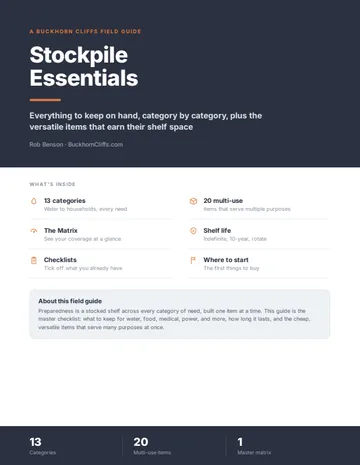
  • Cover of Stockpile Essentials Field GuideStockpile Essentials39 pagesEverything to keep on hand, category by category, plus the 20 multi-use items.
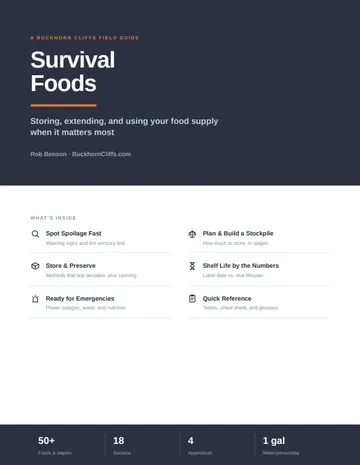
  • Cover of Survival Foods Field GuideSurvival Foods35 pagesStoring, extending, and using the food supply. Real shelf life by the numbers.
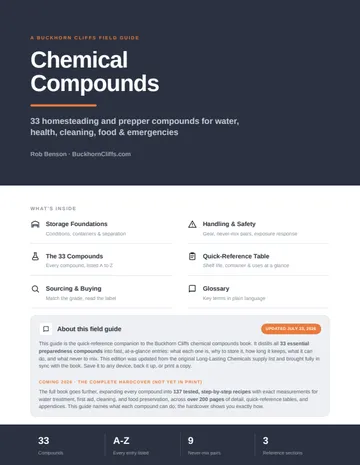
  • Cover of Chemical Compounds Field GuideChemical Compounds29 pagesThe 33 compounds: storage, top uses, hazards, and the never-mix chart.
  • Cover of Spare Parts and Repair Stock Field GuideSpare Parts and Repair Stock40 pagesWhat to keep on hand to fix the home and land when the supply chain breaks.
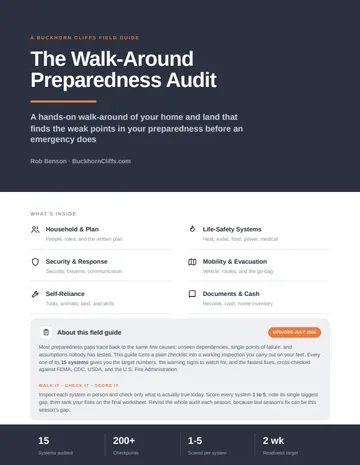
  • Cover of Walk-Around Preparedness AuditWalk-Around Preparedness Audit33 pagesFifteen systems scored 1 to 5, with the printable scorecard.
  • Cover of The Preparedness LogbookPreparedness Logbook30 pagesThe household information that needs to be on paper.

My Manual · included

Build your own field manual

The most useful thing a membership gives you. No book fits your household exactly. My Manual does. Save any page on this site, recipes, charts, and whole field guides included, put them in your order, and print one manual with your name on the cover. It holds only what is relevant to you, and nothing you would skip.

Why it matters

  • It works when this site does notNo power and no signal means no website. A printed manual and an offline PDF still open, which is the whole point of writing any of this down.
  • Only your pagesThis site covers every household. Yours needs a fraction of it. Your manual holds the pages that match your water source, your climate, and your gear, so nobody digs through the rest under stress.
  • Anyone in the house can use itThe person who reads this site may not be the one home when it counts. A binder on the shelf, in your order, with a contents page, is something a spouse or a teenager can follow.
  • One current copy, not a pile of printoutsEvery page prints in the same field guide layout with a cover, a contents page, and the print date. Change a page, print again, and the old copy is easy to spot.

What to build with it

  • The house binderYour water source, your climate, your gear. Only the pages you would reach for.
  • A copy for the bug-out bag or truckA short version that travels: water, first aid, comms, and the recipes you rely on.
  • A copy for familyHand a parent or a grown kid a manual built for their house and their supplies.
  • The shop and the barnParts lists, repair skills, and the never-mix chart, kept where the work happens.
  • A recipe book of your ownThe cleaners, fuels, and remedies you make, with exact amounts, in one place.
  • An offline PDFSaved to a phone, a tablet, or a drive in the Faraday bag. It opens with no signal.

How it works

  1. 1Save what fitsPress "Save to My Manual" on any page: a recipe, a chart, a guide, a parts list, or a whole field guide.
  2. 2Put it in your orderOn My Account, drag the pages into the order you want. Name the manual and add your household name.
  3. 3Print it or save a PDFOpen the preview, then print it or save a PDF. It is sized for 8.5 x 11 inch paper, with a cover and a contents page. Field guides go in exactly as the PDFs are laid out. No ads, no photos.
  4. 4Keep it currentAdd a page, pull one out, print again. The cover carries the date, so you always know which copy is the latest.

Also included

  • The entire site, unlockedAll 158 member pages open in full: exact amounts, every step, every warning, every parts list. Nothing held back.
  • Every recipe and resource in the bookAll 138 recipes and 33 compounds from Prepper's Chemical Survival Guide, with exact amounts, every step, every warning, and the reference charts.
  • A clean PDF of any entryOne press turns any page into a field guide sheet for the binder, the truck, or the shop wall.
  • Checklists and audit scores that follow youSaved to the account, so the phone, the laptop, and the shop computer always match.
  • No adsMembers read the whole site without a single ad.
$49.95per year. About 14 cents a day. Cancel any time and keep the year you paid for.