Quick facts
- Broth, stock, soup in cartonsLabel 12 to 18 months; stored well 2 to 3 years; opened 4 to 5 days
- The same broth in a canLabel 2 years (Swanson: 730 days against 456); stored well 5 to 10
- UHT and plant milksLabel 6 to 12 months; about a year past; opened 7 to 10 days
- Boxed tomatoesLabel 18 months to 2 years; no tin, no metallic taste
- Why shorterOxygen through plastic seams and spouts; crushed corners; wet board; pinholes
- Toss, unopened
- Bloated
- sticky
- leaking
- soft spot
- lifted seam
- loose spout
- sour or fizzy on opening
- KeepSquare, dry, firm, clean seams, even past the date; separation that shakes smooth
- On the shelfStanding up, nothing on top, 50 to 70°F; cans for the deep store, cartons for the kitchen
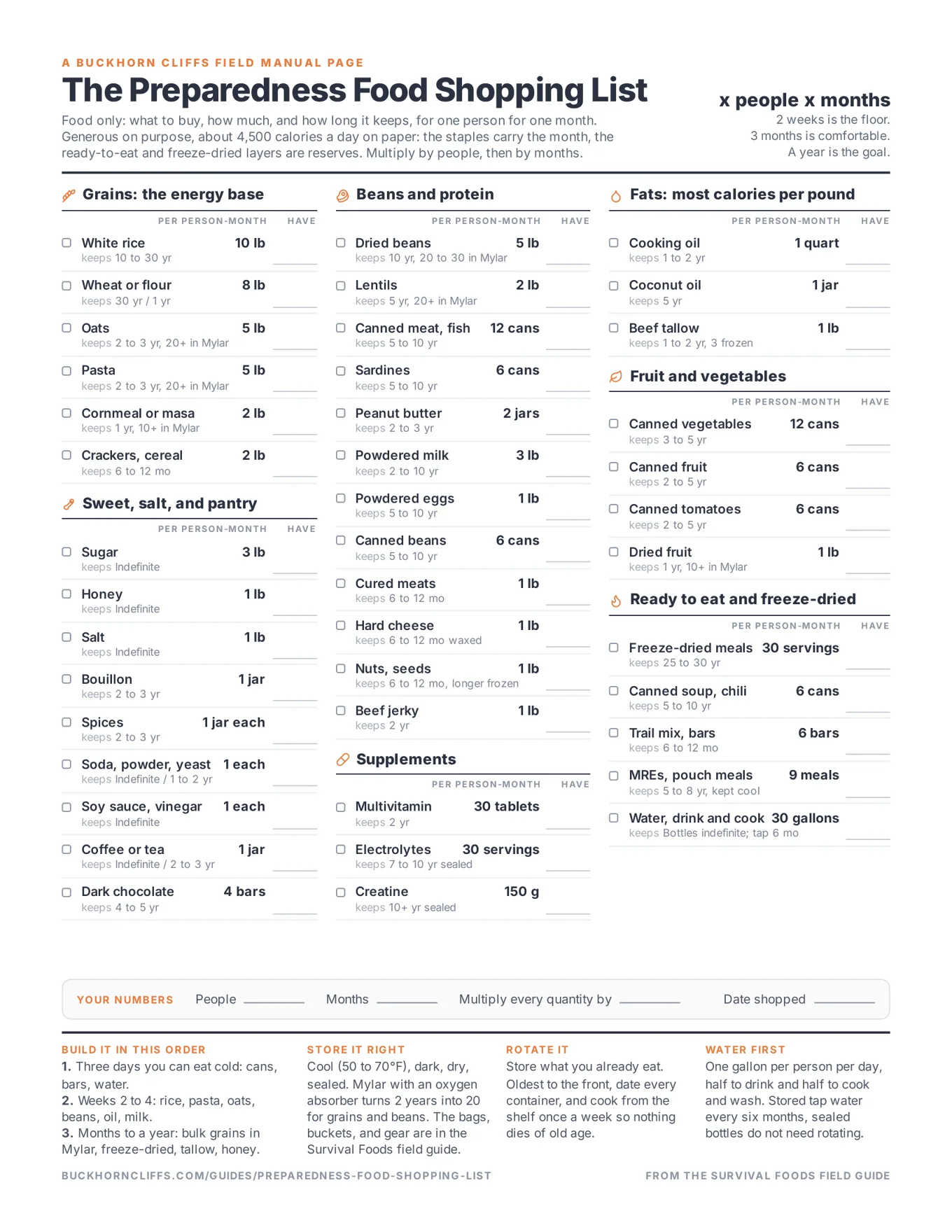
The food shopping list: what to buy, how much, shelf life
The broth in a carton and the broth in a can left the plant equally sterile, and neither needs a fridge until it's open. The difference is the box. A can is steel cooked shut; a carton is paper, plastic and a sheet of foil thinner than a hair, heat-sealed at the edges. That gives the carton a shorter clock and a different set of failure signs, and it is why I keep cans for the deep shelf and cartons for the kitchen. Here is what the box is, how long it really lasts, and how to tell a good one from a bad one.
What a carton isHow long each lastsWhy the clock is shorterKeep it or toss itCarton or canHow I stock them
What a carton is
The word on the box is aseptic. The food and the package are sterilized separately, then brought together in a sterile chamber. The broth is flash-heated to around 275 to 300°F for a few seconds and cooled, which kills everything in it while cooking it far less than a can's long bath does. The carton material comes off a roll, runs through a hot hydrogen peroxide bath and hot air to sterilize it, and is formed, filled and sealed without ever meeting room air. A can works the other way around: filled, sealed, then cooked in the sealed can at 240°F or more. Both end up commercially sterile. One is cooked in its container and the other is not, and that difference runs through everything below.
Can
- Sterilized
- Cooked in the sealed can, 240°F or more, long enough to kill botulinum spores
- Barrier
- Steel, with a lining
- Seams
- Rolled and welded steel
- Label says
- 2 to 5 years for broth and soup
- Weak point
- A dent on a seam, rust, freezing
Carton
- Sterilized
- Flash-heated on its own, filled into a sterilized carton in a sterile chamber
- Barrier
- Aluminum foil thinner than a hair, between plastic layers
- Seams
- Heat-sealed plastic, plus a glued spout
- Label says
- 12 to 18 months for broth and soup
- Weak point
- A crushed corner, a puncture, a damp shelf, a lifted seal
How long each carton really lasts
The label figures are the makers' own. The stored-well figures assume a cool, dry, dark shelf with nothing stacked on the cartons; the food bank guidelines, which exist to decide what is still fit to hand out, carry aseptic broth, soup, fruit and vegetables three years past the code date and UHT milk one year. The fridge figures are for an opened carton with the cap on.
Swanson: 456 days in the carton, 730 in the can. Darkens a little with age; the taste flattens before anything else happens.
Cream soups separate first. Shake before opening; a smooth pour after shaking is fine.
No tin and no lining, so the acid has nothing to work on. The clock here is oxygen through the seals, not corrosion.
A jar makes 38 cups of broth from a quart of space. The long-clock answer to carton broth.
Salt, fat and dried stock. They go stale rather than spoil, and the fat goes flat first.
Browns and tastes cooked with age; that is sugar and protein reacting, not spoilage. Separation that shakes back together is normal.
Settle hard. Shake. A sour smell or lumps that do not shake out is the end.
Vitamin C fades fastest; color darkens. Food banks carry boxed juice 4 to 6 months past the date.
Separates into a solid cap and water in the box; warm it in a pan and stir.
None of these figures mean much on a hot shelf. The same rule as cans applies: every 18°F of warmth roughly halves quality life, and a carton stored over 90°F for a summer is a carton on the label figure or worse. The heat ladder on the canned food page is the arithmetic.
Free download
Get the one-page food shopping list
What to store, how much of it for one person for one month, and how long it keeps. One page with checkboxes, built from the Survival Foods field guide. Print it, multiply by your people and months, and take it to the store.
The PDF comes by email, with my newsletter now and then. Already on the list? You still get it. Read the full page.
Why the carton's clock is shorter
A can's shelf life is limited by corrosion. A carton's is limited by oxygen getting in, and oxygen has four ways in.
- Every seam, the spout, and the fold at each corner is a place where the foil is cut or creased and only plastic stands between the broth and the air.
- A little oxygen every day for a year adds up to flat, darker broth, so the label is shorter.
- Brands that drop the foil for a plastic film run shorter still.
- Stack a case of cans on a case of cartons and the bottom cartons crease. A creased corner can crack the foil without breaking the seal.
- The carton looks fine and ages twice as fast.
- Store cartons standing up with nothing heavy on top.
- A damp shelf, a leaking neighbor, condensation in a garage: the board soaks it up, softens, and the inner layers can delaminate.
- A soft or damp spot means the barrier under it is suspect. That carton gets thrown out, not stored.
- Off the concrete, same as cans, and never under the water jugs.
- A staple, a box cutter, a sharp corner on the next case: a carton punctures where a can only dents.
- Once air is in, the broth is no longer sterile and it will spoil at room temperature in days, and the only sign may be a slight bloat or a sticky patch.
- So a bloated or sticky carton goes out unopened.
What a carton does not do
It does not corrode, it does not put metal in the food, and it does not need the long cook a can needs. A carton of tomatoes at a year old tastes closer to the tomato than a can of the same age, and boxed broth is flash-heated instead of cooked for an hour, which is why it tastes less like soup and more like stock. The carton tastes better. The can keeps longer.
Keep it or toss it
Pick it up, squeeze it gently, look at the corners and the spout, and smell it after you open it. It takes the same five seconds as a can, but the signs are different.
Keep it food, past the date or not
- Past the date, square and dryA flat, firm carton with clean seams is sealed and sterile. Food banks hand these out three years past the date.
- Broth a shade darker, taste a bit flatAge. Cook with it. It is not a safety sign.
- Milk or soup separated, shakes smoothFat and solids settling. Normal in UHT milk, plant milk, coconut milk and cream soups.
- A scuffed or faded printThe outside layer. It says nothing about the inside.
- A light dent that pops backThe board flexed and the foil is intact. Fine.
Toss it unopened, in a bag
- Bloated, pillowed or firm when squeezedGas inside means something is growing. Out, unopened.
- Sticky, stained or leaking anywhereA seal or a pinhole has gone. Even a dried drip on the outside means air got in.
- A soft, damp or delaminated spotWet board. The barrier under it is suspect.
- A creased corner with a crack in it, or a lifted seamBend it gently; if the layers have parted, the foil has too.
- A spout cap that is loose, popped or leakingThe spout is glued plastic through a hole in the foil. If it has lifted, the seal is gone.
- Sour, yeasty or off smell, fizz, lumps that do not shake out, mold at the spoutOn opening. Do not taste. Pour it out and bag the carton.
A carton that fails is a spoilage problem, not a botulism problem in the usual sense: air got in, and ordinary bacteria and yeast grew in a product that was never meant to be preserved by anything but the seal. It smells and bloats long before it is subtle. Trust the squeeze and the nose.
Carton or can
Where the carton wins
- Taste
- Flash-heated and never in contact with metal; tomatoes and broth taste closer to fresh
- Weight
- About a third of a can of the same volume, and it packs flat empty
- Opening
- A twist cap. No opener, no sharp edge, resealable
- Acid
- Nothing to corrode, so the high-acid clock does not apply
- BPA
- None. The food touches polyethylene
Where the can wins
- Time
- Five to ten years for broth and soup against two or three
- Abuse
- Dents instead of punctures, shrugs off a damp shelf, stacks six cases high
- Heat
- Both halve with every 18°F, but the can starts from a longer clock
- Freezing
- A frozen carton splits its seams as readily as a can splits a seam; neither should freeze
- Inspection
- A can tells you with a bulge you can see across the room. A carton pinhole can hide
How I stock them
On my shelf, cartons are for the kitchen and cans are for storage, because of how long each one keeps. A jar of concentrate covers the gap.
- Cans for the deep shelf, cartons for the kitchenBroth I will use this month comes in a carton because it tastes better and pours. Broth I am storing for next year comes in a can, where the same product carries nine more months on the label and years more in practice.
- Concentrate for the long clockA jar of broth concentrate makes about 38 cups and sits two years on the label, years more in a cool pantry. Bouillon cubes and powder keep dry almost indefinitely and weigh nothing. Between them, one shelf of jars replaces a whole shelf of cartons.
- Date the top the day it comes homeMonth and year in marker on the cap end, where you see it. New cartons behind the old ones.
- Standing up, nothing on top, off the floorThe failures are crushed corners and wet board. A carton on its side under a case of cans is the one that creases. A board or a pallet under the shelf keeps the floor damp off the paper.
- Cool, dark, dry, same as cansA closet or basement at 50 to 70°F. Not the garage, not the cabinet over the stove. A carton over 90°F for a summer is on the label figure or worse.
- Shake, pour, cap, fridgeOpened broth and soup last 4 to 5 days capped in the fridge; milk and juice 7 to 10. Anything left after that goes into the stock pot or the freezer in a jar, not back on the shelf.
The canned food guide has the full table for the cans that back these up, and the food shopping list has the per-person amounts.
Questions this answers
Tap a question for the short answer.
How long does boxed broth really last
The label says 12 to 18 months; Swanson prints 456 days on its carton against 730 on its can of the same broth. Stored cool, dry and standing up, a carton is fine for two or three years on quality, and food bank guidelines carry aseptic broth three years past the code date. Once it's open it is a fridge item: 4 to 5 days with the cap on.
Is boxed broth safe after the expiration date
Yes, if the carton is sound. It is aseptic, meaning sterile and sealed, and the date is the maker's quality estimate. A square, dry, firm carton with clean seams is still sealed; the broth may be a shade darker and a little flat. A bloated, sticky, leaking or soft carton has lost its seal and goes out unopened, whatever the date.
Do cartons last as long as cans
No. The food is equally sterile, but the container is not. A carton is paper, plastic and a foil layer thinner than a hair, heat-sealed at the edges; oxygen creeps in through the plastic seams and spout, corners crease, paper wicks water, and it punctures where a can dents. Broth is labeled 12 to 18 months in a carton and about 2 years in a can, and the can keeps going for 5 to 10 years where the carton is done in two or three.
What is an aseptic carton made of
Six layers of three materials: polyethylene outside, paperboard for stiffness (about three quarters of the weight), polyethylene, a sheet of aluminum foil thinner than a hair that does the real work of stopping oxygen and light, polyethylene, and polyethylene on the inside that the food touches. The broth is flash-heated to around 275 to 300°F for a few seconds, the carton material is sterilized in hot hydrogen peroxide, and the two meet in a sterile chamber. No metal ever touches the food.
Why does carton broth expire sooner than canned
Oxygen. Steel stops it completely; a carton's foil does too, but every seam, the spout and every creased corner is a place where only plastic stands between the broth and the air, and plastic only slows oxygen down. A little every day for a year flattens the taste and darkens the color. Add the carton's other weaknesses, crushed corners, wet board and pinholes, and the maker prints a shorter date.
How long does opened broth last in the fridge
Four to five days, capped, for broth, stock and soup; 7 to 10 days for UHT milk, plant milk and juice. The carton is a good fridge container because it reseals. Anything left after that goes into the stock pot or into the freezer in a jar.
How long does shelf stable milk last
UHT milk is labeled 6 to 12 months and is fine for about a year past that stored cool; food bank guidelines carry it one year past the code date. It browns slightly and tastes more cooked with age, which is sugar and protein reacting, not spoilage. Shake it; separation that shakes smooth is normal, lumps that do not are the end. Opened, 7 to 10 days in the fridge. Powdered milk is the storage answer: twenty years against one.
Can I use a bloated or dented carton
A light dent that pops back with the foil intact is fine. A bloated or pillowed carton, one that is firm when squeezed, means gas inside and something growing: out, unopened. A creased corner where the layers have parted, a soft or damp spot, a sticky patch or a lifted spout all mean the seal is suspect, and that carton is thrown out.
Do boxed tomatoes last as long as canned tomatoes
On the label, about the same or a little longer: boxed tomatoes run 18 months to 2 years against 18 to 36 months for the can. In practice they age differently. The can's limit is acid eating the tin and lining, so canned tomatoes go metallic and dark; the carton has no metal, so its limit is oxygen through the seals, and it tastes cleaner at a year old. Neither has the five-year legs of a can of beans. Rotate both inside two years.
How should I store cartons of broth and milk
Standing up, nothing stacked on top, off the floor, at 50 to 70°F in the dark. The failures are crushed corners and wet paperboard, so no cases of cans on top of a case of cartons and never under the water jugs. Date the cap end in marker the day it comes home. Same heat rule as cans: every 18°F of warmth halves the clock, and a garage summer puts a carton on its label date or worse.
How long does broth concentrate or bouillon last
A jar of broth concentrate like Better Than Bouillon is labeled about two years and keeps longer in a cool pantry; once opened it lives in the fridge for months. Bouillon cubes and powder are salt, fat and dried stock: labeled 1 to 2 years, they go stale rather than bad and keep for years if dry. A jar makes about 38 cups of broth from a quart of shelf space, so concentrate is what I store long term and cartons are for the kitchen.
Should I stock cartons or cans
Both, in different places. Cartons for the kitchen rotation: they taste better, pour, reseal and weigh a third of a can. Cans for the deep shelf: the same broth carries 5 to 10 years in steel against two or three in a box, shrugs off a damp shelf and a stack, and tells you with a bulge when it has failed. A jar of concentrate and a tin of bouillon cover the gap between them.
Keep going
Related to this
Membership · $49.95 per year
Everything on this site, open, and your own manual that works with no internet
When the grid goes down, this site goes with it. Membership opens every member page and every recipe from the book, hands over all fourteen field guides as PDFs, and gives you your own manual built from the pages your household uses: searchable on your phone with no internet, and printable as one binder.
- 158member pagesopen in full, every amount and every step
- 138compound recipesfrom the hardcover book, exact amounts. Pick any and add them to your manual
- 14field guides313 pages of PDFs, $140 bought one at a time
- 9military field guidesUS Army manuals cut to 66 pages and laid out to use
- Offlineyour own manualbuilt from any page here, searchable on your phone with no internet
- Build your own manual on this site. pick any page, recipe, chart or whole field guide and put them in your order
- Download it and use it with no internet. it opens like an app on your phone or computer, searchable, with no power grid and no signal
- Print it or save it as one PDF. your cover, a contents page and every page you picked, laid out for paper
- All 138 recipes from my hardcover book. exact amounts for pool shock water purification, Lugol's iodine antiseptic, water glassing eggs, laundry powder and the rest
- All 14 field guides, 313 pages. Stockpile Essentials, Survival Foods, Bug-Out Bag, Home Canning, Solar Power and more, to read here or download
- 9 military field guides. Survival, First Aid, Mountaineering and the other US Army manuals, each cut to its most useful pages
- The Old Library, to print and keep. print any of 4,941 articles from the 1911 Britannica and two old formula books, or save them to My Manual
- 158 how-to pages in full. medical, hygiene, tools and repair, garden and livestock, food, water and more
- The audit, the logbook and the checklists. all 200 audit checkpoints, saved to your account on every device
- One payment, $49.95 per year. Cancel any time and keep access to the end of the year you paid for.
- Sign in by email. No password, and the sign-in renews itself on every visit.
- Most of the site stays free. Membership is for the depth, the PDFs and your own offline manual.

Stay Ready
New entries, updates, and useful instruction.
Stay one step ahead on your preparedness journey.