BUCKHORN CLIFFS

Food · Supply

Powdered milk for food storage

Why powdered milk belongs in food storage: shelf life, nutrition, additives to avoid, bulk buying options, and how to mix it for drinking.

Quick facts

Shelf life, dry
2 to 10 years for nonfat, cool, dry, airtight, oxygen removed
Mix ratio
1 to 1.5 cups powder to make 32oz (4 cups) of milk
Shelf life, mixed
consume within 3-5 days, refrigerated
Mixing method
  • 32oz Ball jar
  • warm water first
  • shake
  • then top off
Cost
50lb bag 26 cents an ounce (at time of post)
Additives to watch
  • preservatives
  • anti-caking agents
  • added vegetable oils

In survival and emergency preparedness, certain items stand out as essentials. Water, non-perishable food, first aid kits, and the like are often the first to make the list. However, one often overlooked item with a plethora of benefits is powdered milk, also known as dried milk.

Shelf Life of Powdered Milk

When you think of the shelf life of various foods, powdered milk emerges as a top choice. Nonfat dry milk, stored cool and dry in an airtight container with the oxygen removed, lasts 2 to 10 years. Whole milk powder is a different product. Its fat goes rancid, so it is a short-term item to rotate within a year or so. Some experts even agree that under ideal conditions, powdered milk can outlast its best-by date, although its flavor and nutritional richness might wane over extended periods.

Nutritional Value of Dehydrated Milk

Beyond its impressive shelf life, the nutritional value of powdered milk is commendable. Despite its dehydrated state, it retains a significant portion of the nutrients inherent in fresh milk. These nutrients, including vital proteins, calcium, and essential vitamins, become indispensable in survival scenarios where maintaining health is a top priority.

Space Savings & Versatility

Another advantage lies in its space efficiency. The dehydration process ensures that powdered milk occupies minimal space, making it a prime candidate for inclusion in emergency kits or storage areas with limited room. This compact nature ensures that individuals can store ample quantities without the burden of bulk.

The versatility of powdered milk further amplifies its importance. While the obvious use is rehydration for drinking, its potential doesn't end there. It seamlessly integrates into a bunch of recipes, from enriching baked treats to enhancing the creaminess of soups and sauces. In situations where culinary ingredients are scarce, this versatility is a boon.

No Fridge Required

The absence of a refrigeration requirement sets powdered milk apart from its liquid counterpart. In many emergency situations, consistent electricity or functional refrigeration units become luxuries. The ability to store powdered milk without these amenities ensures that a reliable source of nutrition remains accessible.

From an economic standpoint, investing in powdered milk can prove more cost-effective in the long run in your self managed insurance policy. Instead of recurrent expenses on fresh milk, a one-time purchase of powdered milk can suffice for extended durations, especially when prepping for potential long-term disruptions.

Are there any additives you should avoid with powdered milk?

Yes, when purchasing powdered milk, it's essential to be aware of potential additives that might not align with your health preferences or dietary needs. Some additives to be cautious of include:

  1. Preservatives: These are added to extend the shelf life of the product. Common preservatives in powdered milk include ascorbyl palmitate and tocopherols. While these are generally recognized as safe, some individuals prefer to avoid additional preservatives in their food.
  2. Anti-caking agents: To prevent the powdered milk from clumping together, anti-caking agents like tricalcium phosphate might be added. While they are considered safe for consumption, some people prefer products without these agents.
  3. Added vegetable oils: Some 'milk drink' and creamer powders replace milk fat with vegetable oil. If the label lists anything besides milk, it is not plain powdered milk.
  4. rBST: Some buyers prefer milk from cows not treated with rBST. That is a preference. No safety difference has been found in the milk. Many consumers now prefer milk products from cows not treated with rBST (a synthetic growth hormone) or antibiotics.

When purchasing powdered milk, it's always a good practice to read the ingredient list and product label thoroughly. Opt for products with minimal additives, and if possible, choose organic or all-natural versions. If you have specific health concerns or dietary restrictions, consulting with a nutritionist or healthcare provider can provide guidance on the best products for your needs.

My Recommendations on Powdered Milk

Powdered Milk

8 lb bucket of nonfat dry milk, one ingredient.

Powdered Milk

50lb bag (at the time of this post the cost was 26 cents an ounce) - you'll need a proper storage method.

What's the best method to prepare powdered milk for drinking?

Using a 32oz Ball jar makes the process of preparing powdered milk efficient and minimizes the need for additional utensils, making it a handy method, especially for on-the-go situations.

32oz Wide Mouth Mason Jar
1Read the InstructionsStart by checking the manufacturer's instructions on the powdered milk package. Different brands might have specific ratios of powder to water.
2Measure the PowderDepending on the brand and your desired consistency, you'll typically need between 1 to 1.5 cups of powdered milk to make 32oz (or 4 cups) of milk. Adjust the amount based on your preference and the manufacturer's recommendations.
3Warm WaterFill the Ball jar about a quarter full with warm (not boiling) water. Warm water will help dissolve the powdered milk more easily.
4Add Powdered MilkSlowly add the measured powdered milk to the jar with the warm water.
5Seal and ShakePlace the lid on the Ball jar securely and shake vigorously until the powdered milk is thoroughly dissolved. The advantage of using a jar is that you can shake it, ensuring a smooth consistency without lumps.
6Add More WaterOnce the powdered milk is dissolved, open the lid and fill the jar with more water, either cool or room temperature is okay, until you reach the 32oz mark or close to the top of the jar.
7Seal and Shake AgainPlace the lid back on and give it another good shake to ensure everything is well mixed.
8RefrigerationFor the best flavor and consistency, refrigerate the reconstituted milk for a few hours before drinking. The cold temperature will also help further dissolve any remaining particles.
9StorageThe Ball jar's lid ensures an airtight seal, which is great for storing the reconstituted milk. Consume within 3-5 days for the best quality.
10Shake Before UsingIf the milk sits in the refrigerator for a while, give it a good shake before using to ensure uniform consistency.

Tips:

  • If you prefer your milk colder immediately after mixing, you can use cold water in step 6 or even add a few ice cubes.
  • Add a drop of vanilla extract can be added if you wish to enhance the flavor.

How is powdered milk made?

Powdered milk, also known as dried milk, is made by removing the moisture from liquid milk. The process transforms the milk into a dry, shelf-stable product that can be easily stored and transported without refrigeration. Here's a step-by-step breakdown of how powdered milk is made:

1StandardizationThe raw milk is first standardized, meaning it's processed to ensure a consistent fat content. Depending on the desired end product, some or all of the fat may be removed to produce whole, skim, or partially skimmed powdered milk.
2PasteurizationThe standardized milk is then pasteurized to kill any harmful bacteria. This involves heating the milk to a specific temperature for a set period and then rapidly cooling it.
3EvaporationAfter pasteurization, the milk is concentrated by removing a significant portion of its water content. This is typically done using an evaporator, which heats the milk under reduced pressure, causing the water to evaporate. The result is a concentrated milk with about half of its original water content.
4Spray DryingThe concentrated milk is then turned into a fine powder using a spray dryer. In this process, the concentrated milk is sprayed into a chamber with hot air. As the tiny droplets of milk come into contact with the hot air, the remaining water quickly evaporates, leaving behind tiny particles of dried milk. The size and consistency of the droplets can be controlled to produce different textures and forms of powdered milk.
5Agglomeration (Optional)To improve the solubility of the powdered milk (i.e., its ability to dissolve back into water), an optional step called agglomeration can be used. This involves reintroducing a small amount of moisture to the dried milk particles, causing them to stick together and form larger, porous clusters. These clusters dissolve more easily in water than non-agglomerated powder.
6PackagingOnce dried, the powdered milk is quickly packaged in airtight containers to protect it from moisture, oxygen, and light, all of which can degrade its quality. The packaging also helps prevent the absorption of odors, as milk is a sensitive product that can easily take on the flavors of other substances.

What are some common recipes made using powdered milk?

Powdered milk is a versatile ingredient that can be used in a variety of recipes, both as a substitute for fresh milk and as a unique ingredient to enhance texture and flavor. Here's a list of recipes commonly made using powdered milk:

1Reconstituted MilkSimply mixing powdered milk with water to produce liquid milk, which can then be used as regular milk for drinking or in any recipe.
2SmoothiesAdd powdered milk to fruit or vegetable smoothies for an extra boost of protein and creaminess.
3Bread and Baked GoodsMany bread recipes, especially for rolls and sweet breads, use powdered milk to enhance the texture and flavor.
4Homemade YogurtUsing powdered milk can help achieve a thicker consistency in homemade yogurt.
5Creamy SoupsPowdered milk can be added to soups to give them a creamy texture without adding extra fat.
6Hot CocoaMix powdered milk with cocoa powder, sugar, and hot water for a quick and easy hot chocolate.
7Puddings and CustardsPowdered milk can be used in place of fresh milk in recipes for puddings, custards, and similar desserts.
8Ice CreamSome homemade ice cream recipes use powdered milk to improve the texture and mouthfeel.
9Mashed PotatoesAdd powdered milk to mashed potatoes for extra creaminess.
10Cream SaucesPowdered milk can be used to make a roux and then turned into a creamy sauce for dishes like pasta, casseroles, or vegetables.
11Energy Bars or Protein BarsIncorporate powdered milk into homemade energy or protein bars for added nutrition.
12Pancakes and WafflesSome recipes use powdered milk to achieve a particular texture or flavor.
13Fudge and CandiesCertain candy recipes, especially fudge, use powdered milk for consistency and flavor.
14Cereal BarsHomemade cereal or granola bars can include powdered milk for added protein.
15DIY Coffee CreamerMix powdered milk with sugar and flavor extracts to create a homemade coffee creamer.

While powdered milk might not be the first item that springs to mind when considering survival essentials, its myriad benefits make a compelling case for its inclusion.

Questions this answers

Tap a question for the short answer.

How long does powdered milk last?

Nonfat dry milk keeps for 2 to 10 years when it is stored cool and dry in an airtight container with the oxygen removed. Whole milk powder is a different product: its fat goes rancid, so rotate it within a year or so. Flavor and nutrition fade over long periods.

How do I mix powdered milk for drinking?

Fill a 32oz Ball jar about a quarter full with warm, not boiling, water, add 1 to 1.5 cups of powder, seal and shake until dissolved. Top off with cool or room temperature water to the 32oz mark, shake again, then chill a few hours before drinking.

How much powdered milk do I need to make a quart?

Plan on 1 to 1.5 cups of powder for 32oz, which is 4 cups of milk. The exact amount depends on the brand and how rich you like it, so check the package ratio first and adjust.

Does powdered milk need to be refrigerated?

The dry powder needs no refrigeration, which is a big reason it suits emergencies where power is unreliable. Once you mix it with water, keep it in the fridge in a sealed jar and drink it within 3 to 5 days.

What additives should I avoid in powdered milk?

Watch labels for preservatives such as ascorbyl palmitate and tocopherols, anti-caking agents like tricalcium phosphate, and added vegetable oils, which some milk drink and creamer powders use in place of milk fat. Some buyers prefer milk from cows not treated with rBST, but that is a preference, and no safety difference has been found in the milk. Choose products with the fewest additives.

How is powdered milk made?

Liquid milk is standardized for fat content, pasteurized, then concentrated in an evaporator until about half its water is gone. The concentrate is sprayed into hot air, which dries the droplets into powder. An optional agglomeration step helps it dissolve, and the powder is packed airtight.

Keep going

Read nextMylar bags: which foods gain the most shelf life (ranked)Ranks foods in five tiers by how much Mylar and oxygen absorbers help, with moisture limits, bag thickness, absorber sizing and sealing.Food · Guide

Related to this

Membership · $49.95 per year

There is a lot more behind the lock

158member pages in full
125recipes with exact amounts
6field guide PDFs, 206 pages
1manual of your own, built from any page

Every recipe and resource from the Prepper's Chemical Survival Guide, all six field guides to read here and download, the full audit and logbook, all twelve reference charts, and no ads.

My Manual · included

Build your own field manual

The most useful thing a membership gives you. Save any page on this site, recipes, charts, and whole field guides included. Put them in your order, name it, and print one manual with a cover and contents, or keep it as a PDF that opens with no signal.

  • It works when this site does not
  • Only your pages
  • Anyone in the house can use it
  • One current copy, not a pile of printouts
  • The house binder
  • A copy for the bug-out bag or truck
  • A copy for family
  • An offline PDF

Join for $49.95 per year

Food · SupplyLast reviewed 2023-10-15

Membership

Save to My Manual is a member tool

Members build their own manual from the pages that fit their household, then print it or keep it as a PDF.

Why it matters

When the grid goes down, this site goes with it. Paper does not. Membership is how you get the whole manual off the screen and onto the shelf: every page in full, every field guide, and a binder built for your own household.

The field guide library

All six field guides. 206 pages. Included.

The complete Buckhorn Cliffs PDF set, yours to download, print, and keep from the day you join.

$60if bought one at a time

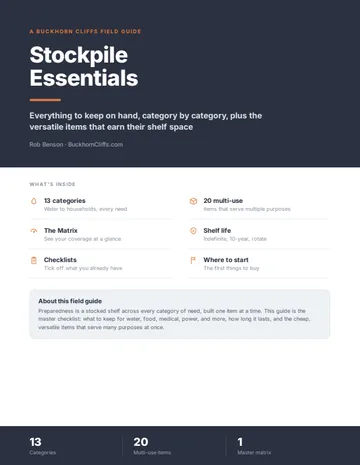
  • Cover of Stockpile Essentials Field GuideStockpile Essentials39 pagesEverything to keep on hand, category by category, plus the 20 multi-use items.
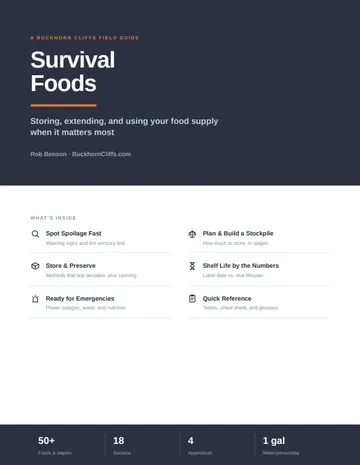
  • Cover of Survival Foods Field GuideSurvival Foods35 pagesStoring, extending, and using the food supply. Real shelf life by the numbers.
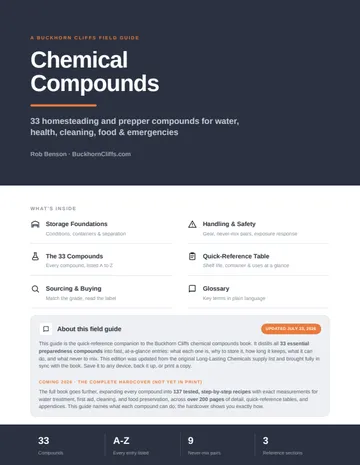
  • Cover of Chemical Compounds Field GuideChemical Compounds29 pagesThe 33 compounds: storage, top uses, hazards, and the never-mix chart.
  • Cover of Spare Parts and Repair Stock Field GuideSpare Parts and Repair Stock40 pagesWhat to keep on hand to fix the home and land when the supply chain breaks.
  • Cover of Walk-Around Preparedness AuditWalk-Around Preparedness Audit33 pagesFifteen systems scored 1 to 5, with the printable scorecard.
  • Cover of The Preparedness LogbookPreparedness Logbook30 pagesThe household information that needs to be on paper.

My Manual · included

Build your own field manual

The most useful thing a membership gives you. No book fits your household exactly. My Manual does. Save any page on this site, recipes, charts, and whole field guides included, put them in your order, and print one manual with your name on the cover. It holds only what is relevant to you, and nothing you would skip.

Why it matters

  • It works when this site does notNo power and no signal means no website. A printed manual and an offline PDF still open, which is the whole point of writing any of this down.
  • Only your pagesThis site covers every household. Yours needs a fraction of it. Your manual holds the pages that match your water source, your climate, and your gear, so nobody digs through the rest under stress.
  • Anyone in the house can use itThe person who reads this site may not be the one home when it counts. A binder on the shelf, in your order, with a contents page, is something a spouse or a teenager can follow.
  • One current copy, not a pile of printoutsEvery page prints in the same field guide layout with a cover, a contents page, and the print date. Change a page, print again, and the old copy is easy to spot.

What to build with it

  • The house binderYour water source, your climate, your gear. Only the pages you would reach for.
  • A copy for the bug-out bag or truckA short version that travels: water, first aid, comms, and the recipes you rely on.
  • A copy for familyHand a parent or a grown kid a manual built for their house and their supplies.
  • The shop and the barnParts lists, repair skills, and the never-mix chart, kept where the work happens.
  • A recipe book of your ownThe cleaners, fuels, and remedies you make, with exact amounts, in one place.
  • An offline PDFSaved to a phone, a tablet, or a drive in the Faraday bag. It opens with no signal.

How it works

  1. 1Save what fitsPress "Save to My Manual" on any page: a recipe, a chart, a guide, a parts list, or a whole field guide.
  2. 2Put it in your orderOn My Account, drag the pages into the order you want. Name the manual and add your household name.
  3. 3Print it or save a PDFOpen the preview, then print it or save a PDF. It is sized for 8.5 x 11 inch paper, with a cover and a contents page. Field guides go in exactly as the PDFs are laid out. No ads, no photos.
  4. 4Keep it currentAdd a page, pull one out, print again. The cover carries the date, so you always know which copy is the latest.

Also included

  • The entire site, unlockedAll 158 member pages open in full: exact amounts, every step, every warning, every parts list. Nothing held back.
  • Every recipe and resource in the bookAll 138 recipes and 33 compounds from Prepper's Chemical Survival Guide, with exact amounts, every step, every warning, and the reference charts.
  • A clean PDF of any entryOne press turns any page into a field guide sheet for the binder, the truck, or the shop wall.
  • Checklists and audit scores that follow youSaved to the account, so the phone, the laptop, and the shop computer always match.
  • No adsMembers read the whole site without a single ad.
$49.95per year. About 14 cents a day. Cancel any time and keep the year you paid for.