Quick facts
- The sumHours on a charge = watt-hours × 0.85 ÷ the load's watts. A 1,024 Wh station runs a fridge averaging 50 W about 17 hours
- Four stationsDELTA 3 Classic 1,024 Wh, Max Plus 2,048 Wh, Ultra Plus 3,072 Wh, PRO 3 4,096 Wh; output 1,800 to 4,000 W
- Four panelsZoupw 400 W folding, 430 W bifacial, 480 W bifacial, 250 W blanket; all under 60 V, all plug into any DELTA
- RefillA panel delivers 70 to 80 percent of its rating in good sun. One 480 W fills the Classic in 3 hours; four fill the PRO 3 in the same time
- Solar cap500 W Classic and Max, 1,000 W Max Plus, 1,600 W Ultra Plus, 2,600 W PRO 3. Match the panels to each port's volts and amps
- Step up forMax Plus: the kitchen. Ultra Plus: a well pump, 11 outlets, an RV. PRO 3: 240 volts, a transfer switch, expansion to 12 kWh and beyond with a second unit
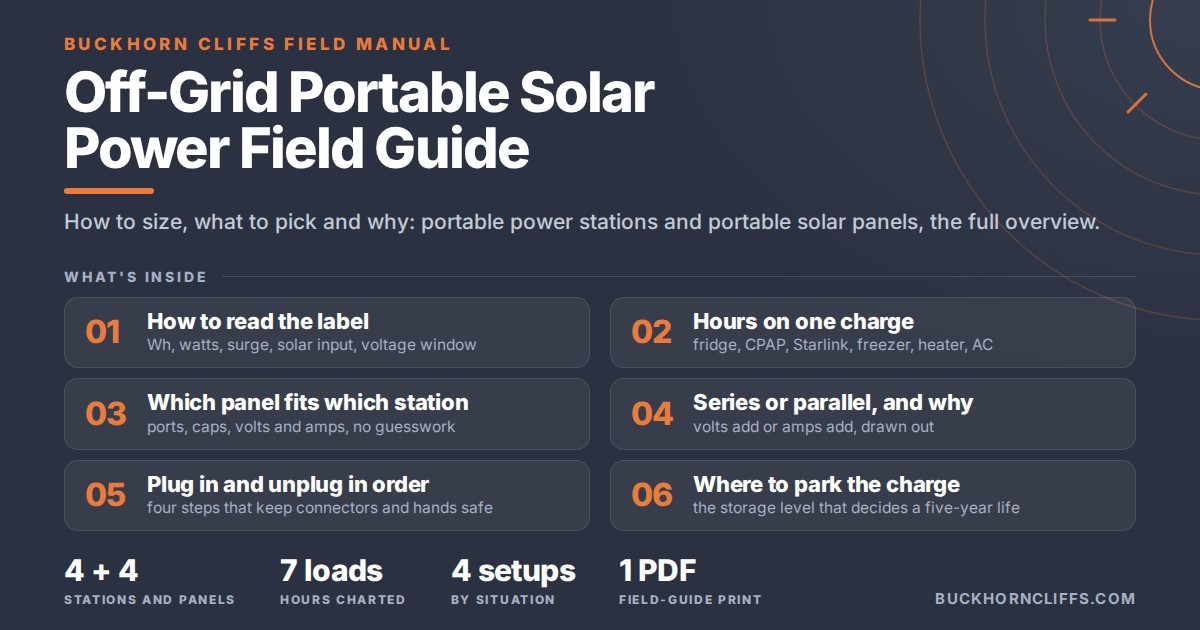
A portable power station and a folding solar panel are the simplest off-grid power there is. Nothing to wire, nothing to permit, nothing to fuel: the station is a battery, a charge controller and an inverter in one box, and the panel plugs into it with one cable. The only real decision is which size, and that comes down to what has to run and for how long. This page is the four EcoFlow DELTA stations I would choose between, from one kilowatt-hour to four, and the four Zoupw panels that feed them, with the numbers to pick the right pair. The arithmetic behind it is in the solar power basics guide; a system wired into the house is the home backup power system.
How to read the numbers
Six numbers on the label decide everything. Read them once and you can size any station against any outage in your head.
How much it holds. Hours on a charge = Wh × 0.85 ÷ the load's watts; the inverter eats the other 15 percent. A fridge averages about 50 W over the day.
The most it runs at once. Add up what is plugged in; if the sum is over the number, something waits its turn. The bar is the 1,800 W pipe.
Motors pull three to six times their running watts as they start. A well pump that runs at 1,000 W asks for 3,000 W first, and this station's surge rating has to cover it. Check the surge figure against your biggest motor.
The most panel watts the port will take, marked by the line. Bring more and nothing breaks: the station draws its 500 W and the panels idle on the rest. One 400 W panel refills this 1 kWh tank in an afternoon; a second one is money spent on watts the port never pulls.
The voltage range the solar port accepts. Any one of these panels sits inside it; two in series add their volts and fall outside on every DELTA 3 port. Cold mornings push volts up 10 to 15 percent, so leave room.
Lithium iron phosphate cells, in every station here: the most heat-tolerant of the common lithium chemistries. The cycle count is not a limit you will reach; how you store it (below) is what decides its life.
Figures on the tiles are the DELTA 3 Classic's; every station on this page carries the same six numbers, bigger as you go up.
| Number | What it means | Rule of thumb |
|---|---|---|
| Wh (watt-hours) | Energy stored. Hours of a load = Wh ÷ its watts | Count on 85 percent of the rating |
| W continuous | The most it will run at once, steadily | Add up everything plugged in |
| Surge | What it tolerates for a second as a motor starts | Pumps and blowers × 3, compressors × 6 |
| Solar input W | The most panel watts it will take at once | Panels beyond the cap are wasted |
| MPPT window | Panel voltage range the solar port accepts | Keep Voc under the limit on the coldest morning |
| LFP cycles | Full charges before capacity fades to 80 percent | 4,000; a decade of daily use |
The four stations
Same family, same lithium iron phosphate cells, same app and ports, four sizes. Each step up buys output as much as storage: the Max Plus runs the kitchen, the Ultra Plus starts a well pump, the PRO 3 puts out 240 volts.
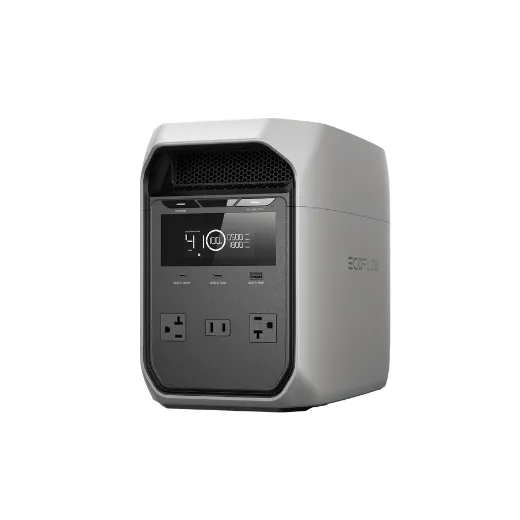
Best forOne room through a night or two: the refrigerator, a CPAP, phones, lights, the router.
What it addsThe entry point. About 27 pounds with a handle, charges from the wall to 80 percent in 45 minutes, and a single 400 W panel refills it in an afternoon.
RunsThe fridge about 17 hours, a CPAP for three nights, Starlink about 10 hours. It will not run a space heater for long, and a well pump is beyond it.
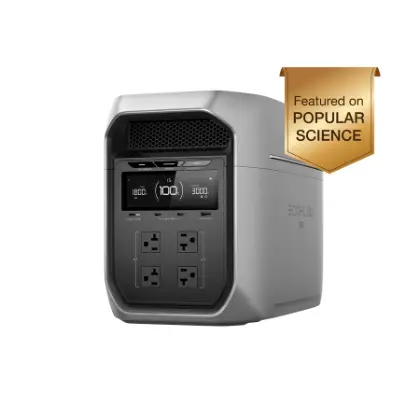
Best forA family through a multi-day outage: fridge and freezer together, the microwave, the coffee maker, a day of Starlink.
What it addsTwice the tank of the Classic and more output. The Max Plus raises output to 3,000 W and adds a second 500 W solar port, so two panels refill it as fast as one refills the Classic.
RunsThe fridge about 35 hours, fridge and freezer together through a day, a 1,500 W heater for an hour. The extra output is what lets the kitchen run normally.
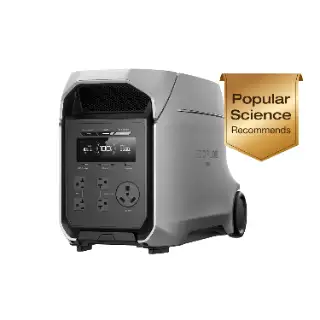
Best forA homestead: the well pump, the shop, an RV, with enough solar input to refill the same day.
What it addsThree kilowatt-hours and 3,600 W of output in one box, 11 outlets, and a 30 amp RV outlet (TT-30). Two 800 W solar ports take a pair of 480 W panels each, so a day of sun puts the whole tank back.
RunsA well pump's daily cycles with room left for the house, or a window air conditioner for three hours. The RV outlet and the outlet count are what the smaller units lack.
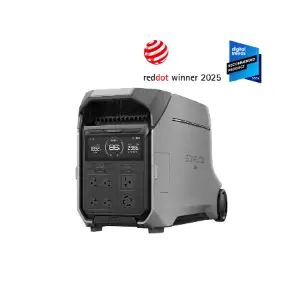
Best forThe whole house's critical circuits: 240 volt loads, a transfer switch, days of autonomy, room to grow.
What it addsThe only one here with 120 and 240 volt output, so it runs a 240 V well pump, a dryer or a mini-split. Two add-on batteries take it to 12 kWh and a second unit doubles that; its high-voltage solar port takes a pair of panels in series, with a second port for two more.
RunsThe fridge about three days alone, or a house's essentials with a transfer switch. The heaviest here, on wheels like the Ultra Plus; it lives where it is used.
| Station | Wh | W out | Solar in | What it adds over the one before |
|---|---|---|---|---|
| DELTA 3 Classic | 1,024 | 1,800 | 500 W | The entry point: 27 pounds, 80 percent from the wall in 45 minutes |
| DELTA 3 Max / Max Plus | 2,048 | 2,400 / 3,000 | 500 / 1,000 W | Twice the tank; Max Plus adds output for the kitchen and a 1,000 W solar cap |
| DELTA 3 Ultra Plus | 3,072 | 3,600 | 1,600 W | Well pump and shop loads, 11 outlets, a 30 A RV outlet, same-day solar refill |
| DELTA PRO 3 | 4,096 | 4,000 | 2,600 W | 120/240 V, transfer-switch ready, 12 kWh with add-on batteries and double with a second unit, a high-voltage solar port for a series pair plus a second port |
What each will run, and for how long
Hours on one charge are the station's watt-hours times 0.85, divided by the load's watts. These are the loads people ask about; a plug-in meter on your own appliance for a day beats any chart.
At 85 percent of the rated watt-hours. The fridge and freezer figures use their average draw, since the compressor runs about a third of the time.
A well pump is a different sum: it runs minutes a day, not hours. A 1,000 W pump that runs 40 minutes a day uses about 670 Wh, which the Ultra Plus and PRO 3 absorb with room left and the Classic cannot start.
| Load | Classic | Max Plus | Ultra Plus | PRO 3 |
|---|---|---|---|---|
| Phones, lights, radio (20 W) | 44 h | 3.6 days | 5.4 days | 7.3 days |
| CPAP, humidifier on (25 W; 8 W without) | 35 h | 2.9 days | 4.4 days | 5.8 days |
| Refrigerator (150 W running, cycling) | 17 h | 35 h | 2.2 days | 2.9 days |
| Starlink standard (75 to 100 W) | 10 h | 20 h | 31 h | 41 h |
| Chest freezer (120 W running, cycling) | 17 h | 35 h | 2.2 days | 2.9 days |
| Window air conditioner (900 W) | 58 min | 1.9 h | 2.9 h | 3.9 h |
| Space heater (1,500 W) | 35 min | 1.2 h | 1.7 h | 2.3 h |
Hours = watt-hours × 0.85 ÷ load watts. Fridge and freezer at their average draw, compressor running about a third of the time.
The chart uses typical draws. Your fridge is not typical. Twenty minutes with either of these and you have your own number.
Cheap, sits between plug and outlet, shows watts now and watt-hours over time. The one tool that beats every chart on this page.
Free, and the screen recalculates as things switch on and off. The chart above is the planning version; this is the live one.
The numbers above are a chart. This is a day.
One DELTA 3 Classic and one 400 W panel, power out since Monday night, a cold clear day with about three and a half hours of good sun. The fridge (50 W average), the router (10 W), a CPAP with the humidifier off (8 W), phones and lights. Every figure below is watt-hours divided by 0.85 for the inverter, against a 1,024 Wh tank. Watch the tank.
Charged full from the wall before the storm. Fridge, router and CPAP plugged in for the night.
Overnight took 62 percent: the fridge 46 (400 Wh through the inverter), the router 9, the CPAP 7. The fridge is the whole story; the humidifier would have added 16 more.
Fridge two more hours, 12 percent. A drip pot of coffee, 14. The panel went out at half past seven into low sun: 16 percent back in. Net, still falling.
Panel tilted up and turned at nine: 280 W in, about 70 W out. The screen's time-to-full starts counting down at roughly 19 percent an hour.
Full since half past twelve. The panel is making 320 W and the station is taking only what the fridge needs; the rest idles. A second panel would have changed nothing today.
Sun gone behind the ridge at four. Panel folded, unplugged at the station, stowed. Lights on, dinner on the propane stove, not the microwave.
Evening: fridge, router, lights, a laptop, phones. About 7 percent an hour. Bedtime at 58, and tonight costs 62.
Empty an hour before dawn, with no sun for three more. The Classic and one panel are a one-night box in January: about 1,050 Wh of sun a day against about 1,700 Wh of draw.
Two ways through the second night. Unplug the fridge at bedtime: a closed fridge holds its cold for four to six hours, and plugged back in at six it has lost nothing. Or step up: the Max Plus holds the night with 300 Wh to spare, and two panels put the day back by noon. That gap is the whole case for the second tier. In June, with six sun hours, the Classic alone sails through.
| Time | Charge | What happened |
|---|---|---|
| 10 pm | 100% | Charged full before the storm; fridge, router, CPAP on for the night |
| 6 am | 38% | Overnight took 62 percent: fridge 46, router 9, CPAP 7 |
| 8 am | 28% | Fridge 12, coffee 14; panel out in low sun, 16 back |
| 10 am | 55% | Panel tilted and turned: 280 W in, 70 W out, about 19 percent an hour |
| 1 pm | 100% | Full since 12:30; the panel idles on the rest |
| 5 pm | 93% | Sun gone at four; panel folded, unplugged, stowed |
| 10 pm | 58% | Evening loads at about 7 percent an hour |
| 5 am | 0% | Empty before dawn: about 1,050 Wh of sun a day against 1,700 Wh of draw |
A DELTA 3 Classic and one 400 W panel in January. Unplug the fridge at bedtime (it holds cold four to six hours), or step up to the Max Plus and two panels. In June the Classic alone sails through.
The four panels
All four are portable: three fold into a case with a kickstand, one rolls up as a blanket. They use N-type cells, which lose less output as the glass warms than the older P-type, and every one stays under the 60 volt limit of the DELTA solar port. They differ in watts, weight, and whether the back face collects light too.
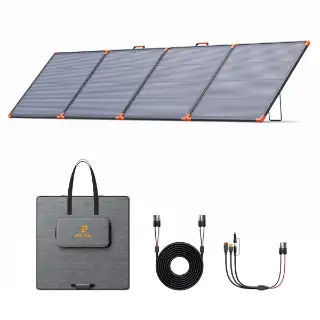
Best forThe one panel to own if you own one. Matches the Classic's 500 W cap on its own and refills it in about three and a half hours of good sun.
Why this oneN-type cells, which lose less output as the glass warms than the older P-type, with 16 fine busbars that cut resistive loss, and bypass diodes for partial shade. Folds to a suitcase with a kickstand. In the box: an MC4 extension and a four-way adapter (XT60, Anderson, two barrel sizes) that reaches the station.
Spec37.2 V at max power, IP68 weather rating, XT60 lead.
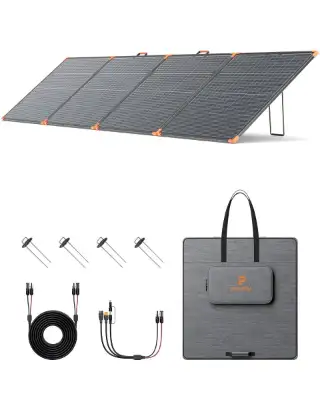
Best forThe most watts per pound here, and the panel I would pair with anything above the Classic. Two of them, one per port, fill a Max Plus in about three hours.
Why this oneBifacial: the back face collects light bounced off snow, sand, concrete or a light deck, up to 30 percent on a bright surface. Lighter than the 400 despite the higher rating.
Spec42.5 V at max power, IP68 weather rating, XT60 lead.
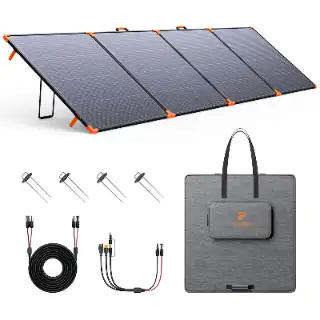
Best forThe 400's successor: same voltage, more watts, five pounds lighter, with the bifacial back. A direct drop-in on any station the 400 fits.
Why this oneSame 43.1 V open-circuit as the 400, so every pairing below that works for the 400 works for this one with a little more to show for it.
Spec37.2 V at max power, IP68 weather rating, XT60 lead.
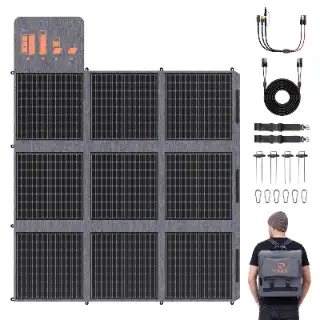
Best forThe panel that goes in the truck or the pack. Half the weight of the others and sold as a two-pack; join a pair in parallel through a Y-branch for about 500 W.
Why this oneFolds to a blanket rather than a case. Refills the Classic in about five and a half hours alone, or three hours as a pair. The right companion to a station that travels.
Spec28.8 V at max power, IP67 weather rating, XT60 lead.
| Panel | Rated W | Voc | Vmp | Weight | Rating | Note |
|---|---|---|---|---|---|---|
| Zoupw 400 W folding | 400 | 43.1 V | 37.2 V | 26 lb | IP68 | N-type 16BB, kickstand, MC4 extension and four-way adapter in the box |
| Zoupw 480 W bifacial | 480 | 49.3 V | 42.5 V | 22.5 lb | IP68 | Back face adds up to 30 percent on bright ground |
| Zoupw 430 W bifacial | 430 | 43.1 V | 37.2 V | 21 lb | IP68 | Drop-in for the 400 anywhere it fits |
| Zoupw 250 W blanket | 250 | 34.7 V | 28.8 V | 12.35 lb | IP67 | Modular blanket; a pair in parallel is about 500 W |
The panel label has four numbers of its own. Read them the same way.
Voc is the panel's voltage with nothing connected: the highest it ever shows, and the number the port's window is checked against. Vmp is the voltage while it is actually delivering power, and the one the watts are figured from.
Imp is the amps while delivering power; Vmp × Imp is the rated watts. Isc is the most current the panel can push if its leads are shorted, the figure a fuse or a port's amp rating has to cover.
N-type cells lose less output as the glass warms than the older P-type. Sixteen fine busbars per cell, instead of a few wide ribbons, cut the resistive loss on the way out. Partial-shade tolerance comes from the bypass diodes, not the busbars. None of it is a spec to size on; it is why the rated number holds up outdoors.
Cells on the back collect light bounced off the ground: a little over grass or dirt, a lot over snow, sand, concrete or a pale deck. Counts as a bonus, never as part of the sizing.
Matching a panel to a station
Two rules: stay under the station's solar cap in watts, and inside its port's voltage window. A panel delivers 70 to 80 percent of its rating in good sun, so refill time is the station's watt-hours divided by about three-quarters of the panel watts.
Port figures are the makers' published solar input limits. A panel delivers 70 to 80 percent of its rating in good sun, which is what the refill times assume. The panel maker publishes no wiring guidance for joining panels; the connections below are the standard MC4 ones, and the station's port limits are the rule that decides them.
| Station | Solar ports | Pair it with | Rated watts on the ports | Empty to full |
|---|---|---|---|---|
| DELTA 3 Classic, 1,024 Wh | One: 500 W, 11 to 60 V, 15 A | One 400 W, 430 W or 480 W; or two 250 W blankets in parallel | 400 to 480 W | About 3 to 3.5 hours |
| DELTA 3 Max Plus, 2,048 Wh | Two: 500 W each, 11 to 60 V | Two 480 W, one on each port | 960 W | About 3 hours |
| DELTA 3 Ultra Plus, 3,072 Wh | Two: 800 W each, 11 to 60 V, 18 A each | Three or four 480 W: a parallel pair on each port | 1,250 to 1,530 W | About 3 hours |
| DELTA PRO 3, 4,096 Wh | High voltage: 1,600 W, 30 to 150 V, 15 A. Low voltage: 1,000 W, 11 to 60 V, 20 A | Four 480 W: two in series on the high-voltage port, two in parallel on the low-voltage port | About 1,800 W | About 3 hours |
Two ways to join panels, and the rules that decide which to use.
Plug one panel's minus lead into the next panel's plus. The two outer leads go to the port. No extra parts; the panels' own connectors do it.
Volts are push. Two panels end to end push one after the other, like two batteries stacked in a flashlight, so the push doubles while the flow (amps) is the same current passing through both.
The port accepts high voltage. Doubling the volts is what trips the 60 V limit on most portable stations, so this is only for a port rated well above the panels' combined open-circuit voltage.
Join both plus leads into one Y-branch connector and both minus leads into another. The two Y outputs go to the port. Needs the pair of Y-branches, sold separately.
Amps are flow. Two panels side by side each push at the same pressure into one pipe, like two hoses into one, so the flow doubles and the pressure is unchanged.
The port's voltage window is tight but it has amps to spare. The volts stay inside the window; if the amps go past the port's cap, the station simply draws its cap and the rest goes unused.
Two 480 W panels make about 960 W in good sun however you join them. Wiring never adds watts; it only changes the shape they arrive in, tall and thin (volts) or short and wide (amps). You pick the shape the port can swallow. Everything below is about what cuts those 960 watts down, and what people worry about that does not.
The port cannot refuse voltage; too much arrives whether it wants it or not and can destroy the input. Count the volts for the coldest morning, when they run 10 to 15 percent high.
The station's charge controller decides how much current to pull and stops at its limit; the panels idle on the rest. Nothing heats up, nothing breaks, you just paid for watts you never see.
A station with two solar inputs takes a panel on each with no series or parallel at all, each port at its own window and cap.
Four checks before anything gets plugged in.
Series: one panel's minus to the next panel's plus, the two outer leads to the port. Volts add, amps stay (two 49 V, 11 A panels make 98 V at 11 A). Only for a port rated well above the combined open-circuit voltage; it trips the 60 V limit on most portable stations. Parallel: both plus leads into one Y-branch, both minus leads into another, the Y outputs to the port. Amps add, volts stay (49 V at 22 A). Volts over the port's window cause damage; amps or watts over its cap are simply not drawn. A station with two ports takes one panel on each, no joining needed. Wiring never adds watts: two 480 W panels make about 960 W in good sun in series, in parallel, or one per port; it only changes whether they arrive as volts or amps. What cuts the watts: the port's caps (unused, not harmful), shade on a series pair, mismatched partners, and sun, angle and heat. What does not matter: which panel is which, a short extension, bringing more panel than the cap, or a full battery that draws less.
The connectors, and what each is for
Eight plugs cover everything on this page. Three carry the solar in, two carry the cheap DC out, and the rest are the ones to recognize so an adapter order is right the first time.
| Connector | Where | For | Watch |
|---|---|---|---|
| MC4 | Every panel lead, extensions, Y-branches | Panel to panel, panel to Y-branch, panel to adapter | Locks; needs the key to separate; never pull under load |
| XT60 / XT60i | DELTA 3 solar input; the panel box has an XT60 adapter head | The last plug: string into the station | XT60i has an ID pin; a plain XT60 fits but may be current-limited, so use the maker's XT60i cable |
| PRO 3 ports | High-voltage port is a plain XT60; low-voltage port is XT60i | Series pair on the high, single or parallel on the low | No solar cable in the PRO 3 box; 98 V into the 60 V port is the mistake |
| Anderson Powerpole | Older panels and stations, 12 V gear | Adapting old to new | No lock; watch polarity |
| DC barrel | Small stations, trickle panels | Small chargers only | No lock, low current, easy to mix sizes |
| 12 V socket | Max, Max Plus, Ultra Plus; the car (Classic: none; PRO 3: DC5521 and Anderson) | CPAP, 12 V fridge, charging from a vehicle | Cheapest watts: no inverter loss; car charging is slow |
| USB-C PD | Every station | Laptops, phones, Starlink Mini, lights | Skips the inverter loss |
| 30 A round (TT-30, L14-30) | Ultra Plus RV outlet; PRO 3 outlets and the house inlet | RV, or the transfer switch | Only through the inlet and switch, never a wall outlet |
Every adapter has a rating and a direction. An MC4-to-XT60 lead is for solar in, not for feeding a 12 V load out. A Y-branch is for parallel, never for series. Buy the adapter for the port it plugs into, check its amp rating against the string, and keep polarity straight: go by the + and − marks on the panel's leads, not by which connector looks male, and check that an adapter keeps them.
Which setup for which situation
Four pairings, smallest to largest. The right one is the smallest that starts your biggest load and holds a night of everything else; the panel count is what makes it last a week instead of a day.
- Station
- DELTA 3 Classic
- Panel
- Zoupw 400 W or 430 W
- Refill
- 3.5 hours of sun
The refrigerator overnight, a CPAP for two nights, phones, lights, the router. Recharged by lunch the next day.
- Station
- DELTA 3 Max Plus
- Panels
- X
- Refill
- 3 hours of sun
Fridge and freezer together through a day, plus the microwave and coffee maker on 3,000 W. The second panel is what keeps it full through a week.
- Station
- DELTA 3 Ultra Plus
- Panels
- Three or four Zoupw 480 W, a pair per port
- Refill
- 3 hours of sun
3,600 W starts a 120 V well pump and runs it daily with the house on top. Eleven outlets, a 30 amp RV outlet, and a solar cap big enough to refill it the same day.
- Station
- DELTA PRO 3
- Panels
- Four Zoupw 480 W: a series pair and a parallel pair
- Refill
- 3 hours of sun
The only 240 V output here: a 240 V well pump, a dryer, a mini-split. Wires to the panel through a transfer switch, grows to 12 kWh with add-on batteries, and doubles with a second unit.
| Situation | Station | Panels | Refill | What the step up buys |
|---|---|---|---|---|
| Short outage, one room | DELTA 3 Classic, 1,024 Wh | One Zoupw 400 W or 430 W | 3.5 h of sun | Fridge overnight, CPAP two nights, phones, lights, router |
| A family, a week | DELTA 3 Max Plus, 2,048 Wh | Two Zoupw 480 W, one per port | 3 h | Fridge and freezer together, microwave and coffee on 3,000 W |
| Homestead | DELTA 3 Ultra Plus, 3,072 Wh | Three or four Zoupw 480 W, a pair per port | 3 h | Starts a 120 V well pump, 11 outlets, 30 A RV outlet |
| Whole house | DELTA PRO 3, 4,096 Wh | Four Zoupw 480 W: a series pair, a parallel pair | 3 h | 240 V loads, transfer switch, 12 kWh with add-ons, double with a second unit |
Find the horsepower on the pressure switch cover, the well tag, or the pump's paperwork. Running watts are roughly 1,000 per horsepower (a ½ HP pump about 600 W, a 1 HP about 1,000, a 1½ HP about 1,500), and the start surge is three to six times that for a second or two. Check the voltage next: most deep-well submersibles are 240 V, which on this page means the PRO 3 wired through a transfer switch; a 120 V jet or shallow-well pump plugs into the Ultra Plus or PRO 3 directly. A soft-start kit on the pump cuts the surge roughly in half and can bring a borderline pump within a smaller station's reach. The energy is never the problem: a 1 HP pump running 40 minutes a day uses about 670 Wh. The first second is.
Living with it
Pass-through is the station charging from the wall or the panel while the fridge runs off it at the same time. In an outage with a panel it is the normal mode: sun in, fridge out, the battery as the buffer between them.
The inverter runs the whole time, so the 15 percent loss applies to every hour, not just the hours you draw, and the box runs warm. A cold station will not take a charge at all until its cells are above freezing; keeping it indoors avoids losing the morning.
Leaving it plugged in with the fridge on it, so an outage never reaches the fridge, works, and the switchover is fast enough for a fridge or a router (not a desktop computer unless the maker rates it for that). Do it with the app's charge limit at 80 percent, or the battery sits at full every day of the year, which the storage section explains.
Plugging in and unplugging, in the right order
A solar panel has no off switch. The moment light hits it, its leads are live, so the order you plug and unplug in is what keeps the connectors healthy and your hands off a live contact. Same four steps every time, in reverse to take it down.
- Fold the panel closed, or cover itA panel in daylight is always live at its open-circuit voltage, even at dusk, even through cloud. Closed or covered, it makes nothing and every plug is safe to handle.
- Join panel to panelSeries or parallel connections go together now, while nothing is flowing. Push each connector until it clicks; a half-seated plug is where heat starts.
- Plug into the station lastThe station's solar port is the last connection, so the string never has a live loose end waving around. Seat the plug fully.
- Open the panel, check the screenUnfold it, face it at the sun, and watch the station's display show solar watts climbing. No watts: a plug is not seated or the voltage is outside the window.
- Fold the panel closed, or cover itThe current stops the moment the cells go dark. The station's screen drops to zero solar watts: that is the signal. At night this step is already done.
- Unplug at the station firstPull the plug by its body, not the cable. With the panel dark there is nothing flowing, so nothing arcs.
- Then separate panel from panelUndo series and parallel connectors last. Keep the pairs together and cap or tuck the open ends so they do not touch metal or each other once the panel sees light again.
- Stow the cables with the panelDry the connectors if they are wet, fold the leads inside the case, and the whole thing is ready to plug in the same order next time.
A panel in daylight is always live, and a connector pulled apart while current flows arcs and pits its contacts. So: fold or cover the panel first, so nothing is flowing; connect the station last and disconnect it first; join and separate panel-to-panel connectors only while the panel is dark. Series pairs run near 100 volts and deserve the most care.
When something looks wrong
Eight things people see on the day, what is usually behind each, and the fix. Most of them are the protections working.
| Symptom | Likely cause | Fix |
|---|---|---|
| No solar watts | Plug not seated, panel shaded or folded, string voltage outside the window | Reseat, aim the panel, check volts for that port |
| Charges then stops | Charge limit reached, station too hot, panel below minimum volts | Check the limit, shade the station, wait for sun |
| Fan loud | Big load or fast wall charge | Air on all sides; slow the charge at night |
| Over-temperature | Direct sun, hot vehicle, closed cabinet | Shade, airflow, drop the load |
| Will not charge in cold | Cells below freezing | Indoors an hour, then charge |
| 0 percent, will not charge | Stored empty, pack locked | Slow wall charge an hour; else warranty |
| Appliance clicks off | Overload | Unplug something; start the motor alone |
| Gauge jumps | LFP gauge drift | Full charge, sit an hour |
Where a power station stops
A station and a panel cover a short outage well and a long one adequately, if the loads are managed and the sun shows up. Four places the category ends, and what takes over.
Storing it between outages
Most power stations do not die in an outage. They die on a shelf, from sitting full in the heat or sitting empty until the cells drop below the point the electronics will allow them back from. The charge level it sits at is the one decision that matters, and the reasons are worth knowing.
The level the battery sits at between outages is what decides whether it is still a full-size station in five years.
Self-drain takes it below the cells' cutoff; the pack locks; caught early a slow charge may wake it, left for weeks it is done.
No harm for weeks. The slow drain is the risk, so look at it every three months.
Low stress on the cells, room to drain. Top it up when it reads 60.
Full the night before a storm. Right for days, wrong for a season.
Park it at 60 to 80 percent, in the house, not the garage. Set the charge limit to 80 percent in the app if the station offers one, so it can live plugged in without sitting at full. Look at it every three months; when it reads 60, top it up. Once or twice a year let it reach 100 and sit there an hour: that is when the station balances its cells and resets its percentage gauge, which drifts on this chemistry. Then run it back down. When a storm is in the forecast, charge it to full the night before: a full battery is the right battery for a week, not for a season. Twice a year, run it under a real load for an hour and plug the panel in, so the inverter, the ports and the cable are proven before the day you need them.
| State of charge | What it means | Rule |
|---|---|---|
| 0 to 10 percent | Dead zone: self-drain reaches the cutoff, the BMS locks the pack, it may never charge again | Never store it here |
| 10 to 60 percent | Fine for weeks; the slow self-drain is the risk | Check every three months |
| 60 to 80 percent | The storage band: low cell stress, room to self-drain | Park it here; top up at 60 |
| 100 percent | Highest cell voltage, fastest aging, worse when hot | Storm-ready for days, not months |
Questions this answers
Tap a question for the short answer.
What size power station do I need for an outage?
Add up what has to run and for how long. One room (fridge, phones, lights, a CPAP) for a night or two is a 1 kWh station like the DELTA 3 Classic. A family for a week, fridge and freezer and the kitchen, is 2 kWh with two panels, the DELTA 3 Max Plus. A well pump and the shop is 3 kWh and 3,600 W, the Ultra Plus. The house on a transfer switch with 240 volt loads is the PRO 3 at 4 kWh and up. The runtime chart on this page gives the hours for each.
How do I safely disconnect solar panels from a power station?
Make the panel dark first: fold it closed or cover it, and watch the station's solar watts drop to zero. Then unplug at the station, by the plug body, and only then separate any panel-to-panel connectors. Connecting is the reverse: panel closed, join the panels, plug into the station last, then open the panel. The reason is that a panel in daylight is always live, and a connector pulled apart under current arcs and pits its contacts; with the panel dark there is nothing flowing. Leaving it plugged in overnight is fine, since a dark panel makes nothing and the station blocks reverse flow.
How long will a power station run a refrigerator?
A modern refrigerator draws about 150 watts running and the compressor runs about a third of the time, so it averages about 50 watts and 1.2 kWh a day. Hours are the station's watt-hours times 0.85 divided by 50: about 17 on the 1,024 Wh Classic, 35 on the 2,048 Wh Max Plus, 52 on the 3,072 Wh Ultra Plus and 70 on the 4,096 Wh PRO 3. With a panel, summer sun puts back more than the fridge takes and it runs indefinitely; a northern January with 3.5 sun hours and one 400 W panel puts back about 1,050 Wh, less than the fridge plus the inverter's share, which the worked day on this page shows.
Can a power station run a cpap through the night?
Yes, easily. A CPAP alone draws under 10 watts; with the humidifier on, about 25, and with a heated tube about 35. A 1,024 Wh Classic runs a humidified machine about 35 hours, four nights, and a bare one for a week. Use the machine's DC cable into a 12 volt socket where the station has one (the Max, Max Plus and Ultra Plus do; the Classic does not), which skips the inverter loss and runs quieter.
How many solar panels can I connect to a power station?
Up to the station's solar input cap: 500 W on the DELTA 3 Classic and Max, 1,000 W on the Max Plus, 1,600 W on the Ultra Plus, 2,600 W on the PRO 3. Panels beyond the cap are wasted, not harmful: the station's charge controller draws up to its limit and the panels idle on the rest. Too many volts is the thing that damages a port, so the voltage window is the hard rule and the watt cap is the budget rule. Then match each port: in series the volts add and the amps stay, in parallel the amps add and the volts stay. Every DELTA 3 port tops out at 60 volts and 13 to 18 amps, so it takes one 480 W panel, or two in parallel with some clipping; only the PRO 3's high-voltage port, 30 to 150 volts, takes a pair in series.
What is the difference between the ecoflow delta 3 models?
Size and what the extra size unlocks. The Classic is 1,024 Wh and 1,800 W, the 27-pound carry. The Max and Max Plus are 2,048 Wh; the Plus raises output to 3,000 W and the solar cap to 1,000 W. The Ultra Plus is 3,072 Wh and 3,600 W with 11 outlets, a 30 amp RV outlet and a 1,600 W solar cap. The PRO 3 is 4,096 Wh and 4,000 W, the only one with 240 volt output; add-on batteries take it to 12 kWh and a second unit doubles that. Each step up buys output as much as storage: the kitchen at 3,000 W, the well pump at 3,600 W, the 240 V circuits at the PRO 3.
Which solar panel works with an ecoflow delta 3?
Any panel whose open-circuit voltage stays under the port's 60 volt limit on a cold morning, with an XT60 lead. All four Zoupw panels on this page qualify: the 400 W and 430 W at 43.1 V, the 480 W bifacial at 49.3 V, the 250 W blanket at 34.7 V. The 400 or 430 on its own matches the Classic's 500 W cap; one 480 on each of the Max Plus's two ports; a parallel pair on each of the Ultra Plus's two ports; and on the PRO 3, a series pair on the high-voltage port and a parallel pair on the low-voltage port.
Can a power station run a well pump?
The bigger ones can. A 120 volt pump rated around 1,000 W asks for about 3,000 W for a second at startup, which the Ultra Plus at 3,600 W and the PRO 3 at 4,000 W tolerate and the Classic does not. A pump runs minutes a day, so energy is not the problem: 40 minutes of a 1,000 W pump is about 670 Wh. A 240 volt pump needs the PRO 3, the only station here with 240 volt output, wired through a transfer switch.
Should I wire portable solar panels in series or parallel?
It depends on the port. Series adds the volts: two 480 W panels make 98.6 V, past the 60 V limit of every DELTA 3 port and inside the PRO 3's 30 to 150 V high-voltage port, so series is a PRO 3 move, two panels at most. Parallel adds the amps through an MC4 Y-branch: two 480s make 22.6 A at 49.3 V, and a DELTA 3 port rated 18 A draws what it can. Where a station has two ports, one panel per port beats either. Do the voltage sum for the coldest morning, when open-circuit voltage runs 10 to 15 percent high.
How fast does a 400 watt solar panel charge a power station?
A 400 W panel delivers about 300 W in good sun, 70 to 80 percent of its rating, so it refills a 1,024 Wh DELTA 3 Classic from empty in about three and a half hours and the 2,048 Wh Max in about seven, a full summer day. Tilt the panel at the sun and turn it at noon; flat on the deck it makes half as much. A 480 W bifacial on bright ground is nearer 360 W and does the same job in three hours.
How should I store a power station between outages?
At 60 to 80 percent charge, indoors, cool. A full cell sits at its highest voltage and ages fastest, worse in heat; an empty one self-drains below the cells' cutoff within months, the battery management system locks the pack to protect it, and the station will not charge again. Set the app's charge limit to 80 percent if it has one, check the level every three months and top up at 60, charge to full only when a storm is in the forecast, and never charge below freezing, because lithium plates onto the electrode instead of into it.
Keep going
Related to this
Membership · $49.95 per year
There is a lot more behind the lock
Every recipe and resource from the Prepper's Chemical Survival Guide, all six field guides to read here and download, the full audit and logbook, all twelve reference charts, and no ads.
My Manual · included
Build your own field manual
The most useful thing a membership gives you. Save any page on this site, recipes, charts, and whole field guides included. Arrange them in the order you want, name it, and print one manual with a cover and contents, or keep it as a PDF that opens with no signal.
- It works when this site does not
- Only your pages
- Anyone in the house can use it
- One current copy, not a pile of printouts
- The house binder
- A copy for the bug-out bag or truck
- A copy for family
- An offline PDF





Stay Ready
New entries, updates, and useful instruction.
Stay one step ahead on your preparedness journey.