Quick facts
- The systemThree 48 V ETHOS 5.12 kWh modules (15.36 kWh), a LuxPower 12K hybrid inverter, nine 550 W bifacial panels on a ground mount, a Predator 13000 tri-fuel generator on propane
- The mistakeA 10-circuit, 30 A, 7,500 W generator transfer switch on the LOAD port of a 12 kW inverter: it worked, backed up eight circuits, and capped the whole system at the switch
- The fixWhole-home through two stacked 125 A load centers: the top one feeds the inverter and a bypass leg, the bottom one takes the inverter LOAD on its main and the bypass on an interlocked backfed breaker, then feeds the untouched main panel
- In an outage12 kW continuous, 24 kW for half a second, 13.8 usable kWh: about 14 hours at 1,000 W, two days of real use with no sun. The car charger drops to 6 to 10 A, not off
- The carAn EV charged from the array is the biggest battery on the property and a full tank the outage does not need you to find. The charger app sets the rate from 6 to 40 A: slow every day, slower in an outage, fast only for a trip
- The car as a generatorA PowerBridge plugs into the charge port and turns the 100 kWh pack into 7,500 W of clean AC on ordinary outlets: about four days of the essentials, cord and plug, no wiring
- An ordinary dayThe array runs the house from mid morning and fills the battery by early afternoon; the battery carries the evening and most of the night; the grid covers the last hours before dawn and gray days. On a clear day the grid supplies almost nothing
- SettingsZero Export on, on-grid cutoff 20 percent (higher to keep a reserve), off-grid cutoff 10 percent, AC charge off, CAN battery protocol
- TestOpen the service disconnect on a sunny afternoon: nothing should blink, the well pump should start, and the inverter should resync on its own when the disconnect closes
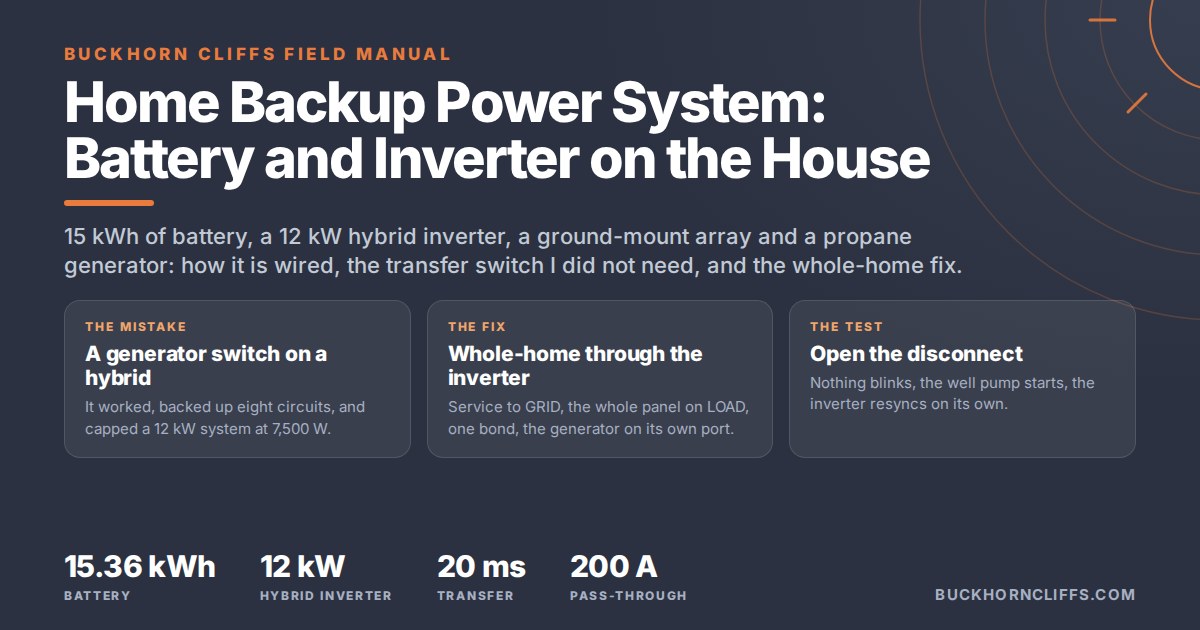
This is the battery and inverter wired into the house: the system that runs the well, the furnace blower, the freezers and the kitchen when the grid is gone, and that will do it without anyone home to flip anything. It is also the page where I show the thing I got wrong. I put a manual transfer switch between a hybrid inverter and the panel, which is the right part for a generator and the wrong part for this inverter. It worked, which is why it took a year to see. Below is what I built, why it ran anyway, what it cost me, and the whole-home wiring that replaces it. No prices on this page; the parts list says what each piece is and does.
The system, part by part
Four things plug into one box. Learn the box and the rest of the page is easy.
15.36 kWh of lithium iron phosphate in a stack, with the management system and a fire suppressant built in. Talks to the inverter over CAN. Expands by adding modules.
See the ETHOS system at BigBattery ↗12 kW continuous, 24 kW for half a second, three MPPT inputs for up to 18 kW of panels, 200 A grid pass-through, a GEN port, and the transfer relay that makes the rest of this page possible.
4.95 kW on a wood rack tilted 32 degrees, facing a little east of south. One string of nine on MPPT1, about 450 V, through one inch of conduit to the house. The panel-level numbers are on the basics page.
The one switch outside: it opens the string before the DC ever enters the conduit, so the inverter end can be worked on with the array dead. Everything else, the PV breakers, the battery breaker and the load breaker, is inside the inverter.
9,100 W running on propane, 12,000 to start; 10,000 running on gasoline. A 50 A 14-50 outlet feeds the inlet. Runs about 16 hours on a 100 lb propane tank at half load. The propane page is the tank math.
The top box takes the service and splits it: breaker A to the inverter, breaker B to the bypass leg. The bottom box takes the inverter LOAD on its main and the bypass on an interlocked backfed breaker, and feeds the main panel. One slide of the interlock puts the house on raw grid while the inverter is off the wall.
40 A at most, and the rate is set from the app anywhere between 6 and 40 A. That slider is the whole EV strategy on this page: low every day, lower in an outage, high only for a trip.
The charger ↗Plugs into the charge port and gives 120 and 240 V AC from the pack, up to 7,500 W, on ordinary outlets. The EV section is why it belongs on a solar house and how it is used.
PowerBridge Pro ↗Every number on this page that is not on a nameplate came from a plug-in meter on the appliance for a day. It is the cheapest part of the system and the one that sized everything.
The meter ↗Where the power comes from, hour by hour
This is the part people miss about a hybrid: it is not sitting there waiting for an outage. Every clear day the array runs the house and the grid barely gets a vote. The band below is an ordinary day with the grid up, read from the inverter screen, and the numbers under it are the arithmetic.
The inverter app shows this split for every day: PV, battery, grid import and consumption. A clear day in any month reads a few hundred watt-hours of import against 7 kWh used. The grid earns its keep on the gray week, and that is also where the generator section comes in. The numbers and the January-versus-June math are on the basics page.
Hybrid vs off-grid vs grid-tied: which system, and why
The word hybrid is doing real work. An off-grid inverter has no idea the grid exists; if the house also has a grid feed, something external has to keep the two apart, and that something is a transfer switch. A grid-tied string inverter is the opposite: it lives on the grid, has no battery, and by law shuts off the moment the grid does. A hybrid sits between them. It has a GRID port and a LOAD port with a relay between, it passes grid power through to the house, it charges and drains a battery on rules you set, and when the grid drops it opens that relay and runs the house as an island. The transfer switch is inside it.
Hybrid
The relay between GRID and LOAD opens in about 20 ms and the house runs on the battery and the array. When the grid comes back the inverter syncs and closes the relay. Nobody has to be home.
Pick it when- The house has utility service and you want it to keep running when that service fails
- You want the sun to carry the daytime load and the grid to be the backstop on the dark weeks
- You want the generator to be the last resort, not the plan
It is tied to the service, so it needs the permit, the inspection and the interconnection agreement even at zero export. In series with the house it is also a single point of failure, which is what the two-box bypass below fixes.
Off-Grid
Nothing changes, because it was never on the grid. The flip side: there is no grid to fall back on. A dark week drains the battery and the generator becomes the grid.
Pick it when- There is no service, or the line extension would cost more than the whole system
- The building is deliberately kept separate from the utility and you want no paperwork with them
- You are willing to size the battery for the worst week of winter and keep the generator fueled and exercised
If the house does have a grid feed, an off-grid inverter cannot share it: something external has to keep the two apart, which is the transfer switch I wired by mistake. Sizing is for the season, not the outage, so the battery and the array both grow.
Grid-Tied
It shuts off, by law, even in full sun. UL 1741 anti-islanding exists so a string inverter can never energize a line a utility crew thinks is dead. The panels do nothing until the grid returns.
Pick it when- Lowering the bill is the only goal and the utility pays well for exported power
- You already have a generator plan for outages and solar is a separate conversation
- You accept that the day the grid fails, the solar fails with it
Adding a battery later usually means replacing the inverter or AC-coupling a second one. If outage power matters at all, start with a hybrid: it does everything a string inverter does, with a battery port and a relay waiting for the day you need them.
Side by side, the table is the same story in rows.
| Hybrid | Off-grid | Grid-tied string | |
|---|---|---|---|
| Grid connection | Yes, with pass-through | None | Yes, and depends on it |
| Battery | Yes | Yes | No |
| In a blackout | Islands in about 20 ms, runs the house | Nothing changes | Shuts off by law |
| Transfer switch | Built in | Needed if the house also has grid | Not applicable |
| Charge from grid | Yes | No | No battery |
| Sell power back | Optional (Zero Export here) | Never | Its whole job |
| Generator | GEN port, automatic | Usually a GEN input | No |
| Built for | A house on the grid that keeps running without it | A cabin with no service | Lowering the bill |
The sizing changes with the topology, and this is the part that surprises people who assume off-grid means the same system minus the bill.
Battery for one night of essentials. Array for the average day. The grid fills the gap on the dark stretch, so a December week does not drive the design. This house: 15 kWh of battery and 4.95 kW of panels.
Battery for three to five days with no sun. Array for December, not June, which can mean twice the panels. The generator is the fourth source, not an option, with fuel on hand and a monthly run. The same house off-grid wants roughly double the battery and double the array.
Which one is right for your house
NoOff-grid, and the decision is made for you. Size for winter, budget the generator, skip the rest of this box.
YesKeep going.
NoGrid-tied is the cheapest way to cut the bill. Know that the panels go dark with the line.
YesHybrid. The relay inside is the transfer switch, and the battery is what it switches to.
IndependentA hybrid set to Zero Export, with the grid as a charger of last resort, is more independent in practice than an off-grid system that leans on a generator every cloudy week. Nothing leaves the property; the grid is a backup you happen to pay for.
ProtectedHybrid, and let the grid carry the house whenever the sun and the battery cannot.
Either wayA hybrid runs indefinitely with nothing on its GRID port. It is an off-grid inverter with one extra port and one relay. Buy the hybrid, wire it for the grid you have, and nothing changes the day that grid stops coming.
Four things people say about these three that are not true.
A hybrid with a battery and a grid port is grid-tied. Zero Export keeps the power home, but the service, the paperwork and the pass-through all say grid-tied, and that is a feature.
It removes one source. A hybrid has the sun, the battery, the generator and the grid; an off-grid system has three. Resilience is sources, not independence.
Not if it is a string inverter. It shuts off with the grid by design. Ask which of the three it is before the first storm, not after.
It is the transfer switch. Putting another one in series was my mistake, and the whole middle of this page is about taking it back out.
Those three words were my mistake in one sentence. I bought a hybrid, then wired it the way an off-grid inverter has to be wired.
What happens in the 20 milliseconds
This is the mechanism that makes an external switch unnecessary, and it is worth seeing as three states.
Grid power passes straight through the inverter to the house, up to 200 A. The array charges the battery and covers the house; the grid fills whatever the sun and the battery do not. Zero Export keeps every watt on the property.
The inverter sees the grid go out of range and opens its grid relay within 20 ms. The house is now an island fed by the battery and the array. Clocks do not reset; the furnace does not notice. This is the anti-islanding rule in UL 1741 working in your favor: it disconnects fast so it can never push power back up the line.
The inverter watches the grid for a stable stretch, syncs its own waveform to it, then closes the relay. The battery goes back to charging from the sun. Nothing to flip, nothing to reset, nobody has to be home.
What I built first, and where I went wrong
The first version ran the inverter's LOAD output into a Reliance Pro/Tran 310D, a ten-circuit manual transfer switch, and fed the inverter's GRID port from a 50 amp breaker in the main panel. Eight circuits went on the switch: the well pump, the furnace, the stove, the kitchen and garage outlets, the desk and the basement, with the compressor pair left off. Every toggle sat on GEN so the inverter fed them all the time, which gave me automatic backup for those eight.
There is a detail that hid the problem for a year. With the grid up, the inverter was not only feeding the eight circuits. It was pushing sun and battery power backward through that 50 amp breaker into the main panel, with the CTs holding zero export at the meter, so the whole house ran on the array every clear day. The bill said the system worked. Only an outage would have shown that most of the house was on the wrong side of the switch.
The Pro/Tran 310D is a generator switch under NEC 702: ten circuits, 7,500 watts, 30 amps at 240 volts, each circuit a three-position toggle between LINE, OFF and GEN. Its job is to let a portable generator on a cord feed a few circuits without any way to backfeed the grid. It was never meant to carry a 12 kW inverter, and it cannot: 7,500 watts is the ceiling and the A and B positions carry 30 amps, the rest 20.
Because the inverter was doing the real work. With the inverter LOAD output on the switch GEN terminals and the toggles left on GEN, those eight circuits were always fed by the inverter, which was passing grid power through while the grid was up and switching to the battery in 20 ms when it dropped. The manual switch never moved. It was a bypass with a limit, not a transfer switch.
Only eight circuits were ever backed up, through a 30 amp pipe, on a system that can push 50 amps and surge to 100. Everything on the LINE side of the switch, and everything not on the switch at all, went dark in an outage. The 50 amp breaker feeding the GRID port capped how much of the house the inverter could carry even with the grid up. And I had two transfer switches in series doing one job, which is one more thing to explain to an inspector.
Safety. A hybrid inverter listed to UL 1741 cannot energize a dead grid: that is the whole point of the standard, and Zero Export means it does not push power out even on a live one. The 310D isolates by design. Nobody on the line was ever at risk. The mistake was treating a hybrid like an off-grid inverter and putting a generator part in front of it.
The right way: whole-home through the inverter
The inverter has a 200 amp pass-through rating for exactly this: the service feeds it, and it feeds the whole house.
- The service disconnect feeds the GRID port. The 125 A main outside becomes the only thing between the meter and the inverter. The manual asks for a 200 A main on a whole-home job; a 125 A service is inside the 200 A pass-through rating with room to spare. The 50 A breaker goes away.
- A grid-side box with two breakers. The inverter has its own breakers on the LOAD output (200 A) and the battery (two at 200 A) but none on the GRID input, so protection comes from outside. The feed from the outside main lands in an Eaton CH 125 A main-breaker load center on the wall where the transfer switch hung. Breaker A feeds the inverter GRID terminals and doubles as the inverter disconnect; breaker B feeds the bypass leg.
- A house-side box with an interlock. A second, identical 125 A load center below it. Its main breaker is fed by the inverter LOAD output, which is the normal path. A backfed breaker takes the bypass leg, and an interlock plate between the two means only one can ever be on, so the grid and the inverter output can never touch. An output breaker feeds the existing main panel, which stays exactly as it is. The next section is why.
- The LOAD port feeds the whole house. Through the bottom box, every breaker in the main panel is now on the far side of the inverter and backed up, the well and the furnace and the kitchen included, with no list to maintain.
- One neutral-to-ground bond, at the service disconnect. The neutral runs through the inverter unbroken, so the bond outside stays the bond for the whole system, grid up or down. The bonding screw in the main panel comes out and its neutrals and grounds move to separate bars, exactly as in any sub-panel. This is the item an inspector looks for first and the one a DIY install most often gets wrong.
- CTs on both grid legs at the service entry, arrows toward the inverter. They tell the inverter what the house is drawing from the grid so it can hold Zero Export and size its own output. If the arrows face the wrong way the inverter reads the house backwards; the fix is a setting (CT direction) rather than a rewire.
- Wire sized to what protects it. Every AC run is protected by a 125 A breaker, the outside main or one of the box mains, so every run is #1 copper with a #6 copper ground. The manual would want 3/0 on the LOAD side if it landed on main lugs; because it lands on the bottom box's own 125 A main, #1 is correct, and that is one of the reasons the second box earns its place.
- The generator gets its own port. A 240 V inlet outside, a 100 A breaker, and a cord to the GEN terminals. The inverter treats it as a third source: it carries the house and charges the battery while the generator runs, then drops it. The old manual switch is not part of this.
- The car gets a plan, not a panel. Everything is behind the inverter, so the EV charger counts against its 12 kW in an outage and can pull on the battery any evening. The plan is one slider in the charger app: charge at noon, at the amps the array can give, slow in an outage, never from the reserve.
- The electrician makes the service-side connections and the inspection is on the paperwork. I ran the conduit, mounted the gear and wired the DC side. The disconnect, the feeder, the bond and the final checks are the electrician's, and the utility gets its interconnection form even though nothing exports.
What changes for the house: nothing, until the grid drops, and then still nothing. Every circuit is backed up, the transfer is automatic, and the only switch anyone ever touches is the service disconnect during a test. What changes for the inverter: it finally sees the loads it was rated for, which is why the next section exists.
The single point of failure, and the two boxes that fix it
Putting the inverter in series fixes the backup problem and creates a new one. Every watt the house uses now passes through one machine. If it ever faults, or has to come off the wall for a warranty swap or a firmware session, the whole house is dark, and the generator cannot help because it feeds through the same machine. The fix is a bypass, and the cleanest way to build one is two identical load centers and an interlock plate.
The feed from the outside 125 A main lands here. Breaker A feeds the inverter GRID terminals and is the inverter disconnect: one throw isolates the inverter from the grid without walking outside or killing the service. Breaker B feeds a bypass leg down to the bottom box.
Its main breaker is fed by the inverter LOAD output; that is the normal path. A backfed breaker is fed by the bypass leg. An interlock plate slides between the two so only one can ever be on, which is what keeps the grid and the inverter output from ever touching. An output breaker feeds the existing main panel, which stays exactly as it is.
The bottom main is on, the backfed breaker is locked off, and the 12K runs everything: pass-through from the grid, the array, the battery, the generator, all through the one box, with the 20 ms transfer doing its job.
Bottom main off. Shut the 12K down in the manual order. Slide the interlock. Backfed breaker on. The house is on raw grid, exactly as it was before any of this existed, until the inverter is back. Then reverse it.
Because the inverter LOAD lands on a 125 A main breaker instead of bare lugs, the manual lets the LOAD-side wire be sized to that breaker. Every AC run in the system is #1 copper instead of 3/0 on the inverter side, which is easier to pull, easier to land, and cheaper.
This is service-side work. It gets a permit and an inspection, the electrician makes the final connections, and the interlock kit has to be the one listed for that load center, not a plate that happens to fit.
Which of all this is required and which is my choice is worth being honest about, because a reader building the same thing can skip the second column and still have a safe, inspectable system.
- A service disconnect with the one N-G bond. The outside 125 A main. Every panel downstream keeps neutrals and grounds apart.
- Overcurrent protection ahead of the GRID terminals. The inverter has no breaker on that port. Here it is breaker A; a breaker in the main panel did the same job badly in the first version.
- A disconnect for the inverter. Code wants a readily accessible, lockable way to isolate it from the grid. Breaker A is that, at the wall, in sight of the inverter.
- Wire sized to the breaker ahead of it, #1 copper on every 125 A run, #6 copper ground with each.
- CTs on the service feed. Not code, but the inverter cannot hold Zero Export without them, and the utility agreement depends on it.
- A listed interlock on any backfed breaker, and a hold-down kit for the breaker itself: a plate that happens to fit is not the same thing.
- Permit, inspection, interconnection form. Service-side work, every time, even at zero export.
- The bypass itself. Nothing requires a way to run the house with the inverter removed. Without it, a dead or absent inverter is a dark house, generator included. One slide of a plate fixes that; it is the cheapest insurance in the system.
- Two boxes instead of one. One load center with the right breakers could hold the inverter feed; the second box is what makes the interlock clean and keeps the grid side and the house side in separate cans a stranger can read.
- 125 A mains on both boxes. Main lugs would be legal. The main breakers are what let the manual size the LOAD-side wire at #1 instead of 3/0, and they give each box its own disconnect.
- The generator inlet and the GEN port. The house runs without them. They turn a gray week from rationing into a propane bill.
- The EV charger behind the inverter. It could stay on the grid side forever. Behind the inverter it charges from the array, which is the whole point of the car on this page.
- Keeping the old main panel. Nothing says it must stay. Leaving every circuit where it is means no re-landing, no relabeling and no inspector asking why.
Wire gauge: what each run carries, and why the size matters
Every run in this system is a different voltage and a different current, and the wire for each is chosen by one rule and one check. The map is the runs in order, the ladder is the sizes, and the three boxes are what happens when the size is wrong in either direction.
| Run | Volts | Sets the amps | Gauge |
|---|---|---|---|
| Array to inverter, one string | About 450 V DC | String short-circuit current × 1.56, about 22 A | 10 AWG PV wire |
| Battery to inverter | 48 V DC | 250 A inverter limit | 4/0 copper, 90 °C, short |
| Outside main to top box, breaker A to GRID | 240 V AC | 125 A main | 1 AWG copper |
| LOAD to bottom box main, bypass leg, box to main panel | 240 V AC | 125 A mains | 1 AWG copper |
| Generator inlet to GEN | 240 V AC | 50 A inlet | 6 AWG copper |
| EV charger | 240 V AC | 50 A breaker | 6 AWG copper |
| Well pump | 240 V AC | 20 A breaker | 12 AWG copper |
Resistance turns amps into heat, and heat is the square of the amps: twice the current, four times the heat. An undersized wire runs warm every day, cooks its insulation over years, and on the one day the load runs flat out it can start the fire the breaker was supposed to prevent. The breaker does not know the wire is small; it only knows its own number. Voltage drop is the quiet version: motors run hot and start hard, the inverter sees a lower battery than there is and cuts out early.
A bigger wire runs cooler and drops less, so one size up is never unsafe. The costs are real but boring: copper is expensive, big wire is stiff and hard to pull, and every terminal has a largest wire it will accept. Force 4/0 into a lug made for 2 and the connection is worse than the right wire would have been. The one true error is the mirror of the first: a big wire does nothing to protect a small one downstream of it.
Pick the breaker for the load, pick the wire for the breaker, then check the drop for the length. Copper at 75 °C terminations from the table, aluminum two sizes bigger with rated lugs, and anything that runs more than three hours at a stretch, a charger or a heater or an inverter, gets a breaker rated at 125 percent of the load. Low voltage is where drop bites: at 48 V a half volt lost is one percent of the system, at 400 V it is nothing, which is why the battery run is short and fat and the array run can be long and thin.
Taking the switch out, in order
The sequence the electrician and I are following. Most of it is undoing the first version one wire at a time; the order matters because two of the sources cannot be made safe by the outside main.
- Shut down in the manual order. Inverter grid breaker off, inverter load breaker off, the DC isolator at the array off, then the battery breaker and the battery modules off.
- Kill the service. Open the outside 125 A main and confirm zero volts with a meter at the main panel, at the inverter terminals and at the transfer switch. The utility side of the outside main stays live until the utility pulls the meter; nothing on that side gets touched.
- Put each circuit back. In the main panel, take each transfer switch wire off its breaker, undo the splice to the original circuit wire, and land the original wire on its own breaker. One circuit at a time, labeled as you go.
- Remove the switch. Disconnect its neutral and ground leads and its feed from the inverter LOAD terminals, then the switch and its conduit come off the wall.
- Remove the backfeed. The 50 A breaker and its conductors between the main panel and the inverter GRID terminals come out.
- Hang the two boxes and rewire in series. Outside main to the top box; breaker A to the GRID terminals; LOAD terminals to the bottom box main; breaker B to the backfed breaker with the interlock plate fitted; the bottom box output breaker to the main panel. Neutral and ground bars stay separate in all three panels, because the only bond belongs at the outside service disconnect.
- Move the CTs to the feed between the outside main and the top box, arrows toward the inverter.
- Power up in the manual order. Battery first, then PV, then the inverter load breaker, and grid last. Confirm the house is live from the inverter, then confirm it reconnects to the grid.
- Test. Open the outside main and confirm the whole house stays on without a flicker. The full test is the section below.
The EV: charging a car from the array
Whole-home means the car charger is behind the inverter too. Mine is an Emporia charger on a 14-50 plug, and the one feature that matters more than any other is in its app: the charge rate, anywhere from 6 to 40 amps, changed from the phone. That single slider is how the car charges on sun, how it stays out of the home battery, and how it keeps charging through an outage without taking the house down. With the grid up the pass-through carries it, and the only question is where the energy comes from: the array, the grid, or the home battery. With the grid down the inverter has 12 kW continuous, and a car at 40 A is most of that. The table is the ceiling; the six rules under it are the slider, used well.
| Load | Running | Surge | Grid down |
|---|---|---|---|
| Well pump, 1/2 hp | About 1,000 W | 3,000 W | Fine |
| Freezer and fridge | 300 to 600 W cycling | 1,500 to 2,500 W | Fine |
| Furnace blower | 400 to 800 W | 1,500 to 2,000 W | Fine |
| Kitchen, lights, router | 200 to 600 W | Small | Fine |
| EV charger, 6 to 40 A in the app | 1,400 W at 6 A, 3,800 W at 16 A, 9,600 W at 40 A | None | Turn it down to 6 to 10 A, not off |
Every setting on this page pushes toward one habit: the car charges when the array is making more than the house uses. With Zero Export on, that surplus has nowhere to go once the battery is full; the car is the best place to put it. Set the charger to start late morning and finish by mid afternoon. A car that leaves at seven can be told to be done by three the day before.
The charger can pull 40 A, which is 9.6 kW. The array makes about 5 kW at noon and the house wants 1 kW of it. The honest number for a sunny day is 16 A, which is 3.8 kW and roughly ten to twelve miles of range an hour, all of it from the sun. Set it in the charger app and leave it there; raise it to 24 A in June, drop it in January. 40 A is for a road trip the night before, on the grid.
The home battery is for the outage, not the car. Set the on-grid cutoff high enough that the car cannot pull the bank down, or schedule the battery not to discharge during the charging window, so the car takes the surplus from the array and then the grid, never the reserve. 15 kWh of house battery into a 100 kWh car battery is a bad trade in every direction.
The car's battery is an asset in an outage: a full pack is the way out if the house has to be left, and a charged car runs its own heat and electronics for days. So the car keeps charging, slowly. The first minute of an outage: open the app and drop the rate to 6 to 10 A, which is 1.4 to 2.4 kW, less than the furnace blower and the well pump together. At noon that comes straight from the array; at night it is a slow draw the house barely notices. 40 A would empty 13.8 usable kWh in an hour and a half; 8 A keeps the car gaining and the house running.
A 100 kWh pack sounds like it needs a field of panels. A 30 mile day needs about 10 kWh, which is two and a half hours at 16 A, which is a clear midday. Nine panels cover an ordinary commute in summer and most of one in winter; the grid covers the rest at night. Add panels to add miles, not to fill the pack.
Nothing about a car needs 40 A at home. A car that sits overnight gets the same miles at 12 A as at 40, and the lower rate leaves more of the array's surplus and more of the grid's headroom for the house at any given minute. Keep the slider low, raise it only for a trip, and the car stops being the biggest load in the house and becomes the most flexible one. This charger will also follow the array on its own, throttling to whatever the panels have spare, when paired with the maker's energy monitor on the service entry.
PowerBridge: the car becomes the generator
Everything above puts energy into the car. This is the box that takes it back out. A PowerBridge plugs into the charge port, draws from the pack and turns it into clean AC on ordinary outlets, with no wiring and no changes to the car. On a 100 kWh pack that is a silent, fuel-free generator with six times the storage of the wall battery, parked in the driveway.
The home battery is 15 kWh. The car is 100. When the gray week outlasts the bank and the propane, the car is the deepest reserve on the property, and it refilled itself from the array every clear day before the storm. The PowerBridge is what makes that reserve usable without a single wire being changed.
The inverter is off the wall and the house is on the bypass with the grid down. The bank is at its cutoff on the third gray morning. A freezer at the barn or a neighbor's well pump needs power the house system cannot reach. Or a trip: the car carries the camp. In every case it is a cord to a load, not a tie-in.
The 240 V output is single-phase with no neutral, which is not what a house panel, a generator inlet or the inverter's GEN port expects; feeding those needs an autotransformer and transfer equipment an electrician installs. Keep it simple: the freezer, the pump, the heaters' electronics and the chargers plug straight into it, same as a portable station.
The Pro, Gen 2, is the one for this page: 120 and 240 V, up to 7,500 W, and it works with Tesla and a long list of other EVs that have CCS support. The Standard, Gen 1, is 120 V only, 3,500 W, and Tesla only; it is the right box for a Tesla owner who only ever needs the 120 V loads. Either way, check the model on the maker's compatibility list first, and note that older Teslas may need the CCS retrofit.
The settings that matter
Seven settings decide how the system behaves, and the defaults are wrong for at least three of them. These are mine, with the reason for each.
The generator: the third source
The old setup had the generator and the inverter competing for the same switch. In the whole-home layout the generator has its own door. A 240 volt inlet outside, a 100 amp breaker, and the GEN terminals on the inverter. The inverter treats the generator as a source it can draw up to 15 kW from: it carries the house on it and charges the battery with what is left, then drops it when the battery reaches the stop setting. The generator never touches the panel directly, so there is nothing to isolate and nothing to backfeed.
The Predator 13000 makes 9,100 watts running on propane, which is less than its gasoline number and the one to plan around, because propane is the fuel that stores. Half load, which is where the house will sit while the battery charges, runs about 16 hours on a 100 pound tank. The inverter manual wants a generator that is neutral-bonded and 240 volt split-phase; the electrician checks the bonding at the inlet, because a floating neutral on a portable generator is common and it matters here.
What the battery actually holds
15.36 kWh is the label. With the off-grid cutoff at 10 percent, 13.8 kWh is what the house can use, and the hours depend entirely on what is switched on. The bars are that arithmetic for five evenings.
| Load | Watts | Hours on the battery |
|---|---|---|
| Night baseline | 500 | 28 |
| Winter night, furnace blower | 1,000 | 14 |
| Busy evening | 2,000 | 7 |
| Car charging at 16 A on top of the house | 4,300 | 3.2 |
| Car charging at 40 A | 9,600 | 1.4 |
Sizing a battery and a hybrid inverter for your house
Three sizes of house, and the three numbers each one needs. Find the column that sounds like yours, then put your own loads into the calculator to get the exact figures.
Fridge, freezer, lights, router, the furnace blower and a well pump. The house you can live in for a week.
The essentials plus the kitchen, laundry, a workshop and a car charging at low amps. Everything except electric heat.
Electric heat or a heat pump, a big shop, two cars. Two inverters in parallel and a bank that fills a wall.
7 kWh × 2 days ÷ 0.9 = 15.5 kWh. Measure the day; do not guess it.
About 5 kW here with the car at 16 A, so 12 kW is roomy. The well pump's 3 kW start is a quarter of the half-second rating.
7 ÷ 3 ÷ 0.75 = 3.1 kW to break even in January. 4.95 kW puts the surplus into the battery and the car.
| House | Battery | Inverter | Array |
|---|---|---|---|
| Essentials | 8 kWh | 6 kW | 4 kW |
| Most of the house (this house) | 15 kWh | 12 kW | 5 kW |
| Everything, with electric heat | 30 kWh or more | 24 kW, two in parallel | 10 kW or more |
The sizing calculator on the basics page does all three sums from a list of your own appliances, with your sun hours and the gray days you want to ride out.
Test it before the storm
An hour on a sunny afternoon, with the family warned. It finds every problem on this page in daylight.
- Pick a weekday afternoon with sun and tell the house. Note the battery percentage on the screen.
- Open the service disconnect. That is the grid going away, the same as a real outage. Watch the inverter screen: it should show off-grid or EPS within a second, and nothing in the house should blink.
- Run the well pump. Open a tap until the pressure switch kicks it on. The surge is the hardest thing this system will ever be asked for; the screen will show the spike and settle.
- Run the furnace, the microwave and the kitchen at once. Watch the load number. It should sit well under 12,000 W. Then, deliberately, set the charger to 40 A for one minute and watch what 9.6 kW does to the battery percentage. That is the lesson, in person; drop it back to 8 A after the minute and watch the house stop noticing.
- Leave it for an hour. Note the percentage again; the drop against the hour is your real overnight rate, which the chart above only estimates.
- Close the disconnect. The inverter should wait, sync and go back to pass-through on its own. If anything in the house rebooted at either end, the transfer is not working and the installer needs to hear about it.
- Do it again with the generator. Start it on the inlet, confirm the inverter picks it up and the battery shows charging, then shut it down and confirm the inverter lets go.
What goes wrong
Questions this answers
Tap a question for the short answer.
Do I need a transfer switch with a hybrid inverter?
No. A hybrid inverter has the transfer relay inside: the grid feeds its GRID port, the house hangs on its LOAD port, and it opens the relay and islands the house in about 20 milliseconds when the grid drops. I put a manual generator switch in front of mine anyway. It worked, because the inverter was doing the transferring and the switch just sat in one position, but it capped the system at the switch's 7,500 watts and backed up only the eight circuits on it. The fix is whole-home wiring: service disconnect to GRID, LOAD to the whole panel, switch removed.
What size wire do I need for a home battery and inverter?
Size each run to the breaker that protects it, then check the voltage drop for the length. On my system: 10 AWG PV wire for the string (high volts, about 22 amps), 4/0 copper rated 90 degrees C and as short as possible for the 48 volt battery run at 250 amps, and #1 copper with a #6 copper ground for every AC run, because every one of them is protected by a 125 amp breaker: the outside main into the top load center, breaker A to the inverter GRID, the inverter LOAD to the bottom box main, the bypass leg, and the bottom box out to the main panel. The manual would want 3/0 on the LOAD side if it landed on bare lugs; a 125 amp main breaker in the box makes #1 correct. 6 AWG for the 50 amp generator inlet and the EV charger, 12 AWG for the 20 amp well pump. Copper at 75 degree terminations; aluminum goes two sizes bigger with rated lugs.
What is the difference between a hybrid inverter and an off-grid inverter?
An off-grid inverter has no grid connection at all; if the building also has grid power, an external transfer switch has to keep the two apart. A hybrid has a GRID port and a LOAD port with a relay between them: it passes grid power through to the house, charges the battery from sun or grid on rules you set, and when the grid drops it opens the relay and runs the house from the battery. A grid-tied string inverter is the third kind: no battery, and it shuts off in a blackout by law. For a house on the grid that wants to keep running without it, the hybrid is the one.
How does a hybrid inverter work in a blackout?
Three states. Grid up: grid power passes through the inverter to the house, up to 200 amps on mine, while the array charges the battery. Grid drops: within about 20 milliseconds the inverter opens its grid relay and feeds the house from the battery and the array; clocks do not reset. Grid returns: the inverter watches for a stable grid, syncs to it, and closes the relay again. Nobody has to be home and nothing gets flipped.
How do I tie a battery backup into my breaker panel?
With a hybrid inverter, the service feeds the inverter's GRID port and the inverter's LOAD port feeds the house. I do it through two stacked 125 amp load centers: the top one takes the outside main and splits it, breaker A to the inverter and breaker B to a bypass leg; the bottom one takes the inverter LOAD on its main breaker and the bypass on an interlocked backfed breaker, so the two can never be on together, and its output breaker feeds the existing main panel. Neutrals and grounds stay separate everywhere but the outside service disconnect, which holds the one bond. Current transformers go on the feed ahead of the top box. The service-side connections are an electrician's work with a permit, and the utility needs an interconnection form even when the inverter is set to export nothing.
How long will a 15 kwh battery run a house?
It depends only on what is on. With 13.8 kWh usable: about 28 hours at a 500 watt night baseline (fridge, freezer, router, a few lights), 14 hours at 1,000 watts with the furnace blower, 7 hours at 2,000, about 3 hours with the car charging at 16 amps on top of the house, and just over an hour with the car charging at 48 amps. A real measured day in my house is about 7 kWh, so the battery alone covers two days with no sun, and a 4.95 kW array puts back about 11 kWh on a clear January day.
How do I charge an ev from solar?
Charge when the array is making more than the house uses, and set the charger's rate to that surplus instead of its maximum. My Emporia charger lets me set anywhere from 6 to 40 amps in its app. On my array that is 16 amps on a sunny day, about 3.8 kW and ten to twelve miles of range an hour, all from the sun; 40 amps is 9.6 kW and belongs to the grid the night before a trip. Keep the home battery out of it with the on-grid cutoff or a discharge schedule. In an outage, turn the rate down, not off: 6 to 10 amps keeps the car's battery gaining, and that pack is an asset when the grid is gone, while the house barely notices the draw.
How much of the house does solar power on a normal day?
Most of it, on a clear day: the house uses about 7 kWh and a 4.95 kW array makes about 11 kWh in January and 20 in June. From mid morning the array carries the house and charges the battery, which is full by early afternoon; the battery carries the evening and the night down to the on-grid cutoff, and the grid covers the last hours before dawn. The inverter app shows the split each day as PV, battery, grid import and consumption; a clear day reads a few hundred watt-hours of grid import against 7 kWh used. A gray week is the opposite, and that is what the grid and the generator are for.
How do I connect a generator to a hybrid inverter?
Through the GEN port, not the panel. A 240 volt inlet outside, a 100 amp breaker, and a cord to the inverter's GEN terminals. The inverter draws up to 15 kW from the generator, carries the house on it and charges the battery with the rest, then drops it at the stop setting. The generator must be neutral-bonded and 240 volt split-phase; a 120 volt only generator cannot feed the port. On propane a Predator 13000 makes 9,100 watts running, which is the number to plan around.
Can I power my house from my ev?
Loads, yes; the panel, not directly. A PowerBridge plugs into the EV's charge port and turns the pack into clean AC: the Pro, Gen 2, gives 240 V up to 7,500 W on a 14-50 and 120 V up to 3,500 W on two outlets, and works with Tesla and many CCS-equipped EVs; the Standard, Gen 1, is 120 V, 3,500 W, Tesla only. A 100 kWh car runs a 1 kW essentials load for about four days. Its 240 V output is single-phase with no neutral, so it is not a drop-in for a house panel, a generator inlet or a hybrid inverter's GEN port without an autotransformer and transfer gear from an electrician. Used cord and plug, the way a portable station is used, it is the deepest reserve on the property with no wiring at all.
Should I go off-grid or hybrid?
If there is a utility line at the house, hybrid. It has every source an off-grid inverter has plus the grid as a charger of last resort, it runs the house through an outage on its own relay, and set to Zero Export nothing leaves the property. Off-grid is the answer when there is no line, or the line extension costs more than the system; then the battery is sized for three to five dark days, the array for December, and the generator is a required fourth source. A hybrid also runs indefinitely with nothing on its GRID port, so it covers both futures.
Will my rooftop solar work in a power outage?
Not if it is a grid-tied string inverter with no battery, which is most rooftop solar. UL 1741 anti-islanding shuts it off the moment the grid drops, even in full sun, so it can never energize a line a crew thinks is dead. Only a hybrid or off-grid inverter with a battery keeps the house running; a hybrid opens its grid relay in about 20 ms and islands the house on the battery and the array.
Can I install a home battery backup myself?
Most of it. I mounted the battery stack and the inverter, built the ground mount, set the DC isolator at the array and ran the conduit and the DC side. The service-side work, the feeder from the disconnect to the inverter, the load panel conversion with the bond removed, the generator inlet and the final checks, is the electrician's, and the whole thing is permitted and inspected with an interconnection form to the utility. The one thing not to do yourself is guess at the bond.
Keep going
Related to this
Membership · $49.95 per year
There is a lot more behind the lock
Every recipe and resource from the Prepper's Chemical Survival Guide, all six field guides to read here and download, the full audit and logbook, all twelve reference charts, and no ads.
My Manual · included
Build your own field manual
The most useful thing a membership gives you. Save any page on this site, recipes, charts, and whole field guides included. Arrange them in the order you want, name it, and print one manual with a cover and contents, or keep it as a PDF that opens with no signal.
- It works when this site does not
- Only your pages
- Anyone in the house can use it
- One current copy, not a pile of printouts
- The house binder
- A copy for the bug-out bag or truck
- A copy for family
- An offline PDF





Stay Ready
New entries, updates, and useful instruction.
Stay one step ahead on your preparedness journey.