Quick facts
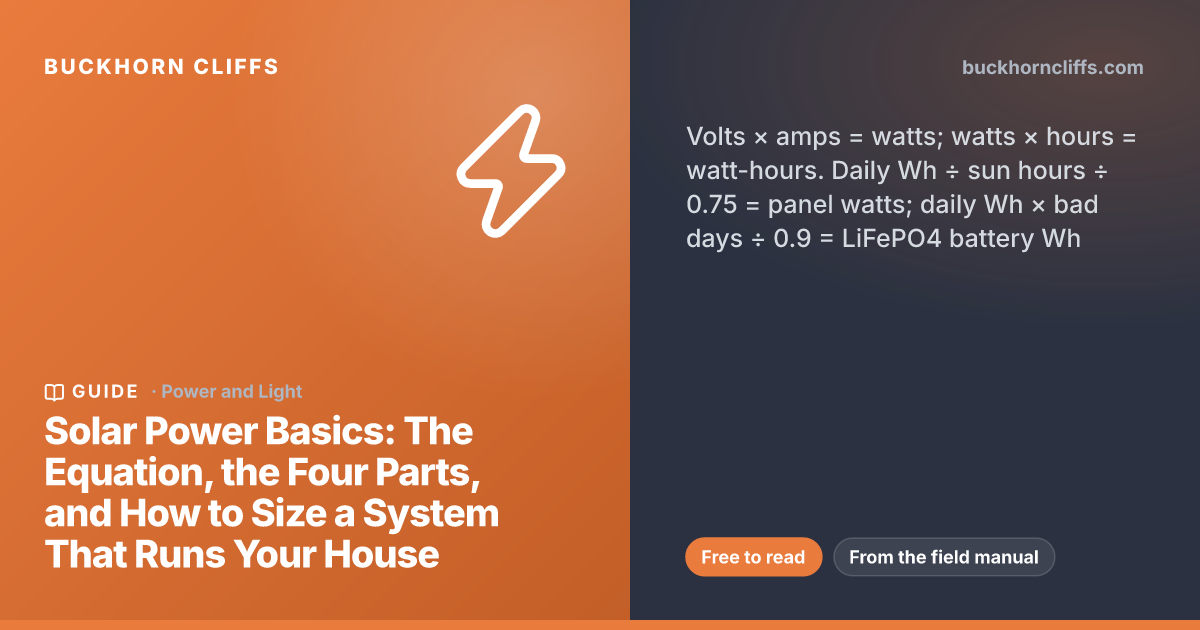
- The equationVolts × amps = watts. Watts × hours = watt-hours. Every label, quote and bill is one of the two
- The four partsPanels (DC) → charge controller → battery bank → inverter (AC) → loads, with fuses and a disconnect between each
- Buy
- MPPT controller
- lithium iron phosphate battery
- pure sine wave inverter
- monocrystalline panels
- SizingDaily Wh ÷ sun hours ÷ 0.75 = panel watts. Daily Wh × 1.5 days ÷ 0.9 = battery Wh. Biggest loads at once + 20 percent = inverter
- Sun hours3 in a northern winter, 4 to 5 most places most of the year, 6 in a desert summer; size for your worst month
- Blackout ruleGrid-tied solar with no battery shuts off when the grid does. A battery, a hybrid inverter and a transfer switch keep the lights on
Solar is one equation and four parts. People get lost in the brand names and the marketing watts and miss that a 200 watt suitcase panel on a camp battery and a 10 kilowatt array on a barn roof are the same system at different sizes. Learn the equation and the four parts once and every product label, every quote and every forum argument makes sense. This is that primer, with the numbers to size a system for your own house; the portable solar power field guide covers the power station and panel route, and the home backup system is the one I built into the house.
The equation
Two lines of arithmetic run the whole subject. Volts are pressure, amps are flow, and multiplied together they are watts, the power something draws right now. Watts held for time are energy, and energy is what a battery stores and a bill charges for.
| Worked | Meaning |
|---|---|
| 18 V × 11 A = 200 W | What one panel makes in full sun |
| 200 W × 5 h = 1,000 Wh | One kilowatt-hour banked in a day of good sun, before losses |
| 12 V × 100 Ah = 1,200 Wh | What a common battery holds |
| 60 W × 10 h = 600 Wh | One light, one night, half of that battery |
Amps also decide what the wire, the fuse and the controller have to carry, which is why a system that runs at 48 volts instead of 12 pushes a quarter of the current for the same power and uses far thinner wire. Every sizing decision on this page is one of those two lines.
Amp-hours on a battery label are only half a number. A 100 Ah battery at 12 volts holds 1,200 Wh; at 48 volts it holds 4,800. Compare batteries in watt-hours or kilowatt-hours, never in amp-hours alone.
The four parts, and how the power moves
Left to right: the sun goes in, the house comes out. Everything up to the inverter is direct current; everything after it is the alternating current in your outlets.
Panels (DC) → charge controller (DC) → battery bank (DC) → inverter (DC to AC) → loads (AC), with a fuse and a disconnect between every step. Everything up to the inverter is direct current; everything after it is the alternating current in the outlets.
A power station (EcoFlow, Jackery, Bluetti, Anker) is all four parts in one box with a display. It is the right first purchase for most households, and every number on its label is the arithmetic above.
Sun hours: the number that sizes everything
A peak sun hour is one hour of full noon sun. The weak light of morning and evening is folded into the day's total, which is why a 14-hour summer day counts as 5 or 6 sun hours and a 9-hour December day in Michigan counts as 2. The annual average is the number on every solar map; the winter number is the one a backup system is built on.
| Where | Annual average, hours a day | Worst month, roughly |
|---|---|---|
| Arizona, southern Nevada, New Mexico | 6 to 6.5 | 4 to 4.5 |
| California, Colorado, Utah, west Texas | 5.5 to 6 | 3 to 3.5 |
| Texas, Florida, Georgia, the Carolinas | 5 to 5.5 | 3.5 to 4 |
| Montana, the Plains, Kansas, Missouri | 4.5 to 5 | 2.5 to 3 |
| Ohio, Michigan, Minnesota, New York, New England | 4.5 | 2 to 2.5 |
| Oregon, Washington west of the Cascades | 4 | 1.5 to 2 |
| Alaska | 3 | Under 1 |
The numbers assume panels tilted at about your latitude, facing south, clean and unshaded. Flat on a roof costs 10 to 15 percent; a north face or a tree over one panel of a series string costs far more. In snow country, steep panels shed snow and a ground mount can be brushed off with a broom, which is worth more than any efficiency number in January.
What things actually draw
Labels list the maximum. What matters for sizing is the running draw and the hours a day it really runs. These are typical; a cheap plug-in meter on your own appliance for a day beats every table.
| Load | Running watts | Startup surge | A day, typical |
|---|---|---|---|
| Refrigerator, modern | 100 to 200 | 600 to 1,000 | 1 to 1.5 kWh |
| Chest freezer | 80 to 150 | 500 to 900 | 0.7 to 1 kWh |
| Well pump, 1/2 hp | 750 to 1,000 | 2,000 to 3,000 | 0.5 to 1 kWh |
| Furnace blower (gas or propane furnace) | 400 to 800 | 1,200 to 2,000 | 2 to 4 kWh in winter |
| Sump pump | 600 to 900 | 1,500 to 2,500 | Depends on the water |
| LED bulbs, six | 60 | none | 0.3 kWh |
| Router, modem, Starlink | 20 to 75 | none | 0.5 to 1.5 kWh |
| Phones and a laptop | 40 | none | 0.2 kWh |
| CPAP | 10 to 60, most of it the heated humidifier | none | 0.1 to 0.5 kWh |
| Microwave | 1,000 to 1,500 | none | 0.2 kWh for 10 minutes |
| Window air conditioner | 500 to 1,200 | 1,500 to 3,000 | 4 to 8 kWh |
| Electric space heater | 1,500 | none | 6 to 12 kWh: do not |
| Electric water heater, range, dryer, central AC | 3,000 to 5,000+ | high | Not on a backup system |
Anything that makes heat from electricity (space heater, water heater, range, dryer) needs more solar than a house can carry. Heat comes from propane or wood; the solar runs the fridge, the pumps, the blower, the lights and the radios. The propane page and the warmth guide are the other half of this one.
Size it from your own list
Four numbers come out of one list of loads, and they fall out in order. The worked example below is a house running a fridge, lights, internet and the furnace blower through a gray week in spring; the calculator under it does the same arithmetic for your own list.
| Step | Arithmetic | Example |
|---|---|---|
| Daily energy | Each load's watts × hours a day, added up | 4,140 Wh |
| Battery bank | Daily Wh × bad-weather days ÷ usable share (0.9 LiFePO4, 0.5 lead-acid) | 4,140 × 1.5 ÷ 0.9 = 6,900 Wh (7 kWh) |
| Panel array | Daily Wh ÷ sun hours ÷ 0.75 | 4,140 ÷ 4 ÷ 0.75 = 1,380 W (four 400 W) |
| Inverter | Everything on at once + 20%; surge = biggest motor × 3 (blower, pump) or × 6 (compressor) | 770 W → 2,000 W, 4,000 W surge |
| Charge controller | Panel W ÷ battery V × 1.25 | 1,380 ÷ 48 × 1.25 = 36 A MPPT |
Daily energy is the sum of watts times hours. The battery holds that energy for the nights and the gray days, divided by the share of the battery you can use. The panels have to put that energy back in the sun hours you get, with a quarter lost to wiring, heat and conversion. The inverter has to carry everything that runs at once, plus the surge of the biggest motor.
Add the things that have to run in an outage with their watts and the hours a day they actually draw. The numbers on the right update as you type. Watts are on the label or a plug-in meter; a refrigerator's compressor runs about a third of the day, so 150 W for 8 hours.
| Load | Watts | Hrs/day | Remove |
|---|
Panels assume 75 percent of nameplate reaches the battery (wiring, heat, conversion). Round every result up to the next size sold. A generator covers the stretch of gray days the battery does not.
The calculator does not care whether the battery is on a wall or in a box with a handle. The battery figure is the station size in watt-hours; the panel figure is the folding panel to buy; the continuous and surge inverter figures are the output rating on the station's label; skip the charge controller, it is built in. A 1 kWh station with a 400 W panel is the answer for most lists under 1,000 Wh a day. The portable solar power field guide takes it from there, with four station sizes and the hours each one gives. For the house, the home backup power system is this arithmetic built: 15 kWh, 12 kW, a 4.95 kW array.
Load and watts × hours a day: ______________________ · ______________________ · ______________________ · ______________________ · ______________________ · ______________________. Daily total: __________ Wh. Battery: total × ______ days ÷ ______ usable = __________ Wh. Panels: total ÷ ______ sun hours ÷ 0.75 = __________ W. Inverter: __________ W running + 20% = __________ W, surge __________ W. Controller: panel W ÷ ______ V × 1.25 = __________ A.
Round every result up to the next size sold, and size for your worst month, not your average. A generator on the transfer switch covers the stretch of gray days the battery does not.
12, 24 or 48 volts, and the wire
The battery voltage decides the current, and the current decides the wire, the fuses and how much heat the system throws away. The same 2,000 watts:
| Battery voltage | Current at 2,000 W | Wire from battery to inverter | Best for |
|---|---|---|---|
| 12 V | 167 A | 2/0 to 4/0 AWG, welding-cable thick | Under about 1,500 W: camp, RV, a fridge and lights |
| 24 V | 83 A | 2 to 4 AWG | 1,500 to 3,000 W: a cabin, a critical loads panel |
| 48 V | 42 A | 6 to 8 AWG | Above 3,000 W: a house, a well pump, a shop |
- Keep voltage drop under 3 percent: short, fat runs between battery and inverter; the panels can be far away if they are wired in series at high voltage.
- A fuse or breaker on every positive wire, sized at 125 percent of the continuous current, and a Class T fuse at the battery, because a lithium bank can deliver thousands of amps into a short.
- A disconnect between the panels and the controller, and between the battery and the inverter, so you can work on either side.
- One ground for the whole system, to a rod, with every metal frame and case bonded to it.
- The power and batteries spare parts list is the fuses, connectors, lugs and cable that keep it running.
Three sizes of system
- Panels
- 200 to 400 W
- Battery
- 100 Ah LiFePO4, 1.2 kWh
- Controller
- 20 to 30 A MPPT
- Inverter
- 1,000 W pure sine
A fridge, lights, phones and a radio through a short outage. Or the same money buys a 1 kWh power station and a folding panel with no wiring at all.
- Panels
- 600 to 1,200 W
- Battery
- 5 to 7 kWh
- Controller
- 60 A MPPT
- Inverter
- 2,000 to 3,000 W
A cabin, an outbuilding, or a critical loads panel in a house: fridge, freezer, blower, lights, internet, a small pump.
- Panels
- 3,000 to 5,000 W
- Battery
- 10 to 15 kWh
- Inverter
- 6,000 W hybrid
- Also
- Racking, wire, transfer switch
The well, the furnace, the kitchen and the shop; a generator on the transfer switch covers the gray weeks. The home backup system page is one of these, built and wired whole-home.
| Tier | Panels | Battery | Inverter | Runs |
|---|---|---|---|---|
| Starter, 12 V | 200 to 400 W | 100 Ah LiFePO4 (1.2 kWh), 20 to 30 A MPPT | 1,000 W pure sine | A fridge, lights, phones and a radio through a short outage; or a 1 kWh power station and a folding panel |
| Mid-range, 24 V | 600 to 1,200 W | 5 to 7 kWh, 60 A MPPT | 2,000 to 3,000 W | A cabin, an outbuilding, or a critical loads panel: fridge, freezer, blower, lights, internet, a small pump; most families for a week |
| Whole house, 48 V | 3,000 to 5,000 W | 10 to 15 kWh | 6,000 W hybrid | The well, furnace, kitchen and shop, with a generator on the transfer switch for gray weeks; electrician and permit for the tie-in |
Panels are the cheap part now; the battery is the big line of any system, and it is also the part that wears out. Buy the battery you need and the panels you can afford; adding panels later is easy, replacing a bank is not.
Connecting to a house
An inverter's output ties into the house through a transfer switch or an interlocked breaker that disconnects the house from the grid first, never through a cord into a wall outlet. A house still connected to the grid pushes power out the service drop, and that is how line workers get killed during outages. Grid-tied systems need a permit and an interconnection agreement with the utility, and the inspector will look for exactly this.
What goes wrong
The outage gear list is what to buy first if none of this exists yet, and the EMP page is why a spare charge controller sits in a Faraday bag next to the system.
Questions this answers
Tap a question for the short answer.
How does solar power work?
Sunlight knocks electrons loose in the silicon of a panel and they flow as direct current. A charge controller takes that DC and feeds it into a battery at the right voltage. An inverter takes DC from the battery and makes the 120 volt alternating current the house runs on. That is the whole system: panel, controller, battery, inverter, with wire, fuses and a disconnect between them. A power station is all four in one box; a home system is the same four parts, bigger, on the wall.
What does a solar charge controller do?
It sits between the panels and the battery and manages the charge: it drops the panel voltage to what the battery wants, tapers the current as the battery fills, stops at full so the battery is not overcharged, and blocks current from flowing backward into the panels at night. Without one, a panel cooks a battery on a sunny day and drains it after dark. It is the cheapest part of the system and the one people skip.
What is the best battery for a solar system?
Lithium iron phosphate (LiFePO4) for almost everyone. It gives 3,000 to 6,000 charge cycles against 300 to 1,000 for lead-acid, you can use 80 to 90 percent of its capacity instead of 50, it needs no watering or equalizing, it weighs a third as much, and it is the most heat-stable lithium chemistry. It costs more up front and far less per cycle. Lead-acid still makes sense for a system that sits unused most of the year, or below freezing where lithium cannot charge without a heater.
What is the difference between pwm and mppt charge controllers?
A PWM controller connects the panel to the battery and pulses the connection, which drags the panel down to battery voltage and wastes the difference; on a cold bright day that is a quarter of the power. An MPPT controller finds the panel's best voltage and current point and converts it to the battery's voltage, harvesting 10 to 30 percent more, and it lets you run panels in series at higher voltage over thinner wire. PWM is fine for a 100 watt panel on a trickle charge; anything over 200 watts gets MPPT.
What does an inverter do in a solar setup?
It turns the battery's DC into the 120 volt AC that ordinary appliances use. Buy pure sine wave, not modified sine, because motors, chargers, medical devices and anything with electronics run hot or fail on the cheap kind. Size it for the largest things you will run at once plus 20 percent, and check the surge rating against the biggest motor: a refrigerator that draws 150 watts running pulls 600 to 1,000 for a second on startup, and a well pump three to five times its running watts. A hybrid inverter combines the inverter, the charger and the grid connection in one box and is what a house system uses.
What is net metering?
The billing arrangement for a grid-tied system: your meter runs backward when the panels make more than the house uses, and the utility credits you for it. It is what makes rooftop solar pay off, and it is why those systems shut down in a blackout: a grid-tied inverter is required to stop exporting the instant the grid drops, so it cannot energize a line a crew is working on. Net metering rules and rates are set by each utility and state, and most have been getting less generous.
How many solar panels do I need to run a refrigerator?
A modern refrigerator uses about 1 to 1.5 kWh a day. At 4 sun hours and 75 percent system efficiency, one 400 watt panel makes about 1.2 kWh, so one to two panels cover the fridge, with a 2 to 3 kWh battery to carry it through the night and a cloudy day. In a northern winter at 3 sun hours, two or three panels. The number is not the panel; it is your daily watt-hours divided by your sun hours, with a margin for weather, and the calculator on this page does that arithmetic for your own list.
Why does my grid-tied solar not work in a blackout?
By design. A grid-tied inverter with no battery synchronizes to the grid and must shut down the moment the grid goes away, so it cannot backfeed a line and electrocute a line worker. Your roof can be in full sun during an outage and the house is dark. To have power in a blackout you need a battery with a hybrid or off-grid inverter and a transfer switch that isolates the house from the grid, or a generator on the same transfer switch.
How many peak sun hours do I get?
A peak sun hour is one hour of full noon sun; the day's weaker morning and evening light is folded into the total. Annual averages run from about 6.5 a day in Arizona and 6 in California, through 5.7 in Colorado and 5 to 5.5 across Texas, Florida and the Southeast, to 4.5 in the Midwest and Northeast, 4 in Oregon and Washington, and 3 in Alaska. Winter is the number that matters for a backup system: half the annual figure in the north, two-thirds in the south. Size for your worst month, not your average.
Should I build a 12 volt, 24 volt or 48 volt system?
By power. Under about 1,500 watts, 12 volts is fine and every RV and camp part is made for it. Between 1,500 and 3,000 watts, 24 volts halves the current and the wire size. Above 3,000 watts, and for any whole-house system, 48 volts: a 2,000 watt inverter pulls 167 amps at 12 volts, 83 at 24 and 42 at 48, and 167 amps needs welding-cable-sized wire and enormous fuses. Higher voltage means thinner wire, smaller losses and cheaper copper.
Is a power station enough for an outage?
For most short outages, yes, and it is the right first purchase. A 1 kWh station runs a refrigerator overnight and charges everything else; a 2 kWh station covers a day; a 4 kWh station runs a fridge, a freezer and a furnace blower for a day or two and expands with extra batteries. Add a 400 W folding panel and it recharges through the day. What it does not do is run a well pump, central air, or a house through a week of gray weather; that is the 48 volt system and a generator. The portable solar power field guide picks the size and the panel.
Keep going
Related to this
Membership · $49.95 per year
There is a lot more behind the lock
Every recipe and resource from the Prepper's Chemical Survival Guide, all six field guides to read here and download, the full audit and logbook, all twelve reference charts, and no ads.
My Manual · included
Build your own field manual
The most useful thing a membership gives you. Save any page on this site, recipes, charts, and whole field guides included. Arrange them in the order you want, name it, and print one manual with a cover and contents, or keep it as a PDF that opens with no signal.
- It works when this site does not
- Only your pages
- Anyone in the house can use it
- One current copy, not a pile of printouts
- The house binder
- A copy for the bug-out bag or truck
- A copy for family
- An offline PDF


Stay Ready
New entries, updates, and useful instruction.
Stay one step ahead on your preparedness journey.