Quick facts
- Three doorsNothing to wire: the portable field guide. The whole house: the home backup system. Understand it first: solar power basics
- The pathBlackout guide → outage gear → solar basics → portable field guide → home backup → spare parts → EMP and the Faraday bag
- Buy firstA portable power station and a folding panel. No wiring, no permit, useful on day one and after the bigger system exists
- Four rulesVolts × amps = watts, watts × hours = watt-hours. Size for the worst month. Heat is never electric. Never backfeed through an outlet
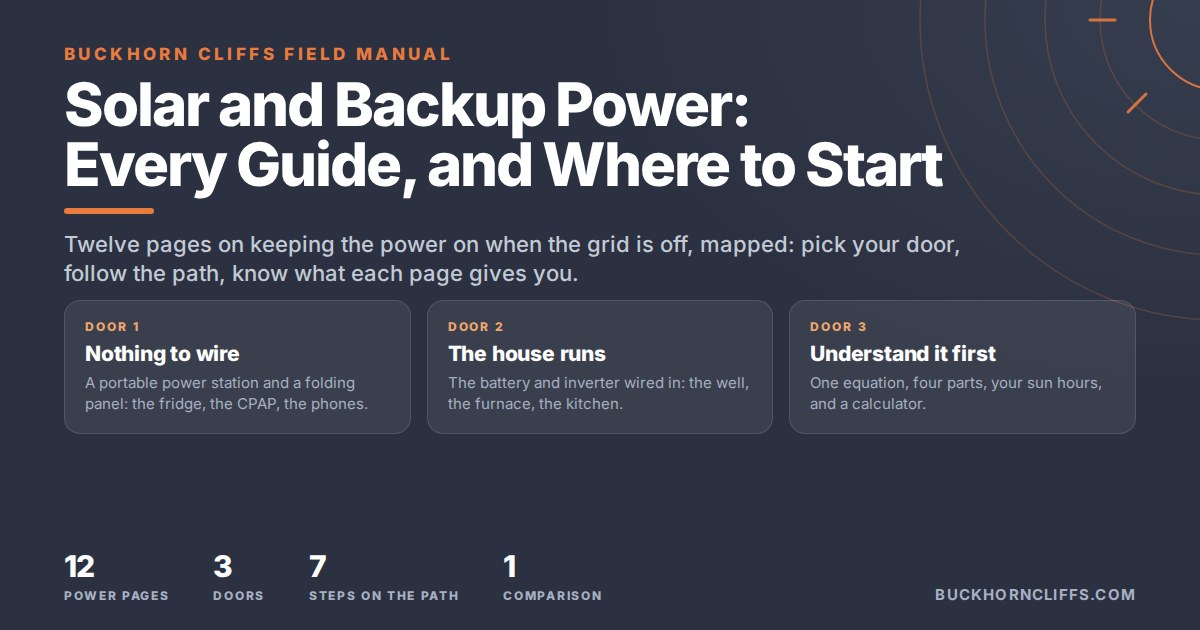
Twelve pages on this site are about keeping electricity on when the grid is off, and they were written over two years for different reasons. This page is the map. Pick the door that sounds like you, or follow the path in order; every page below says what it gives you and when to read it, so you know where to go next without reading all twelve.
Where are you?
Three situations cover nearly everyone. Each door opens the one page that answers it, and names the page to read after.
Then: Solar power basics, for the arithmetic behind the sizes
- Lights, fridge and phones with nothing to wire: the portable solar power field guide, then solar power basics.
- The whole house has to run: the home backup power system, then solar power basics.
- Understand it first: solar power basics, then the portable field guide.
The path, in order
If you would rather build the whole thing in sequence, this is the order the pages were meant to be read in. Nobody has to read all seven; stop at the step that matches how far you want to go.
- 1StartBlackout survival guideRead it whenyou have nothing yet and want to know what an outage actually asks of a house.You leave withthe first 45 minutes, the first three days and beyond, with power as one piece of the plan.
- 2Buy firstPower outage gearRead it whenyou want the cheap, certain purchases first: light, phones, news, warmth.You leave witha checklist in the order the hours arrive, before any solar.
- 3UnderstandSolar power basicsRead it whenyou are about to spend real money and want the sizes to come from your own loads.You leave withthe equation, the four parts, your sun hours, and a system sized on paper.
- 4First systemOff-grid portable solar power field guideRead it whenyou want a system this week with no wiring, no permit and no electrician.You leave withthe station and panel to buy, what they run, and the printable field guide.
- 5The houseHome backup power systemRead it whenthe portable box is not enough and the well, the furnace and the kitchen have to run.You leave withthe wired system, the bypass, the wire sizes and the settings.
- 6Keep it runningSpare parts: power and batteriesRead it whenthe system exists and has to keep working for years.You leave withthe fuses, connectors, cable and batteries that fail first, stocked deep.
- 7Protect itEMP, and the Faraday bagRead it whenyou want the solar gear to survive the one event that targets electronics.You leave withwhat a pulse really does, and which spares live in the bag.
- Blackout survival guide: what an outage asks of a house.
- Power outage gear: the cheap, certain purchases first.
- Solar power basics: the sizes from your own loads.
- Off-grid portable solar power field guide: the first system, no wiring.
- Home backup power system: the wired system for the house.
- Spare parts, power and batteries: keep it running.
- EMP and the Faraday bag: protect it.
Portable, wired, or a generator
The three ways to have power with the grid down, side by side. The first column is the one most people should start with, whatever they end up adding later.
Most houses end up with two of the three: a portable station for the small loads and the quiet nights, and either the wired battery or a generator for the big ones. The portable box is the one to buy first in every case, because it is useful on day one and still useful after the bigger system exists.
| Portable station and panel | Battery wired into the house | Generator | |
|---|---|---|---|
| Wiring, permit, electrician | None | All three | Transfer switch or interlock |
| Runs | Fridge, CPAP, phones, lights, router, a freezer on the bigger sizes | The well, the furnace blower, the kitchen, a shop | Anything, while the fuel lasts |
| Through a long outage | Days with sun; one night per charge without | Weeks, with the panels | As long as the fuel |
| Noise, fumes, fuel | None | None | All three |
| Cost | Hundreds to low thousands | Five figures built | Hundreds to low thousands, plus fuel |
Every power page, by job
The full set, grouped by what you are trying to do.
Understand it
GuideSolar power basicsThe equation, the four parts, sun hours, loads and the sizing calculator.GuideUnderstanding EMPWhat a pulse does to the grid, the truck and the small stuff, and what is worth doing.Size it and buy it
Field guidePortable solar power field guideFour stations, four panels, what each pair runs, and the printable guide.BuildHome backup power systemThe battery and inverter on the house, whole-home, with an interlocked bypass.ChecklistPower outage gearThe checklist for the first hour, night and week.Get through the outage
Master guideBlackout survival guideThe first 45 minutes, the first three days, and how the house runs after that.GuideWhen the power goes outHow long the fridge and freezer hold, and the order to eat them down.GuideBackup internet on any budgetFour ways to keep a Starlink Mini running, from a pocket battery to solar.GuideStarlink Mini and Star-BattInternet that travels: the dish and the battery that carries it.Protect it and keep it running
BuildFaraday bag for electronicsThe sling bag and the hard case, and what goes in each.Parts listSpare parts: power and batteriesFuses, connectors, lugs, cable and cells, stocked before they fail.Parts listSpare parts: lighting and off-grid utilityBulbs, wicks, mantles, batteries and the small parts light depends on.The numbers that run every page
Four rules come up on every page above. Learn them here once and the rest reads faster.
The basics page has the arithmetic behind each one, and the portable field guide works a whole January day through them hour by hour.
Questions this answers
Tap a question for the short answer.
Where do I start with solar for an outage?
With a portable power station and a folding panel, sized from the loads that have to run: the fridge, a CPAP, the phones, the router. Nothing to wire and no permit, and it is useful on day one. The portable solar power field guide on this site picks the size and the panel; solar power basics has the arithmetic if you want to size it yourself first.
Should I buy a power station or a home battery?
Both, in that order, if the house ever has to run. A power station covers the fridge, the small loads and the quiet nights for hundreds to low thousands with no wiring. A battery wired into the house with a transfer switch runs the well, the furnace blower and the kitchen for weeks with panels, and costs five figures built. Most houses end up with the portable box plus either the wired battery or a generator.
Is a generator better than solar?
They do different jobs. A generator runs anything while the fuel lasts, needs a transfer switch or interlock, makes noise and fumes, and depends on fuel you have to store and rotate. Solar with a battery is silent, runs indoors, and refills itself, but it cannot carry electric heat or a whole house without a large system. The common answer is a portable station for the small loads and the nights, and a generator on the transfer switch for the big loads and the gray weeks.
What order should I read the solar guides in?
Blackout survival guide, then power outage gear, then solar power basics, then the portable solar power field guide, then the home backup power system, then the spare parts list for power and batteries, then the EMP page and the Faraday bag. Stop at the step that matches how far you want to go; most people stop after the portable field guide.
What should I buy first for backup power?
Light, phone charging and a radio first, from the power outage gear checklist, because they are cheap and certain. Then a portable power station and a folding panel, sized to the fridge, a CPAP and the router. Then, if the house has to run, the wired battery system or a generator on a transfer switch.
Keep going
Related to this
Membership · $49.95 per year
There is a lot more behind the lock
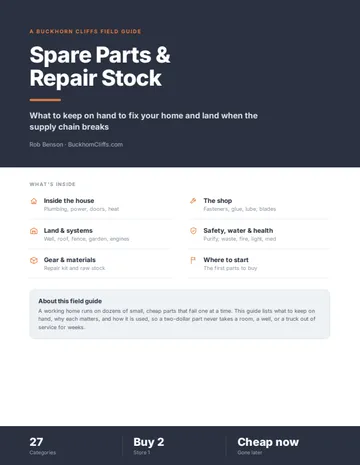
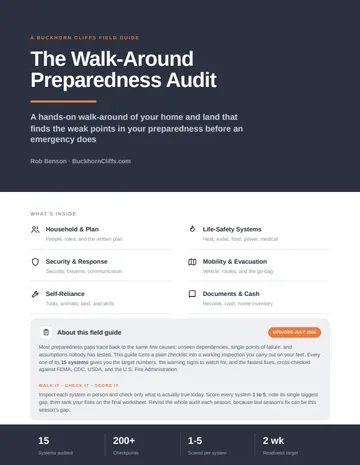
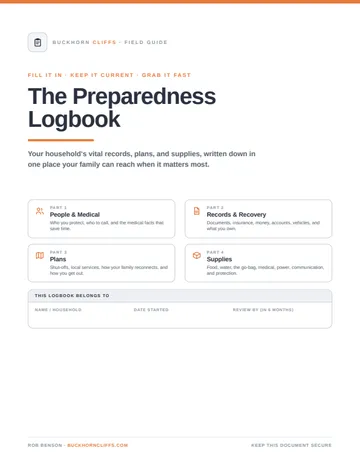
Every recipe and resource from the Prepper's Chemical Survival Guide, all six field guides to read here and download, the full audit and logbook, all twelve reference charts, and no ads.
My Manual · included
Build your own field manual
The most useful thing a membership gives you. Save any page on this site, recipes, charts, and whole field guides included. Arrange them in the order you want, name it, and print one manual with a cover and contents, or keep it as a PDF that opens with no signal.
- It works when this site does not
- Only your pages
- Anyone in the house can use it
- One current copy, not a pile of printouts
- The house binder
- A copy for the bug-out bag or truck
- A copy for family
- An offline PDF
Stay Ready
New entries, updates, and useful instruction.
Stay one step ahead on your preparedness journey.