Quick facts
- Shelf lifeIndefinite; the cylinder has a date (12 years from the collar stamp), the propane does not
- Energy91,500 BTU per gallon; a 20 lb cylinder holds 4.7 gallons, about 430,000 BTU; a 1 lb canister about 21,600
- FillTanks fill to 80 percent to leave room for expansion: a 500 gallon tank holds 400, a 1,000 holds 800
- StorageCylinders outdoors, upright, shaded, valve closed; never in the house, basement or attached garage
- Leak checkSoapy water on every connection after each hookup; bubbles mean shut it off. Rotten egg smell means leave
- IndoorsOnly heaters rated for indoor use, with a window cracked and a CO alarm; stoves and generators stay outside
If I could keep only one fuel for the next few years it would be propane. It does not go stale like gasoline, it does not need a chimney, it runs the stove, the water heater, the freezer, the heater and the generator, and a tank filled today is the same fuel in twenty years. Its one weakness is that it arrives on a truck. This is how much to keep, where it is allowed to sit, how to handle it so it never scares you, and what I run on it.
How long a tank lasts
Propane is sold by the pound in cylinders and by the gallon in tanks; a gallon weighs 4.2 lb and carries 91,500 BTU. Everything else is division.
| Container | Holds | BTU | Runs |
|---|---|---|---|
| 1 lb canister | 1 lb | 21,600 | A camp stove burner on high 1 to 2 hours; a Buddy heater on low 5 hours |
| 20 lb cylinder | 4.7 gal | 430,000 | Family cooking 2 to 3 weeks; Buddy heater on high 48 hours; 2,000 W generator at half load 8 to 12 hours |
| 100 lb cylinder | 23.6 gal | 2.2 million | A 30,000 BTU wall heater about 3 days continuous, 2 weeks at a third duty |
| 500 gal tank (400 usable) | 400 gal | 36.6 million | A house at 100,000 BTU a day: about a year |
| 1,000 gal tank (800 usable) | 800 gal | 73 million | A house at 100,000 BTU a day: about 2 years |
Weigh a cylinder to know what is left: the tare weight (empty) is stamped TW on the collar, usually 17 to 18 lb for a 20 lb cylinder, so a full one weighs about 37 lb and a half-full one 27.
Wood or propane
I burn both, and they are for different lengths of trouble.
The plan: a stationary propane tank or a rack of cylinders for the convenience and the bridge, a wood stove and two years of seasoned wood as the floor under it. The wood stove install is the other half of this page.
Where it lives
NFPA 58, the propane code most states adopt as law, does not allow grill-size (20 lb) and larger cylinders inside a house, a basement or an attached garage, in use or in storage. Propane vapor is heavier than air; a leak pools on the floor and waits for the water heater to light. The rule does not bend for winter.
- Outdoors, upright, on a level pad or in a rack, so the relief valve vents vapor, not liquid
- Shaded from direct summer sun; an open-sided lean-to or a slatted box, never a sealed shed
- Away from doors, windows, dryer vents and the air intake, and off the deck under the grill
- Valve closed and the plastic plug in the outlet when not connected
- Away from anything that burns or sparks, and out of reach of the mower
- Chained or racked so a cylinder cannot fall and shear the valve
- Small 1 lb canisters: same rack, or a metal cabinet outside
Stationary tanks are set by the propane company: 10 feet from the house and the property line for tanks up to 500 gallons, more for larger, on a pad, with the regulator and pigtail inspected at every fill. Never move or refill one yourself.
Leaks, and the fears worth having
Propane tanks and cylinders are built with relief valves, overfill protection and thick walls, and a cylinder that is stored upright, outdoors and out of the fire does not explode. The real hazards are smaller and closer.
How much to keep
Store as much as your space and the code safely allow, because it does not go bad and the price is not going down. Size it from the loads:
| Load | Burn | Two weeks |
|---|---|---|
| Camp stove, three meals for a family | About 1 lb a day | 15 lb, one cylinder |
| Buddy heater, 6 hours a night on low | About 1.3 lb a night | 20 lb, one cylinder |
| 2,000 W inverter generator, 6 hours a day | 3 to 4 lb a day | 50 lb, three cylinders |
| Propane freezer | About 1.5 lb a day | 20 lb, one cylinder |
| House heat, cold climate | 2 to 4 gal a day | 30 to 60 gal; a tank, not cylinders |
For a two-week outage with cooking, some heat and some generator, four to six 20 lb cylinders in the rack covers it. For heating a house through a winter without deliveries, a 500 or 1,000 gallon tank filled in late summer is the answer, and the warmth guide is how to make it last by heating one room instead of the house.
The propane gear I run
Cooking, heat, cold storage and power from one fuel. Everything here burns; generators run outside at least 20 feet from the house, and only the heaters rated for indoor use come inside, with a CO alarm.
Propane torch
Fire starting, soldering, thawingScrews onto a 1 lb canister. Lights the wood stove in the wet, sweats a copper joint, thaws a frozen hose bib.
1 lb propane canisters and the refill adapter
The small stoves, lanterns and heatersA case of canisters for the camp stove and the Buddy heater, and the adapter that refills them from a 20 lb cylinder for a fraction of the price. Refill outdoors, cylinder inverted, and weigh the canister so you do not overfill it.
Camping stove and the Blackstone griddle
Every meal in an outage, outdoorsThe two-burner camp stove is the outage kitchen; the griddle is the one that feeds a crowd. Both run on 1 lb canisters or a hose to a 20 lb cylinder. Neither comes inside.
Propane freezer
Cold storage with no gridAn absorption freezer burns about a pound and a half a day and keeps a season of meat frozen with no electricity at all. The most underrated propane appliance there is.
Forced-air and tank-top heaters
The shop and the outdoors; not the houseThe cordless forced-air heater warms a garage or a work site fast; the tank-top radiant heater screws onto a 20 lb cylinder and heats a porch or a tent doorway. Both are outdoor and well-ventilated-space heaters. For the living room, an indoor-rated Buddy heater.
Inverter and dual-fuel generators
Power from the same cylindersThe 2,000 watt inverter generator runs the fridge, the freezer, the router and the phone chargers on a cylinder a day. The large dual-fuel generator runs the well pump and the furnace blower, on propane or gasoline. Outside, 20 feet from the house, exhaust pointed away.
Questions this answers
Tap a question for the short answer.
How much propane should I store for emergencies?
Work from the appliances. A camp stove burns about a pound a day cooking three meals for a family; a Buddy heater on high burns about a pound every three hours; a 2,000 watt inverter generator burns 3 to 5 pounds a day at moderate load. So a two-week outage with cooking, a few hours of heat and some generator time is roughly 60 to 80 pounds, which is four 20 lb cylinders. A 100 lb cylinder or a 250 to 500 gallon tank is the step up for heating a house through a winter. Keep as much as you can store legally and safely, because propane never goes bad.
Can I store propane tanks in my garage?
Grill-size and larger cylinders, no. The fire code most states adopt (NFPA 58) does not allow them inside a house, a basement or an attached garage, and propane vapor is heavier than air, so a leak pools on the floor near the water heater. They live outdoors, upright, on a level pad or in a rack, shaded, away from doors and windows, with the valve closed and the plug in. The small 1 lb canisters are the exception in small numbers; I still keep mine in the outdoor rack.
Does propane go bad?
No. Propane is a single, stable compound with nothing to separate, oxidize or grow, and a tank filled twenty years ago is the same fuel today. The cylinder is what has a date: DOT cylinders must be requalified 12 years after the manufacture date stamped on the collar, then every 5 years, and nobody will refill an out-of-date one. Big stationary tanks are inspected by the propane company. Rust, a bent valve guard or a dented cylinder also gets a refusal at the fill station.
How do I check a propane tank for leaks?
Soapy water in a spray bottle. Open the valve with the appliance off and spray every connection, the valve stem and the regulator; growing bubbles mean a leak, so close the valve, tighten or replace the fitting, and test again. Do it after every hookup and every cylinder swap. A rotten egg smell is the odorant they add to propane: if it is strong, do not touch a switch or make a spark, get everyone out, close the valve if you can reach it from outside, and let it air out before you go back in.
Is propane or wood better for emergency heat?
Propane for the first months, wood for the long haul, and I keep both. Propane is instant, clean, needs no work and stores indefinitely; the same volume of storage holds more than twice the heat of a cordwood stack, and a 1,000 gallon tank filled to 800 gallons runs a 100,000 BTU a day house for about two years. But when it is gone it is gone unless a truck comes. Wood grows on the property, and a saw, a maul and a stove make heat out of it forever, at the cost of real labor. The plan is propane for convenience and the bridge, wood as the fuel that cannot be cut off.
What size propane tank do I need?
20 lb cylinders for the grill, camp stove, small heater and portable generator; they are cheap, swappable anywhere and one person carries them full. 30 and 40 lb for an RV or a heavier heater. 100 lb cylinders for a cabin stove or wall heater. 120 to 500 gallon tanks for water heating, a range and a furnace, and 1,000 gallons for whole-house heat in a cold climate with a long delivery gap. Stationary tanks over 125 gallons are set by the propane company, with setback rules from the house and property line.
How long does a 20 lb propane tank last?
It holds 4.7 gallons, about 430,000 BTU. On a camp stove cooking three meals a day for a family, two to three weeks. On a Mr. Heater Buddy on low (4,000 BTU) about 100 hours, on high (9,000 BTU) about 48 hours. On a big two-burner outdoor stove or a griddle on high, 8 to 10 hours of burner time. On a 2,000 watt inverter generator at half load, 8 to 12 hours. A tank's weight tells you what is left: the empty weight is stamped on the collar as TW, and a full 20 lb cylinder weighs about 37 lb.
Can I use a propane heater indoors?
Only one built and rated for indoor use, such as the Buddy series with an oxygen sensor and tip-over switch, with a window cracked an inch, a working battery CO alarm in the room, and never while you sleep. Forced-air torpedo heaters, tank-top radiant heaters, camp stoves and any generator stay outside no matter how cold it gets. Propane burns clean when it burns right and makes carbon monoxide when it does not, and you cannot smell CO.
Keep going
Related to this
Membership · $49.95 per year
There is a lot more behind the lock
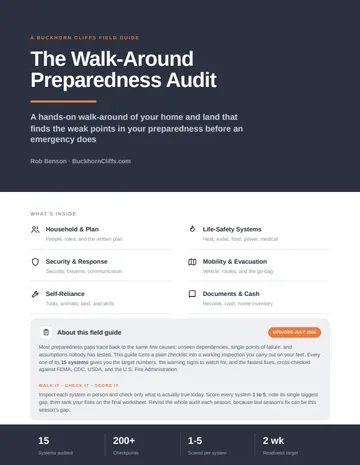
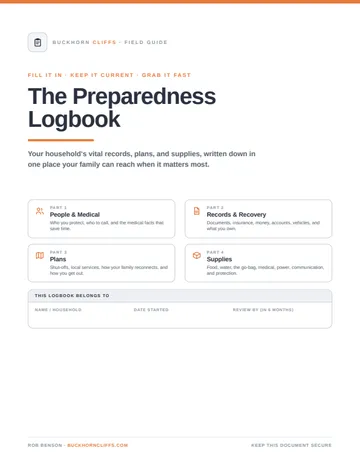
Every recipe and resource from the Prepper's Chemical Survival Guide, all six field guides to read here and download, the full audit and logbook, all twelve reference charts, and no ads.
My Manual · included
Build your own field manual
The most useful thing a membership gives you. Save any page on this site, recipes, charts, and whole field guides included. Arrange them in the order you want, name it, and print one manual with a cover and contents, or keep it as a PDF that opens with no signal.
- It works when this site does not
- Only your pages
- Anyone in the house can use it
- One current copy, not a pile of printouts
- The house binder
- A copy for the bug-out bag or truck
- A copy for family
- An offline PDF

Stay Ready
New entries, updates, and useful instruction.
Stay one step ahead on your preparedness journey.