Quick facts
- HeatOne small, well-insulated, south-facing room. Blankets over the doors and windows.
- CO alarmsBattery powered: one per level, one outside every sleeping area. Keep spare batteries.
- Heater clearanceSpace heaters: 3 feet from anything that can burn. Wood stove: the clearance in its manual.
- GeneratorOutdoors only. 20 feet or more from the house when you can, exhaust pointed away from all openings.
- Backup fuelWeeks, not a day or two. Propane gas keeps indefinitely. Cylinders: requalify within 12 years of manufacture.
- HypothermiaWet skin or clothes can bring it on above 40°F. Shivering means a lot of heat is already gone.
- Roof leakKeep a heavy tarp and cap nails ready. Put the tarp on when it is safe to get up there.
Cold kills faster than hunger, and babies, old people and animals feel it first. This page gives you the order of work when the heat is out, a side by side look at backup heat, and the build order for a home that stays livable in a deep freeze or in a heat wave.
The heat just went outFive numbers to rememberHeat sources side by sideCarbon monoxide: the rule behind every flameHold heat from the skin outWhat to build firstCommon situationsGo deeperRecipes that fitSpare parts, skills, and the auditWhat goes wrong
The heat just went out
In a winter storm the power, the roads and the heat tend to go together. The plan has four parts: shrink the living space, hold the heat you have, keep the water from freezing, and stay off the roads. Work in this order.
First 15 minutes
- Fill every container with water first, while the pressure lasts.A bathtub holds 40 to 80 gallons. Pressure may last hours or minutes, so act like it is minutes.Blackout guide: first 45 minutes, first 3 days, and beyond
- Find out how far the outage reaches: look at the breaker panel, look out the window, tune a battery radio or the car radio.Your house, your block, or your region changes how long you are settling in for.
- Close the doors to every room you will not use.Act while the house is still warm. Closing up early saves the residual heat.Staying warm with limited gear (mild or warm climates)
- Test the battery CO alarms before you light anything.You cannot see or smell CO. A working alarm is your only early warning.Audit: Heat & Temperature Control
First hours
- Pick one small, well-insulated room, south-facing if you can, and move everyone into it.The less air you have to keep warm, the further body heat and fuel go.Audit: Heat & Temperature Control
- Hang blankets over the doorways and windows, push towels into the gap under the door, and cover the floor where people sit and sleep with rugs, cardboard or spare bedding.Drafts steal more heat than you would guess, and a cold floor pulls heat out of your body.Staying warm with limited gear (mild or warm climates)
- Layer early, core first: chest, neck and head before arms and legs. Wool next to the skin.A warm core keeps warm blood moving to hands and feet.Wool for survival clothing and blankets
- Start backup heat only if it is made for indoors: a heater labeled for indoor use, 3 feet clear of anything that can burn, or a vented wood stove at the clearance in its manual. Run it with the ventilation its label calls for and a battery CO alarm beside it.You have just closed this room up. A grill, camp stove or generator stays outside with no exceptions, and an oven is not a heater.
- Drip the faucets while you still have water pressure, and make sure you can reach the main water shutoff.Pipes with no freeze plan are a red flag in the audit. The shutoff is what limits the damage if a pipe splits.
- Eat from the fridge first, and keep the fridge and freezer doors shut between meals. Throw out meat, dairy, eggs or leftovers once they have sat above 40°F for 2 hours.An unopened fridge stays at a safe temperature only about 4 hours. The freezer comes second: roughly 48 hours if it is full, closer to 24 if it is half full. Judge by a fridge thermometer, not by smell.Blackout guide: first 45 minutes, first 3 days, and beyond
First night
- Sleep everyone in the one room. Pitch a tent or build a sheet fort or canopy inside it and lay the bedding on the insulated floor. Wherever a heater or stove is running, the tent, bedding and hung blankets stay 3 feet or more from it.This is a no-heater method. A microclimate that small holds heat on body warmth alone.Staying warm with limited gear (mild or warm climates)
- Do not sleep with a portable fuel heater running. Warm the room, shut it off, then sleep under the layers.A flame nobody is awake to watch can fill the room with CO or start a fire. The tent and the layers carry you through the night.Audit: Heat & Temperature Control
- Fill bottles or mason jars with warm water, wrap them in towels, and put them at your core, thighs or feet.Water holds heat well and gives steady warmth for hours.
- Eat fats and carbohydrates before bed, drink something hot, and keep drinking water. Change out of damp clothing and do not pile on layers until you sweat.Calories equal heat and dehydration speeds heat loss. Sweat cools the body long after you stop moving.
- Check the very young, the old, and your animals through the night. Confusion, slurred speech, fumbling hands or drowsiness means hypothermia: a medical emergency.Loss of heat hits them first.
- If the CO alarm sounds, or anyone near a running heater gets a headache, dizziness or nausea: get everyone outside, then call 911 from outside.Those are the carbon monoxide warning signs. Several people or pets sick at once, and better outdoors, is the giveaway. Do not wait for it.
Day two and beyond
- Count your fuel and ration it to the one room.The goal is to make the fuel last. Backup fuel should be measured in weeks, not a day or two.Audit: Heat & Temperature Control
- Run the generator outdoors only, 20 feet or more from the house when you can, with its exhaust pointed away from all doors, windows and vents.Exhaust pools in still air and finds its way back in through any opening.Blackout guide: first 45 minutes, first 3 days, and beyond
- Stay off the roads. Leave when you are forced out: fire, flood, structural damage, no viable water, medical needs you cannot meet at home, or an ordered evacuation. Then go with a plan: where to, by which route, bag already packed.When your home is prepared, the road is nearly always the more dangerous place.Why bugging out early is a mistake
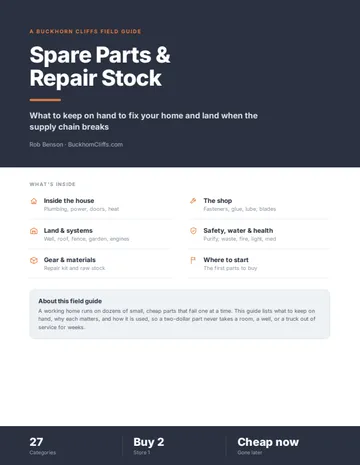
- Deal with storm damage: plastic sheeting and tape over broken glass. For a roof leak: stay off the roof while the storm is on. Indoors, catch the water and move what it can ruin. Put the tarp on when it is safe to get up there.A heavy tarp and cap nails hold the leak back until the real repair. Left alone, a small leak rots the roof deck and ruins the ceiling below it.Spare Parts and Repair Stock field guide: Roofing & Exterior
- Check the animals: wind-protected shelter and water that is not frozen.The audit asks if they can survive several nights of extreme cold without you.
- Move on to the freezer as it thaws, then shelf-stable food, and make the meals warm.Warm food helps hold body temperature. The 40°F discard rule from the first hours still applies to everything that thaws.
Five numbers to remember
Heat sources side by side
Ask the audit questions of each one: does it need electricity, is it safe indoors, can it heat one enclosed room, and how much fuel is on hand right now.
Wood stove
- Needs electricity
- No. Heats and cooks off-grid
- Safe indoors
- Yes, vented through a proper chimney
- Fuel and how it stores
- Seasoned firewood. A cord of hardwood holds about 20 million BTUs
- What it heats
- Sized by square footage. Mine is sold as a 2,500 sq ft stove
- Watch out for
- Creosote, chimney fires, a leaky door gasket. Clearance: stove manual, larger number wins
Indoor-rated heater
- Needs electricity
- Choose a non-electric model
- Safe indoors
- Only if labeled for indoor use, with the ventilation its label calls for and a CO alarm
- Fuel and how it stores
- The fuel on its label. Stock weeks of it, safe from moisture and theft
- What it heats
- One enclosed room, by radiant heat
- Watch out for
- 3 feet from anything that can burn. CO alarm beside it. Shut it off before you sleep
Gas or propane furnace
- Needs electricity
- Yes: fan, control board, thermostat
- Safe indoors
- Yes. Service it yearly
- Fuel and how it stores
- Natural gas or delivered propane
- What it heats
- The whole house, while power and supply hold
- Watch out for
- Fails with the grid or a missed delivery. The flame sensor is the usual first failure
Body heat in a closed-off room or indoor tent
- Needs electricity
- No
- Safe indoors
- Yes
- Fuel and how it stores
- Calories: fats and carbohydrates before rest, hot drinks, water
- What it heats
- A tent, a sheet fort, or one small room
- Watch out for
- Damp clothes. Vent humid air briefly before closing up. No heater within 3 feet
Warm water bottles
- Needs electricity
- No, but you need a way to warm water
- Safe indoors
- Yes
- Fuel and how it stores
- Bottles, mason jars or tightly sealed containers
- What it heats
- A bed, a couch or your feet, for hours when wrapped in towels
- Watch out for
- Wrap them in towels or cloth to slow the heat loss
Hand and body warmers
- Needs electricity
- No
- Safe indoors
- Made to carry in a pocket
- Fuel and how it stores
- Packaged. A rotate item on my checklist
- What it heats
- A pocket, for hours
- Watch out for
- Warms a person, not a room
Grill, camp stove, oven, generator
- Needs electricity
- Beside the point: none of these is heat
- Safe indoors
- Never indoors, never as heat. Grill, camp stove and generator run outside only
- Fuel and how it stores
- Does not matter: none of it burns indoors
- What it heats
- Nothing indoors
- Watch out for
- Carbon monoxide. An oven is not a heater. Generator 20 feet or more from the house
Wood against propane, both burned at 100,000 BTUs a day: one cord of seasoned hardwood lasts four to five months through a 70 percent efficient stove. A 1,000 gallon propane tank, filled to 80 percent, lasts about 659 days through a 90 percent efficient furnace.
Carbon monoxide: The rule behind every flame
Any heat source needs a CO detector. CO is colorless and odorless, so you will not notice it on your own.
Hold heat from the skin out
Staying warm is about managing heat loss, not making extreme heat. Build these layers from your body outward before you burn any fuel.
Skin
Stay dry
- Wool base layers and socks, with a dry spare set held back. Wool can soak up as much as 30% of its own weight in moisture and still not feel damp.
- Vent clothing while you work, seal it before you rest, and change damp clothes promptly.
Wool for survival clothing and blankets Staying warm with limited gear (mild or warm climates)
Core and head
Protect the torso first
- Insulate chest, neck and head before arms and legs. Scarves and blankets around the torso come first.
- Hats, gloves and a balaclava. Cover head and neck indoors, most of all during sleep.
Staying warm with limited gear (mild or warm climates) Warmth and Shelter checklist
Bed and seat
Insulate underneath, then on top
- Rugs, blankets, cardboard or spare bedding under you before blankets over you.
- Wool blankets and sleeping bags: warmth that works when wet. A new wool blanket softens with a gentle cold wash and low-heat drying in 10 minute cycles.
- Warm water bottles wrapped in towels. Foil works as a reflector, shiny side toward you, never as a sealed wrap.
Staying warm with limited gear (mild or warm climates) Break in a new wool blanket
Microclimate
Shrink the air you have to warm
- A tent, sheet fort or canopy set up indoors holds heat on body warmth alone. It is a no-heater method. Wherever a heater or stove is running, the tent, bedding and hung blankets stay 3 feet or more from it.
- Mylar emergency blankets reflect body heat. Pack many.
Staying warm with limited gear (mild or warm climates) Warmth and Shelter checklist
The room
One closed-off space for everyone
- One small, well-insulated, south-facing room. Blankets over the doorways and windows, towels under the door.
- Plastic sheeting and tape help close off the room and block drafts. Foil behind window coverings cuts radiant loss through glass.
- If the air is humid, ventilate briefly before you close up.
- If a fuel heater runs in the room, do not tape it airtight: leave the ventilation its label calls for. Put a battery CO alarm beside it, and keep the tent, bedding and hung blankets 3 feet or more from it.
Audit: Heat & Temperature Control Warmth and Shelter checklist Staying warm with limited gear (mild or warm climates)
The house
Keep the structure and the plumbing intact
- Weatherstripping and window film cut drafts before winter.
- Know the main water shutoff, heat-tape exposed pipes, and drip the faucets while you still have water pressure.
- A heavy tarp and cap nails kept ready for the roof, to go on when it is safe to get up there.
Audit: Heat & Temperature Control Spare Parts and Repair Stock field guide: Roofing & Exterior
What to build first
The usual plan is whole-house heat, with no thought for night two. Build for one room and for weeks.
- CO alarms before any heaterBattery powered, one per level and one outside every sleeping area, with spare batteries. Any heat source needs one. Audit: Heat & Temperature Control
- Choose the room and the means to close it offOne small, well-insulated room, south-facing if you have it. Store the blankets, plastic sheeting and tape that close it off and block drafts. Warmth and Shelter checklist
- Layers and bedding for every personWool bedding and base layers with a dry spare set, head and hand cover, and plenty of mylar blankets. The full list is on the checklist. Warmth and Shelter checklist
- A non-electric heater rated for indoor use, plus its fuelRadiant heat sized to one room. It has to run with no grid power, no furnace fan and no delivery truck. Buy what it needs to run in a closed-off room: the ventilation its label calls for, a fireproof surface, and a battery CO alarm to sit beside it. Audit: Heat & Temperature Control
- Fuel in weeks, stored rightPropane gas keeps indefinitely, but a portable cylinder needs requalifying within 12 years of the date stamped on its collar before it can be refilled. I store portable cylinders outdoors, upright, shaded and ventilated. Keep several weeks to a few months of use, protected from moisture and theft. Storing and using propane for self-sufficiency
- Wood heat for the long haulWith tools and timber, wood is the fuel that outlasts deliveries. My through-the-roof stove install took less than 10 hours and cost $2,682 in total. Set the stove at the clearance in its manual: where that and the pipe listing differ, the larger number wins. Stock seasoned firewood, a door gasket and a chimney brush. Wood stove installation through a ceiling and roof (DIY)
- Tighten the house and protect the pipesWeatherstripping, window film, draft-blocking window coverings. Find the main water shutoff, heat-tape exposed pipes, and give the animals wind-protected shelter and freeze-resistant water. Audit: Heat & Temperature Control
- Storm patch kitHeavy tarps in several sizes, cap nails, spare shingles or roll roofing, and roof cement. Furnace and stove spares are in the parts list further down this page. Spare Parts and Repair Stock field guide: Roofing & Exterior
Common situations
Go deeper
Staying warm with limited gear
The heat-loss playbook, written in pairs: what to do outdoors and what to do at home. It works with almost nothing on hand.
- Block wind and drafts before you add layers
- Insulate underneath you first
- Foil is a reflector, not a sealed wrap
- Act before you feel cold
Blackout guide
The order of work for a long grid-down stay at home: the first 45 minutes, the first 3 days, and beyond. Heat is one part of it.
- Fill water first: 40 to 80 gallons in a bathtub
- Close off unused rooms in winter
- Fridge food first: an unopened fridge holds about 4 hours
- Generator outside, 20 feet from the house
Wood stove install through a ceiling and roof
My own install, part by part: the stove, each section of 6 inch pipe indoors and on the roof, the support box in the ceiling, the tools, and what it cost.
- Less than 10 hours, $2,682 in total
- Double-wall pipe: 6 inches from a combustible wall, 8 inches from a ceiling
- The stove manual's clearance applies too, and the larger number wins
- Roof bracket when the chimney stands more than 4 feet above the roofline
Storing and using propane
Propane against wood for heat, where and how to keep tanks, leak checks, tank sizes, and how much to hold.
- The gas keeps indefinitely. Portable cylinders need requalifying within 12 years
- Cylinders upright, secured, outdoors, shaded and ventilated
- Soap and water on connections to find leaks
- Several weeks to a few months of use on hand
Wool for clothing and blankets
Why wool is my survival fiber: it insulates, handles moisture, resists odor and flame, and lasts. The drawbacks are covered too.
- Fiber crimp traps body heat in tiny air pockets
- Self-extinguishes away from a flame
- Heavy when soaked and slow to dry
- Layer it with synthetics and down
Break in a new wool blanket
How to take the scratch out of a new blanket without shrinking it.
- Check the care label first
- Gentle cycle, cold water
- Low heat in 10 minute cycles, clearing lint each time
- Optional vinegar rinse for more softness
Winterize an RV water system
A 13-step sequence that drains the tanks and lines, bypasses the water heater, and fills the plumbing with RV antifreeze so nothing bursts.
- Non-toxic RV antifreeze only, never automotive
- Run every faucet until antifreeze shows
- Pour antifreeze into the drains to protect the P-traps
Wilderness survival basics
Fire, shelter and priorities when you are away from any building.
- Rule of threes: about 3 hours without shelter, and the times may vary
- A-frame shelter with thick walls and a slanted roof
- Fire at least 15 feet from anything flammable, shelter at least 15 feet from hazards
Car survival kit
Two canvas bags that live in the vehicle, one large and one small, with the item list for each.
- Wool blanket, mylar blanket, wool socks and hat
- Small tarp, paracord, folding shovel, ice scraper
Why bugging out early is a mistake
Seven phases of a disaster and where leaving fits.
- Prepare to leave, but plan to stay
- Go early when an evacuation is ordered
- Set up shelter as soon as you arrive
Recipes that fit
One member recipe belongs on this page.
Comfort rub for sore joints and muscles
- Castor oil and cayenne pepper salveTwo-ingredient warming rub for sore joints and muscles
Spare parts, skills, and the audit
When heat quits, the cause is usually a small cheap part and not the whole unit. Keep the spares that match how you heat, and practice the three skills on a normal day.
- Skill: shrink and seal a room
- Skill: layer for cold
- Skill: run a heater safely
- Gas furnace spares to keep: a flame sensor (a dirty one is the usual reason for no heat), a hot surface igniter or thermocouple matched to your unit, 3A blade fuses for the control board
- Any furnace: a year or two of air filters in your size, a spare thermostat and batteries, a run capacitor matched to the microfarad rating
- Wood stove: door gasket rope and cement, stovepipe, chimney brush and creosote control, damper and spark arrestor
- Propane: regulators and pigtails, hoses and fittings, O-rings, yellow gas-rated tape or approved paste, soapy water for leak checks
- Safety: smoke and CO detectors with spare batteries, ABC extinguishers, a fire blanket, a burn first-aid kit
- Storm repair: heavy tarps in several sizes, roofing and cap nails, spare shingles or roll roofing, roof cement, flashing, house wrap and felt paper
- Batteries in every size for detectors, thermostats and lights
Score your heat plan in the auditWarmth and Shelter checklistSpare parts: heating, cooling and HVACSpare parts: fire, smoke and safetySpare parts: propane and fuel systemsSpare parts: electricalRoofing and exterior repair stockWalk-around preparedness audit
What goes wrong
Putting up the tarp: a bowline at the first tree, two half hitches at the far end to pull it tight, and a sheet bend for a corner with no grommet. All four knots are on the knots page.
Questions this answers
Tap a question for the short answer.
What do I do first when the heat goes out
Fill every container with water while the pressure lasts: a bathtub holds 40 to 80 gallons. Then find out how big the outage is: look at the breaker panel, look out the window, and tune a battery radio or the car radio. Then shut the doors to rooms you will not use, and test your battery CO alarms before you light any backup heat.
How do I keep one room warm without a furnace
Pick one small, well-insulated room, south-facing if possible, and move everyone into it. Hang blankets over the doorways and windows, block the gap under the door with towels, and lay rugs, cardboard or spare bedding on the floor. Body heat does real work in a small closed-off space. Any heater you add must be labeled for indoor use, with the ventilation its label calls for and a CO alarm.
Which heaters are safe to use indoors during a power outage
Only a heater whose label says indoor use. Run it with the ventilation its label calls for, put a battery CO alarm next to it, and keep it 3 feet from anything that can burn. A wood stove on a proper chimney also counts, set at the clearance in its manual. A grill, camp stove or generator never runs indoors, and an oven is not a heater.
What are the signs of carbon monoxide poisoning
Headache, dizziness, nausea, confusion or sudden weakness. The giveaway is several people or pets sick at once, and better outdoors, but never wait for that. CO has no color or smell, so an alarm is the only early warning. If the CO alarm sounds, or anyone near a running heater gets a headache, dizziness or nausea: get everyone outside, then call 911 from outside. Stay out until responders clear it.
How far should a generator be from the house
Outdoors only, 20 feet or more from the house when you can, with its exhaust pointed away from every door, window and vent. The distance lets the exhaust thin out before it reaches an opening. If you do not have 20 feet, use as much space as you have, aim it downwind, and let a CO alarm cover the difference.
How do I keep pipes from freezing when the power is out
Know where the main water shutoff is before you need it, so you can close it fast if a pipe splits. Dripping the faucets only helps while you still have water pressure, and pressure may not outlast the outage. Heat tape runs on electricity, so it stops working when the grid is down. Pipes with no freeze plan are a red flag in my audit.
How long does propane last in storage
The gas itself keeps indefinitely. Propane is my pick for the first stretch of a long emergency because it is easy to use and tools built for it are easy to find. The cylinder is what carries a date: a portable one needs requalifying within 12 years of the date stamped on its collar before anyone can refill it. I store cylinders outdoors, upright, secured, shaded and ventilated.
How long does a cord of firewood last compared to propane
Burn 100,000 BTUs a day and one cord of seasoned hardwood, through a stove that is 70 percent efficient, lasts four to five months. A 1,000 gallon propane tank is filled to only 80 percent, about 800 gallons, and at that daily rate lasts about 659 days through a 90 percent efficient furnace. Wood is the long-haul fuel if propane deliveries stop.
How do I patch a roof leak or a broken window in a storm
Stay off the roof while the storm is on. Indoors, catch the water and move what it can ruin. Keep a heavy tarp and cap nails ready. Put the tarp on when it is safe to get up there. The real repair comes later: spare shingles or roll roofing, and roof cement. For a window, plastic sheeting and tape cover broken glass, or a heavy tarp closes it fast.
How do I stay warm at night with no heat
Sleep everyone in the one closed-off room, inside a tent or sheet fort if you can: it works on body warmth alone. Insulate under the bed or pad first, then add wool blankets on top. Put warm water bottles wrapped in towels at your core, thighs or feet. Eat fats and carbohydrates before rest, cover your head and neck, and change out of damp clothing.
What are the signs of hypothermia
Shivering means you have already lost a lot of heat. Hypothermia shows as slurred speech, confusion, fumbling hands, drowsiness or exhaustion, and it is a medical emergency. It does not take freezing weather: wet skin or clothing can bring it on at temperatures above 40°F. Babies, old people and animals go first, so check on them through the night.
How do I stay cool in a heat wave with no power
Work on cooling the person, not the house. Move to the lowest, shadiest room, shut the sun out by day and open the house at night. Wet your skin and find any breeze, which beats sitting in still air. Drink ahead of thirst. Infants, the elderly and pets overheat first, so watch them. Heat stroke shows as hot skin, confusion or collapse: call 911 and cool the body fast.
Keep going
Related to this
Membership · $49.95 per year
There is a lot more behind the lock
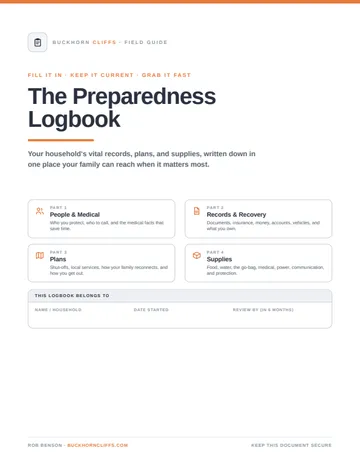
Every recipe and resource from the Prepper's Chemical Survival Guide, all six field guides to read here and download, the full audit and logbook, all twelve reference charts, and no ads.
My Manual · included
Build your own field manual
The most useful thing a membership gives you. Save any page on this site, recipes, charts, and whole field guides included. Arrange them in the order you want, name it, and print one manual with a cover and contents, or keep it as a PDF that opens with no signal.
- It works when this site does not
- Only your pages
- Anyone in the house can use it
- One current copy, not a pile of printouts
- The house binder
- A copy for the bug-out bag or truck
- A copy for family
- An offline PDF


Stay Ready
New entries, updates, and useful instruction.
Stay one step ahead on your preparedness journey.