Quick facts
- Closed fridgeKeeps food safe about 4 hours with the door shut
- FreezerAbout 48 hours when full and about 24 hours when half full, with the door shut
- Discard lineMeat, fish, eggs, milk, soft cheese, yogurt, leftovers: out after 2 hours above 40°F
- Eating order
- Fridge first
- freezer next
- shelf-stable last
- PropaneIndefinite shelf life; a 1 lb canister cooks roughly 1 to 2 hours
- CombustionOutdoors, 20 feet or more from the house; a battery CO detector in each heated room
- FireKeep three independent ways. Checklist: stormproof matches and lighters, ferro rod and tinder, wax starters
When the power or the gas is off, you still have to eat. This page gives you the order to eat cold food in, the ways to cook without the grid and where each one is safe, the fuels worth storing, and three independent ways to make fire. Each section links to the deeper page.
The power is out and you need a hot mealWays to cook without power, side by sideFuels: shelf life, storage, and how much to keepCommon situationsMaking fire: from the easy way down to the hard wayFire safety: detect it, smother it, put it outWhat to build firstThe deeper pagesRecipes and builds, by jobSpare parts, skills, and the audit questionsWhat goes wrong
The power is out and you need a hot meal
Work in this order. The food clock started when the lights went out, and the stove stays outside the whole time.
First hour
- Fill every container with water before you cook anything.Pressure may last hours or minutes. A bathtub holds 40 to 80 gallons, and you need clean water to cook and wash up.Blackout guide: first 45 minutes, first 3 days, and beyond
- Shut the fridge and freezer and keep them shut.A closed fridge keeps food safe about 4 hours. A full freezer holds about 48 hours, a half-full one about 24.Survival Foods field guide: When the Power Goes Out
- Set the camp stove or grill up outside, 20 feet or more from the house.Camp stoves make carbon monoxide. They are not safe in a home, garage, vehicle, or tent. The 20 feet comes from the category checklist rule.Grab-and-go camp kitchen checklist
- Give every heated room its own battery CO detector, and keep an ABC extinguisher in the kitchen.The checklist calls the detector a twenty-dollar life saver. The fire safety section below covers baking soda and the rest of the gear.Spare parts: Fire, Smoke & Safety Member
- Cook the first hot meal from the fridge.The fridge holds the most perishable food, so it gets eaten first.
- Stay out of the stores.The pantry covers the next 72 hours. A trip to the store at hour two of a blackout gains you nothing.
First day
- Eat in order: fridge first, freezer next as it thaws, shelf-stable last.Shelf-stable food keeps with or without power.Survival Foods field guide: When the Power Goes Out
- Read the appliance thermometer before you trust cold food.The fridge should hold below 40°F and the freezer below 0°F. Judge by numbers, not your nose, and never taste to decide.Audit: Food
- Discard meat, poultry, fish, eggs, milk, soft cheese, yogurt, leftovers, cut fruit, and opened baby food after 2 hours above 40°F.Bacteria can grow in warm meat and dairy without changing the look or smell.
- Keep hard cheeses, butter, margarine, unopened condiments, and anything that still has ice crystals.These are still safe.
- Cook what may spoil while it is still safe: most perishable and highest value first.A full freezer becomes a problem the moment the power fails unless you have a plan to cook it off.
- Count your fuel.A 1-pound propane canister gives roughly 1 to 2 hours of cooking.What I'd do right now to be better prepared
First three days
- Work through the freezer as it thaws. Refreeze only food that is still icy or that never rose above 40°F.It is safe to refreeze at that point, though quality may drop.Survival Foods field guide: When the Power Goes Out
- Bring a second cooking method into use, on a different fuel.A single way to cook that depends on the grid, or on one fuel, is a red flag in the audit.Audit: Food
- Test every propane joint with soapy water when you swap a tank, hose, or regulator.The regulator, the hose, and the O-rings are where propane systems leak and fail.Spare parts: Propane & Fuel Systems Member
- Move to cans and dry goods when the cold food is gone, and keep the manual can opener with the food.The can opener is the tool your canned food needs. The audit says to stash two.
- Keep the cooking clean: clean hands, clean surfaces and utensils, raw kept apart from ready-to-eat, food cooked fully.Help may be hours or days away, so not getting sick matters more than usual.Survival Foods field guide: Eating Well in a Crisis
- If a generator is keeping the freezer cold, run it outdoors, 20 feet or more from any door, window, or vent, exhaust aimed away.Carbon monoxide in the exhaust can come back in through any opening. Shut it off and let it cool before refueling.Audit: Power & Energy
Longer
- Shift the daily cooking toward wood.Propane is the practical fuel at first, possibly for a few years. If resupply stops, wood is the long-haul fuel, provided you have the tools and ready access to timber.Storing and using propane for self-sufficiency
- Cook large meals over the fire with a Dutch oven and a grill grate.A Dutch oven bakes, roasts, and stews, and its thick walls cook evenly.Grab-and-go camp kitchen checklist
- Make fire starters from what is on hand.Petroleum jelly worked into cotton balls or dryer lint burns 4 to 8 minutes and costs pennies.Petroleum jelly fire starters (cotton balls)
- Add protein, fats, spices, and variety to the pot.A diet of plain rice keeps you fed but runs the body down over weeks, and bland repeats kill appetite when calories matter most.Survival Foods field guide: Eating Well in a Crisis
- If you heat or cook with a wood stove, keep the chimney brushed and creosote under control.That is how you prevent a chimney fire when nobody may be coming to put it out.Spare parts: Fire, Smoke & Safety Member
Ways to cook without power, side by side
Every flame in this table makes carbon monoxide. The default place for all of them is outside.
Propane or butane camp stove
- Fuel
- Propane or butane canisters; 1 lb tank plus adapter for larger ones
- Where to use it
- Outdoors only: not in a home, garage, vehicle, or tent
- What it does well
- Simple and controllable: boils water, fries, simmers
- Limits
- Roughly 1 to 2 hours of cooking per 1 lb canister
Rocket or wood stove
- Fuel
- Small sticks, scavenged
- Where to use it
- Outdoors
- What it does well
- Burns small sticks efficiently, no fuel to buy
- Limits
- Wood works best seasoned and split ahead
Charcoal or gas grill
- Fuel
- Charcoal or propane
- Where to use it
- Outdoors only: never indoors, in a garage, or in a tent
- What it does well
- Boiling and reheating
- Limits
- Charcoal makes heavy carbon monoxide; regulators and hoses fail on gas grills
Canned heat
- Fuel
- Sterno and fuel tabs
- Where to use it
- Outdoors by default: the checklist rule keeps combustion outside
- What it does well
- Warms food and boils small amounts
- Limits
- Small jobs only
Alcohol stove
- Fuel
- High-proof grain alcohol or denatured alcohol
- Where to use it
- Open air only: never in a tent or closed room
- What it does well
- No valves or moving parts to fail; can be made from a small can
- Limits
- Flame is nearly invisible; never refuel it hot or lit
Campfire with Dutch oven or grill grate
- Fuel
- Firewood and kindling
- Where to use it
- Outdoors
- What it does well
- Bakes, roasts, stews, and grills large meals
- Limits
- Dutch oven and grate do not fit in the grab-and-go case
Stove or heater rated for indoor use
- Fuel
- Depends on the unit
- Where to use it
- Indoors only as a last resort, with the rules in the note
- What it does well
- Cooking when it is too cold to cook outside
- Limits
- Strong cross-ventilation, someone awake, battery CO detector in the room
Four conditions for any indoor use, from the field guide: an indoor-rated unit, strong cross-ventilation, somebody awake the whole time, and a working battery CO detector in that room. A charcoal grill or a generator stays out of the house, the garage, and the tent, open window or not.
Fuels: Shelf life, storage, and how much to keep
Propane is the fuel to store deep. Gasoline is for engines and needs rotating.
Portable propane cylinders (20 to 40 lb)
- Shelf life
- Indefinite; cylinder requalified within 12 years of the date on the collar
- How to store it
- Outdoors, upright, secured, shaded, ventilated
- Where it burns
- Outdoors
- How much to keep
- Several weeks to a few months of use, at minimum
1 lb propane or butane canisters
- Shelf life
- Indefinite, per the checklist
- How to store it
- Keep many (the checklist says store deep); out of heat, direct sun, and damp
- Where it burns
- Outdoors, on a camp stove
- How much to keep
- Start with 6 to 8, about 30 to 50 dollars with the stove
Firewood and kindling
- Shelf life
- No date on the checklist (listed DURABLE)
- How to store it
- Seasoned and split ahead
- Where it burns
- Outdoors, or in an installed wood stove
- How much to keep
- A cord of seasoned hardwood lasts four to five months at 100,000 BTUs a day
Alcohol stove fuel
- Shelf life
- On the member recipe page
- How to store it
- Away from heat and any flame; container details on the recipe page
- Where it burns
- Open air only
- How much to keep
- On the member recipe page
Gasoline
- Shelf life
- Untreated: 3 to 6 months. With stabilizer: up to a year
- How to store it
- Approved cans, well away from where you live and from any pilot light
- Where it burns
- Engines and generators, outdoors only
- How much to keep
- Rotate it; a 5,000-watt generator burns about 0.75 gal per hour
Propane and butane canisters, matches, lighters, ferro rods, fire starters, and long-burn candles are all marked INDEFINITE on the category checklist. Spare fuel with stabilizer is marked ROTATE. The firewood figure is from the propane page, which rates a cord of seasoned hardwood at about 20 million BTUs.
Common situations
Making fire: From the easy way down to the hard way
Keep three independent ways to make fire. Build the top layers deep so you rarely need the bottom one.
Layer 1: flame you carry
The fast, easy ways. Keep them dry and keep many.
- Stormproof matches and lighters. Store them dry and store a lot of them.
- A ferro rod and tinder: a striker with no fuel to run out.
Cooking, Fuel and Fire checklist Spare parts: Lighting & Off-Grid Utility Member
Layer 2: fire starters you make
A long, steady flame that carries a spark through to burning wood.
- Petroleum jelly cotton balls: 4 to 8 minutes each, waterproof, keep indefinitely in a sealed tin. Do not over-saturate, and treat them as a supplement, not your only method.
- Paraffin egg carton starters: lint or wood shavings soaked in wax. Waterproof, long-burning ignition. The member recipe has the method.
- Tallow and beeswax paste: a fire starter for when other tinder is damp. It also waterproofs gear.
- The reusable torch recipe also shows how to turn its leftover fuel into fire starters.
Petroleum jelly fire starters (cotton balls) Paraffin Wax Fire Starters (Egg Carton Method) Member Tallow and beeswax paste for gear, fire starting and skin Member Reusable survival torch (conduit, rope, petroleum jelly and wax) Member
Layer 3: fire with no matches or lighter
Backup methods to practice before you need them.
- Battery and steel wool: very fine steel wool across the terminals of a 9V battery.
- Magnifying lens: focus the sun to the smallest point on the tinder and hold steady.
- Flint and steel: aim the sparks onto tinder, then blow the ember into flame.
- Bow drill and hand drill: softwood baseboard, hardwood spindle. The bow drill is less tiring.
- Potassium permanganate and glycerin: flame with no spark. The reaction starts after a delay, then turns vigorous and throws sparks, so set it up on a dry, non-flammable surface and keep your face and hands back. It is slow or fails in the cold. Never premix the two or carry them in one container.
Fire-starting methods without matches or a lighter Start a fire with potassium permanganate and glycerin Member
Layer 4: the wood
Dry fuel ready before you strike anything.
- Firewood and kindling, seasoned and split ahead.
- An axe, two hands, for splitting firewood. A hatchet, one hand, for small pieces and branches.
Fire safety: Detect it, smother it, put it out
Open flame, wood heat, and stored fuel push fire risk up at the same time the fire department may not be coming.
What to build first
In order. Each step works on its own, so stop wherever the budget stops.
- A camp stove and 6 to 8 one-pound propane canistersAbout 30 to 50 dollars. Each canister cooks roughly 1 to 2 hours. A stove with no fuel is the common mistake. The stove burns outside only. What I'd do right now to be better prepared
- Two manual can openers, cast iron, and a potStash the openers where you keep food. Cast iron works over any heat source and does not wear out. Cooking, Fuel and Fire checklist
- Battery CO detector, ABC extinguishers, baking sodaA battery CO detector costs about twenty dollars. Extinguishers go one per floor and in the kitchen. Spare parts: Fire, Smoke & Safety Member
- Three independent ways to make fireThe checklist stocks stormproof matches and lighters, a ferro rod with tinder, and paraffin or beeswax fire starters. Add a tin of homemade starters. Petroleum jelly fire starters (cotton balls)
- Appliance thermometers in the fridge and freezerThey tell you whether the fridge held below 40°F and the freezer below 0°F, so you judge food by numbers. Audit: Food
- Deeper fuelBuild propane toward several weeks to a few months of use. My portable cylinders live outside, standing upright, shaded, with air moving around them. Season and split firewood ahead. Storing and using propane for self-sufficiency
- A second cooking method, and one rated for indoor useDo not tie all your cooking to the grid or to one fuel. Add fuel for the backup too. An indoor-rated unit still runs under the four conditions in the cooking table note. Audit: Food
- Pack the camp kitchen, stock the spares, then practicePut the kit in one grab-and-go case, add regulators, hoses, and O-rings, and cook a meal without power before you need to. Grab-and-go camp kitchen checklist
The deeper pages
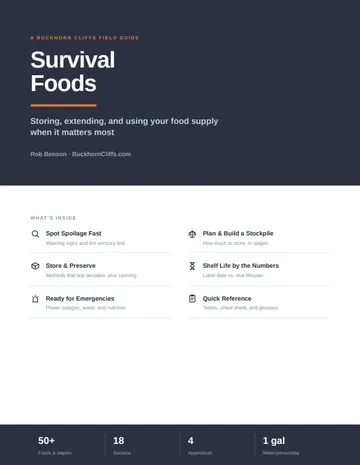
When the Power Goes Out (Survival Foods field guide)
The food clock, the eating order, the keep and discard lists, the refreeze rule, and the four ways to cook without power.
- 4 hours for a closed fridge, 48 for a full freezer, 24 for a half-full one
- Discard risky foods after 2 hours above 40°F
- Charcoal grills and generators never run indoors
Storing and using propane
How propane compares with wood, where and how to keep cylinders, what can go wrong with leaks, the tank sizes, and the amount to hold.
- Indefinite shelf life; portable cylinders requalified within 12 years
- Store upright, secured, shaded, ventilated, outdoors
- Portable sizes: 20 pound, and 30 to 40 pound
- A rotten egg smell means a leak. So do bubbles that keep growing when you brush soapy water on a connection.
Grab-and-go camp kitchen checklist
The full item list for my camp kitchen, packed in a Pelican Vault hard case that is crushproof and sealed against moisture and dust.
- Stove, 1 lb propane tank, and an adapter for larger canisters
- Frying pan, coffee pot, utensils, can opener, foil, spice kit
- Soap, scrubber, towels, gloves, zip bags, garbage bags
- Dutch oven, campfire grill, cooler, table, and chairs ride outside the case
Fire-starting without matches or a lighter
Six methods, from friction to chemistry: bow drill and hand drill, flint and steel, a magnifying lens, a battery with steel wool, and potassium permanganate with glycerin.
- A 9V battery is the common choice because its terminals sit close together
- Very fine steel wool lights more easily than coarse
- Where to buy potassium permanganate and glycerin
Blackout guide: first 45 minutes, first 3 days, and beyond
The whole-house sequence for a long outage. It starts with water and finding out how wide the outage is, then covers eating order, warmth, electricity, radio, and first aid.
- Fill every container first; a bathtub holds 40 to 80 gallons
- Keep the fridge and freezer closed from the first minute
- Generator outdoors, 20 feet away from the house, with its exhaust aimed away from windows
Baking soda for small grease and electrical fires
Why water makes grease and electrical fires worse, and how to smother a small one with a lid or baking soda.
- Keep at least 1 lb by the stove, labeled so nobody grabs flour or baking powder
- Electrical flare-up: cut power first, then baking soda at the base
- Not for large, chemical, deep-fryer, wood, or fabric fires
Wood stove installation through a ceiling and roof
My own install: choosing the stove, every 6 inch pipe and chimney part inside and out, the ceiling support box, tools, and cost.
- Less than 10 hours and 2,682 dollars in total
- DVL double-wall pipe only: listed at 6 inches from a combustible wall and 8 inches below a ceiling. If the stove manual asks for more, the manual wins
- An extended roof bracket goes on once the chimney rises more than 5 feet above the roofline, plus another for each 5 feet after that, or whatever the pipe manual specifies
Recipes and builds, by job
Member pages hold the exact amounts and steps. One caution up front: the smoke signal mix does not light itself and still needs a flame or a strong spark. Use it outdoors only, on bare ground, standing upwind. Never confine it and never pack it into a closed container, because trapped pressure can make it explode.
Fire starters and ignition aids
- Petroleum jelly fire starters (cotton balls)4 to 8 minute waterproof starter from cotton and jelly
- Paraffin wax fire starters (egg carton method)Waterproof, long-burning starters from wax and lint
- Tallow and beeswax pasteFire starter paste that also waterproofs gear
- Emergency smoke signal or ignition aidSmoke signal; still needs a flame or strong spark
Fire with no spark
- Potassium permanganate and glycerinDelayed, then vigorous; slow or fails in the cold
Stoves, light, and flame
- Alcohol stove and fuelThe simplest cooker: a can that burns alcohol
- Beeswax emergency candlesCandles that burn cleaner than paraffin, with less soot
- Reusable survival torchConduit, rope, and wax fuel torch; outdoors only
- Crayon candle15 to 30 minutes of light from one crayon
In the kitchen
- Baking soda fire suppressantSmother a small grease or electrical fire
- Cornstarch thickenerTurn thin broth into a filling meal
- Improve the taste of treated or stored waterFix the flat taste of boiled water
Spare parts, skills, and the audit questions
Propane and fuel systems break at the regulator, the hose, or an O-ring. Each part is cheap, and any one of them can shut down a heater, a grill, or a generator.
- Propane parts: regulators and pigtails, hoses and fittings, O-rings and tank gaskets.
- Gas-rated thread sealant: the yellow gas-rated tape or an approved paste. Plain PTFE tape carries no gas rating. Test each joint with soapy water before you light anything.
- Liquid fuel parts: fuel line and primer bulbs, fuel cans, and spare spouts, since spouts break first. Add stabilizer and a carburetor kit for each engine.
- Camp stove fuel, lantern mantles, lamp wicks, stormproof matches, lighters, and a ferro rod: small, cheap, and easy to forget.
- Wood stove: door gasket and rope with the cement, stovepipe, and a chimney brush.
- Skills to practice: starting a fire when everything is wet, cooking off-grid, and using an extinguisher.
- Audit questions to answer on paper: What is your primary cooking method? What is your backup? What fuel does it require? Can it be used indoors safely?
- Audit questions for cold food: which food spoils first in an outage, is there a plan to cook or preserve it fast, and can you realistically eat it in time?
Spare parts: Propane and Fuel SystemsSpare parts: Fire, Smoke and SafetySpare parts: Lighting and Off-Grid UtilitySpare parts: Small Engine and EquipmentSpare parts: Heating, Cooling and HVACAudit: Food (cooking capability)Audit: Power and Energy (fuel)The full Cooking, Fuel and Fire checklist
What goes wrong
Questions this answers
Tap a question for the short answer.
What should I eat first when the power goes out
Eat the fridge first, the freezer next as it thaws, and cans and dry goods last. A closed fridge stays safe about 4 hours. A full freezer holds about 48 hours and a half-full one about 24, if the doors stay shut. Cook whatever may spoil while it is still safe to eat. Shelf-stable food waits until the cold food is gone.
How long is food safe in the fridge and freezer without power
About 4 hours in a closed fridge. About 48 hours in a full freezer and about 24 in a half-full one, doors shut. Once meat, poultry, fish, eggs, milk, soft cheese, yogurt, leftovers, or cut fruit sit above 40°F for 2 hours, discard them. Judge with an appliance thermometer, never by smell or taste.
Can I use a camp stove indoors
No. A camp stove gives off carbon monoxide, so cook outside, 20 feet or more from the house. If you truly have no other option, the field guide allows only a small stove or heater rated for indoor use, with strong cross-ventilation, somebody awake while it runs, and a working battery CO detector in that room. A charcoal grill or a generator never comes inside, open window or not.
How can I cook without electricity or gas
The field guide lists four ways: a propane or butane camp stove, a rocket or wood stove burning small sticks, a charcoal or gas grill for boiling and reheating, and canned heat (Sterno and fuel tabs) for small jobs. An alcohol stove or a campfire with a Dutch oven also works. All of them make carbon monoxide, so all of them burn outside, 20 feet or more from the house.
How long does propane last in storage
Propane has an indefinite shelf life, which is why it is the set and forget fuel. The cylinder is what carries a date: a portable cylinder needs requalifying within 12 years of the manufacture date on its collar, or nobody will refill it. Store cylinders outdoors, upright, secured, shaded, and ventilated, and test the connections with soap and water.
How much propane should I store for cooking
Start with a camp stove and 6 to 8 one-pound propane canisters, about 30 to 50 dollars. Each canister gives roughly 1 to 2 hours of cooking. After that, the propane page says to build to several weeks to a few months of use. Propane does not go bad, so the limit is what you can store safely. The stove itself burns outside, 20 feet or more from the house.
How do I start a fire without matches or a lighter
Six ways: fine steel wool across the terminals of a 9V battery, a magnifying lens in full sun, flint and steel, a bow drill, a hand drill, and a chemical reaction. Potassium permanganate and glycerin make flame with no spark after a delay, then react hard and throw sparks. Set them up on a dry, non-flammable surface and keep your face and hands back. Cold slows or stops the reaction.
How do I start a fire with wet wood
Use a fire starter that burns long enough to dry the kindling. A cotton ball worked full of petroleum jelly burns about 4 to 8 minutes and sheds water. Set the burning starter under prepared kindling and let it burn through before you add larger fuel. Do not over-saturate the cotton, and carry the starters as a supplement, not as your only way to make fire.
How do I put out a grease fire
Turn off the heat if you safely can, then slide a metal lid over the pan. With no lid, dump baking soda from directly above. Never use water, flour, or baking powder. If it is not out in a few seconds, or it continues to grow, get out, close doors behind you, and call emergency services if any are available. Baking soda only suits a small flare-up in one pan.
What fire safety gear do I need when cooking off grid
An ABC extinguisher on every floor and one in the kitchen, with the gauge checked twice a year. Smoke and CO detectors with spare batteries, and new units every 10 years. Give each heated room a battery CO detector. Add a fire blanket, baking soda at the stove for a small grease fire, and a burn first-aid kit. Off-grid heat raises fire risk just when outside help is least likely.
What spare parts should I keep for a propane stove or grill
Regulators and pigtails, propane hoses and fittings, O-rings and tank gaskets, and gas-rated thread sealant. These cheap parts stop a grill, a heater, or a tank cold. Plain PTFE tape has no gas rating. Seal gas threads with the yellow gas-rated tape or an approved paste, then test each joint with soapy water before you light anything. Grills and camp stoves burn outside, 20 feet or more from the house.
How long does stored gasoline last
3 to 6 months untreated, and up to a year with stabilizer. Gasoline is for generators and engines, run outdoors, not for cooking. Keep it in approved cans, well away from where you live and from any pilot light, and rotate it. A 5,000-watt generator burns roughly 0.75 gallons an hour, near 18 gallons over a full day. Shut the generator off and let it cool before you refuel.
Keep going
Related to this
Membership · $49.95 per year
There is a lot more behind the lock
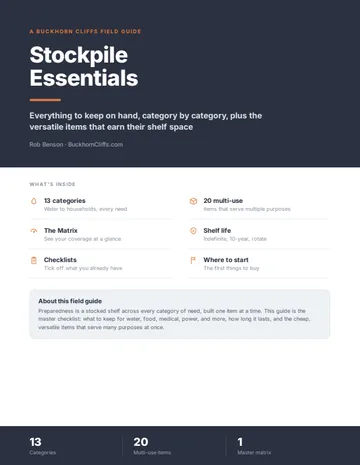
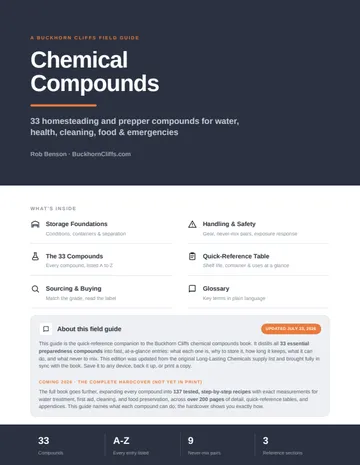
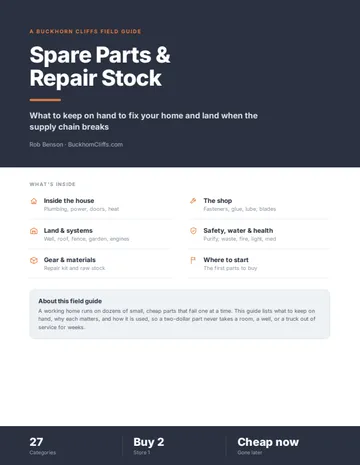
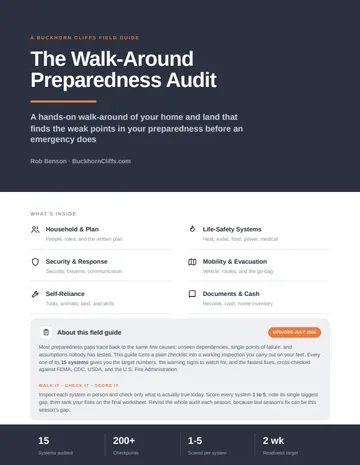
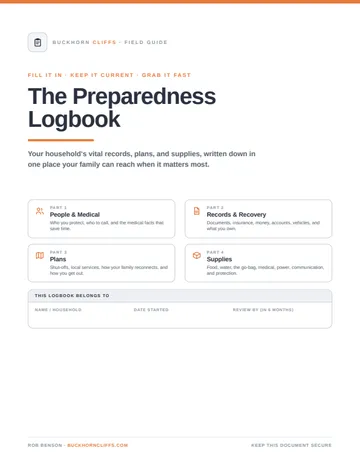
Every recipe and resource from the Prepper's Chemical Survival Guide, all six field guides to read here and download, the full audit and logbook, all twelve reference charts, and no ads.
My Manual · included
Build your own field manual
The most useful thing a membership gives you. Save any page on this site, recipes, charts, and whole field guides included. Arrange them in the order you want, name it, and print one manual with a cover and contents, or keep it as a PDF that opens with no signal.
- It works when this site does not
- Only your pages
- Anyone in the house can use it
- One current copy, not a pile of printouts
- The house binder
- A copy for the bug-out bag or truck
- A copy for family
- An offline PDF
Stay Ready
New entries, updates, and useful instruction.
Stay one step ahead on your preparedness journey.