Quick facts
- Case
- Pelican Vault
- crushproof
- sealed
- foam cut to the gear
- StoveTwo burner propane on a 1 lb tank, adapter hose for a 20 lb tank
- Cookware
- Cast iron skillet
- a pot
- a percolator
- a large bowl
- Outside the case
- Cooler
- dutch oven
- campfire grate
- table
- chairs
- Outdoors onlyCamp stoves make carbon monoxide; never in a house, garage, vehicle or tent
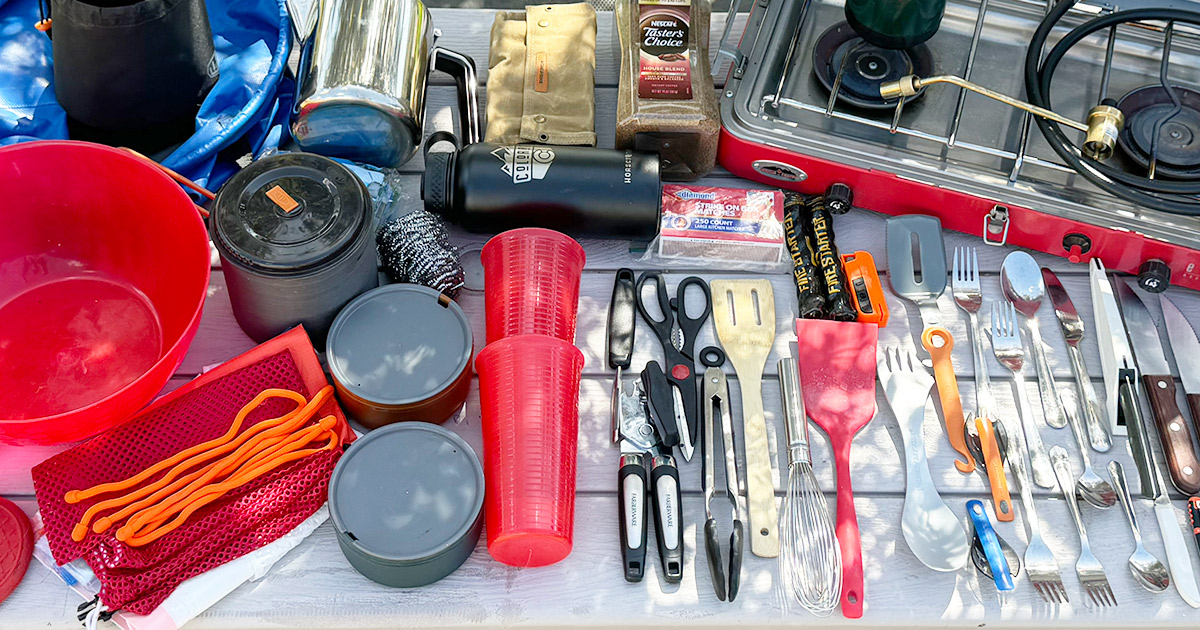
A camp kitchen that lives in a pile of bins gets packed differently every trip and always leaves something behind. Mine lives in one hard case, cut so every piece has a spot, and it loads in a single trip: for a weekend at the lake, for a hunting camp, and for the night the power goes out and dinner moves to the porch. This page is what is in it, what deliberately stays outside it, and the checklist to pack it.
Every stove on this page makes carbon monoxide. Cook on the porch, the driveway or the campsite, never in a house, garage, vehicle or tent, even with a window open. This is the one rule of the camp kitchen that is not about convenience.
The case
Pelican Vault hard case
The kitchen · everything below rides in itHigh impact polymer, crushproof, sealed against rain and dust, with foam inside. I cut the foam so the stove, the skillet, the pot and the coffee pot each drop into their own cutout and the small gear sits in a lidded bin on top; one look at the open case shows what is missing. It stacks in the truck, it sits on a tailgate as a counter, and the lid is a cutting surface in a pinch. The same idea as the grab-and-go kit: packed by job, not by pile.
Heat, water and coffee
Two burner propane stove, 1 lb tank, adapter hose
Heat · the center of the kitchenA two burner propane stove lights in wind and rain, simmers and boils at the same time, and runs on the 1 lb bottle that lives in the case. The adapter hose connects it to a 20 lb tank at home or at a long camp, which is twenty times the fuel for the same stove. Refillable 1 lb cylinders cost more once and nothing after; a dozen filled from a 20 lb tank is a month of dinners. Cooking fuel and fire compares propane, butane, white gas and wood, and self-sufficiency with propane covers tanks and run times.
Water filter and bottle
Water · the case is not the water supplyA gravity or squeeze filter in the case turns creek water into cooking water without a pump or power, and an insulated bottle keeps coffee hot and water cold. Two gallons per person per day rides in jugs beside the case when there is no source. Clean water covers which filter handles what.
Percolator and instant coffee
Morale · the first thing litA stainless percolator makes real coffee on the stove or the coals for a crowd, and a jar of instant covers the morning the percolator is dirty and the day you are packing up. Coffee is the first thing lit every morning of every trip and every outage; it is not optional gear.
Cooking and eating
Cast iron skillet, a pot, a large bowl
Cookware · one pan does most of itA cast iron skillet handles eggs, steak, bread and stew on the stove or the coals, lasts forever and seasons with the oil you cook in. A pot for boiling water, pasta and dishes. A large bowl for mixing, marinating and washing vegetables. That is the whole cookware list for the case; the dutch oven and the campfire grate are the additions when there is a fire and room in the truck.
Knives, board, utensils
Prep · metal, nothing that meltsA fixed blade with spare blades or a chef's knife, a paring knife and a folding cutting board. A spatula, a big spoon, a ladle, tongs, a whisk, kitchen shears, a peeler, a can opener and a one cup measure. Heavy foil for cooking on coals, wrapping leftovers and lining a dirty grate. Keep the knives in a sheath or a roll so the foam and your fingers survive.
Plates, bowls, cups, forks and spoons
Eating · a set for the family plus twoBowls and plates with a thumb rest so you can eat standing at the tailgate, a stainless cup per person, and a mesh bag of forks and spoons plus a few steak knives. Plastic or enamel, nothing that breaks. Two extra of everything for the neighbor who wanders over.
Camp spice kit
Flavor · what makes stored food dinnerSalt, pepper, garlic, chili, cumin, oregano, cinnamon and a bouillon in small screw-top jars, plus a small bottle of oil and one of hot sauce. The survival spices page is the list and how long each keeps; this kit is the travel version of it.
Cleanup and trash
Collapsible bucket, soap, scrubber, towel, gloves
Cleanup · the part that gets skippedA collapsible bucket hauls water and becomes the wash bin. Biodegradable soap, a sponge, a stainless scrubber for the cast iron, a quick-dry towel, rubber gloves for the greasy pot and heat resistant gloves for the hot one. Wash 200 feet from any water and scatter the strained gray water. Zip bags in three sizes for leftovers and wet things, and contractor grade trash bags, because the cheap ones leak in the truck.
Keep a small fire suppressant beside the stove; a grease fire on a tailgate is a ten second problem with one and a much longer one without.
What stays outside the case
The outage kitchen
The same case is the plan for the night the power goes out. It goes to the porch, the stove goes on the table, and dinner and coffee happen the way they do at camp. A few things make it work at home: a 20 lb propane tank kept full and the adapter hose in the case; the food in the pantry that cooks with one pot and one pan, which is most of it; the water jugs filled before the storm; and a headlamp in the case so you can cook after dark. The power outage gear list covers the rest of the house, and freeze dried foods covers the pouches that only need hot water.
The checklist
In the case
- Two burner stove, 1 lb propane, adapter hose
- Lighter, matches, fire starter
- Cast iron skillet, pot, large bowl
- Percolator, instant coffee, insulated bottle
- Water filter
- Knife and spare blades, paring knife, cutting board
- Spatula, spoon, ladle, tongs, whisk, shears, peeler, can opener, measuring cup
- Plates, bowls, cups, forks, spoons, steak knives
- Spice kit, oil, hot sauce
- Heavy foil, zip bags, trash bags
- Collapsible bucket, soap, sponge, scrubber, towel
- Rubber gloves, heat resistant gloves
- Headlamp
Beside the case
- Cooler and ice
- Water jugs
- Dutch oven, campfire grate
- Table, chairs
- 20 lb propane tank for a long camp or an outage
The rest of the campsite, from shelter to sleep to clothing, is on camping essentials.
Questions this answers
Tap a question for the short answer.
What do I need in a camp kitchen?
A stove and fuel, one pan and one pot, a way to make coffee, a knife and a board, a spatula, spoon, tongs and can opener, plates, bowls and cups, a spice kit, a wash bin with soap, a scrubber and a towel, foil, zip bags and trash bags, and a lighter and matches. Pack it all in one hard case so it loads in a single trip and nothing gets left. The cooler, the dutch oven, the grate and the table travel beside it.
How do I cook when the power is out?
Carry the camp kitchen case out to the porch or the driveway and light the stove. A two burner propane stove on a 1 lb bottle, or a 20 lb tank through the adapter hose, cooks every meal a kitchen range does, and the case already holds the pan, the pot, the coffee and the utensils. Outdoors only: camp stoves make carbon monoxide, and every winter storm kills people who bring one into the kitchen or the garage. A gas range with electronic ignition still lights with a match if the gas is on.
What is the best case for a grab and go camp kitchen?
A hard polymer case with a seal and foam: crushproof, closed against dust and rain, and it stacks in the truck. I use a Pelican Vault; the foam is cut so the stove, pan, pot and coffee pot each have a spot and the small items sit in a bin, so a glance tells you what is missing. A soft bag crushes and hides its contents; a tote lets everything rattle.
What cooking utensils should I pack for camping?
A spatula, a big spoon, a ladle, tongs, a whisk, kitchen shears, a peeler, a can opener, a fixed blade or chef's knife with a small paring knife, a folding cutting board and a one cup measure. Metal or heat resistant silicone, nothing that melts on the edge of a pan. That list covers every camp meal I have ever cooked.
What cleaning supplies do I need for a camp kitchen?
Biodegradable soap, a sponge, a stainless scrubber for the cast iron, a collapsible bucket or wash bin, a quick-dry towel, rubber gloves and heavy trash bags. Wash 200 feet from any water, even with biodegradable soap, and strain and scatter the gray water. A collapsible bucket doubles as the water hauler.
How much propane does a camp stove use?
A 1 lb bottle runs a two burner stove on high for about an hour, which is two or three days of camp meals on one burner at normal settings. A 20 lb tank through the adapter hose is about twenty times that. Bring one more bottle than you think you need; the refillable 1 lb cylinders cost more once and nothing after.
What food do I keep with the camp kitchen?
Only what keeps forever in the case: instant coffee, the spice kit, salt, oil in a small bottle, and a few freeze dried pouches for the night the cooler is empty. Everything else comes from the pantry or the cooler on the day. The survival foods field guide and the freeze dried foods page cover the pantry side.
Keep going
Related to this
Membership · $49.95 per year
There is a lot more behind the lock
Every recipe and resource from the Prepper's Chemical Survival Guide, all six field guides to read here and download, the full audit and logbook, all twelve reference charts, and no ads.
My Manual · included
Build your own field manual
The most useful thing a membership gives you. Save any page on this site, recipes, charts, and whole field guides included. Arrange them in the order you want, name it, and print one manual with a cover and contents, or keep it as a PDF that opens with no signal.
- It works when this site does not
- Only your pages
- Anyone in the house can use it
- One current copy, not a pile of printouts
- The house binder
- A copy for the bug-out bag or truck
- A copy for family
- An offline PDF






Stay Ready
New entries, updates, and useful instruction.
Stay one step ahead on your preparedness journey.