Browse by need · 10 entries
Power and Light
Keep power and light when the grid is down
The grid is the first thing to go and the last to return. Keep a way to make and store power, layered light, and a plan to send and receive word when the phones are down.
Start with the full guide
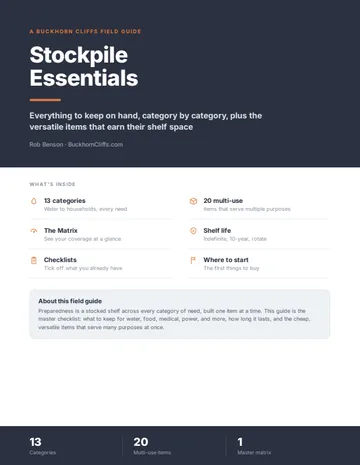 Field guideStockpile Essentials Field GuideThe master checklist: 239 items across 16 categories, the shelf life class of each, and the 20 multi-use items that cover the most jobs. 39 pages.Open the field guide Master guideBlackout GuideWhat to do in the first 45 minutes, the first 3 days, and beyond: water, food order, heat, power, comms, and medical.Open the full page ChecklistPower Outage Gear ChecklistWhat to have for an extended outage, from cash and backup power to water, lighting, fuel, and communication, with product picks.Open the full page
 Have a plan for when the phones fail
Cell networks jam or fail early in any disruption. A pair of radios, a weather receiver, and a written check-in plan keep a household coordinated. The full radio, satellite, and Faraday build is.
Skills 1
Guides 7
Spare parts lists 2
Nothing matches those filters. Clear one and try again.
The checklist
Tick what you already have. Checks are saved on this device.
Power, Light and Comms Keep power, keep light, keep contact
Power
Light
Comms
Audit questions
From the walk-around audit. Tap a question for what a good answer looks like.
What stops working instantly?
Lights, the furnace fan, the well pump, the refrigerator, the internet, and any medical device on the wall. Good means you have written that list for your own house, because it is the list the backup has to carry. When the Power Goes Out and the Blackout guide walk the first hours.
What fails within hours?
Cell towers on backup batteries, municipal water pressure, the refrigerator after four hours closed, phones and radios as they drain. Good is a plan that covers those hours before the outage: power banks charged, water stored, the cell plan written. The power outage gear page is the list.
What fails after several days?
The freezer, the propane in the tank, gasoline in the cans, and the generator that has to run all day to keep a fridge cold. Good means a solar and battery layer for the small loads so the fuel goes only to the big ones. The off-grid power setup is the system I run for that.
Do you have batteries, a generator, solar, or a hybrid system?
A generator alone is fuel measured in hours; a battery alone is energy measured in a day. Good is layered: a small solar generator for phones, radios and lights, a battery bank for the critical loads, and a generator on a transfer switch for the gray weeks. Solar Power Basics sizes it and the home backup system shows one built.
How long can it realistically run critical loads?
List the critical loads, add up their watts and hours, and divide into what the battery holds and what the panels put back. Good means you have that number in days, for winter sun, not the sticker. The load calculator on the solar page does the arithmetic.
Do you know the actual runtime, not the advertised one?
Advertised runtime assumes a light load and a full tank. Good means you have run the generator or battery on your real loads and timed it, and you know the fuel burn: a 5,000 watt generator drinks about three quarters of a gallon an hour. Propane for self-sufficiency covers the fuel side.
Common mistake
A power station you never test, and no plan for when phones die.
Skills to learn
size a solar setup · program GMRS radios · conserve a battery bank
When it matters