Quick facts
- Small buildFaraday Defense 10 liter sling: backup phone, one radio, power bank, cables, flashlight
- Full buildMilwaukee Packout or Condition1 case; every device in its own Faraday bag
- What it protects againstThe fast pulse of a nuclear EMP, and everyday tracking. Not a solar storm, which hits the grid
- Test itSeal your phone in the bag and call it. If it rings, the seal or the bag failed
- Keep outsideThe solar panel, for size; charge the power bank from it every three months
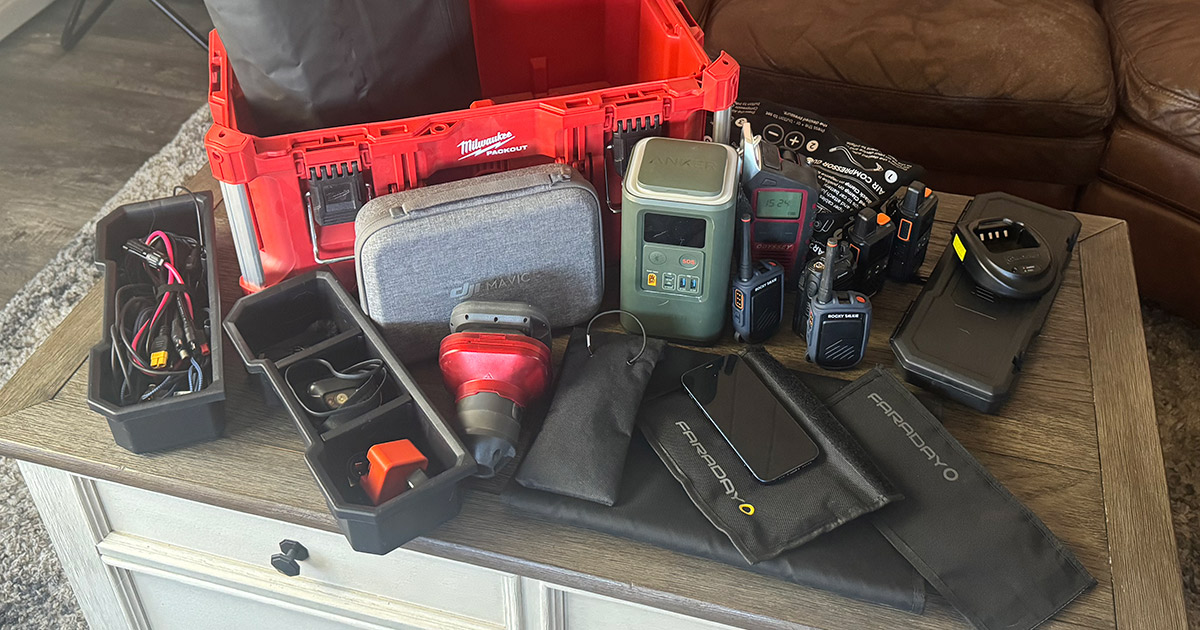
A Faraday bag does one thing: it keeps a fast electromagnetic pulse from reaching what is inside. That covers the pulse from a nuclear detonation, and it covers the everyday case too, a phone or a key fob that cannot be tracked or cloned while it is sealed. It does not cover a solar storm, which hits the grid and long power lines, not a phone in a drawer. So the kit is built around the second question, not the first: when the power and the towers are down for a long time, what do I want working?
Two builds. The sling bag is the small one, a shielded bag that is itself the shield. The full build is a hard case with every device in its own bag, which is more work and holds more.
A Faraday Defense 10 liter dry sling pack, rated over 85 dB. Backup phone, one GMRS radio, a power bank, a flashlight, cables and a USB drive. Grab it and go. About $350 with the phone you already own.
A Milwaukee Packout box or a Condition1 rolling case. Each device in its own Faraday bag or jacket, wrapped so it does not touch the lining. Radios, phone, laptop, drives, lights, weather meter, keys, chargers, the folding panel outside. Lives at home, rides in the truck when you leave.
How the shielding works, and how it fails
What an EMP does, and does not do
The difference between a nuclear pulse and a solar storm, what each one damages, and why the vehicle is probably fine, is on understanding EMP. What stops working in the first hours of any outage is on the EMP scenario and blackout.
The bag and the case
Faraday Defense 10L dry sling pack
Small buildThe sling bag is the shield: a roll-top dry bag with three layers of shielding fabric, rated over 85 dB, with a laptop compartment and a side pocket. Double roll the top and clip it; that is the whole procedure.
- Available in 5, 10, 20 and 30 liters. The 10 holds a phone, a radio, a power bank, a light and cables with room to spare.
- Waterproof as well as shielded, so it doubles as the dry bag for the bug-out bag.
Milwaukee Packout large tool box
Full buildImpact-resistant, IP65 weather seal, and it stacks and locks to the rest of the Packout system, so the electronics case rides on top of the tool cases in the truck. The box is not a shield; every device inside goes in its own Faraday bag or jacket.
Condition1 22 inch rolling hard case
Full build · alternateWaterproof, with a pick-and-pluck foam interior you cut to each device, wheels and a pull handle. The better choice if the kit lives in a closet and only moves when you do.
Power
Power bank: Anker 548
Both buildsA 60,000 mAh bank charges a phone about a dozen times and runs a radio charger for a week. Charge it every three months; lithium banks lose a few percent a month sitting.
Folding solar panel and connector cable
Both builds · stored outside the shieldA folding 100 watt panel refills the power bank in a day of sun and keeps the radios alive indefinitely. It lives in its own pouch beside the case; the panel is the least complex electronic in the kit and the bank is the one worth shielding.
- The cable that fits your bank's input is the part people forget. Buy it now and tape it to the panel.
- What a small panel can and cannot run is on solar power basics.
Cables, adapters and radio chargers
Both buildsUSB-C, Lightning and micro-USB, a multi-port adapter, and a USB charger for every radio in the kit. A radio with a dead battery and a wall charger is a paperweight; the USB charger runs from the bank or the panel.
Jump starter with air compressor
Full buildThe same unit that rides in the car kit: a dead battery, a flat tire and a dead phone from one box. Bagged, it survives what the vehicle's own electronics may not.
Communication
GMRS radio: Wouxun KG-935G Plus
My GMRS pick · both buildsUp to 5.5 watts on every GMRS channel, a removable antenna so you can add a better one, weather alerts, and repeater capability, which is how a handheld reaches across a county. GMRS needs an FCC license: no test, ten years, one license covers the family.
- Getting the license and setting up the family plan is on communicating with no cell or internet; the difference from FRS is on GMRS vs FRS.
- A spare antenna in the case: a longer whip roughly doubles usable range on a handheld.
FRS radio: Rocky Talkie Mountain Radio
My FRS pick · both buildsNo license, two watts, a battery that runs three to five days, and built for being dropped on rock in the cold. This is the radio for the kids and the neighbors: simple, tough, and it talks to the GMRS radio on the shared channels.
Hand crank weather radio
Full buildAM, FM and the weather band, on a crank and a small panel, with a flashlight and a USB port. This is how you hear what is happening when nothing else works, and it needs no batteries at all.
Satellite messenger
Full buildText and an SOS button that reach a satellite from anywhere with open sky, on a subscription you can pause. When the towers are down for a week, this is the one device that still reaches the outside world.
Meshtastic node
Full buildA pocket-sized LoRa radio that sends texts and GPS positions to other nodes and relays them across miles, paired to your phone by Bluetooth. Cheap, no license, and it builds a private network for a family or a road; it does not reach anyone outside it.
Devices, data and light
Backup phone
Both buildsAn old unlocked phone, charged, loaded before it goes in: offline maps of your state, photos of IDs, insurance and prescriptions, the site's pages you use saved to My Manual as PDFs, and the apps for the radios. It works on Wi-Fi with no plan and takes a spare SIM.
Backup laptop or tablet
Full buildLoaded the same way, with the manuals, the maps and the family's files, and a charger that runs from the power bank. What to put on it and how to keep it current is on the backup laptop.
Portable SSD and encrypted USB drives
Full buildDocuments, photos, records, the things you would rebuild a life from. Encrypted, updated twice a year with the kit check. Why an SSD and how to set it up is on the portable SSD.
Flashlight, headlamp and lantern
Flashlight in both · lantern and headlamp in the full buildA rechargeable flashlight with a real throw for the sling bag; a headlamp for hands-free work and a lantern for a room in the case. All USB, so the bank and the panel keep them alive.
Weather meter
Full buildWind, temperature, humidity and pressure in the hand. Falling pressure tells you a storm is coming when there is no forecast to check; wind and humidity decide whether a fire is safe to light.
Small drone
Full build · optionalTen minutes in the air shows a washed-out road, a fire line or a downed fence a mile off that would take an afternoon to walk. Optional, and the batteries need the same quarterly charge as everything else.
Spare key fobs and keys
Full buildA fob is a small computer. The spare for every vehicle goes in a Faraday pouch, labeled, so a pulse or a lost key ring does not strand the truck. It also stops the relay theft that copies a fob's signal through a front door.
Keep it working
Questions this answers
Tap a question for the short answer.
What should I put in a faraday bag?
The things you could not replace or would need first: a backup phone with maps and documents loaded, a GMRS radio and its charger, a power bank, a flashlight, a USB drive with your papers, and the spare key fob. The full build adds a laptop, a hand crank weather radio, a satellite messenger, a hard drive, a weather meter and the cables for all of it, each device in its own bag inside a hard case.
What electronics should I protect from an emp?
Small, battery-powered things you depend on: phones, radios, a laptop, drives, a power bank, key fobs, a GPS. Anything plugged into the wall or a long antenna when a pulse hits is the most exposed; anything sealed in a shielded bag has the best odds. Big appliances and the vehicle are not practical to shield, so the kit is about what keeps you informed, in touch and mobile.
Do solar panels need to be in a faraday bag?
A folding panel fits in a bag if you have one large enough, and it is cheap insurance. Mine stays outside the case for size, in its own pouch, and I accept the risk. What must be shielded is the charge controller and the power bank, which are the electronics; the panel itself is the least complex part.
What is a good faraday bag for emergency electronics?
One that is tested and rated, with a fold-over or roll-top closure you can seal properly. I use Faraday Defense: the 10 liter dry sling pack for the small build, and their bags and jackets inside a hard case for the full build. Rated at over 85 dB of attenuation, which is more than a phone signal or a pulse gets through.
Why put a towel in a faraday bag?
The shielding works when nothing inside touches the metalized layer. A towel, a piece of foam or a second cheap bag around each device keeps it off the shield, and cushions it. Stacking bare devices against the lining is the common mistake.
What radio should I keep in a faraday bag?
A GMRS handheld with a spare battery and its charger: I keep a Wouxun KG-935G Plus and the Rocky Talkie for the family. Add a hand crank AM, FM and weather band receiver, which needs no batteries at all. Radios only help if the people you need to reach have one too, so the plan matters more than the model.
How do I protect electronics from an emp?
Seal them in a rated Faraday bag with a nonconductive layer between the device and the lining, and keep the bag closed except when you check it. Nest two bags for anything you cannot replace. A solar storm is a different event: it damages the grid and long lines, not unplugged handheld gear, so for that the kit's job is power and communication, not shielding.
What is the best case for an emergency electronics kit?
A hard case with a weather seal. I use the Milwaukee Packout large tool box, IP65 rated, with the devices in individual Faraday bags inside; it stacks with the rest of the Packout system. The Condition1 22 inch rolling case is the alternative, waterproof with a foam interior you cut to fit.
What is a meshtastic device used for?
Text messages and GPS positions between a group with no cell towers, over LoRa radio, relayed device to device across miles. It pairs to a phone by Bluetooth and costs less than a radio. It is for your own group, not for reaching the outside world.
Should I keep a backup phone for emergencies?
Yes. An old unlocked phone, charged, loaded with offline maps, your documents, photos of IDs and insurance, and the apps you would want, sealed in a bag. It works on Wi-Fi with no plan, takes a spare SIM, and is the one item in the kit that replaces three others.
How do I test a faraday bag?
Put your phone in, seal it exactly as you would for storage, and call it from another phone. If it rings, the seal or the bag is not doing its job. Check that Wi-Fi and Bluetooth drop too. Test it again after a year of use; folds and wear open gaps.
Keep going
Related to this
Membership · $49.95 per year
There is a lot more behind the lock
Every recipe and resource from the Prepper's Chemical Survival Guide, all six field guides to read here and download, the full audit and logbook, all twelve reference charts, and no ads.
My Manual · included
Build your own field manual
The most useful thing a membership gives you. Save any page on this site, recipes, charts, and whole field guides included. Arrange them in the order you want, name it, and print one manual with a cover and contents, or keep it as a PDF that opens with no signal.
- It works when this site does not
- Only your pages
- Anyone in the house can use it
- One current copy, not a pile of printouts
- The house binder
- A copy for the bug-out bag or truck
- A copy for family
- An offline PDF






Stay Ready
New entries, updates, and useful instruction.
Stay one step ahead on your preparedness journey.