BUCKHORN CLIFFS

Communications · Guide

Communicate without cell service or internet (GMRS radios)

A plain guide to GMRS two-way radios for families: licensing, radio-to-radio range, repeaters, finding a repeater, and Rob's handheld pick.

Quick facts

Pick
Rocky Talkie Expedition Radio, 5 watt GMRS (IP67 waterproof)
Range
2-8 miles typical, up to 35 miles in open areas
Battery
4-6 days on a single charge
GMRS bands
462 MHz and 467 MHz
Power limits
handhelds 1-5 watts; base and mobile up to 50 watts
License
  • FCC
  • ten-year duration
  • covers licensee
  • immediate family

To communicate without cell service or internet, you can use two-way radios, such as those operating on GMRS, FRS, or amateur (ham) radio frequencies. Ensure both radios are set to the same channel or frequency, and you'll be able to communicate directly with each other over a range that depends on the radios' power, terrain, and any physical obstructions. This method provides a reliable means of communication in areas lacking cell or internet connectivity.

This post (while there are technical bits) isn't intended for radio dorks. This is a guide for the easiest to use devices available. This guide is for people that aren't interested in learning everything and making this a hobby. This is for people that just want to communicate if things in society get dicey or you're just on an adventure and there's no cell service.


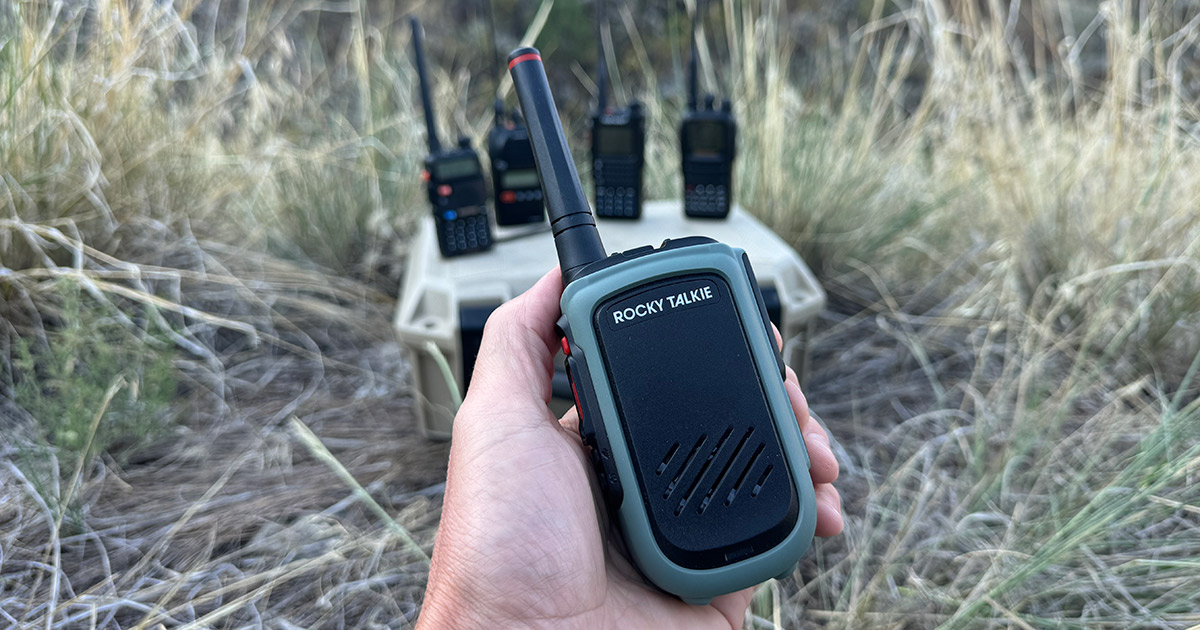
Top GMRS Radio- Rocky Talkie

My Pick: ROCKY TALKIE (purchase online now)

Rugged DurabilityWaterproof, shatterproof, built tough.
Extended Battery4-6 days on one charge.
Strong Range2-35 miles communication.
Repeater CompatibleEnhanced range with repeaters.
Weather AlertsReal-time updates.
User-FriendlyLightweight, simple, secure.

If you want to skip all the technical stuff and just get right to the recommendations, click here.

My Choice: Communication via GMRS Radio

GMRS (General Mobile Radio Service) provides a licensed radio communication option in the United States, operating within the 462 MHz and 467 MHz frequency bands.

Here's a technical overview of GMRS

1LicensingRequired by the FCC for operation, covering the licensee and immediate family. Non-commercial use only. While I strongly recommend getting the license. If society begins to unravel and you're in a situation where you NEED to communicate with family, a license will be meaningless. HOW TO GET GMRS LICENSE
2Frequency and PowerUtilizes 462-467 MHz bands with power limits up to 50 watts for base and mobile units, while handhelds typically range from 1-5 watts.
3Channels and CodesOffers dedicated channels within its frequency range, supplemented by CTCSS/DCS codes for reduced channel interference. These codes do not encrypt communications.
4Communication RangeVariable, influenced by power output, geographic terrain, and environmental obstructions. Open area range significantly exceeds urban settings.
5Equipment VarietyIncludes handheld, mobile, and base station units, selected based on range, functionality, and operational requirements.
6Dual-Service RadiosMany devices support both FRS and GMRS, enabling license-free operation on FRS channels or licensed operation on GMRS channels.
7ApplicationsSuited for remote communication where cellular networks are unavailable, such as outdoor adventures, vehicle convoys, and emergency family scenarios.
8Regulatory ComplianceAdherence to FCC regulations governing channel use, power limits, and operational etiquette is mandatory.
9License ValidityThe GMRS license has a ten-year duration, requiring renewal and associated fees.
10InteroperabilityCompatibility with FRS radios on shared channels facilitates broader communication networks.

How to get your GMRS license. (the FCC requires it to transmit on GMRS, and it takes ten minutes. Here's how)


If I have two GMRS radios can I communicate with nothing else?

Yes, if you have two radios that are compatible (i.e., they operate on the same frequency bands and modes), you can communicate directly with each other without the need for any additional infrastructure like repeaters or internet-based systems. This type of communication is often referred to as "simplex" communication, where radios transmit and receive on the same frequency.

For successful simplex communication, consider the following:

1Frequency MatchBoth radios must be set to the same frequency or channel.
2Range LimitationsThe effective communication range will depend on the radios' power output, the surrounding terrain, and any potential obstructions. Typically, handheld radios have a range of a few miles under optimal conditions, but this can vary widely.
3Line of SightFor VHF and UHF radios, having a clear line of sight between the radios can significantly enhance communication range. Obstacles like buildings, hills, and trees can attenuate the signal.
4Power SourceEnsure both radios are adequately charged or have a reliable power source to maintain communication.
5AntennaThe efficiency and placement of the antenna can also impact the communication range. Sometimes, using an aftermarket antenna that's better suited to your specific needs can improve performance.

Direct communication between two radios is a straightforward and effective way to stay in touch over short to moderate distances, making it ideal for various activities such as hiking, camping, or coordinating work in areas without cellular coverage.


How can I make my radio transmit further?

To extend the transmission range of your radio, using a repeater significantly enhances its ability to communicate over longer distances. A repeater receives your radio's signal and retransmits it at a higher power and from a location typically higher or unobstructed, allowing the signal to cover greater distances than a direct transmission from your radio alone.

Here’s how a repeater works to increase your radio's range:

1ReceptionIt captures your radio's signal, which might be weak or hindered by obstacles.
2AmplificationThe repeater boosts the strength of your signal, mitigating any loss or noise.
3Re-transmissionIt then sends out this amplified signal at a higher power and usually on a different frequency to avoid interference with the incoming signal.
4Elevated PlacementRepeaters are often placed on high ground or atop buildings to maximize coverage by overcoming geographical and man-made obstructions.
5Efficient Antenna SystemUtilizing specialized antennas, sometimes combined with a duplexer for shared transmit/receive functions, further ensures the extended reach of your signal.

Incorporating a repeater into your communication setup allows your radio to achieve far greater coverage, making it an effective solution for extending the transmission range beyond what's possible through direct radio-to-radio communication.

How do I find a GMRS repeater near me?

Finding a GMRS repeater near you involves a few steps, leveraging both online resources and local community connections. Here's how you can locate a GMRS repeater in your area:

1Online Repeater DirectoriesWebsites like RepeaterBook.com maintain up-to-date listings of GMRS repeaters across the United States. These sites allow you to search by location, providing details such as frequency, tone, and sometimes the coverage area of each repeater.
2GMRS Licensing ResourcesThe Federal Communications Commission (FCC) website and the Universal Licensing System (ULS) database can sometimes offer information about licensed GMRS repeaters. However, these sources may require more effort to navigate and extract specific repeater details.
3Local Radio ClubsJoining a local GMRS or amateur radio club can connect you with experienced operators who can share information about repeaters in your area. Clubs often maintain their own repeaters and can offer guidance on accessing and using them.
4Social Media and Online ForumsOnline communities and social media groups focused on GMRS and two-way radio communications are valuable resources. Members frequently share information about repeaters, including those not listed in the major directories.
5Ham Radio Events and MeetingsAttend local ham radio swap meets, events, or club meetings. Even though ham radio and GMRS are different services, there's a significant overlap in the community, and ham operators can often provide information on local GMRS repeaters.

When you find a repeater, remember to check its usage rules and whether it requires permission or membership to access. Some repeaters are open for public use, while others may be private or require users to be part of an organization.


GMRS Purchase Recommendations

I own several GMRS product(s) and I've dialed in the best options for newbs.

Without question, my go-to recommendation is the Rocky Talkie Expedition Radio (the 5 watt GMRS model, formerly sold as the 5 Watt Radio). Here's a short list

Rugged DurabilityIP67 waterproof, shatterproof, and built for extreme conditions.
Extended Battery LifeOperates 4-6 days on a single charge, optimized for cold weather.
Strong Communication Range2-8 miles typical range, up to 35 miles in open areas.
GMRS Repeater CompatibilityEnhances communication range with repeaters.
NOAA Weather AlertsProvides real-time weather updates.
User-FriendlyLightweight, compact, and easy to use, with secure attachment options.
Ideal for outdoor enthusiasts in challenging environments.

And here's a longer list on why I recommend these 5 watt radios:

Rocky Talkie GMRS 5 Watt Radio Overview

  1. Durability and Build Quality:
    • Designed for rugged environments with an IP67 waterproof rating and a shatterproof screen. Built to withstand extreme conditions, including impacts and harsh weather.
    • Made with high-impact polycarbonate and ultra-durable TPE, ensuring longevity in tough situations.
  2. Battery Life:
    • Long-lasting battery, designed to operate for 4-6 days on a single charge. The lithium-ion battery is optimized for performance in cold weather, making it reliable in various conditions.
    • The radio uses an 1,800mAh, 7.4V rechargeable battery that Rocky Talkie rates for 4 to 6 days of typical use.
  3. Range:
    • Provides a typical range of 2-8 miles in hilly, mountainous, or forested terrain, with a maximum range exceeding 35 miles in open areas.
    • Comes with two antennas: a short antenna for compact carry and a long-range antenna for extended communication distances.
  4. Communication Features:
    • Offers GMRS repeater compatibility, enabling communication over even greater distances when repeaters are available.
    • Equipped with 22 GMRS channels, 121 privacy codes, and dual-channel monitoring, allowing for flexible communication options and minimal interference.
  5. Weather Alerts:
    • Includes NOAA weather alert functionality, providing real-time updates on weather conditions, which is crucial for backcountry safety.
  6. Ease of Use and Ergonomics:
    • At 9.1 ounces it is still easy to carry on long trips.
    • Comes with a steel gator clip and a backup leash to secure the radio to your gear, ensuring it remains attached even during intense activity.
  7. Accessories and Customization:
    • The package includes two antennas, a USB-C charging cable, a steel gator clip, and a backup leash.
    • Optional accessories are available for enhanced functionality, such as the remote speaker mic and additional charging options.
  8. User-Friendly Interface:
    • Intuitive controls and a simple interface make it easy to operate, even with gloves on.
    • The radio's screen is backlit, allowing for visibility in low-light conditions.
  9. Portability:
    • Designed with portability in mind, the Rocky Talkie is ideal for outdoor adventurers, hikers, and mountaineers who require reliable communication in remote areas.
  10. Environmental and Situational Adaptability:
    • The long battery life and durable build make it suitable for extended trips without access to charging facilities.

These features make the Rocky Talkie 5-Watt Radio a reliable and versatile communication tool for anyone venturing into challenging outdoor environments.

TOP PICK:

Rocky Talkie 5 watt GMRS Radio

Rocky Talkie GMRS Radio: Purchase Online

The Rocky Talkie 5-Watt Radio is built for those who need reliable communication in tough environments. Its rugged durability includes IP67 waterproofing and a shatterproof design, making it ideal for extreme conditions. With a battery life of 4-6 days on a single charge, it’s perfect for extended trips. The radio offers a strong communication range, from 2 to 35 miles, and is compatible with GMRS repeaters to enhance range. It also provides NOAA weather alerts for real-time updates. Lightweight and user-friendly, it's designed for ease of use in the outdoors.


2nd Choice: Buy Two Way Radios

In second place (behind the Rocky Talkie), I recommend a few specific models from the website: Buy Two Way Radios. These are slightly more clunky, not as weather resistant or user-friendly but I would take these over all other options (not including the Rocky Talkies).

  1. Custom Programming: Their Wouxun radios are custom-programmed, ensuring they are ready to use with optimal settings for efficient communication.
  2. Exclusive User Manual: The company produces its own user manuals for the radios, indicating a deep understanding of the products and a commitment to customer education.
  3. Accessible Customer Support: With 16 employees based in South Carolina, customers have direct access to knowledgeable support for any questions or assistance needed.
  4. Comprehensive Warranty: A 1-year warranty guarantees protection and ensures that your units and components remain fully operational, offering peace of mind.
  5. Easy to Understand: Custom Prepper Kit
    • Two Wouxun KG-805G GMRS Two-Way Radios: Highly popular for their power, channel support (all 30 GMRS channels, including simplex and repeater channels), and additional features such as 128 programmable memory channels, CTCSS/DCS codes, and a three-color LCD display.
    • Two Spare High Capacity Batteries: Provide extended usage time, crucial for long periods without access to charging facilities.
    • Two Nagoya NA-701G GMRS Antennas: These upgraded antennas enhance range and performance beyond the standard equipment.
    • Two Battery Eliminators: Facilitate the operation of your KG-805G radios directly from your vehicle, ensuring constant power supply.
    • Two "AA" Battery Cases: Offer the flexibility to power the radios with standard "AA" alkaline batteries, adding another layer of convenience.
    • Two USB DC Charger Cables: Allow for versatile charging options by connecting the desktop charger to any USB port.
  6. Prepper and Survivalist Essentials: The kit includes a laminated, waterproof frequency list & 333 Plan card, covering emergency frequencies and protocols across various radio services. This tool is invaluable for preparedness and survival situations, providing key communication channels at a glance.

As mentioned in the list above, the pre-prepped kit is perfect for a family/couple wanting a simple communication option if cell and internet aren't available. Details below.

Here are My 3 Recommended GMRS Options from Buy Two Way Radios:

If you want to communicate with family (no extras) and you want weather alerts and more radio options, purchase the Prepper Walkie Talkie Kit + (1) Advanced GMRS Radio (that's what I have). This will provide you with 3 communication devices, one of which has more features (like weather data).

If it's just two of you and you want the advanced features on both radios, go with the Advanced GMRS Radio Kit. Details below.


Prepper Walkie Talkie Kit - Family Communication Package (2 Radios + Accessories)

Purchase Online

Wouxun KG-805G GMRS Two Way Radio
Prepper Walkie Talkie Kit - Family Comm Package (2 Radios)

The Prepper Walkie Talkie Kit - Family Comm Package by BTWR Essentials is a comprehensive and cost-effective solution for families or couples needing reliable communication when cell and internet services are down, such as in severe weather or emergencies. It includes everything needed for immediate, effective off-grid communication, like two durable Wouxun KG-805G GMRS Two-Way Radios that cover all GMRS channels, additional high-capacity batteries, upgraded antennas for extended range, and vehicle power options. The kit also features a waterproof emergency frequency list, ensuring users have essential communication channels at their fingertips. Designed with practicality in mind, it comes with all necessary accessories to keep you connected in critical situations, making it an excellent investment for preparedness and ensuring peace of mind.

WHEN ORDERING: use coupon code BUCKHORN for a discount.


Rugged Wouxun KG-935G Plus GMRS Two Way Radio

Purchase Online

Wouxun KG-935G Plus GMRS Two-Radio

If you're looking for a solid way to stay in touch when cell and internet are down, especially during emergencies, I highly recommend checking out the Wouxun KG-935G Plus. This radio goes above and beyond, offering not just clear communication on all GMRS channels but also the ability to tune into NOAA weather alerts, which is super handy in unpredictable situations. It's incredibly user-friendly with dual receive on UHF and VHF, customizable channels to cut through interference, and even a built-in FM radio.

What really makes the KG-935G Plus stand out to me is its toughness and practicality. It’s water and dust-resistant, meaning it’s ready for any adventure you throw at it. Plus, the large, colorful display and backlit keypad make it easy to use in any lighting. It comes with a long-lasting battery, and there's even a flashlight built in, which could be a lifesaver. All in all, this radio is a fantastic choice for anyone serious about keeping their communication lines open, no matter where they are or what they're doing.

WHEN ORDERING: use coupon code BUCKHORN for a discount.


Rugged Wouxun KG-935G Plus GMRS Two-Radio Value Pack

Purchase Online

Wouxun KG-935G Plus GMRS Two-Radio Value Pack

When you grab a 2-pack of the Wouxun KG-935G Plus, you're essentially doubling down on all the advanced features and rugged reliability that make this unit a standout for serious communicators and outdoor adventurers alike. Each radio in this duo packs the same punch, transmitting across all GMRS channels at up to 5.5 watts, offering dual receive on both UHF and VHF bands, and ensuring you're always in the know with built-in NOAA weather alerts.

The real beauty of opting for the 2-pack is in the seamless integration and shared functionality between units. With 999 programmable channels, customizable CTCSS/DCS tones, and the ability to scan for split tones, setting up your pair to work together perfectly, or within a larger group, is straightforward. Both radios share the advanced features like the customizable Area Message, the Channel Wizard for easy programming, and enhanced durability with an IP66 rating. Plus, each radio comes fully equipped with a high-capacity battery, USB-C charging, and all the essential accessories. For families, teams, or prepper pairs, this 2-pack means you're fully equipped to stay connected, no matter what the world throws your way.

Purchase Online


Recap: Simplify This Information

In planning for communication without cell and internet services, GMRS radios stand out as a reliable option. They're straightforward to use; just power on, sync the channel, and communicate. Remember, GMRS operation requires an FCC license, covering the licensee and their immediate family for non-commercial use. While I highly recommend securing this license, in extreme situations where society's structure is compromised, the immediate need for communication surpasses licensing concerns.

Here's a brief on the options:

  1. ROCKY TALKIES If you want simplicity and water resistant reliability go with the Rocky Talkie GMRS Radio. Best option for preparedness and ease of use.
  2. Prepper Walkie Talkie Kit (2 Radios): Ideal for easy, immediate communication needs. Good for those who want simplicity and reliability.
  3. Advanced GMRS Radio: Offers NOAA weather alerts, FM radio, and greater durability. Suitable for individuals seeking enhanced features in addition to reliable communication.
  4. Rugged Advanced GMRS Radio Kit (2 Radios): The best choice for comprehensive communication needs, providing all advanced features in both radios for every user.

In summary, consider your group's size and the necessity of advanced features across all devices. Whether you prioritize simplicity or comprehensive functionality, there's a GMRS option suited to your needs.


FAQ

What is the difference between GMRS and Ham radios?

GMRS (General Mobile Radio Service) offers straightforward, license-based communication without requiring a test, ideal for short-range, two-way contacts. It's user-friendly for emergency readiness, with handheld and mobile radios. Ham (Amateur) Radio, requiring a test-based license, caters to enthusiasts seeking broader, technical communication pursuits, including long-distance and experimental radio activities. GMRS: accessibility for emergency communication. Ham Radio: comprehensive, hobbyist-oriented.

Best option for long range communication (not GMRS)?

For long-range communication beyond GMRS, Ham (Amateur) Radio is the best option. It offers a vast range of frequencies, modes, and the ability to use high-power transmitters and sophisticated antennas, facilitating global communication. Ham radio requires passing a licensing exam.

What's the typical range of GMRS radios (with no repeater)?

The typical range of GMRS radios without a repeater can vary greatly depending on terrain, obstacles, and the radio's power output. Generally, they can communicate over distances of 1 to 2 miles in urban areas with many obstructions and up to 5 to 25 miles in open, rural areas under optimal conditions.

Can GMRS work for communication across the United States?

GMRS (General Mobile Radio Service) isn't suited for direct, nationwide communication due to its inherent range limits. However, by leveraging repeaters, devices that boost signal reach, it can enable wider-area connections. A repeater stretches coverage across a county or more, but FCC rules do not allow linking GMRS repeaters into networks, so GMRS stays a local and regional tool. For truly national reach, exploring alternative communication modes or services would be advisable.

What's the difference between GMRS and CB Radios?

GMRS (General Mobile Radio Service) requires a license for operation, offering higher power output and access to repeater systems, enhancing communication range. CB (Citizens Band) Radio operates license-free with a lower power limit, restricting its range but promoting ease of use. GMRS allows for dedicated frequencies for personal or family use, while CB is open, facilitating broader, albeit more congested, public access.

Are these the same thing as Baofeng?

Baofeng radios are cheap and cover many bands, but most models are not certified for GMRS. The FCC requires a GMRS radio to be certified under Part 95, and a radio that can transmit outside its approved frequencies cannot legally be sold or used for GMRS. A few Baofeng models are sold as certified GMRS radios, so check the FCC ID before buying. However, it's important to clarify that Rocky Talkies, Wouxun, and Baofeng are distinct entities, with no rebranding activities between them. These recommendations in this post are genuine GMRS radios, designed to comply with regulations and offer reliable communication solutions, underscoring the separate paths these brands have taken in the market.

What's the distance of GMRS?

The distance GMRS radios can cover varies widely based on terrain, antenna type, and power output. Generally, handheld GMRS radios can communicate over distances of 1 to 2 miles, while more powerful setups with external antennas can reach 5 to 25 miles under optimal conditions. With a well-placed repeater, GMRS radios can cover 20 miles or more. FCC rules do not allow GMRS repeaters to be linked together over the internet or other networks, so coverage ends at the edge of each repeater's footprint.

Does GMRS use cell towers?

No, GMRS (General Mobile Radio Service) does not use cell towers. GMRS operates on designated frequencies that are independent of cellular networks. Communication via GMRS involves direct two-way radio transmissions or through GMRS repeaters that enhance the range of these radios, but it does not involve or rely on cellular network infrastructure or cell towers.

How do I prepare for an EMP if I want to use GMRS?

To prepare for an EMP while planning to use GMRS, focus on protecting your equipment. Consider storing radios and essential components in Faraday cages or similar EMP-proof containers to shield them from electromagnetic pulses. Also, familiarize yourself with manual operation and setup of your equipment, as reliance on digital manuals or internet resources might not be feasible post-EMP. Developing a communication plan that includes meeting points and scheduled check-ins can enhance your preparedness, ensuring you're ready to use GMRS effectively even in challenging conditions.

Would repeaters be affected by an EMP?

Yes, repeaters, like most electronic devices, could be affected by an EMP (Electromagnetic Pulse). An EMP can damage or destroy electronic equipment that is not specifically hardened against such an event, due to the intense electromagnetic energy released. The extent of the damage would depend on the EMP's strength, the repeater's proximity to the EMP source, and whether any protective measures are in place.

If the power grid is down would a repeater still work for me?

If the power grid is down, a repeater might still work if it has an alternative power source, like batteries or a solar power system. However, its operational capacity would depend on the duration of the power outage and the repeater's backup power longevity. Without electricity or backup power, the repeater would not function.

What's the difference between GMRS and FRS?

GMRS (General Mobile Radio Service) and FRS (Family Radio Service) are both two-way radio services. GMRS requires a license, offers higher power output (up to 50 watts), and can use repeaters for extended range. FRS is license-free, limited to lower power output (2 watts or less), and cannot use repeaters, making it suitable for short-range communication.

Questions this answers

Tap a question for the short answer.

How do I communicate with no cell service or internet?

Use two-way radios on GMRS, FRS, or ham frequencies. Set both radios to the same channel and they talk directly to each other, with range depending on power, terrain, and obstructions. My choice is GMRS, and my handheld pick is the Rocky Talkie Expedition Radio, formerly sold as the 5 Watt Radio.

What is the best gmrs radio for beginners?

My go-to for beginners is the Rocky Talkie Expedition Radio, the 5 watt GMRS model formerly sold as the 5 Watt Radio. It is IP67 waterproof and shatterproof, runs 4 to 6 days on a single charge, gets 2 to 8 miles of typical range and up to 35 miles in open areas, works with repeaters, and has weather alerts.

Can two gmrs radios talk to each other without a repeater?

Yes. Two compatible radios set to the same channel talk directly with no repeater or other infrastructure, which is called simplex. Handhelds typically reach a few miles in good conditions, and range depends on power output, terrain, line of sight, antenna, and battery charge.

How can I make my radio transmit further?

Use a repeater. It picks up your signal, boosts it, and retransmits it at higher power from high ground or a tall building, usually on a different frequency, so it covers far more distance than radio to radio. A clear line of sight and a better aftermarket antenna also help.

How do I find a gmrs repeater near me?

Search an online directory such as RepeaterBook.com by location for frequency and tone details. You can also check the FCC licensing database, join a local GMRS or ham radio club, ask in online forums and social media groups, or attend ham events. Check each repeater's rules, since some are private or need permission.

Do I need a license for gmrs?

Yes, the FCC requires a license to operate on GMRS. It lasts ten years, covers you and your immediate family, and is for non-commercial use. I strongly recommend getting it, though if society unravels and you need to reach family, it will be meaningless. FRS channels on dual-service radios need no license.

Keep going

Read nextHow to get a GMRS licenseStep-by-step FCC process for getting a GMRS license, with cost, duration, family coverage, channels and power limits.Communications · Skill

Related to this

Membership · $49.95 per year

There is a lot more behind the lock

158member pages in full
125recipes with exact amounts
6field guide PDFs, 206 pages
1manual of your own, built from any page

Every recipe and resource from the Prepper's Chemical Survival Guide, all six field guides to read here and download, the full audit and logbook, all twelve reference charts, and no ads.

My Manual · included

Build your own field manual

The most useful thing a membership gives you. Save any page on this site, recipes, charts, and whole field guides included. Put them in your order, name it, and print one manual with a cover and contents, or keep it as a PDF that opens with no signal.

  • It works when this site does not
  • Only your pages
  • Anyone in the house can use it
  • One current copy, not a pile of printouts
  • The house binder
  • A copy for the bug-out bag or truck
  • A copy for family
  • An offline PDF

Join for $49.95 per year

Communications · GuideLast reviewed 2024-09-05

Membership

Save to My Manual is a member tool

Members build their own manual from the pages that fit their household, then print it or keep it as a PDF.

Why it matters

When the grid goes down, this site goes with it. Paper does not. Membership is how you get the whole manual off the screen and onto the shelf: every page in full, every field guide, and a binder built for your own household.

The field guide library

All six field guides. 206 pages. Included.

The complete Buckhorn Cliffs PDF set, yours to download, print, and keep from the day you join.

$60if bought one at a time

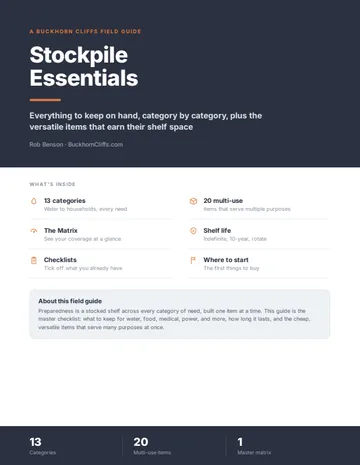
  • Cover of Stockpile Essentials Field GuideStockpile Essentials39 pagesEverything to keep on hand, category by category, plus the 20 multi-use items.
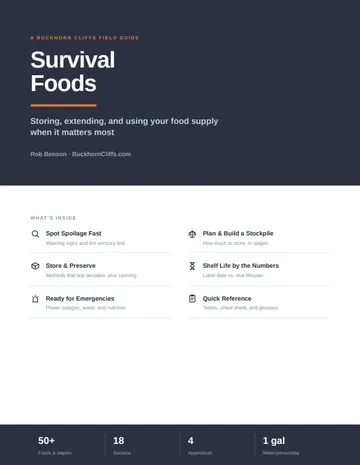
  • Cover of Survival Foods Field GuideSurvival Foods35 pagesStoring, extending, and using the food supply. Real shelf life by the numbers.
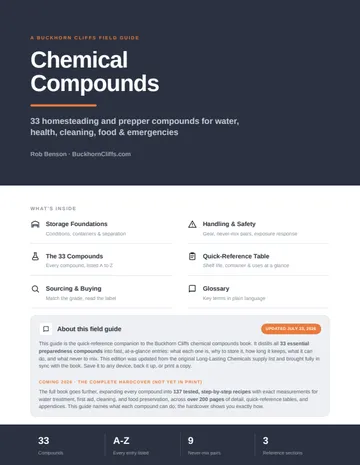
  • Cover of Chemical Compounds Field GuideChemical Compounds29 pagesThe 33 compounds: storage, top uses, hazards, and the never-mix chart.
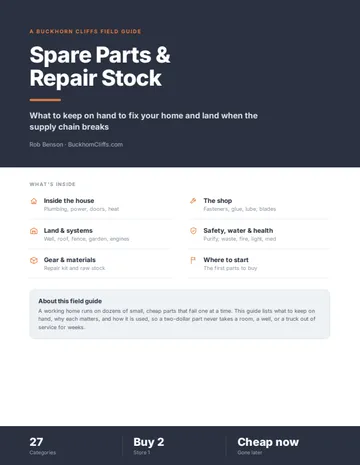
  • Cover of Spare Parts and Repair Stock Field GuideSpare Parts and Repair Stock40 pagesWhat to keep on hand to fix the home and land when the supply chain breaks.
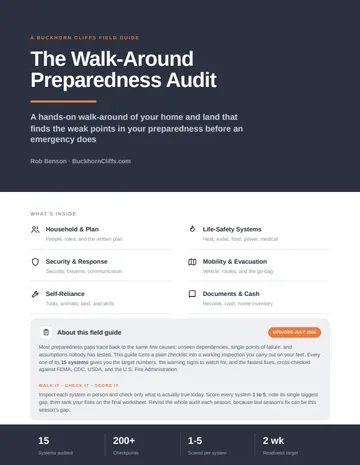
  • Cover of Walk-Around Preparedness AuditWalk-Around Preparedness Audit33 pagesFifteen systems scored 1 to 5, with the printable scorecard.
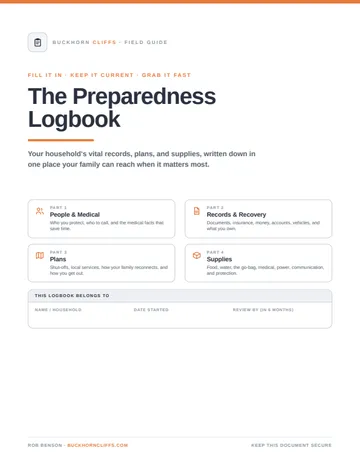
  • Cover of The Preparedness LogbookPreparedness Logbook30 pagesThe household information that needs to be on paper.

My Manual · included

Build your own field manual

The most useful thing a membership gives you. No book fits your household exactly. My Manual does. Save any page on this site, recipes, charts, and whole field guides included, put them in your order, and print one manual with your name on the cover. It holds only what is relevant to you, and nothing you would skip.

Why it matters

  • It works when this site does notNo power and no signal means no website. A printed manual and an offline PDF still open, which is the whole point of writing any of this down.
  • Only your pagesThis site covers every household. Yours needs a fraction of it. Your manual holds the pages that match your water source, your climate, and your gear, so nobody digs through the rest under stress.
  • Anyone in the house can use itThe person who reads this site may not be the one home when it counts. A binder on the shelf, in your order, with a contents page, is something a spouse or a teenager can follow.
  • One current copy, not a pile of printoutsEvery page prints in the same field guide layout with a cover, a contents page, and the print date. Change a page, print again, and the old copy is easy to spot.

What to build with it

  • The house binderYour water source, your climate, your gear. Only the pages you would reach for.
  • A copy for the bug-out bag or truckA short version that travels: water, first aid, comms, and the recipes you rely on.
  • A copy for familyHand a parent or a grown kid a manual built for their house and their supplies.
  • The shop and the barnParts lists, repair skills, and the never-mix chart, kept where the work happens.
  • A recipe book of your ownThe cleaners, fuels, and remedies you make, with exact amounts, in one place.
  • An offline PDFSaved to a phone, a tablet, or a drive in the Faraday bag. It opens with no signal.

How it works

  1. 1Save what fitsPress "Save to My Manual" on any page: a recipe, a chart, a guide, a parts list, or a whole field guide.
  2. 2Put it in your orderOn My Account, drag the pages into the order you want. Name the manual and add your household name.
  3. 3Print it or save a PDFOpen the preview, then print it or save a PDF. It is sized for 8.5 x 11 inch paper, with a cover and a contents page. Field guides go in exactly as the PDFs are laid out. No ads, no photos.
  4. 4Keep it currentAdd a page, pull one out, print again. The cover carries the date, so you always know which copy is the latest.

Also included

  • The entire site, unlockedAll 158 member pages open in full: exact amounts, every step, every warning, every parts list. Nothing held back.
  • Every recipe and resource in the bookAll 138 recipes and 33 compounds from Prepper's Chemical Survival Guide, with exact amounts, every step, every warning, and the reference charts.
  • A clean PDF of any entryOne press turns any page into a field guide sheet for the binder, the truck, or the shop wall.
  • Checklists and audit scores that follow youSaved to the account, so the phone, the laptop, and the shop computer always match.
  • No adsMembers read the whole site without a single ad.
$49.95per year. About 14 cents a day. Cancel any time and keep the year you paid for.