BUCKHORN CLIFFSA preparedness field manual

Kits and Planning · Guide

The Drive by the Door: Photograph Everything You Own and Keep the Papers Where a Fire Cannot Reach Them

How to document a house for an insurance claim in one afternoon, what the adjuster will actually ask for, which documents go on the drive with the photos, and how to keep three copies so a fire, a flood or a pulse takes none of them.

Quick facts

  • DriveSanDisk Extreme Portable SSD, hardware encrypted; the basic model is not, so encrypt the files yourself
  • PhotosEvery room wide, every item close, serial numbers, the item in place in your home
  • Also on it
    • IDs
    • insurance policies
    • deeds
    • titles
    • wills
    • prescriptions
    • medical records
    • receipts
    • contacts
  • ProtectionFaraday jacket inside a fireproof bag, unplugged
  • Copies
    • Computer
    • this drive
    • an encrypted cloud
    • a duplicate drive off site
  • RefreshTwice a year, and after any big purchase
After a fire or a flood, the insurance company asks one question over and over: prove it. What was in the house, what it was worth, and that it was yours. The people who get paid in full are the ones who can answer with photos and paper; the ones who argue for a year are the ones working from memory. This is the two-hour job that settles it, and the same drive that holds the photos holds the documents a family needs on the worst day: the policies, the deeds, the prescriptions, the contacts. Then three copies, so no single disaster takes them all.

This guide pairs with the Preparedness Logbook, the printed version of the same records, and both belong to the self-managed insurance plan.

2 hrsTo photograph a housePhone, room by room
3Copies, three placesComputer, drive, off site
1 TBHolds everythingA household's whole record
2x a yearRefresh itAnd after big purchases

Photograph the house

1Every room, wide.From the doorway, then from the opposite corner. Turn on the lights.
2Every closet, drawer and cabinet, open.The adjuster does not know what was in the kitchen drawers, and after a fire neither will you.
3Every item over about a hundred dollars, close.Two angles, the label, and the serial number for electronics, appliances, tools, firearms, bikes and anything with a motor.
4The item in place.The TV on your wall, the ring in your drawer, the saw on your bench. This is what proves it was yours and in your house.
5The garage, the shed, the attic, the vehicles.Tools and equipment are where claims come up short, because nobody photographed them.
6The supplies.The pantry, the water, the gear. It is part of the claim and it is a stock check.
7One walk-through video.Start at the front door, say the date, walk every room slowly and narrate what you see. Fifteen to thirty minutes. Adjusters accept it as proof of condition.
What the adjuster wants

Proof of ownership, identity and condition: the item from more than one angle, the make, model and serial number, the item in your home, and a receipt or card statement for the expensive things. High-resolution JPEG or PNG, not a format that needs special software. Folders by room, so the living room claim is one folder.

The documents that go with it

The photos are for the claim. The rest of the drive is for the week after, when you are in a motel with a phone and need the policy number, the pharmacy, the deed.

IdentityDriver's licenses, passports, birth certificates, Social Security cards, marriage certificate, for everyone in the house.
InsuranceHome, auto, health, life and any riders, with the policy numbers and the claim phone numbers on the first page.
PropertyDeeds, titles, mortgage and loan papers, the survey, the well and septic records.
LegalWills, powers of attorney, medical directives, guardianship papers.
MedicalA one-page summary per person: conditions, medications and doses, allergies, doctors, pharmacy. Immunization records. The logbook has the form.
Contacts and moneyFamily, neighbors, doctors, the insurance agent, the bank, the vet. Recent tax returns, account list, receipts and warranties for the expensive things.

Add the child identification sheet for each child, current photos included, and the records that protect you in a dispute. Keep a printed copy of the medical summary and the contact list with the drive; a phone with a dead battery cannot read a drive.

The drive, and how it is stored

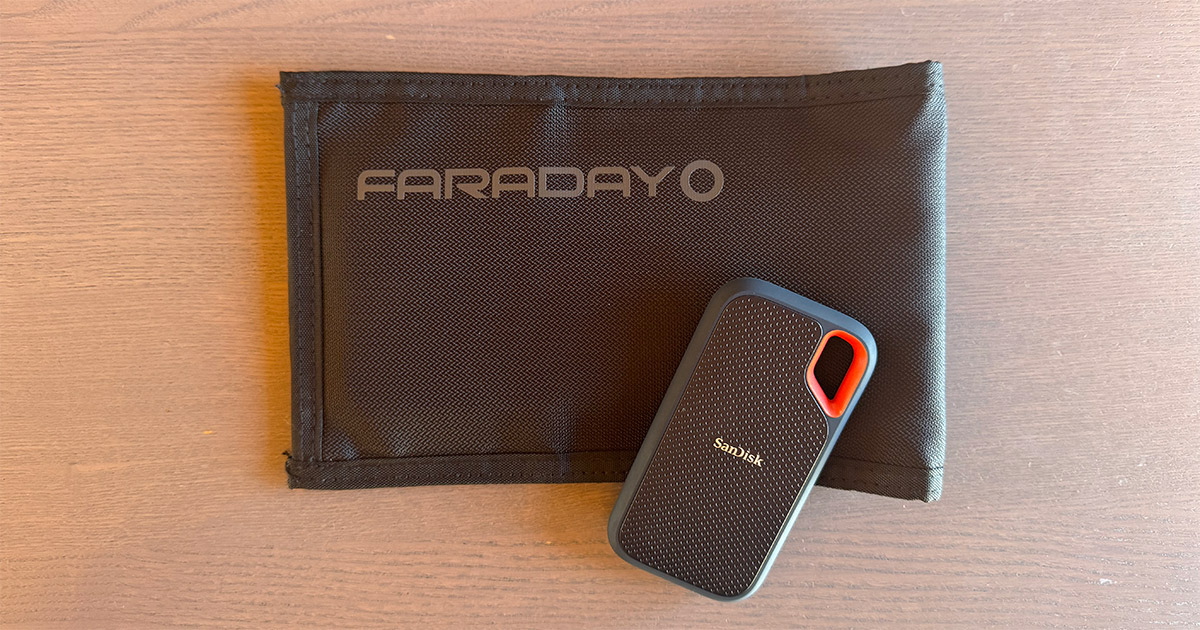
SanDisk Extreme Portable SSD

The drive · buy the Extreme, not the basic

Solid state, no moving parts, shock resistant, the size of a credit card, and it plugs into a phone as well as a computer so the photos go on it the same afternoon. The Extreme model has hardware encryption behind a password; the basic SanDisk portable SSD does not list it, so either buy the Extreme or encrypt the files yourself, because this drive holds your identity documents and it should be unreadable to whoever finds it. One terabyte holds every photo and document a household will produce.

Faraday jacket inside a fireproof bag

The storage · unplugged, by the door

The Faraday jacket is a sleeve of conductive fabric that blocks a strong electromagnetic field from reaching the drive. A nuclear pulse is the one realistic threat to a small unplugged drive; a solar storm hits the grid through long lines and transformers, not a drive in a bag. The jacket does nothing for a surge that arrives through a cable, which is why the drive lives unplugged. The fireproof document bag around it handles the far more likely fire and flood, and the whole thing sits by the door with the bug-out bag so it leaves with you. The Faraday bag guide covers what the bag does and does not do.

Three copies, three places

The computer at homeThe working copy, where the photos land and the documents get scanned.
The drive by the doorIn the jacket and the fireproof bag, updated from the computer twice a year. This is the one that leaves with you.
Off siteA duplicate drive at a relative's house in another town, or an encrypted cloud account, or both. A fire that takes the house takes one copy at most.

Twice a year, when the clocks change: copy the computer to the drive, swap the off-site drive for the fresh one, and open a few files on each to be sure they still read. Photograph anything big you bought since. A backup nobody has tested is a hope, not a backup; the backup laptop guide covers keeping a machine that can read the drive when the house computer is gone.

The checklist

  • Every room wide, every drawer and closet open
  • Every item over $100 close, with serial number and in place
  • Garage, shed, attic, vehicles, supplies
  • Walk-through video with the date
  • Receipts and warranties for the expensive things
  • IDs, insurance, deeds, titles, wills, directives
  • Medical summary and contacts, also printed
  • Child ID sheets
  • Drive encrypted, in the Faraday jacket, in the fireproof bag, by the door
  • Second copy off site, third on the computer
  • Refreshed twice a year

Questions this answers

Tap a question for the short answer.

How do I document my belongings for an insurance claim?

Walk the house with a phone in one afternoon. In each room: a wide shot from the door, a wide shot from the opposite corner, then every drawer, closet and cabinet open. For anything worth more than a hundred dollars, a close-up, the serial number, and a shot of it in place in your house. Add a slow walk-through video narrating what you see. Put it all in folders by room on a portable SSD, with the receipts you can find. It takes two hours and it is the difference between a full claim and an argument.

What documents should I back up for an emergency?

Scans of driver's licenses, passports, birth certificates, Social Security cards, marriage certificate; home, auto, health and life insurance policies with the policy numbers and the claim phone numbers; deeds, titles, mortgage and loan papers; wills, powers of attorney and medical directives; prescription lists, immunization records and a one-page medical summary per person; recent tax returns; a contact list; and the home inventory photos. Photos of the emergency supplies too, for the same claim.

What is the best portable drive for emergency document backup?

A rugged solid state drive with no moving parts, small enough for a fireproof bag. I use the SanDisk portable SSD; buy the Extreme model, which has hardware encryption and a password, because the basic model does not, and a drive full of your identity documents should not be readable by whoever finds it. A terabyte holds every photo and document a household will ever produce.

How do I protect a hard drive from an emp?

Keep it unplugged in a Faraday jacket, a bag of conductive fabric that blocks the field from reaching it, inside a fireproof document bag. A nuclear pulse is the only realistic threat to a small unplugged drive; a solar storm hits the grid through long lines, not a drive in a bag. The jacket does nothing for a surge that comes through a cable, which is why the drive lives unplugged. The Faraday bag guide covers the rest.

What photos do insurance companies want for a claim?

Proof you owned it, what it was, and its condition: the item from more than one angle, a close-up of the make, model and serial number, and a photo of it in place in your home so it is clearly yours and not a catalog picture. Receipts or credit card statements for the expensive things. A dated walk-through video covers condition better than anything, and adjusters accept it.

How many backups of important documents should I keep?

Three, in three places. The computer at home, which is the working copy. The portable SSD in the Faraday jacket and fireproof bag by the door, which leaves with you in an evacuation. And a duplicate drive or an encrypted cloud account somewhere else, a relative's house in another town, so a fire or flood that takes the house takes one copy at most. Refresh all three twice a year.

How do I take a home inventory video?

Start at the front door with the date said out loud. Walk every room slowly, panning wide, then open every closet, drawer and cabinet and say what is in it: 'top drawer, my watch, my wedding ring, the camera.' Turn over anything with a serial number. Do the garage, the shed, the attic and the vehicles. Fifteen to thirty minutes for a normal house. One video, one date, the whole house.

Keep going

Read nextThe Backup Laptop: What Goes on It, How It Is Stored, and the Faraday Case It Lives InAn old laptop, wiped, loaded with every document, map, manual and file the household would need with the internet gone, powered off and sealed in a Faraday bag on a shelf. It costs nothing but an afternoon, and it is the copy of your life that survives a lightning strike, a house fire in the other room, a ransomware attack, or an EMP. What goes on it, how to set it up so it still boots in three years, and the case I use.Kits and Planning · Guide

Related to this

Membership · $49.95 per year

There is a lot more behind the lock

158member pages in full
125recipes with exact amounts
9field guide PDFs, 248 pages
1manual of your own, built from any page

Every recipe and resource from the Prepper's Chemical Survival Guide, all nine field guides to read here and download, the full audit and logbook, all twelve reference charts, and no ads.

My Manual · included

Build your own field manual

The most useful thing a membership gives you. Save any page on this site, recipes, charts, and whole field guides included. Arrange them in the order you want, name it, and print one manual with a cover and contents, or keep it as a PDF that opens with no signal.

  • It works when this site does not
  • Only your pages
  • Anyone in the house can use it
  • One current copy, not a pile of printouts
  • The house binder
  • A copy for the bug-out bag or truck
  • A copy for family
  • An offline PDF

Join for $49.95 per year

Kits and Planning · GuideLast reviewed 2026-09-29

Membership

Save to My Manual is a member tool

Members build their own manual from the pages that fit their household, then print it or keep it as a PDF.

Why it matters

When the grid goes down, this site goes with it. Paper does not. Membership is how you get the whole manual off the screen and onto the shelf: every page in full, every field guide, and a binder built for your own household.

The field guide library

All nine field guides. 248 pages. Included.

The complete Buckhorn Cliffs PDF set, yours to download, print, and keep from the day you join.

$90if bought one at a time

  • Cover of Stockpile Essentials Field GuideStockpile Essentials39 pagesEverything to keep on hand, category by category, plus the 20 multi-use items.
  • Cover of Survival Foods Field GuideSurvival Foods35 pagesStoring, extending, and using the food supply. Real shelf life by the numbers.
  • Cover of Chemical Compounds Field GuideChemical Compounds29 pagesThe 33 compounds: storage, top uses, hazards, and the never-mix chart.
  • Cover of Spare Parts and Repair Stock Field GuideSpare Parts and Repair Stock40 pagesWhat to keep on hand to fix the home and land when the supply chain breaks.
  • Cover of Walk-Around Preparedness AuditWalk-Around Preparedness Audit33 pagesFifteen systems scored 1 to 5, with the printable scorecard.
  • Cover of The Preparedness LogbookPreparedness Logbook30 pagesThe household information that needs to be on paper.
  • Cover of Off-Grid Portable Solar Power Field GuideOff-Grid Portable Solar Power16 pagesSize a power station and a folding panel, pair them, wire them, keep them alive.
  • Cover of Home Backup Power System Field GuideHome Backup Power System20 pagesA battery and a hybrid inverter wired into the house: hybrid against off-grid, the wiring, the mistake to skip.
  • Cover of The Four KnotsFour Knots6 pagesWhich knot for the job, and how to tie each one in four moves.

My Manual · included

Build your own field manual

The most useful thing a membership gives you. No book fits your household exactly. My Manual does. Save any page on this site, recipes, charts, and whole field guides included, arrange them in the order you want, and print one manual with your name on the cover. It holds only what is relevant to you, and nothing you would skip.

Why it matters

  • It works when this site does notNo power and no signal means no website. A printed manual and an offline PDF still open, which is the whole point of writing any of this down.
  • Only your pagesThis site covers every household. Yours needs a fraction of it. Your manual holds the pages that match your water source, your climate, and your gear, so nobody digs through the rest under stress.
  • Anyone in the house can use itThe person who reads this site may not be the one home when it counts. A binder on the shelf, in the order you chose, is something a spouse or a teenager can follow.
  • One current copy, not a pile of printoutsEvery page prints in the same field guide layout with a cover and the print date. Change a page, print again, and the old copy is easy to spot.

What to build with it

  • The house binderYour water source, your climate, your gear. Only the pages you would reach for.
  • A copy for the bug-out bag or truckA short version that travels: water, first aid, comms, and the recipes you rely on.
  • A copy for familyHand a parent or a grown kid a manual built for their house and their supplies.
  • The shop and the barnParts lists, repair skills, and the never-mix chart, kept where the work happens.
  • A recipe book of your ownThe cleaners, fuels, and remedies you make, with exact amounts, in one place.
  • An offline PDFSaved to a phone, a tablet, or a drive in the Faraday bag. It opens with no signal.

How it works

  1. 1Save what fitsPress "Save to My Manual" on any page: a recipe, a chart, a guide, a parts list, or a whole field guide.
  2. 2Arrange it your wayOn My Account, drag the pages into the order you want. Name the manual and add your household name.
  3. 3Print it or save a PDFOne button makes a real PDF file, laid out for 8.5 x 11 inch paper with a cover. Print it from any device or keep the file. Field guides go in exactly as the PDFs are laid out. No ads, no photos.
  4. 4Keep it currentAdd a page, pull one out, print again. The cover carries the date, so you always know which copy is the latest.

Also included

  • The entire site, unlockedAll 158 member pages open in full: exact amounts, every step, every warning, every parts list. Nothing held back.
  • Every recipe and resource in the bookAll 138 recipes and 33 compounds from Prepper's Chemical Survival Guide, with exact amounts, every step, every warning, and the reference charts.
  • A clean PDF of any entryOne press turns any page into a field guide sheet for the binder, the truck, or the shop wall.
  • Checklists and audit scores that follow youSaved to the account, so the phone, the laptop, and the shop computer always match.
  • No adsMembers read the whole site without a single ad.
$49.95per year. About 14 cents a day. Cancel any time and keep the year you paid for.