Quick facts
- MoneyA month of expenses in cash at home; savings spread across more than one institution; assets that cannot be frozen
- RecordsCopies of IDs, deeds, titles, insurance, medical, prescriptions, receipts: on an encrypted offline drive and on paper
- PhoneLocation off when not needed, permissions cut, a PIN not a face, a Faraday bag when you want to disappear
- A stop"Am I free to go?" "I do not consent to a search." "I want a lawyer." Calm, short, and nothing else
- CamerasSecurity cameras that record locally, a dash cam, photos of every serial number you own
- People
- Neighbors you know
- a small circle you trust
- skills you have practiced
Most of the ways a normal life can be stopped cold have nothing to do with weather. A frozen account. A locked cloud login. A platform that decides you are done. A traffic stop that goes sideways. A record that exists only in an office that is closed. Resilience against those is the same idea as a full pantry: make sure the things you depend on are things you hold. Nothing on this page is dramatic. All of it is done in advance, on a quiet afternoon, and then it is simply true.
Money and assets
I am not a financial advisor. This is the household version of not keeping every egg in one basket.
Records in your own hands
Every document that proves who you are, what you own and what you are owed, in two copies you control:
- IDs, passports, birth and marriage certificates, Social Security cards
- Deeds, titles, registrations, the mortgage and loan papers
- Insurance policies with the claim phone numbers
- Medical records, prescriptions and dosages, vaccination records
- Tax returns, wills, powers of attorney
- Receipts and serial numbers for every valuable thing; photos of every room
- A contact list with addresses, and an account list with the numbers
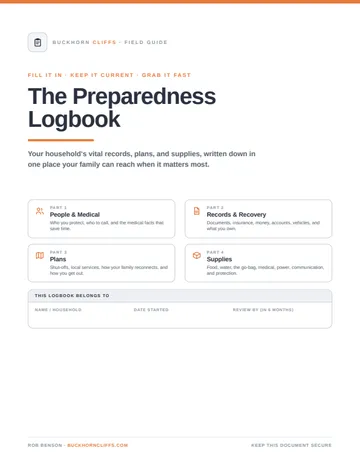
One set scanned to an encrypted drive that stays offline (the portable SSD), a second on the backup laptop, and the paper set in the preparedness logbook in a fire-resistant box. Paper does not need a password or a charge.
Digital privacy
Cameras and documentation
The encounter
- "Am I being detained, or am I free to go?"
- "I do not consent to any search."
- "I want to speak to a lawyer."
Hands visible, license and registration handed over when asked, the question you were asked answered and nothing more. You are generally not required to answer questions beyond identifying yourself where your state requires it. Consent is what turns a request into a search; a lawful order is something you comply with and contest later. Never argue at the roadside and never resist; the dash cam and a lawyer are how it gets sorted out. Practice the sentences out loud now, because nobody thinks clearly with lights in the mirror.
General information, not legal advice. Laws differ by state; a local attorney is the source for yours.
Medical independence
- A supply of the prescriptions your family actually takes, and an emergency antibiotic kit, on the shelf before they are needed. The prescription medication guide is how.
- A real first aid kit, not a box of bandages. The medical preparedness guide is the list.
- The skills: bleeding control, wound care, CPR. A weekend class fills the gap between the injury and the help.
- Instructions on paper. Phones die; the binder does not.
Communication and power
Routine, awareness, and the door
The things that make it hold
The home security guide is the physical side of this list; the start here page is the order to build the rest in.
Questions this answers
Tap a question for the short answer.
How do I protect myself from government or institutional overreach?
Reduce how much of your life depends on any single institution behaving well. Keep cash and hard assets that no one can freeze remotely. Hold your own copies of every record so no office or server is the only source. Run a phone and a home that do not broadcast where you are and what you do. Know the handful of sentences that protect you in an encounter with authority and practice saying them calmly. Keep your own medicine, food, water, power and communication. And build the neighbors and skills that make you someone who does not need to ask permission. None of it is dramatic; all of it is done in advance.
How do I protect my privacy from tracking?
Start with the phone, because it is the tracker you carry voluntarily. Location services off except for the apps that truly need it, and only while using them. Every app's permissions cut back to what it needs to function; most want contacts, location and the microphone for no reason. A privacy browser with tracking protection, and no loyalty apps or discount cards that log every purchase against your name. Do not post your routine, your vacations or your kids' schedules in real time. Pay cash where it makes sense. And for the times you want to be off the map entirely, a Faraday bag is the only privacy mode that actually works.
How much of my money should I keep outside the bank?
Enough cash at home to run the household for a month with the cards down: fuel, food, medicine, a repair. In small bills, in more than one place, in something fireproof. Beyond that, do not let one institution hold everything: a second bank, a credit union, some savings in hard assets (tools, equipment, land, metals) that keep their use no matter what a screen says. A frozen account, a bank outage or a fraud hold is not rare; it is a Tuesday. I am not a financial advisor and this is not investment advice, just the household version of not keeping every egg in one basket.
What documents should I keep copies of for emergencies?
Everything that proves who you are, what you own and what you are owed: IDs and passports, birth and marriage certificates, Social Security cards, deeds, vehicle titles and registrations, insurance policies with claim numbers, medical records and prescription lists, tax returns, wills and powers of attorney, the mortgage and major loan papers, receipts and serial numbers for valuable gear, and photos of every room. One set scanned to an encrypted drive that stays offline, one set on paper in a fire-resistant box, and the critical few in the go-bag. The preparedness logbook is built to hold the paper set.
What should I say during a police stop?
As little as possible, calmly and politely. Keep your hands visible, hand over license, registration and insurance when asked, and answer the question you were asked, nothing more. Three sentences cover the rest: "Am I being detained, or am I free to go?" "I do not consent to any search." "I want to speak to a lawyer." You are generally not required to answer questions beyond identifying yourself where state law requires it, and consent is the thing that turns a request into a search. Never argue at the roadside, never resist; the place to contest anything is later, with the dash cam footage and a lawyer. This is general information, not legal advice; laws differ by state, and a local attorney is the source for yours.
How do I reduce phone tracking?
Location off by default and on per app only while in use. Bluetooth and wifi off when you are not using them; both are used for tracking indoors. Ad tracking and personalization off in the system settings. Uninstall the apps that exist to harvest data: most loyalty, coupon and free-game apps. A PIN or a passcode, not just a face or a fingerprint, because a passcode is something you can decline to give. Airplane mode is not privacy; a Faraday bag is, when you need it. And an old phone, wiped and stored, means losing or surrendering the main one does not take your contacts and files with it.
Why should security cameras record locally?
Because a camera that records only to someone else's cloud gives them the footage, the off switch and the subscription price. Cloud accounts get suspended, breached, subpoenaed and shut down when the company folds, and the internet goes out exactly when you need the recording. Cameras that write to a local recorder or an SD card, with the cloud as an optional copy, keep the footage in your hands. The same logic puts a dash cam in every vehicle: a stop, a crash or a claim goes the way the recording says it did.
What is a faraday bag for?
It blocks every radio signal in and out of whatever is inside: cellular, wifi, Bluetooth, GPS and RFID. A phone in a sealed Faraday bag cannot be located, pinged, remotely wiped or listened to, which makes it the only real privacy mode there is; airplane mode is a software promise. The same bag protects the spare phone, the radios and the backup drive from an EMP or lightning. Mine live in the truck and the go-bag.
Keep going
Related to this
Membership · $49.95 per year
There is a lot more behind the lock
Every recipe and resource from the Prepper's Chemical Survival Guide, all six field guides to read here and download, the full audit and logbook, all twelve reference charts, and no ads.
My Manual · included
Build your own field manual
The most useful thing a membership gives you. Save any page on this site, recipes, charts, and whole field guides included. Arrange them in the order you want, name it, and print one manual with a cover and contents, or keep it as a PDF that opens with no signal.
- It works when this site does not
- Only your pages
- Anyone in the house can use it
- One current copy, not a pile of printouts
- The house binder
- A copy for the bug-out bag or truck
- A copy for family
- An offline PDF
Stay Ready
New entries, updates, and useful instruction.
Stay one step ahead on your preparedness journey.