10-30 YRPROTEIN BASESOAK AND SIMMERWorks without power
Quick facts
- Real shelf lifeUp to 10 years airtight; 20 to 30 years in Mylar with an absorber
- Label date says1 to 2 years
- Best storage
- Mylar
- absorber
- bucket
- cool
- dark
- Watch for
- Mold
- pests
- a musty smell
- beans that will not soften
Where this sits on the food shopping list
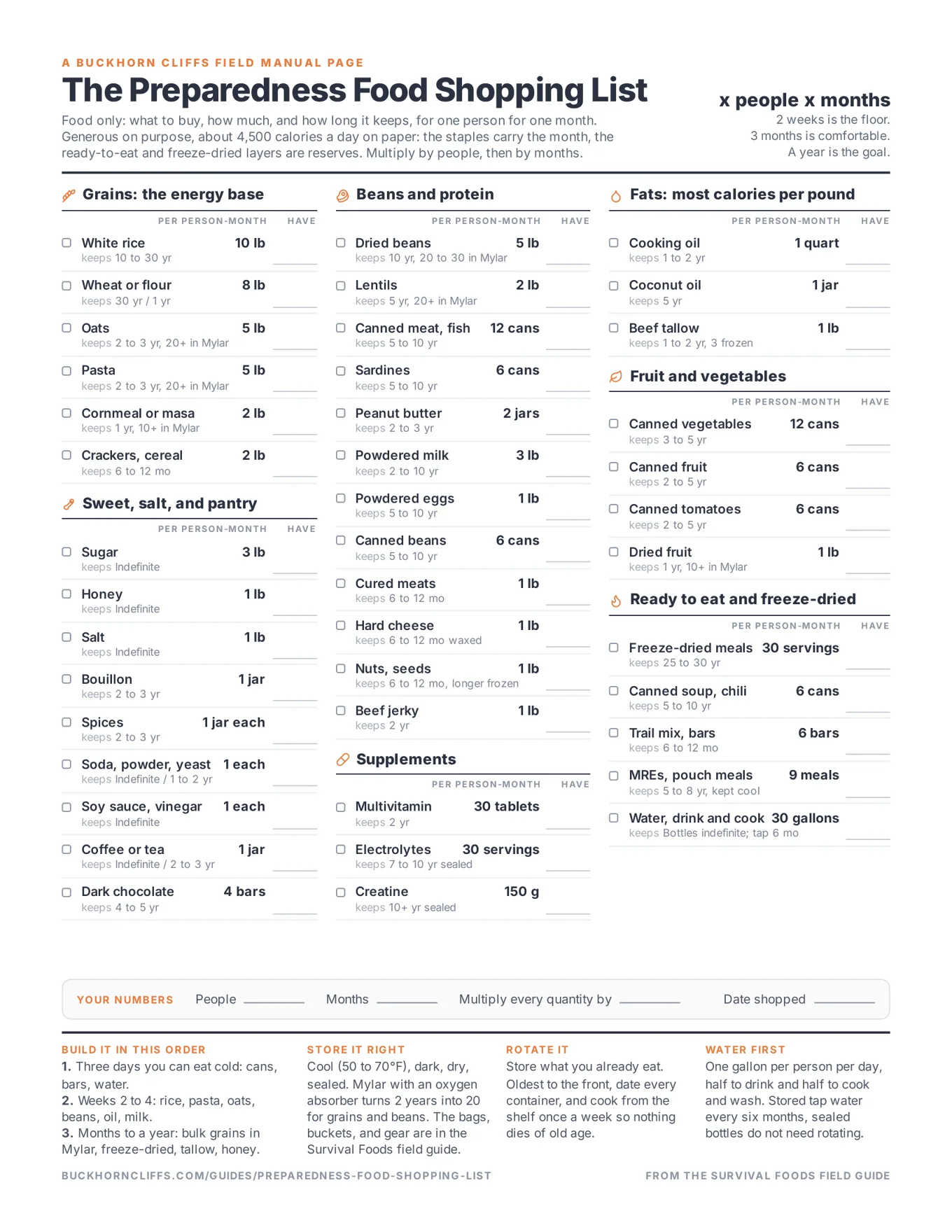
Dried beans are the protein of the bucket store: cheap, dense, and good for up to 10 years in a sealed container and 20 to 30 in Mylar with an oxygen absorber beside the rice. A pound is about 1,500 calories and 100 grams of protein, and beans and rice together make the complete protein that neither has alone. The one thing age does to a bean is make it slow to soften, and the second half of this page is about cooking the old ones.
Which to buy
Pinto, black, navy, kidney, great northern and chickpeas are the stock beans; split peas and lentils cook without soaking and have their own page. Buy from a supplier that turns stock over, in 25 or 50 pound bags, and pack them the week they arrive; beans that sat in a warm warehouse for a year are already harder to cook. Mixed sizes from one bag cook unevenly; keep kinds separate.
How long it really lasts
By how it is kept
| Form | Label says | Real, stored well |
|---|---|---|
| Dried beans, Mylar with oxygen absorber, cool | 1 to 2 years | 20 to 30 years; the field guide's Mylar figure |
| Dried beans, airtight jar or bucket, cool | Up to 10 years; harder to cook each year after about 2 | |
| Dried beans, original bag on the shelf | 1 to 2 years at best cooking quality | |
| Cooked beans, refrigerated | 3 to 5 days; 6 months frozen |
Free download
Get the one-page food shopping list
What to store, how much of it for one person for one month, and how long it keeps. One page with checkboxes, built from the Survival Foods field guide. Print it, multiply by your people and months, and take it to the store.
The PDF comes by email, with my newsletter now and then. Already on the list? You still get it. Read the full page.
How to store it
Cool, dark and dry, in something airtight. The original bag or box is fine for the months you will use it in; for the years, the answer is the same as for rice: a Mylar bag with an oxygen absorber inside a food-grade bucket, which keeps out oxygen, moisture, light and every insect egg that came home from the mill. The Mylar ranking says which foods take an absorber and which do not.
A 5 gallon bucket holds about 35 pounds of beans. Beans are dry enough for an absorber. Keep them cool: beans stored warm lose the ability to soak up water and turn into the hard beans that never soften, which is a storage problem, not a safety one.
How to tell it has turned
Look for mold, webbing, holes or beetles and smell for mustiness; any of those and the bag goes. Beans that are sound but old have faded color and a wrinkled skin, and they will take longer to cook. The test for an old lot is to soak and cook a cup: if it softens, the lot is good; if it stays rock-hard after a long simmer, the lot is for the pressure cooker and the grinder, not the stew pot.
Faded, wrinkled beans that are dry and clean smelling; a lot that takes twice as long to soften.
Mold, a musty smell, webbing, holes, larvae or beetles.
How much, and how to use it
A cup of dry beans makes about three cups cooked and is three servings; plan on a pound per person per week with the rice. Soak overnight in three times their volume of water (or boil two minutes and let stand an hour), drain, and simmer 1 to 2 hours in fresh water with the salt added at the end. For old beans: a quarter teaspoon of baking soda per quart of soaking water softens the skins, and a pressure cooker brings a 2 hour bean to 30 minutes; beans that still will not soften grind into flour for soups and refried beans. Never eat kidney beans raw or undercooked; ten minutes at a full boil destroys the toxin before the simmer.
When the power goes out
Beans are the fuel-hungry staple, which is why the canned ones are on the shelf for the first weeks. A thermal cooker or a pot wrapped in blankets after a ten minute boil finishes beans with almost no fuel, and a solar cooker does it on a clear day. Soak them the night before every time.
Shelf-life figures are from the Survival Foods field guide; fridge, freezer and pantry times are from the USDA cold and pantry storage charts. Run the look, smell, taste check before eating anything past its date.
Questions this answers
Tap a question for the short answer.
How long does dried beans last?
Dried beans last up to 10 years when stored airtight and cool, even though the label date says 1 to 2 years. Packed in Mylar with an oxygen absorber, my field guide notes put beans at 20 to 30 years.
How do I store dried beans long term?
Mylar with an oxygen absorber inside a food-grade bucket, cool and dark; about 35 pounds to a bucket. Heat is what makes stored beans hard, so keep them out of the garage.
How do I tell if dried beans has gone bad?
Look for mold, pests, or a musty smell. Then soak and cook a small sample: beans that stay rock-hard after soaking and cooking, or taste off, are past their useful life.
How long do dried beans last?
Up to 10 years airtight and cool, against a label of 1 to 2 years, and 20 to 30 years sealed in Mylar with an oxygen absorber. Older beans stay edible but take longer to soften.
How do I tell if dried beans have gone bad?
Mold, a musty smell, webbing, holes or beetles. Faded color and wrinkled skins are age; soak and cook a cup to test a lot.
How do you cook old dried beans that stay hard?
Soak overnight with a quarter teaspoon of baking soda per quart of water, then pressure cook 30 to 40 minutes. Beans that still will not soften are ground into flour for soups and refried beans.
Keep going
Related to this
Membership · $49.95 per year
Everything on this site, open, and your own manual that works with no internet
When the grid goes down, this site goes with it. Membership opens every member page and every recipe from the book, hands over all fourteen field guides as PDFs, and gives you your own manual built from the pages your household uses: searchable on your phone with no internet, and printable as one binder.
- 158member pagesopen in full, every amount and every step
- 138compound recipesfrom the hardcover book, exact amounts. Pick any and add them to your manual
- 14field guides313 pages of PDFs, $140 bought one at a time
- 9military field guidesUS Army manuals cut to 66 pages and laid out to use
- Offlineyour own manualbuilt from any page here, searchable on your phone with no internet
- Build your own manual on this site. pick any page, recipe, chart or whole field guide and put them in your order
- Download it and use it with no internet. it opens like an app on your phone or computer, searchable, with no power grid and no signal
- Print it or save it as one PDF. your cover, a contents page and every page you picked, laid out for paper
- All 138 recipes from my hardcover book. exact amounts for pool shock water purification, Lugol's iodine antiseptic, water glassing eggs, laundry powder and the rest
- All 14 field guides, 313 pages. Stockpile Essentials, Survival Foods, Bug-Out Bag, Home Canning, Solar Power and more, to read here or download
- 9 military field guides. Survival, First Aid, Mountaineering and the other US Army manuals, each cut to its most useful pages
- 158 how-to pages in full. medical, hygiene, tools and repair, garden and livestock, food, water and more
- The audit, the logbook and the checklists. all 200 audit checkpoints, saved to your account on every device
- One payment, $49.95 per year. Cancel any time and keep access to the end of the year you paid for.
- Sign in by email. No password, and the sign-in renews itself on every visit.
- Most of the site stays free. Membership is for the depth, the PDFs and your own offline manual.



Stay Ready
New entries, updates, and useful instruction.
Stay one step ahead on your preparedness journey.