10 TO 30 YRCALORIE BASESKIP BROWNWorks without power
Quick facts
- Real shelf life10 to 30 years sealed; 4 to 5 on the shelf
- Per person, per month10 lb, about 1,650 calories a pound
- Best storage
- Mylar
- 2000 cc absorber
- bucket
- cool
- dark
- Watch forMusty smell or mold: toss. Weevils in an open bag: sift and eat soon
Where this sits on the food shopping list
White rice is the cheapest calorie that keeps. Milled of its bran and the oil in it, it has almost nothing left to go rancid, which is why a bag sealed today is still food in 2050. This page is the whole job: which rice, what wrecks it, how to pack a bucket in an hour, how to spot trouble, and how to cook it when the power is off.
Which rice to store
Every white rice stores the same way. The differences are cost, cooking, and one big exception.
The workhorse. Lowest cost per calorie, cooks fluffy and separate, and it is what the 10 to 30 year figure was measured on. Enriched long grain is the one to buy in 25 and 50 lb bags.
Steamed under pressure before milling, which drives some of the bran's vitamins into the kernel. Firmer, harder to overcook, forgiving on a camp stove. Keeps as long as plain white.
Store the same way and they keep the same way. The aroma fades over the years, the calories do not. Buy them for the rice you eat now and rotate.
Calrose, sushi, arborio. Same milling, same shelf life, stickier on the plate. Good for rice pudding, congee and anything you want to hold together.
Cooked and dried, so it keeps for years sealed, but it is bulky for its calories and costs several times more per pound. A few boxes for no-fuel days, not the base.
The bran carries oil, and oil goes rancid: six months to a year at room temperature, longer frozen. The field guide lists it under skip or limit. If you want it, eat it from the store, do not bucket it.
The four enemies, and what each does to rice
The field guide names them: oxygen, moisture, heat, light. Storage conditions slow spoilage; storage methods stop it.
Oxidizes the trace oil in the kernel and keeps insects alive. It is the reason a bag on a shelf gets stale and buggy while a sealed one does not.
Your moveAn oxygen absorber inside a sealed Mylar bag. It pulls the oxygen to near zero and holds it there.
Rice sells at about 12 percent moisture. Let it climb and mold follows; seal it wet and low-oxygen storage becomes dangerous instead of safe.
Your moveKeep it dry from the day you buy it. Never seal rice that has been damp, and do not add a desiccant to a bag that has an absorber; it is not needed.
The clock. Rough rule from the storage studies: every 18°F cooler roughly doubles the years. Rice at 90°F ages four times faster than rice at 55°F.
Your moveA cool spot that stays cool: a basement, an interior closet, under a bed on the north side. Not the garage, not the attic.
Light does little to white rice on its own, but the containers that let light in let air and bugs in too. Weevil eggs arrive in the bag from the mill.
Your moveAn opaque barrier and a hard shell: Mylar inside a bucket. The absorber kills every stage of the insects that came with it.
Free download
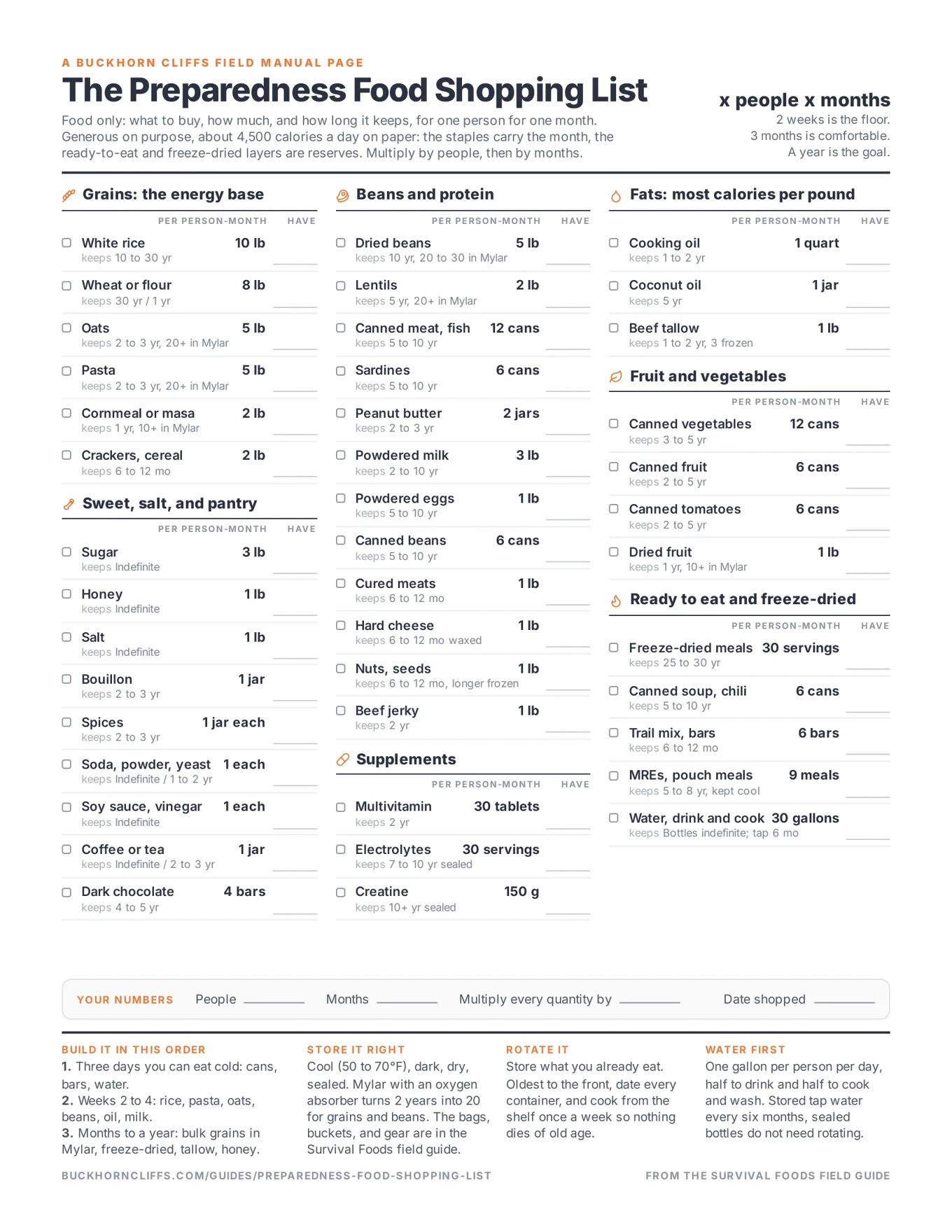
Get the one-page food shopping list
What to store, how much of it for one person for one month, and how long it keeps. One page with checkboxes, built from the Survival Foods field guide. Print it, multiply by your people and months, and take it to the store.
The PDF comes by email, with my newsletter now and then. Already on the list? You still get it. Read the full page.
How long it lasts, by how you store it
Same rice, four outcomes. The bar is years.
Bugs and staleness, not spoilage, end it.
Airtight keeps bugs out and moisture steady. Oxygen is still inside.
The method in the field guide. Cool storage gets you the top of that range.
Nitrogen flushed at the packer. Costs the most per pound; nothing to do at home.
Containers, ranked
Best to worst for white rice, by how well each keeps oxygen and moisture out and how long it holds up. Years assume cool, dark storage.
- 1Mylar bag with an oxygen absorber, inside a food-grade bucket20 to 30 years
Aluminum-layered film blocks oxygen, moisture and light; the absorber removes the oxygen that is left; the bucket takes the knocks and keeps rodents out. The field guide's method and the only one that gets you decades at home.
- 2#10 cans, commercially packed30 years
Steel and a nitrogen flush at the packer. Rodent-proof and light-proof, stack well, and open with any can opener. You pay per pound for the packing, so buy them for the deepest layer or skip them and pack your own.
- 3Glass jars with an absorber or vacuum sealed10 to 20 years
Glass passes no oxygen at all, so a jar with a 100 cc absorber or a vacuum-sealed lid is as good a barrier as Mylar. What it is not is tough: it breaks in a move and holds two or three pounds. Best for the working pantry.
- 4PETE bottles (2 liter soda and juice bottles) with an absorber5 to 10 years
PETE is a fair oxygen barrier, better than most plastics, and the bottles are free. Wash, dry completely, fill, one 100 cc absorber, cap tight. Light gets through, so keep them in a dark cupboard.
- 5Food-grade bucket with a gamma lid, no bag5 to 10 years
Airtight against bugs and moisture, easy to open. The bucket plastic lets oxygen creep in over years and the rice picks up a plastic smell if it sits long. Fine for rice you will eat inside a decade.
- 6Vacuum-sealed plastic bags3 to 5 years
The vacuum helps at first, then oxygen migrates back through the plastic. The bags puncture on rice edges. A short-term convenience, not a store.
- 7The original woven or paper bag4 to 5 years
Nothing stopping air, moisture or the weevil eggs that came with it. The label date is honest for this one.
The freezer: what it is for, and what it is not
Four days at 0°F kills weevils at every stage, eggs included. Then let the bag come all the way to room temperature, still closed, before it goes into a container, or condensation puts moisture into rice you are about to seal. With an absorber in the bag the freezing step is unnecessary; the absorber does the same job without the thaw risk.
White rice keeps indefinitely frozen, but it spends freezer space that meat and butter need more, and a freezer is the first thing an outage takes. Brown rice is the case for it: frozen, its oils hold a year to eighteen months instead of six. Bag it in meal-sized portions, and when you pull one, use it within the month.
Cooked rice freezes well in flat bags and reheats in minutes with a splash of water, which makes it a fast meal for the first days of an outage while the freezer is still cold. Cool it within an hour of cooking before it goes in.
Pack a bucket in an hour
- 1Buy it dry, in bulk50 lb = 5 person-months
Enriched long grain in 25 or 50 lb bags. Check the bag for holes and dust on the shelf under it, which means bugs are already in the lot. Bring it home and pack it the same day.
- 2Line a 5 gallon bucket with Mylar5 mil minimum
A 5 mil bag or heavier, 20 by 30 inches. Fold the top over the rim so the rice goes in clean. Food-grade bucket with a good lid; a gamma lid if you plan to open it.
- 3Fill to about 4 inches from the top35 lb per bucket
Tap the bucket on the floor as you go so it settles. A 5 gallon bag takes about 35 lb of white rice.
- 4Drop in the oxygen absorber2000 cc
1500 to 2000 cc for a 5 gallon bag, one large or two 1000 cc. Absorbers start working the moment their pack is opened, so open it last and reseal the spares in a canning jar within a few minutes.
- 5Press out the air and sealIron on cotton
Fold the bag flat, push the air out, and seal across the top with a clothes iron or hair straightener on a board, leaving room to open and reseal later. The seal should look smooth and uniform, no wrinkles or gaps.
- 6Check it the next dayBrick test
A good bag pulls in tight and feels like a brick within 24 hours. If it is still soft, the seal leaked: open it, add a fresh absorber, reseal.
- 7Label, lid, and put it away cool40 to 70°F
Contents, weight, and date on the bag and the bucket. Lid on, bucket off the concrete on a board or pallet, in the coolest dark place you have. Write it in the inventory.
Rice is the calorie base, not the whole diet. The field guide puts it plainly: a stockpile of plain rice fills stomachs but wears bodies down over weeks. Every bucket of rice wants beans, oil, salt and something with vitamins beside it. The split is on the food shopping list.
Smaller batches and the rotating pantry
Buckets are for the deep store. The rice you cook this month lives in something you can open without a can of absorbers.
Washed, bone dry, filled, one 100 cc absorber, cap on tight. Holds about 4 lb. Stacks in a closet and is the right size to open and use.
Quart jars with a 100 cc absorber or vacuum sealed with a jar attachment. Pretty on a shelf, breakable in a move.
Six or seven pounds each, 300 to 500 cc absorber. Open one at a time so the rest stay sealed. The best middle ground for a household that eats rice weekly.
Rotate oldest first. Date every container, put new ones at the back, and cook from the front. A household that eats rice twice a week goes through about 2 lb a month per person, so a 25 lb bag in bottles is a year of eating and a year of practice.
Bugs, smells, and when to throw it out
Weevil eggs are in most rice from the mill, which is the strongest argument for the absorber: it kills them before they hatch. In an open bag, freezing it for four days does the same, and food-grade diatomaceous earth in the bag keeps anything from taking hold. Bay leaves are folklore.
| What you see | What it is | What to do |
|---|---|---|
| Tiny holes in kernels, fine dust, small dark beetles | Rice weevils | The eggs were laid inside the kernels at the mill. Sealing with an absorber kills every stage. In an open bag, sift, rinse, and eat it soon; a few weevils are harmless. |
| Webbing, clumps, small grey moths | Indian meal moths | Larvae spin the webbing. Toss anything with webbing, then clean the shelf; the larvae travel. |
| Musty or sour smell, clumping, grey or green specks | Moisture got in | This is the one that matters. Rice that smells off or shows mold is finished. Do not rinse and cook it. |
| Yellowing, stale or waxy smell, no bugs | Old and oxidized | Safe, just tired. It cooks fine. Rotate it into the pot and pack the next bucket better. |
Cooking it when the power is off
An hour in cold water cuts cooking time by a third and the fuel with it. Cook it in the soaking water so the enriched vitamins stay in the pot.
Bring rice and water to a full boil for five minutes, lid on, then wrap the pot in towels or set it in a cooler for 45 minutes. It finishes on its own heat. The largest fuel saver there is.
The B vitamins and iron are sprayed onto the kernel. Rinsing sends them down the drain. Rinse only if you want the grains to separate and you have other sources of those vitamins.
Cooked rice left warm grows a spore-forming bacterium that survived the boiling. Eat it within a couple of hours, or cool it fast and eat it cold the next day. With no refrigerator, cook per meal.
Fuel is the limit in an outage, and rice is a fuel-hungry food if you boil it for twenty minutes. Soaked and thermal cooked, it takes five minutes of flame. The stoves and fuels themselves are on Cooking, Fuel and Fire.
What rice gives you, and what it does not
A pound of dry white rice is about 1,650 calories and 30 grams of protein, with almost no fat, which is exactly why it keeps. Enriched rice carries added thiamine, niacin, folate and iron. What it lacks is the amino acid lysine, fat, and nearly every vitamin outside the B group. Beans fill the lysine gap, which is why rice and beans is the oldest survival meal there is. Oil or tallow fills the fat gap. Canned vegetables, dried fruit and a multivitamin fill the rest. Stack it that way and the rice bucket is the base of a diet, not the whole of one.
Prep hard, people.
Questions this answers
Tap a question for the short answer.
How long does white rice last?
Sealed in Mylar with an oxygen absorber and kept cool, 20 to 30 years; the field guide lists 10 to 30. In its original bag on a pantry shelf, 4 to 5 years by the label and longer in practice, ended by bugs and staleness rather than spoilage. Brown rice is the exception at six months to a year, because the oil in its bran goes rancid.
What is the best container to store rice in?
In order: a Mylar bag with an oxygen absorber inside a food-grade bucket (20 to 30 years), commercially packed #10 cans (30 years), glass jars with an absorber or vacuum lid (10 to 20 years, for the working pantry), PETE soda bottles with an absorber (5 to 10 years), a bare bucket with a gamma lid (5 to 10 years), vacuum-sealed plastic bags (3 to 5 years), and last the original bag (4 to 5 years).
Should I freeze rice before storing it?
Only if you are storing it without an oxygen absorber. Four days at 0°F kills weevils at every stage; then let the closed bag reach room temperature before packing, or condensation seals moisture in with the rice. With an absorber, skip the freezer: no oxygen kills the insects without the thaw risk. Brown rice is the one rice worth keeping frozen, since its oils hold a year or more that way instead of six months.
How do I store white rice long term?
Line a food-grade 5 gallon bucket with a 5 mil Mylar bag, fill it with about 35 lb of dry rice, drop in a 1500 to 2000 cc oxygen absorber, press out the air, and heat seal the bag with an iron or hair straightener. Check the next day that the bag has pulled tight, then lid it, label it, and keep it off concrete in the coolest dark place you have, ideally 40 to 70°F.
How much rice should I store per person?
10 lb per person per month, the food shopping list figure. That is about 16,500 calories, roughly a third of a month's food for one adult, with beans, oil, and canned goods carrying the rest. A 5 gallon bucket holds 35 lb, three and a half person-months; a 50 lb bag is five.
What kind of rice is best for long term storage?
Enriched long grain white rice: the lowest cost per calorie, and the rice the 30 year storage figures were measured on. Parboiled (converted) keeps as long and is harder to overcook. Jasmine, basmati and short grain store the same way but lose aroma over the years. Instant rice keeps but costs more for fewer calories per box.
Can you store brown rice long term?
No. The bran carries oil, and the oil goes rancid in six months to a year at room temperature, longer in a freezer. The field guide lists brown rice under skip or limit. Buy it to eat now, not to bucket.
What size oxygen absorber for a 5 gallon bucket of rice?
1500 to 2000 cc, as one large absorber or two 1000 cc ones. More does no harm in a dry food. For a 1 gallon bag, 300 to 500 cc; for a 2 liter bottle or quart jar, 100 cc. Open the absorber pack last and reseal the spares in a canning jar within a few minutes, because they start working in open air.
How do I tell if white rice has gone bad?
Smell it. Musty, sour, or damp, or any grey or green specks or clumping, means moisture got in, and that rice is finished. Yellowing with a stale, waxy smell and no bugs is old but safe; cook it. Tiny holes and fine dust are weevils; webbing is meal moths. Sealed rice with dead weevils is harmless. An open bag with live ones gets sifted and eaten soon, or tossed if there is webbing.
How do I get rid of weevils in rice?
For storage, the oxygen absorber does it: no oxygen, no living insect at any stage, eggs included. For an open bag, freeze it for four days, or sift and rinse and use it within weeks. Food-grade diatomaceous earth mixed into an unsealed bin keeps them from taking hold. Bay leaves do not work.
How do you cook rice without electricity?
Soak it an hour, then bring one part rice and two parts water to a full boil with the lid on for five minutes and wrap the pot in towels or set it in a cooler for 45 minutes. It finishes on its own heat, on five minutes of fuel instead of twenty. Cook only what you will eat; cooked rice left warm for hours is a food poisoning risk.
Is rice enough to live on?
No. A pound of white rice is about 1,650 calories and 30 grams of protein with almost no fat, and it lacks the amino acid lysine and most vitamins outside the B group. The field guide says a stockpile of plain rice fills stomachs but wears bodies down over weeks. Beans cover the lysine, oil or tallow the fat, canned vegetables, dried fruit and a multivitamin the rest.
Keep going
Related to this
Membership · $49.95 per year
There is a lot more behind the lock
Every recipe and resource from the Prepper's Chemical Survival Guide, all six field guides to read here and download, the full audit and logbook, all twelve reference charts, and no ads.
My Manual · included
Build your own field manual
The most useful thing a membership gives you. Save any page on this site, recipes, charts, and whole field guides included. Arrange them in the order you want, name it, and print one manual with a cover and contents, or keep it as a PDF that opens with no signal.
- It works when this site does not
- Only your pages
- Anyone in the house can use it
- One current copy, not a pile of printouts
- The house binder
- A copy for the bug-out bag or truck
- A copy for family
- An offline PDF






Stay Ready
New entries, updates, and useful instruction.
Stay one step ahead on your preparedness journey.